B2B / Conversion
Kalle Mobeck
•

A conversion strategy is a structured plan that turns existing traffic into revenue by fixing tracking, mapping the buyer journey, and running prioritized tests. Start now: audit your tracking setup and pick one leaking funnel stage to fix this week. With AI-driven search cutting into click-through rates, every visitor you already have is worth more than the next one you’re chasing.
TL;DR:
• Focus your conversion strategy on a single primary revenue-related metric, like revenue per visitor or lifetime value, supported by stage-specific KPIs.
• Map every touchpoint and micro-conversion in your funnel, with clear ownership and stage-specific goals to prevent leaks at handoff points.
• Conduct a thorough tracking audit within the first two weeks to identify duplicates, broken goals, and visitor hesitations before running tests.
• Prioritize fixing structural issues, stage definitions, and handoff friction over superficial A/B tests to maximize revenue gains from existing traffic.
• Use a 90-day phased plan that emphasizes audit, hypothesis building, experimental testing, and rolling out winners, especially in multi-market B2B contexts.
Table of Contents
• What Is a Conversion Strategy, and Which Conversions Matter?
• The Funnel Stages Your Conversion Framework Needs
• Your 90-Day Conversion Optimization Plan
• Metrics That Tell You Where the Funnel Is Leaking
• The Tactics That Actually Move Conversion Numbers
• The Stack and the AI Layer Behind Every Conversion Test
• How Align Turns the Conversion Roadmap Into Commercial Outcomes
• What Actually Moves the Needle (And What Doesn’t)
• Get a 90-Day Conversion Plan Built for Your Funnel
• Sources
What Is a Conversion Strategy, and Which Conversions Matter?
A conversion strategy is the plan that governs how you turn visitors, leads, and prospects into paying customers, and it only works when you’ve defined what counts as a “conversion” in the first place. Most teams track too many things loosely instead of one thing precisely.
Split conversions into two buckets. Macro conversions are revenue events: a closed deal, a completed purchase, a signed contract. Micro conversions are the steps that predict revenue: a demo request, a trial activation, a whitepaper download, a pricing-page visit. B2C businesses often optimize toward a single checkout event. B2B and product-led companies need a chain of micro conversions, because the buying group is larger and the sales cycle stretches over weeks or months.
• Purchase or subscription (B2C, self-serve SaaS)
• Demo request or trial activation (B2B, product-led growth)
• MQL-to-SQL handoff (sales-led B2B)
• Content engagement depth (early-funnel signal, not a revenue proxy on its own)
Pick one primary metric tied directly to revenue. Everything else becomes a supporting signal, not a competing priority.
The Funnel Stages Your Conversion Framework Needs
A b2b conversion funnel breaks down cleanly into stages, and skipping this mapping exercise is the single most common reason optimization efforts stall. Buying committees in B2B deals typically include multiple stakeholders, according to research summarized by Monday, which is exactly why a vague “top of funnel to bottom of funnel” model is not granular enough.
Build the framework in this order:
• Define your stages. Visitor → known lead → MQL → SQL → opportunity → customer works well for sales-led B2B. TOFU/MOFU/BOFU works for simpler, content-driven funnels.
• Map every touchpoint where a prospect interacts with your brand, from a paid ad click to a sales call, and assign an owner for each one.
• Capture micro-conversions at each stage rather than only counting the final handoff.
• Set stage-specific goals and SLAs. If marketing hands off an MQL, sales needs a response-time commitment. Without it, leads go cold and nobody’s accountable.
This is where most B2B revenue teams quietly fall apart: marketing and sales use different definitions of “qualified,” and the funnel leaks precisely at the handoff. Fixing that alignment often produces the largest relative lift of any single change you can make.
Your 90-Day Conversion Optimization Plan
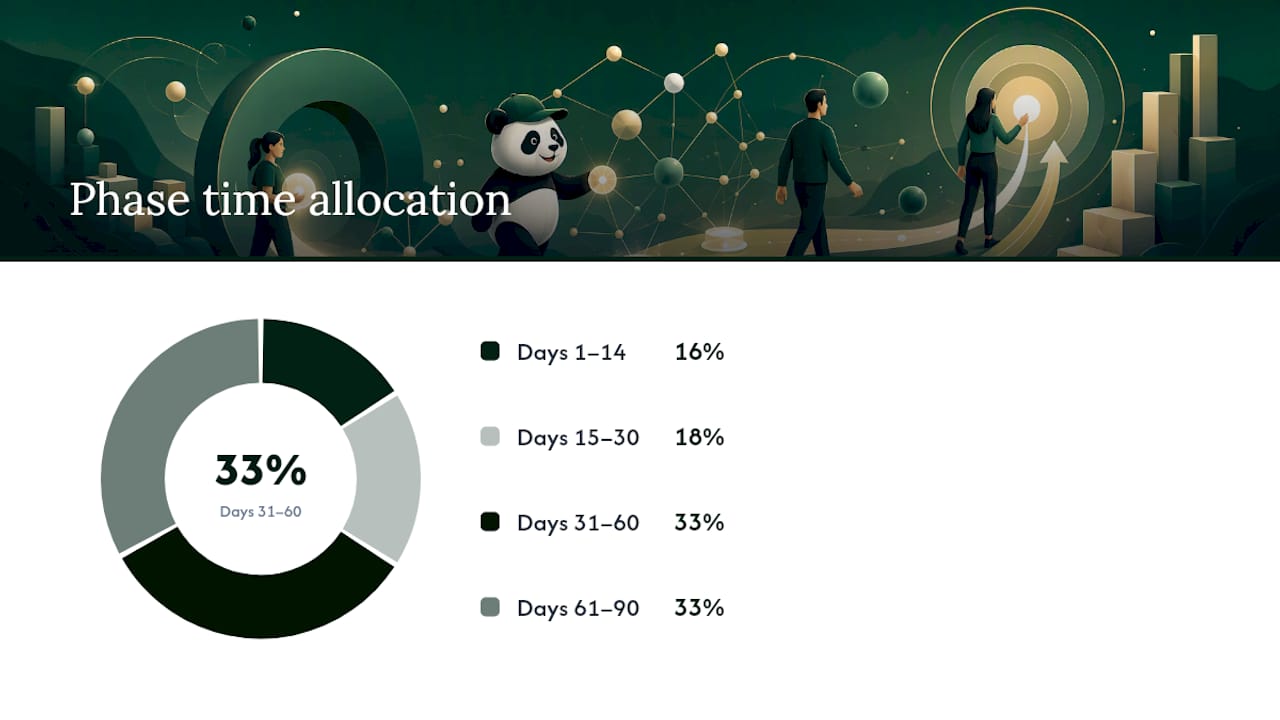
A structured, phased roadmap turns conversion rate optimization from scattered guesswork into a repeatable revenue system. Here’s how the 90 days should break down.
Phase 1: Audit and baseline (Days 1 to 14). Verify your tracking is clean before you touch anything else. Check for duplicate events, broken goals, and misfired tags. Run session recordings to see where visitors hesitate or abandon. Talk to five to ten recent customers or lost deals about what almost stopped them from converting.
Phase 2: Build the test backlog (Days 15 to 30). Generate 15 to 20 hypotheses from the audit findings. Prioritize with a framework like PIE or PXL rather than subjective gut-feel scoring, then select the top five to eight for execution.
Phase 3: Run experiments (Days 31 to 60). Before launching anything, run a null test to confirm your A/B platform splits traffic and tracks events correctly. Calculate the sample size you actually need before starting, run two to three concurrent tests, and document every result, including the ones that fail.
Phase 4: Review and roll out (Days 61 to 90). Ship the winners, calculate the revenue impact in dollars, archive what you learned, and build your next 90-day backlog from those learnings.
• Days 1 to 14: Tracking audit, funnel leak diagnosis, customer interviews
• Days 15 to 30: Hypothesis generation, PIE/PXL prioritization
• Days 31 to 60: Null test, sample-size calculation, concurrent experiments
• Days 61 to 90: Rollout, revenue calculation, test archive
Pro Tip: If your traffic is too low for standard A/B testing, don’t force it. Test bolder changes and measure with pre/post comparisons or sequential analysis instead of splitting an already-thin visitor pool.
Metrics That Tell You Where the Funnel Is Leaking
You need one primary metric and a handful of supporting KPIs that explain why the primary number moves. The primary metric should always tie directly to revenue, whether that’s revenue per visitor (RPV), customer acquisition cost (CPA), or lifetime value (LTV).
• Stage-to-stage conversion rate: percentage of prospects advancing from one funnel stage to the next
• MQL-to-SQL rate: often the single biggest lever for B2B teams, since it exposes handoff friction
• Time-in-stage (velocity): how long prospects sit at each stage before moving or dropping off
• Win rate: opportunities closed divided by opportunities created
• Revenue per visitor (RPV): total revenue divided by total sessions
Statistic to watch: HubSpot’s guidance on AI-driven search notes that AI overviews and AI-native search experiences are compressing traditional click-through rates, which raises the value of every existing visitor and makes stage-to-stage measurement more urgent than chasing new traffic alone.
Before trusting any of these numbers, apply guardrails: confirm sample sizes are large enough to be statistically meaningful, and audit your data quality quarterly. A dashboard built on broken tracking will send you optimizing the wrong stage entirely.
The Tactics That Actually Move Conversion Numbers
Four psychological pillars drive most conversion lifts: clarity of the value proposition, reduced cognitive friction, smart use of persuasion, and risk mitigation. Nearly every effective test maps back to one of these four.
• Value proposition clarity: rewrite headlines so a visitor understands the benefit in under five seconds
• Friction removal: cut form fields, simplify navigation, use progressive disclosure so forms ask less upfront and more as trust builds
• Personalization: build industry- or role-based landing pages, tailor trial onboarding to the visitor’s use case, adjust pricing-page messaging by segment
• Risk mitigation: add trust signals, specific guarantees, and social proof near the conversion point, not buried in a footer
Content itself needs to match the funnel stage it serves. Early-stage content needs reach and distribution; middle-funnel content needs ROI calculators and shareable assets for internal buying committees; bottom-funnel content needs sector-specific demos and proof that speak directly to the buyer’s industry.
Pro Tip: A test that shows no lift isn’t a failure, it’s data. Treat a null result as evidence to sharpen your next hypothesis rather than a reason to abandon the idea entirely.
The Stack and the AI Layer Behind Every Conversion Test
Your minimum viable stack needs five pieces: web analytics (GA4 or an equivalent platform), session replay software, an A/B testing platform, CRM integration to connect conversions to closed revenue, and feature flags for controlled rollouts. Skipping proper GA4 conversion tracking instrumentation is the most common reason test results turn out unreliable months later.
AI now handles intent-signal extraction, generates creative variants at scale, and builds personalization rules faster than manual segmentation ever could. Human review still matters at the decision point, especially where messaging touches pricing, compliance, or brand voice.
Before launching your next test, confirm three things: your platform passes a null test, your event schema is documented, and you’ve run a sample-size calculation. Skip any one of these and you risk shipping a “winner” that was never real.
How Align Turns the Conversion Roadmap Into Commercial Outcomes
A 90-day roadmap is only as good as the team executing it, and that’s where most internal marketing functions stretch thin. Align, The Commercial Collective®, operates as a global marketing partner built to help ambitious companies build demand and enter new markets, not just run isolated tests in a vacuum.
Align’s operating model breaks from the traditional fixed-department agency structure. Instead, senior specialists assemble around each specific commercial challenge, which matters enormously for conversion work because funnel leaks rarely respect departmental lines; a pricing-page problem might be a brand positioning problem in disguise, and a demo-to-close gap might be a sales enablement gap.
In practice, that means Align delivers funnel mapping across every touchpoint, a prioritized test backlog built on real hypothesis rigor, a measurement dashboard tied to revenue, and execution that holds up across markets, particularly for companies operating between East and West where buyer expectations and channel behavior differ sharply.
What Actually Moves the Needle (And What Doesn’t)
Most conversion advice online is a list of button-color tests and headline tweaks. That’s not wrong, exactly. It’s just aimed at the wrong altitude. The research is consistent on this point: the biggest gains come from fixing structural problems, tracking integrity, stage definitions, MQL-to-SQL handoffs, before you ever run a single A/B test on a landing page.
Here’s where conventional wisdom falls short. Teams love the idea of “always be testing,” but they skip the null test, skip the sample-size math, and end up making decisions on noise. A prioritization framework like PXL exists precisely to stop internal debates from deciding what gets tested next; use it, or you’ll default to whoever argues loudest in the Monday meeting.
The AI-driven search shift changes the calculus further. When organic click-through rates compress, the visitors you already have become disproportionately valuable. Prioritize the audit before the acquisition budget increase. Fix the leak before you pour in more water.
— Kalle
Get a 90-Day Conversion Plan Built for Your Funnel
If you’re a B2B marketing leader or business owner running a cross-market launch and you don’t have the internal bandwidth to run a proper 90-day testing cadence, that’s exactly the gap Align closes. Align brings senior specialists who’ve mapped funnels, built test backlogs, and executed conversion programs across multiple markets, without the six-month ramp-up a traditional in-house build usually requires.
A short conversion audit is the fastest way to find out where your funnel is actually leaking; before any test gets built, you get a clear view of your tracking health, your stage definitions, and your first prioritized backlog. Explore Align’s approach or look at the B2B capabilities page to see how the model applies to your funnel, then request a 90-day plan built around your specific stages and revenue targets.
Sources
• Conversion funnel — HubSpot
• Customfit
• Monday
Recommended
• The Great Content Flood: How AI Marketing Strategy and Sora 2 Are Transforming Content Marketing in 2026
A 90-day conversion optimization plan.
THE POINT

Five components behind reliable conversion experimentation.
KEY TAKEAWAYS
01
Choose one primary metric directly tied to revenue.
02
Audit tracking and funnel handoffs before launching tests.
03
Build, run, and learn from a focused 90-day test backlog.
RELATED INSIGHTS



LET’S TALK
What are you trying to grow next?
Brand, launch, market entry or performance. Book 30 minutes and tell us what you’re working on.