Growth / Performance
Kalle
•

Cross-cultural marketing is the practice of adapting brand strategy, creative, and media buying to the values, symbols, and habits of a specific cultural audience, not just its language. It works because cultural fit changes conversion, not just perception. The next step is simple: research the segment’s core values, then run a small local test before you scale a single global campaign across borders.
TL;DR: Standardizing campaigns works best when product categories are commoditized, regulatory risks are low, and adaptation costs are manageable. Conduct local research, hire native talent, and run small pilots with shared KPIs before full-scale global launches. Platform differences and cultural symbolism require tailored media strategies and creative formats rather than uniform approaches. Superficial localization or ignoring cultural nuances often leads to poor engagement and brand damage. Managed, short-term pilots with local reviewers and data-driven validation help identify cultural fit before committing large budgets.
Table of Contents
What Cross-Cultural Marketing Actually Means
How to Decide When to Standardize and When to Localize
The Best-Practice Checklist for Planning a Campaign
Media and Channel Strategy Is Not One Size Fits All
Where Cross-Cultural Campaigns Usually Fail
Measuring Whether a Campaign Actually Fits the Culture
How Align Applies This Framework in Practice
A Six-Week Pilot Worth Running
Get a Managed Pilot Instead of a Guessing Game
Sources
What Cross-Cultural Marketing Actually Means
Cross-cultural marketing means adjusting the substance of a campaign, its values, imagery, and message structure, to fit how a specific audience actually thinks, not just translating the words. A skincare brand that swaps “youth and perfection” messaging for “family ritual and inheritance” in a market where multigenerational care matters is doing cross-cultural marketing. A retailer that runs the same ad with subtitles is not.
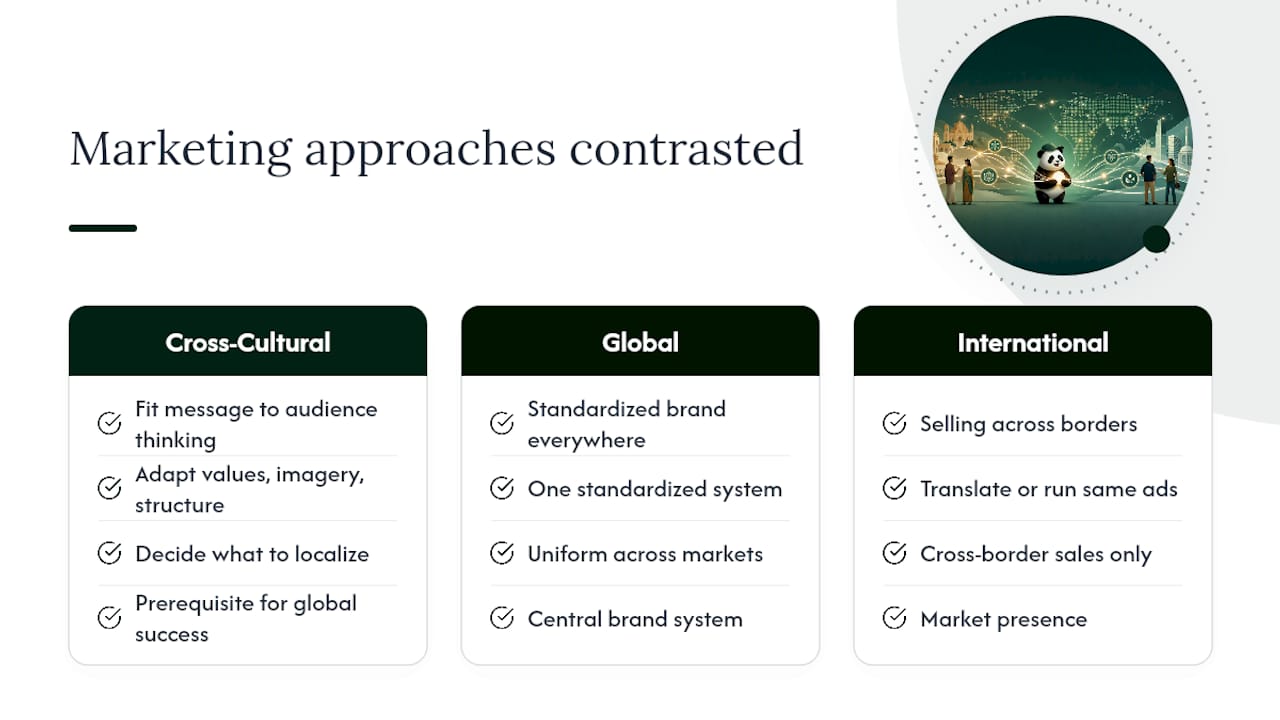
The term gets confused with three neighbors. International marketing means selling across borders, full stop. Global marketing usually means one standardized brand system deployed everywhere. Cross-cultural marketing sits underneath both: it is the discipline of knowing which parts of that system need to bend for a given culture and which can stay fixed. Building this skill matters because cross-cultural communication is a prerequisite for global marketing success , not an optional layer added after launch. The real work is deciding where standardization saves money and where local adaptation saves the campaign.
How to Decide When to Standardize and When to Localize
Five criteria settle most of these calls. Run through them before a campaign brief goes to any agency or internal team.
Product category: Commoditized goods (electronics, software) tolerate more standardization than identity-linked goods (food, beauty, family products).
Cultural sensitivity: Anything touching religion, family roles, or national symbols needs local review before it needs a media plan.
Channel fit: A platform-first strategy in one country can be irrelevant in another (more on this below).
Regulatory risk: Advertising claims, comparative ads, and influencer disclosure rules vary sharply by country.
Cost of adaptation: Full localization is expensive; know which markets justify it and which get a lighter touch.
Global firms that handle this well often use a lead-market model: one region sets the strategic template, and a defined set of “adaptation zones” adjust creative, offer, and channel mix within core brand guardrails, a pattern documented in global marketing strategy research . The alternative, adapting case by case with no shared rules, burns budget and produces inconsistent brand equity.
Pro Tip: Run local pilots against one shared KPI set (not market-specific metrics) so you can compare cultural fit across regions without arguing about whose numbers count.
The Best-Practice Checklist for Planning a Campaign
Treat this as the brief you hand to an agency or internal team before creative starts, not a postmortem checklist.
Commission local audience research before writing a single headline; secondary data from a similar market is not a substitute.
Hire local creative talent or cultural reviewers who live in the target market, not translators reviewing English copy after the fact.
Build cultural values into the creative concept itself, shared experience, family role, status, humor style, rather than swapping stock photography for diversity’s sake.
Adapt format and channel mix per market before locking a media plan.
Clear legal and regulatory review for claims, imagery, and endorsements in each target country.
Fund a pilot budget with a defined approval gate before full rollout.
Language deserves its own line item here. Many words and idioms carry cultural weight that does not survive literal translation , and a native copywriter catches nuance no glossary will. Brands that treat translation as a final production step, rather than part of the creative process, are the ones that end up explaining an ad after it has already caused damage. For teams managing creative across many regional versions at once, versioning promotional materials by market is a useful operational discipline to borrow.
Media and Channel Strategy Is Not One Size Fits All
Platform dominance varies enough between countries that a media plan built on assumptions from your home market will misfire abroad. WeChat functions as a payment system, social feed, and customer service channel in China simultaneously; LINE plays a similar role in parts of Southeast Asia and Japan. Treating either as “just another messaging app” wastes both budget and creative.
Format preferences shift by culture too. Some audiences respond to long-form storytelling and brand narrative; others favor short, transactional formats with a clear immediate offer. Media strategy and format choice often determine engagement more than the creative representation itself , which means a beautifully localized ad on the wrong platform still underperforms.
Practical steps before scaling a media buy:
Test local platform engagement at small spend before committing the full budget.
Match creative length and format to local content norms, not your home-market defaults.
Set market-specific measurement windows since purchase cycles and attention spans differ by platform and culture.
Where Cross-Cultural Campaigns Usually Fail
Most failures trace back to five repeatable mistakes.
Surface localization. Swapping a model’s face without changing the message is tokenism, and audiences notice. Superficial translation without deeper behavioral insight consistently produces weak engagement.
Wrong channel assumptions. Launching a campaign built for one platform’s norms on a different dominant platform, then wondering why performance craters.
Symbol and color errors. Colors, numbers, and gestures carry different meanings by culture; an unreviewed asset can turn a harmless graphic into an insult.
Literal translation of taglines. Idioms and wordplay rarely survive word-for-word conversion, and a rushed launch skips the native-speaker review that would have caught it.
Skipping small-scale validation. Full rollout without a pilot means the first real signal you get is a public one.
The fix for all five is the same: a native cultural reviewer in the approval chain, and a limited pilot before national or global spend.
Measuring Whether a Campaign Actually Fits the Culture
Local conversion rate, engagement rate, sentiment, and lifetime value by segment tell you more than a single blended campaign metric ever will. Design pilots to isolate one variable at a time, creative, channel, or call to action, using matched local control groups, so you know exactly which change moved the number.
Statistic to build a business case around: [ 42% of Hispanic consumers in the U.S. say living in the present and sharing experiences with loved ones matters most to them, versus 23% of non-Hispanic White consumers]( https://openstax.org/books/principles-marketing/pages/8-3-multicultural-marketing ). A campaign built on shared experience will likely outperform a feature-focused one for that segment, and a pilot is how you confirm it before scaling spend.
How Align Applies This Framework in Practice
Align TCC built its methodology at the intersection of Scandinavian brand thinking, precise, values-led positioning, and the speed of Chinese market execution, where testing and iteration happen fast and often. That combination shapes how the decision framework above gets operationalized: core brand rules stay fixed, adaptation zones get local creative and media testing, and AI-assisted production speeds up localization without replacing the human judgment a cultural reviewer brings. The goal is always the same: get a market-specific pilot running fast enough to learn something real before a full-budget commitment.
A Six-Week Pilot Worth Running
Pick one underperforming market, write a culturally specific brief, test two creative variants against a shared KPI, and measure local conversion at week six. If the value-based variant beats the feature-focused one, you have your answer, and a rollout worth funding.
— Kalle
Get a Managed Pilot Instead of a Guessing Game
Running the six-week test above internally takes real coordination: a local creative brief, a cultural reviewer, a media buy sized correctly for the platform, and a KPI framework everyone agrees on before the numbers come in. A specialized agency runs that whole pilot as a managed engagement, combining brand strategy, localization, and market entry work across various markets with AI-assisted production that speeds up creative testing without cutting the human cultural review out of the process.
That means you get a market-ready test cycle without building a new internal team from scratch, and a partner who has already built the governance model, lead market plus adaptation zones, as this article laid out above. If your next campaign needs to prove cultural fit before it earns a bigger budget, book a strategy conversation on Align’s approach page and scope a pilot for your next target market.
Sources
For the underlying frameworks: OpenStax’s multicultural marketing chapter covers segment values in depth, while Principles of International Marketing explains language and cultural dimensions. Advertising Week’s strategy report and University of Florida’s communication guide round out the practical view.
Redefining multicultural marketing: It’s time to rethink strategy – Advertising Week
3.5 Marketing across cultures – Principles of International Marketing (WSU Pressbooks)
Navigating cross-cultural communication in global marketing — University of Florida
Recommended
Our Approach
Our Approach
Our Approach
The Commercial Collective
THE POINT
RELATED INSIGHTS



LET’S TALK
What are you trying to grow next?
Brand, launch, market entry or performance. Book 30 minutes and tell us what you’re working on.