•

Rebranding Strategy: Test Backlash Before a 12–24 Month Reset
Only rebrand when a clear external trigger demands it: a merger, a reputational liability, a legal or trademark conflict, or expansion into a category or market your current brand blocks. Otherwise, choose a targeted refresh. A refresh keeps your recognition assets and runs weeks to months. A full rebrand resets equity, runs 12–24 months, and costs far more.
TL;DR:
Before approving a rebrand, document an external trigger, a measurable objective, and proof that the current name or identity blocks that objective.
Test recognition in the logo, colors, and typography among target groups, then preserve assets audiences still recognize; research should precede creative development.
Audit legal clearance, packaging, digital listings, signage, contracts, and sales materials early, assigning each item an owner, lead time, and cost.
For high stakes launches, pilot in a contained market and monitor sentiment from day one, with named owners, prepared responses, and clear escalation triggers.
Measure awareness, branded search, conversion, retention, and sales against prelaunch baselines, then review results immediately and at 3, 6, and 12 months.
AligntccMake Your Brand Resonate Across MarketsAlign TCC combines Scandinavian brand thinking with Chinese market methodologies to help companies sharpen positioning and engage audiences across markets.Explore Aligntcc
Table of Contents
When to rebrand: the triggers that justify the cost and risk
Refresh or full rebrand: a decision test and scope rule
Research and positioning: what to test before design starts
Identity and creative decisions: name, logo, architecture and tone
Implementation and rollout: channels, phasing and the internal launch
Governance, stakeholder alignment and CEO readiness
Timeline and cost expectations: realistic ranges and cost drivers
Measuring success: KPIs and a pre-launch scorecard
Dos and don’ts: an executive checklist
How modern sentiment dynamics change rebrand planning
Adapting rebranding strategy for cross-cultural markets
Change management practices to ensure smooth internal adoption
Integration of AI tools in rebranding strategy
A rule of thumb from the agency
How we help with rebrand strategy and rollout
FAQ
Sources
When to rebrand: the triggers that justify the cost and risk
A rebranding strategy starts with one question: has the market changed underneath you? CMO Mag’s decision guide puts it the same way. Rebrand when the world around the brand has shifted, not when the brand has merely started to bore the people who look at it every day.
Four triggers hold up under scrutiny:
Merger or acquisition. Two brands become one business, and customers, employees and investors need a single, coherent story. Rebranding after a merger is a positioning decision first and a design exercise second.
Reputational liability. The name or mark itself has become the problem, and no amount of messaging will separate the two.
Legal or trademark conflict. You cannot defend or register the name where you need to operate.
Category or geographic expansion. The old name, promise or visual language actively blocks growth in the segments or regions you are entering.
A fifth case sits close to these: a fundamental repositioning of the business itself, where the company now does something materially different from what the brand signals.
What does not qualify? Boredom. A new executive’s taste. A competitor’s shiny launch. Internal politics dressed up as strategy. These are preferences, and preferences are expensive. If your only driver is internal, put that budget into the things that move revenue: sharper positioning, better creative inside your existing identity, or stronger demand programs.
Be honest about what a full rebrand can destroy. Brand equity is a strategic asset, and the 5Bs framework from the American Marketing Association treats it as something to be actively managed in service of organizational strategy. Replace the name or core mark and you may write off years of recognition, then have to pay to rebuild it. That rebuild is a measurable investment, not a rounding error.
Run a quick trigger test before any agency conversation. Can you name the external event? Can you state the business problem in one sentence? Can you show that a smaller change would not solve it? If you answer no to any of those, you probably need a refresh, or nothing at all. We also see leadership teams skip a crucial question: what happens if we do nothing? If the honest answer is “very little,” the trigger is not strong enough. Write that answer down before you commission anything. It becomes the baseline your scorecard measures against later.
Refresh or full rebrand: a decision test and scope rule
Choose the smallest scope that solves the documented business problem. That principle prevents most budget overruns and most accidental equity loss.
A refresh keeps the name and updates the visual layer: logo refinement, color adjustment, typography, imagery, tone of voice. Think of a legacy brand whose identity looks dated but whose name is well known and well regarded. CMO Mag’s guidance draws the line clearly: refresh when you can solve the problem without changing the name.
A full rebrand replaces the name or the core mark. Think of two merged companies that need one identity, or a business whose name is legally blocked in a target market.
Apply this three-part decision test:
Market trigger. Name the external event that makes change necessary, not just attractive.
Measurable objective. Define what success looks like in numbers: awareness in a new segment, branded search for the new name, conversion in a new region.
Systems impact. Ask whether your current name, mark or architecture would blocked the objective. If it would block markets, channels or legal registration, favor a rebrand. If it would not, favor a refresh.
Before you commit, map the operational footprint. A name change touches more than a logo file:
Legal clearance and trademark registration
Packaging and labeling
Digital references, domains, app listings and email
Signage and physical environments
Vendor and partner contracts
Templates, decks, contracts and sales collateral
Each item has an owner, a lead time and a cost. Count them early. Leaders tend to underestimate the length of this list, and the schedule slips in exactly the places nobody put on the plan. If your rebrand touches mobile products, include app store identity in that audit; this partner guide on app store discoverability is a useful reference for how listings affect findability.
Research and positioning: what to test before design starts
No creative brief should be written before the research is done. Research turns a rebrand from a taste decision into a defensible business decision, and it protects the CEO when someone inevitably says “I just don’t like it.”
Start with visual equity. Test your logo, color and typography to find out which assets still carry recognition and meaning. Heritage elements are not automatically baggage. Berkeley Haas coverage of David Aaker’s playbook makes the point that modernization should balance heritage with relevance, and that a typeface or an iconic color may still hold real recognition value. Discard it without testing and you pay twice. The AMA’s guide to modernizing a legacy brand reaches the same conclusion: examine how visual assets map to current audience meaning before you change them.
The core research agenda:
Stakeholder interviews. Leadership, sales, customer success and partners surface the real reasons behind the request and expose misalignment early.
Segmentation research. Learn who actually buys, who influences the purchase and what each group expects from you.
Concept testing. Put early territories in front of target audiences before you invest in full development.
Quantitative baselines. Measure unaided awareness, brand preference and branded search volume now, so you can judge the result later.
Category matters here. Academic research on brand equity indicates that awareness, relevance and esteem affect sales differently depending on the product category. Work out which equity driver matters most in your category before you reposition. A brand that wins on esteem should be careful about trading it for a flashier but less trusted image. A summary of related brand equity research adds that the dimension that matters most depends on category characteristics.
Then add the layer most guides still skip: sentiment sensing and risk scenario testing. A technically sound rebrand can still be misread, mocked or hijacked. Pressure-test your creative against the narratives that could attach to it. Ask what the least charitable reading would be, who would push it, and which communities would amplify it. Write down the answers and prepare a response for each.
Identity and creative decisions: name, logo, architecture and tone
Creative choices should follow the research, not lead it. Every decision in this section needs a documented reason connected to the business problem you named at the start.
Naming. A name change is strategically justified when the current name blocks growth, creates legal exposure, or no longer describes what you do in a way customers can follow. Judge candidate names against clear criteria:
Legal availability in every market you operate in or plan to enter
Pronounceability and meaning across your languages and cultures
Fit with the repositioned promise
Availability of domains and social handles
Distance from competitors and from unfortunate associations
If none of those problems exist, keep the name. A name carries years of memory that no new identity can buy back cheaply.
Visual identity. Decide asset by asset. Test whether the logo, color palette and typography still trigger recognition, and update only what fails. The AMA’s legacy brand guidance warns against discarding valuable recognition when the goal is to move relevance. Often a typography change and a cleaner system will modernize a brand while the distinctive color and shape stay put.
Tone of voice. Voice is the cheapest identity element to change and often the most noticeable. If your positioning is shifting, tone should shift with it, and your teams need examples, not adjectives.
Brand architecture. This choice shapes launch complexity more than any logo. Moving to a single master brand simplifies marketing but requires retiring sub-brands and their equity. Keeping a house of brands preserves distinct identities but multiplies the rollout and measurement burden, because each brand needs its own baseline and its own scorecard. Research on strategic brand factors notes that architecture and market position moderate brand equity through business cycles, so treat architecture as an investment decision, not a tidy-up.
Decide architecture before you finalize anything visual. It determines how many assets you need, how many audiences you must brief, and how you will attribute results. Make it explicit, then freeze it.
Implementation and rollout: channels, phasing and the internal launch
Rollout is where a good rebranding strategy either holds together or splits at the seams. Plan it in phases, and let risk, not enthusiasm, set the pace.
A practical sequence:
Pilot. Launch in a contained market, segment or product line. Use it to find broken assets, legal snags and messaging that confuses people.
Soft launch. Switch on owned channels and key accounts first. Brief partners and customers directly before the public sees anything.
Full-scale launch. Roll out across paid media, PR, retail, packaging and signage once the pilot data is clean.
Stabilize. Retire old assets on a dated schedule and monitor leakage, where the old brand keeps appearing.
Use a pilot when the stakes or the footprint are large. Go straight to a coordinated launch only when the change is small, such as a visual refresh with the name retained.
Internal launch comes first. Employees are your first audience and your fastest source of inconsistency. Governance should begin before launch: the IPA’s work on brand coherence notes that setting clear brand guidance at the outset reduces internal noise and strategic drift across touchpoints. Build the essentials:
A playbook that explains the why, the new positioning and the dos and don’ts
A central asset repository with a single approved source for every file
Training for customer-facing teams, with real scripts and examples
A named owner for questions, exceptions and approvals
External sequencing. Brief journalists, key customers and partners before the public announcement. Time paid media to land when the story is already told. Switch owned channels at a coordinated moment so no one sees two brands at once. Packaging and signage run on longer lead times, so start them first and let them trail the digital switch if necessary. For market entries, localization is part of rollout, not an afterthought; our own write-up on performance branding with AI localization for Europe shows how that thinking plays out in practice.
Governance, stakeholder alignment and CEO readiness
Most rebrands that go wrong in public went wrong in governance first. Clear roles and decision gates reduce risk more than any extra round of creative.
Set up a compact structure:
Executive sponsor. Usually the CEO or CMO, with the authority to settle disputes and the willingness to stay visible.
Brand owner. One accountable person who runs the program day to day.
Cross-functional council. Legal, HR, sales, product, communications and regional leads, meeting on a fixed cadence.
Decision gates. Research sign-off, positioning sign-off, creative sign-off, launch readiness. Nothing advances without a documented yes.
Sign-off checklist. Legal clearance, scorecard baseline, asset readiness, spokesperson preparation, monitoring in place.
Prepare the CEO and executive team. Leaders will be asked why, in plain words, and often under hostile framing. The IPA’s guidance recommends articulating the “why” of the change clearly and embedding scenario planning. Practically, that means message discipline (three points everyone repeats), media and Q&A rehearsal with difficult questions, and an alignment session where the executive team hears the same story at the same time.
Scenario planning and the command center. A practitioner case documented by the AMA, lessons from the firm behind Cracker Barrel’s logo update, shows that even extensive testing can be derailed by politicized backlash. The lesson is to plan for how a narrative could be hijacked and to build pressure-testing and CEO readiness into the launch plan. Stand up a launch command center with real-time sentiment monitoring, pre-approved response lines and a clear escalation path. Our guide to reputation management strategy covers the response side of that setup.
Timeline and cost expectations: realistic ranges and cost drivers
Set planning bands early, then hold them against what you learn in research.
Timeline.
Refresh: weeks to months, since the name stays and most systems keep running.
Full rebrand: 12–24 months, according to CMO Mag’s rebrand guidance, once legal, packaging, signage and media are included.
Cost. A refresh for a small business commonly lands between $15,000 and $75,000. Costs climb with scale: mid-market programs and enterprise programs add markets, products and approvals, and CMO Mag notes that full rebrands can run into seven or eight figures. Treat these as planning bands, not quotes.
What drives cost up:
Legal work and trademark clearance across multiple jurisdictions
Packaging redesign, reprinting and inventory write-offs
Signage and physical environments
Media investment to rebuild awareness for a new name
Number of sub-brands, languages and markets
Late changes after sign-off
Budget for three things leaders usually leave out. First, measurement: baselines, tracking and post-launch research. Second, contingency: hold a reserve for the surprises that every rollout produces. Third, a short-term dip: recognition and search demand can fall before they recover, so plan commercial targets with that in mind rather than promising instant lift.
Measuring success: KPIs and a pre-launch scorecard
Set the scorecard before launch, not after. If you wait until results arrive, you will pick whichever numbers look best.
Core KPIs:
Unaided awareness among your target segments
Branded search demand for the new name, tracked against the decay curve of the old one
Conversion across key funnel stages
Retention and repeat purchase
Incremental sales, wherever you can isolate them
Measure at fixed windows: a pre-launch baseline, the immediate post-launch period, then 3, 6 and 12 months. Expect a pattern: a temporary dip as audiences adjust, then a rebuild. Read short-term attribution with caution, because a rebrand rarely shows clean last-click returns in its first weeks.
Proof that repositioning can pay is out there. An IPA Effectiveness Awards case for Currys documents a repositioning built on a single insight and integrated creative and media investment that generated measurable incremental revenue.
Currys repositioning case, IPA Effectiveness Awards: A brand re-engineered around one insight, with creative and media working together, delivered measurable incremental revenue and shifted brand preference.
Dos and don’ts: an executive checklist
Use this as a quick screen before you approve budget.
Do invest in research before creative. Don’t rebrand to solve internal politics or personal taste.
Do pressure-test narratives against hostile readings. Don’t assume good testing makes you immune to backlash.
Do change only what the business problem requires. Don’t change everything at once.
Do prepare the CEO and executive team. Don’t let leadership improvise on launch day.
Do set governance and decision gates. Don’t skip sign-off to save time.
Do budget for measurement and a short-term dip. Don’t promise instant lift.
Quick actions you can assign this week:
Appoint a single brand owner with decision authority
Draft the scorecard and capture baselines
Schedule visual-equity and concept tests
Book the CEO’s media rehearsal on the calendar
List every system the new brand will touch
How modern sentiment dynamics change rebrand planning
Launches are no longer judged only by customers. Politicized networks can seize a creative change and recast it as a cultural argument within hours. The AMA’s Cracker Barrel case shows that rigorous testing alone does not prevent this, and the IPA recommends adding sentiment sensing and real-time risk planning to the process. Build these in:
Narrative pressure tests before launch, using skeptical panels
Live sentiment monitoring from day zero, with named owners
Pre-approved response lines and escalation triggers
A rehearsed CEO position, not a reactive one
Adapting rebranding strategy for cross-cultural markets
A brand that works in one market can misfire in another, and a rebrand is the moment to find out why. Names carry different meanings, colors signal different things, and platforms behave differently from region to region. Treat each market as a research question before it becomes a rollout line.
Our working lens blends two traditions. Scandinavian brand thinking contributes clarity: a sharp positioning, a disciplined identity system, a single idea held consistently. Chinese market methodologies contribute speed: fast testing, rapid iteration on platforms and a close read of shifting consumer behavior. Together they give you a core that stays coherent and a surface that adapts quickly.
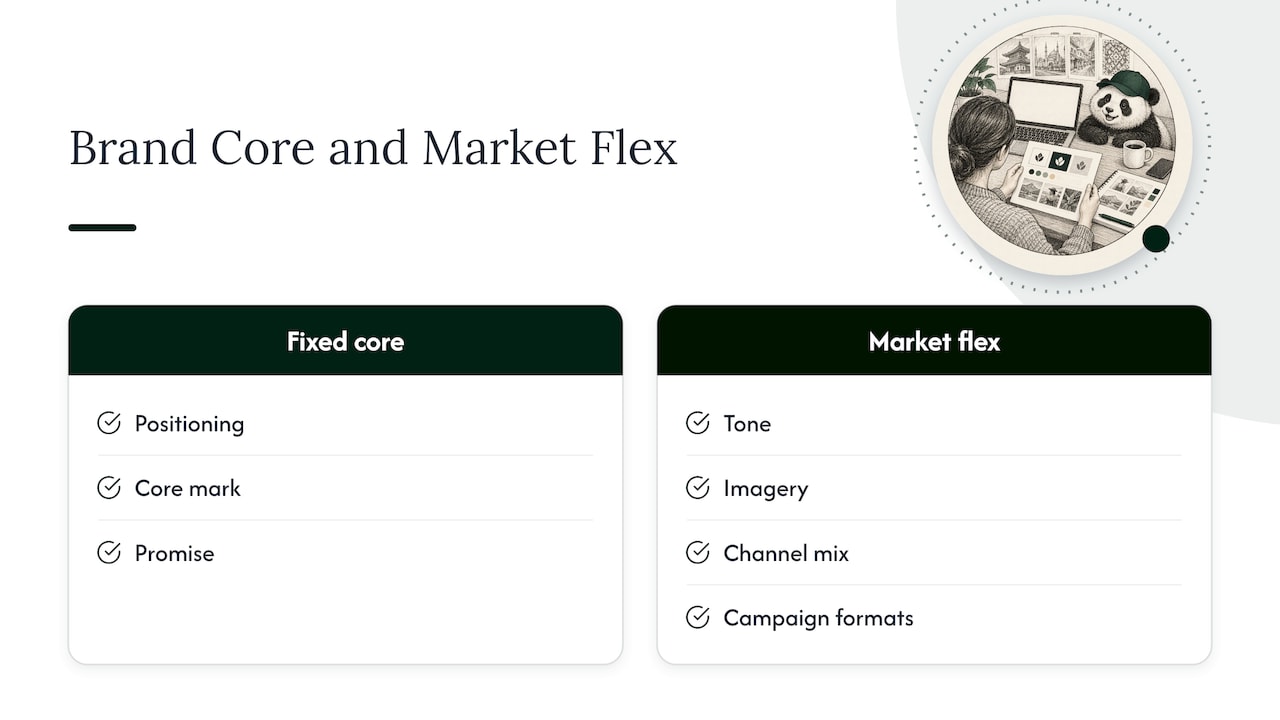
In practice, that means defining what must never change (the positioning, the core mark, the promise) and what can flex by market (tone, imagery, channel mix, campaign formats). Localize names and key messages with native speakers and test them in market before committing. Run pilots in one region while the rest of the program stays steady. For leaders entering APAC, immersion helps: our leadership trips put teams in front of real consumers and platforms before major decisions are locked.
Change management practices to ensure smooth internal adoption
A rebrand is a change program with a logo attached. If employees do not understand it, believe it or know how to use it, customers will see the inconsistency within days.
Start with the “why.” Explain the external trigger and the business problem in plain language, and explain it before the announcement, not after. People defend what they helped shape, so involve a cross-section of teams in testing and feedback. Name champions in each function and region who can answer questions and spot problems early.
Give people tools, not just a PDF. A usable playbook, ready templates, example copy and a single repository for approved assets remove the excuses for off-brand work. Train customer-facing teams first, since they carry the story into every conversation. Set a clear cutoff date for old materials, and make it easy to comply.
Then keep listening. Run short pulse surveys in the first weeks, collect the questions teams keep asking and fix the gaps visibly. Recognize teams that adopt the new brand well. Adoption is not a launch-day event; it is a habit you build over time.
Integration of AI tools in rebranding strategy
AI belongs in a rebrand where it speeds up learning and monitoring, not where it replaces judgment. Our position is simple: technology should enhance creativity, not stand in for it.
Useful applications:
Research synthesis. Analyze large volumes of interviews, reviews and social conversation to surface themes faster.
Sentiment monitoring. Track mentions and tone in real time during launch, and flag shifts early. Our 90 day reputation plan with AI aware monitoring describes how we structure this.
Concept exploration. Generate and screen early territories quickly, then let human strategists and designers decide what is worth developing.
Localization support. Draft market variants for native review, not for direct publication.
Content production. Scale asset adaptation once the system is approved.
For a broader view of how AI changes brand building, this partner overview of AI strategies for digital branding is a helpful reference.
Set guardrails. Keep a human owner on every output that reaches the public, check legal and cultural fit manually and never let a model decide positioning. AI can tell you what people are saying. Deciding what your brand stands for remains your job.
A rule of thumb from the agency
Choose the smallest scope that solves the business problem, and write the scorecard before you write the brief. Most expensive rebrand mistakes come from skipping one of those two steps. When we advise leaders, we work through a blended lens: Scandinavian strategic clarity, fast commercial execution and AI-enabled monitoring through launch. It is a way of working, not a guarantee, and the evidence in your own research should always outrank our instincts.
— Kalle
How we help with rebrand strategy and rollout
If you are weighing a refresh against a full rebrand, we can pressure-test the decision with you. Our Brand & Positioning and Commercial Strategy work covers the research and positioning, Go-to-Market & Market Entry covers new geographies, and we run AI-enabled monitoring and rollout execution through launch. A typical engagement moves from discovery to research, then positioning, then phased rollout.

See what we offer on our services page and tell us where your brand stands today.
FAQ
What are the most common branding strategies?
Common approaches include personal branding, product branding, corporate branding, service branding, co-branding and geographic branding. Which one fits depends on your architecture: a single master brand favors corporate branding, while a house of brands favors product-level strategies. Choose by business problem, not by label.
What are the 5 C’s of branding?
Different practitioners define the 5 C’s differently, and there is no single canonical version. A common version covers clarity, consistency, credibility, connection and commitment. Treat any such list as a checklist for your own brand audit rather than a formal standard.
What is the 3-7-27 rule of branding?
Marketing heuristics vary, so we do not rely on fixed rules for planning. Use your own baselines instead: measure unaided awareness, branded search and conversion before and after launch.
How do I decide between a refresh and a full rebrand?
Apply the three-part test: an external market trigger, a measurable objective and a systems impact. If the current name or mark would block markets or legal registration, favor a full rebrand. If not, choose the smallest scope that solves the documented problem, which is usually a refresh.
Sources
Recommended
RELATED INSIGHTS



LET’S TALK
What are you trying to grow next?
Brand, launch, market entry or performance. Book 30 minutes and tell us what you’re working on.