•

Brand Film Production: One Shoot, Measurable Reach Across Channels
Brand film production creates long-form, story-led video that builds consideration and cultural position for a company, not a quick product pitch. We use it when the goal is memory and meaning, not a click in the next ten seconds. If you need a fast conversion push, a short-form ad does that job better; if you need people to feel something about whom you are, a brand film is the format built for it.
TL;DR:
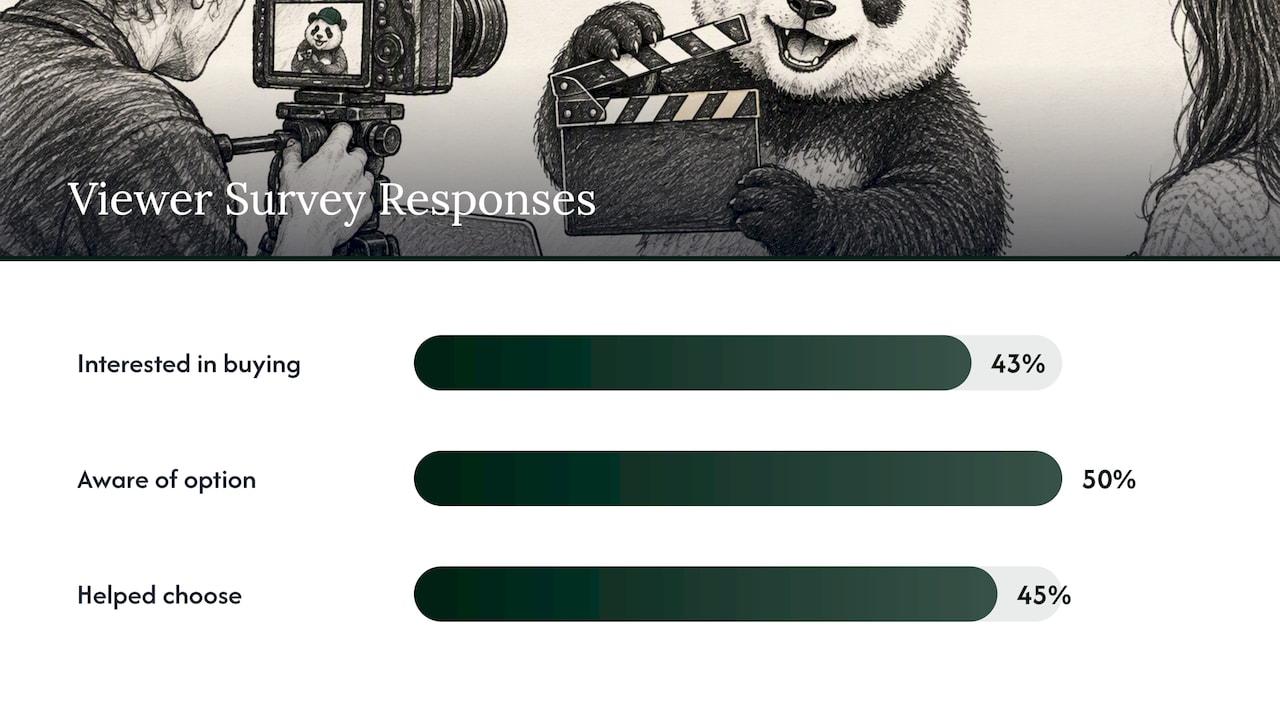
Google’s study found video interested 43% of viewers in buying, made half aware of unconsidered options, and helped 45% choose between brands.
Match the format to the story: use documentary films for sustainability or employer branding, founder testimony for trust, and hero films for repositioning or announcements.
Approval cycles, not shoot days, commonly delay projects; name one final approver before filming and consolidate feedback instead of routing cuts sequentially.
Budget depends on crew, talent, locations, licensing, effects, and schedule; planning six to eight derivative cuts with the hero film spreads costs across months.
Publish the full film on YouTube, extend reach through creator partnerships, and measure brand lift, view through rate, and later consideration or purchase signals.
AligntccMake Your Brand Story Travel FurtherAlign TCC helps brands shape compelling commercial strategies and engage audiences across platforms with market-specific execution.Explore Align TCC
Table of Contents
What a Brand Film Is and How It Differs From a Traditional Ad
Why Brands Commission Brand Films: Objectives and Business Use Cases
Creative Elements and Examples: What High-Performing Brand Films Do
Production Process and Timeline: Pre-Production, Shoot, and Approval Tips
Budget and Asset Strategy: What Drives Cost and How to Amortize Value
Distribution and Measurement: Platform Choices and KPIs That Show Impact
How to Choose a Production Partner and Brief Them
Align’s Perspective on Brand Film Production
How Align Helps You Plan a Brand Film
FAQ
Sources
What a Brand Film Is and How It Differs From a Traditional Ad
A brand film is a narrative-first piece of video, usually long-form, built to carry a company’s values rather than sell a single product. It soft-sells: the story earns attention first, and the brand earns trust as a byproduct.
Common formats include the hero or anthem film (a sweeping, often wordless statement of identity), the documentary-style piece (real people, real stakes, minimal scripting), the founder or customer story (one voice, one arc, high intimacy), and the episodic series (a recurring format that builds audience over months). Each format serves a different relationship with the viewer, and the best production choices start by picking the right one for the goal.
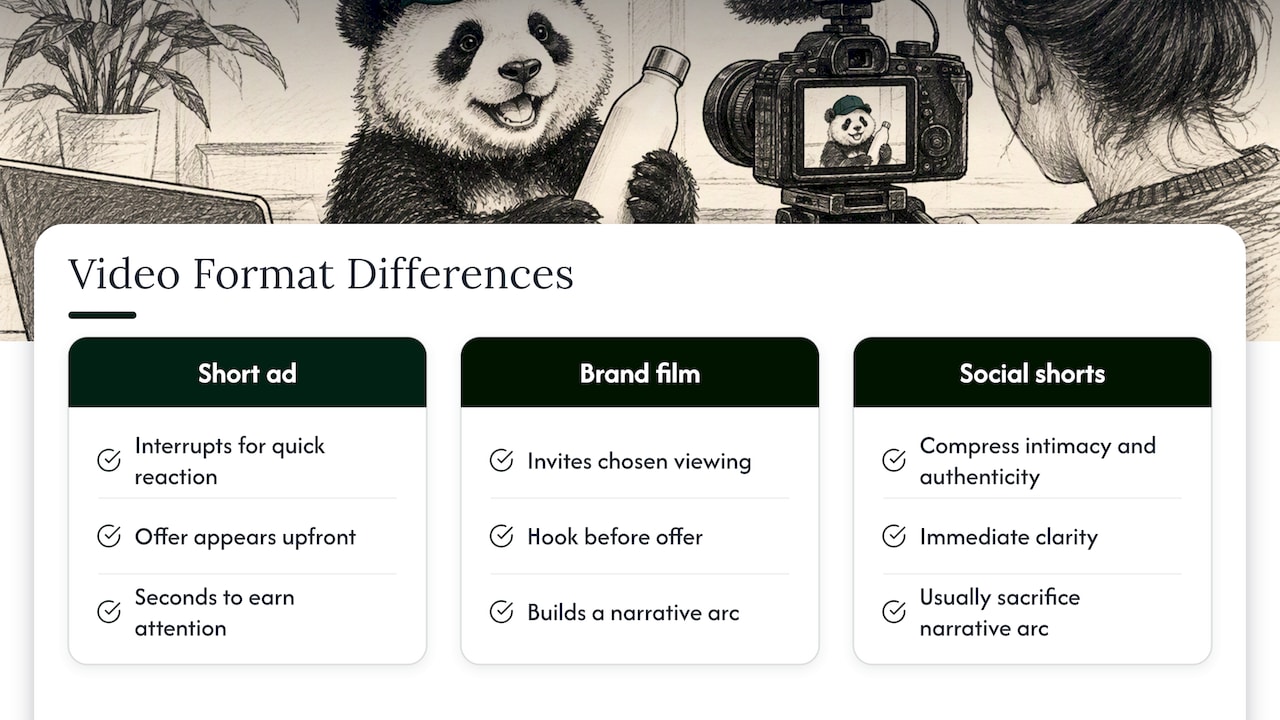
A short ad is built for interruption: it has seconds to earn a reaction before the viewer moves on. A brand film is built for invitation: the viewer chooses to watch, which changes everything about pacing, music, and structure. Ads front-load the offer. Brand films front-load the hook and let the offer arrive as a feeling rather than a line of copy. Social shorts borrow some brand film techniques, mostly intimacy and authenticity, but compress them into short formats and usually sacrifice narrative arc for immediate clarity. Knowing which lane you are in before the first script draft saves budget and prevents a film that tries to do both jobs and does neither well.
Why Brands Commission Brand Films: Objectives and Business Use Cases
Brand films get commissioned when the objective sits higher up the funnel than a transaction: building awareness, shaping consideration, establishing a cultural position, strengthening employer brand, or telling a sustainability story with enough depth to be credible. These are not goals a short ad can carry.
Video’s influence on purchase decisions is well documented. In a Google-commissioned study, 43% of viewers said video got them interested in buying a product, half said it made them aware of an option they hadn’t considered, and 45% said it helped them choose between products or brands. That spread across the funnel is exactly why long-form video belongs in a consideration strategy rather than only a performance campaign.
Choose a brand film when the story needs room to build, when the audience includes stakeholders beyond the end buyer (investors, talent, partners), or when the brand’s position depends on nuance a short cut cannot hold. Choose short-form when the job is immediate action from an audience that already knows who you are.
Creative Elements and Examples: What High-Performing Brand Films Do
The strongest brand films share a short list of ingredients. Analysis from Google of AI-driven video marketing found that high-performing films still depend on a strong opening hook, visible human sentiment, and a clear narrative arc, regardless of how much AI assists the production.
A hook in the first few seconds that earns the next thirty, before any brand message appears.
Human sentiment over polish, since a real reaction on camera outperforms a perfectly lit but flat delivery.
A sonic identity, meaning a music and sound choice distinct enough that the brand is recognizable with the picture off.
Casting that matches the audience, not the brand’s internal idea of who the audience is.
Format should map to objective. A cinematic hero film suits a brand repositioning or a major announcement. An intimate, direct-to-camera piece suits founder-led trust building. A documentary style suits sustainability or employer-brand storytelling, where credibility matters more than gloss. A creator partnership suits audiences that trust a familiar face more than a studio production.
A strong brand film treats its opening seconds as a decision point, not a warmup. One pattern is the slow reveal: withhold the product entirely until the emotional arc has landed. Another is the direct testimony: one subject, one camera, minimal cutting, letting unscripted language carry the credibility. A third is the ensemble documentary: multiple voices stitched around one theme, built for a brand with many communities to represent rather than one hero customer.
Production Process and Timeline: Pre-Production, Shoot, and Approval Tips
A brand film moves through several phases, and most schedule slippage happens in the phase with no camera involved at all.
Pre-production: lock the creative brief, concept, and script, then build storyboards, cast talent, and scout locations.
Shoot: plan shoot days according to scope, with defined on-set roles and a shot checklist reviewed each morning.
Post-production: cut the edit, finish sound design, grade color, route for approvals, and deliver final masters plus derivative cuts.
Shoot days are usually the most predictable part of the timeline. What extends a project is almost always the approval cycle: multiple stakeholders reviewing the same cut in sequence rather than in parallel, each with their own notes. Consolidating sign-off into a single approver, or a small committee with one final decision-maker, keeps a project on schedule far more reliably than adding review rounds.
Pro Tip: Name one final approver before the shoot, not after the first cut lands, so creative notes do not compound across multiple rounds.
Partners who plan shoot days around the final cut lengths you need, rather than one long take edited down later, tend to protect both budget and schedule. Guidance on matching shoot planning to target lengths makes the case for deciding your short-form and hero-length cuts before the camera rolls, not after.
Budget and Asset Strategy: What Drives Cost and How to Amortize Value
Cost in brand film production tracks a handful of variables: crew size and experience, talent fees, location complexity, music and footage licensing, visual effects, and total schedule length. A single-location documentary with a small crew costs a fraction of a multi-location hero film with a cast, stunts, or heavy post-production.
Rather than anchoring to a fixed number, budget against scope: how many locations, how many shoot days, how much original music, and how much derivative content you need afterward. A short shoot with a lean crew sits at the low end of that range; a multi-day production with licensed music and color-heavy post sits considerably higher.
The strategy that protects return on that spend is ecosystem thinking. Planning a hero master film alongside six to eight derivative cuts built from the same shoot amortizes the production cost across social clips, mid-form edits, and cinemagraphs, turning a production into months of usable content.
Distribution and Measurement: Platform Choices and KPIs That Show Impact
Where a brand film lives matters as much as how it is made. AI analysis of thousands of YouTube campaigns found that strong hooks, cultural references, creator partnerships, and multiformat assets consistently drive performance, and YouTube’s reach made it notably more influential for consideration and purchase than social platforms in Google’s purchase-decision research.
Lead with YouTube for the full-length cut, since longer-form video performs best where viewers expect to watch.
Use creator partnerships to extend trust into audiences a brand channel alone cannot reach.
Track brand lift and view-through rate, not just completion, to separate attention from recall.
Watch downstream consideration and purchase signals, since brand film impact often shows up weeks after release.
Our guide to brand lift measurement walks through proving that impact in practical terms. Testing multiple cut lengths against the same audience, rather than guessing which length wins, consistently sharpens where budget should go next.
How to Choose a Production Partner and Brief Them
Evaluate a potential partner on several things: storytelling craft in their reel, platform experience across the channels you need, production management discipline, and whether they think about measurement before the shoot rather than after.
Ask for examples in the format closest to your objective, not just a generic highlight reel.
Ask who owns approvals on their side and how they handle revision rounds.
Ask what derivative assets come standard from a single shoot day.
Confirm usage rights cover every platform and timeframe you plan to use the footage.
Pro Tip: Put deliverables, usage rights, and derivative asset counts in the contract before the shoot date is set, not after the edit is locked.
Align’s Perspective on Brand Film Production
We approach brand film production the way we approach every commercial engagement: Scandinavian brand thinking paired with the execution speed we have adapted from Chinese market methodologies. A film is never the end product for us. It is the hero asset in a content ecosystem built to carry a brand’s position across every platform it needs to show up on.
We use AI to streamline the editing and distribution workflow, never to replace the human judgment that makes a story land. Clients typically leave an engagement with sharper positioning.
— Kalle
How Align Helps You Plan a Brand Film
A brand film works best when it sits inside a bigger commercial plan, not beside one. We connect brand film production to the positioning, go-to-market, and content work that gives it a reason to exist and an audience ready to receive it.
Brand & Positioning shapes the story before a script gets written.
Commercial Strategy ties the film to the business outcome it needs to move.
UGC & Content and Demand & Performance turn the hero film into the derivative assets that carry it across channels.
An initial engagement usually starts with a discovery brief, followed by a creative sprint to pressure-test the concept before full production begins. Explore our services to start that conversation.
FAQ
What makes a video a brand film instead of a commercial?
A brand film is narrative-first and built to carry values or identity, while a commercial is built around a direct offer with a short window to act. The distinction shows up in pacing, length, and how late the product appears in the story.
How long does brand film production typically take?
Shoot days themselves vary depending on scope, but approval cycles often extend the full timeline well beyond that. Naming a single final approver before the shoot begins is one of the most reliable ways to keep a project on schedule.
How do you measure the impact of a brand film?
Brand lift studies, view-through rate, and downstream consideration or purchase signals are the core measurement approaches, since completion alone does not capture recall or trust. Our brand lift measurement guide breaks down how to set this up before launch.
What is commercial film production?
Commercial film production refers to video made for paid advertising, typically short-form and built around a direct offer or call to action rather than an extended narrative. It sits on the opposite end of the spectrum from brand film production, which prioritizes story over immediate conversion.
How is AI used in brand film production today?
AI tools help scale editing, optimize delivery across platforms, and generate derivative cuts faster, but the strongest films still depend on human-driven hooks and narrative craft. Our overview of AI marketing workflows covers where AI fits without replacing creative judgment.
Recommended
RELATED INSIGHTS



LET’S TALK
What are you trying to grow next?
Brand, launch, market entry or performance. Book 30 minutes and tell us what you’re working on.