Growth / Performance
Kalle Mobeck
•

What Is an AI Marketing Workflow, and Where Do You Start?
An AI marketing workflow is a sequence of marketing tasks where autonomous or semi-autonomous agents handle execution, from data analysis to content creation to campaign adjustments, while people set strategy and approve high-stakes decisions. Done well, it compresses weeks of manual campaign work into days and personalizes at a scale no human team can match. The fastest way to see the value is to pick one repeatable process, like repurposing content or managing lifecycle emails, and run it as a contained pilot before touching anything else.
Before you open a single tool, get three things straight:
Pick one workflow, not five. Repurposing, lead scoring, or ad budget optimization are strong starting points because they’re repeatable and measurable.
Confirm your data is centralized. Agents can’t personalize or optimize against scattered spreadsheets and disconnected platforms.
Decide upfront what stays human. Brand voice, pricing, and legal claims should never run on autopilot.
Key Takeaways
The most effective AI marketing workflows pair narrow, repeatable pilots with strict human oversight, unified data, and metrics tied to pipeline and revenue rather than vanity engagement numbers.
Point | Details |
|---|---|
Start with one pilot | Choose a repeatable, low-risk workflow like content repurposing before automating anything higher-stakes. |
Unify your data first | Agents personalize and optimize only as well as the customer data feeding them allows. |
Define human gates upfront | Decide before launch which decisions stay human, like pricing and brand positioning. |
Track business outcomes | Measure pipeline, CAC, and retention instead of open rates or clicks. |
Get expert scoping | Aligntcc runs six-week pilots with staffed roles and built-in governance for teams that want a faster, guided start. |
Table of Contents
Building Blocks Of An AI Marketing Workflow
Four Workflow Blueprints You Can Copy This Quarter
How Do You Take A Pilot From Test To Standard Practice?
Who Runs This, And What Tools Do You Actually Need?
Which Metrics Actually Prove An AI Workflow Is Working?
Align In Practice: Scoping An AI Workflow Pilot
Keeping AI Marketing Workflows Compliant With Privacy Rules
Why Do Most AI Marketing Workflow Projects Stall?
Getting Your Team To Actually Use The New Workflow
Do AI Models Need Maintenance After Launch?
What Should You Look For In An AI Marketing Platform?
Sources
Building Blocks Of An AI Marketing Workflow
Every functioning AI marketing workflow rests on the same four layers: a unified data foundation, a set of specialized agents, an orchestration layer connecting them, and a defined boundary where humans step in. Skip any one of these and the workflow either stalls or makes expensive mistakes at speed.
The data foundation is non-negotiable. Agents make decisions based on what they can see, and if your customer data lives in four disconnected tools, an agent optimizing send times or ad spend is working half blind. A unified system of record, whether that’s a CDP, a well-integrated CRM, or a data warehouse feeding both, is what lets a segmentation agent and a creative agent agree on who the audience actually is. McKinsey’s research on agentic AI in marketing notes that agentic systems can execute multistep processes and even reallocate budget without constant human input, but only when the underlying data infrastructure supports it.
From there, think in terms of agent archetypes rather than individual tools:
Segmentation agents group audiences by behavior, lifecycle stage, or intent signals, updating continuously instead of on a monthly refresh.
Creative agents generate and adapt copy, images, or video variants for different channels and segments.
Analytics agents monitor performance in near real time and surface anomalies before a human would notice them in a dashboard.
Activation agents push the final decision, whether that’s a send, a bid adjustment, or a budget shift, out to the actual platform.
Orchestration is the layer that makes these agents work together instead of stepping on each other. It’s the connective tissue linking agent outputs to activation endpoints: your ad platforms’ APIs, your CDP’s audience builder, your email service provider’s send engine. Bloomreach describes this shift as agentic orchestration replacing rigid, rules-based automation with systems that adapt and personalize continuously, provided the agents have clear interfaces and data contracts between them. Without that clarity, you get agents overwriting each other’s work or duplicating effort across channels.
Finally, decide where humans stay in the loop. This isn’t a matter of trust, it’s a matter of risk tolerance. Budget reallocation within a preset band, subject line testing, and send-time optimization are generally safe to automate. Brand positioning shifts, pricing changes, and anything touching legal or regulatory claims should always route through a person. Marketers who blur this line tend to find out the hard way when an agent published something off-brand at 2 a.m.
Pro Tip: Write your human-in-the-loop rules down as an actual document before you launch a pilot, not after something goes wrong. “We’ll figure it out” is not a governance policy.
Four Workflow Blueprints You Can Copy This Quarter
Theory is easy. Execution is where most AI marketing workflow projects stall, so here are four blueprints built from inputs, agent roles, and approval gates you can adapt without reinventing the architecture.
Content repurposing pipeline. A long-form blog post or webinar recording goes in. A creative agent breaks it into a LinkedIn carousel, three social posts, an email snippet, and a short video script. A QA agent checks tone, factual consistency, and formatting against brand guidelines. A human reviewer approves before anything schedules. This is the single most common first pilot because the input is already produced, the output is low-risk, and the time savings are visible within the first week.

Lifecycle email and lead-scoring workflow. Behavioral and firmographic data flows into a segmentation agent that scores leads and assigns lifecycle stage. A personalization agent drafts subject lines and body copy matched to that stage. A send-optimization agent tests delivery windows per segment. A human marketer reviews flagged edge cases, typically leads scoring near a threshold or accounts flagged as high-value, before anything sends to a named account.
Ad budget and creative optimizer. A real-time signal agent watches spend, CPA, and conversion data across paid channels. When performance drifts outside a defined band, a budget-rebalancer agent shifts spend between campaigns automatically. A separate creative agent flags underperforming ad variants for pause or rewrite, but doesn’t publish new creative without sign-off. This is where House of Martech’s research on hybrid human-agent models becomes concrete: the agents execute the mechanical rebalancing, but a human still owns the creative direction.
Analytics-to-insight agent. Instead of pulling a weekly report by hand, a conversational analytics agent answers natural-language questions (“Why did MQLs drop in the Northeast region last week?”) and drafts attribution narratives for executive review. This use case matters because it changes who can access insight, not just how fast it arrives.
Conversational, ask-your-data agents shorten the time between a question and an answer, which changes who inside a marketing team can act on data, not just how quickly the answer arrives.
Implementation notes that actually matter:
You’ll need connectors between your CDP or CRM, your ad platforms, your email service provider, and whatever you’re using for creative generation. Missing even one turns “automated” into “automated with a manual export step,” which defeats the purpose.
Expect your first human review cycle within 48 to 72 hours of launch, not weeks. If review is taking longer, your approval gates are probably too broad.
In the first seven days, watch for tone drift in generated copy, unexpected budget swings outside your set bands, and any output that required more than a light edit. Those are signals your data inputs or agent instructions need tightening, not signs the whole approach is broken.
Atlassian’s overview of AI marketing automation use cases is a useful reference point for mapping which tooling category handles which piece of this, particularly if you’re deciding what to build versus buy.
How Do You Take A Pilot From Test To Standard Practice?
Scaling an AI marketing workflow badly is worse than not automating at all, because a broken process now runs at machine speed. Here’s the sequence that avoids that outcome.
Choose a pilot with four traits: it’s repeatable, it carries low brand risk if something goes wrong, its outcome is measurable within a few weeks, and you already have the data to feed it. Content repurposing checks all four boxes for most teams, which is why House of Martech recommends starting with predictable, repetitive workflows rather than your highest-stakes campaign.
Audit your data and integrations before you touch agent configuration. At minimum, you need clean contact records, campaign performance history, and API access to your activation platforms. The ideal schema adds behavioral event data and lifecycle stage tagging, but don’t let the ideal block the minimum viable start.
Define success metrics tied to business outcomes, not vanity signals. Pipeline generated, cost per acquisition, and time-to-publish tell you whether the workflow is working. Open rates and click-throughs tell you almost nothing about whether it’s worth scaling.
Set your approval tiers before launch. Decide what auto-publishes, what needs one reviewer, and what needs two. Build an audit trail so you can trace every agent decision back to its inputs, and set a rollback trigger, a specific performance threshold that pauses the workflow automatically if crossed.
Run a formal review cadence. Weekly for the first month, then biweekly once the workflow stabilizes. This is where you catch drift before it compounds.
Decide what to standardize and what stays bespoke as you scale. Your approval workflow and data schema should standardize across teams. Your creative voice and channel mix should stay flexible enough to reflect different products or regions.
Pro Tip: Resist scaling a second workflow until your first pilot has run cleanly for at least one full review cycle without a manual rescue. Speed to scale matters less than proof the guardrails actually hold.
Who Runs This, And What Tools Do You Actually Need?
You don’t need a data science team to run an AI marketing workflow, but you do need clarity on tool categories and role ownership, or the whole thing collapses into ad hoc tool sprawl.
The tool stack breaks into five categories: a CDP or CRM as your data foundation, an orchestration layer or agent controller that routes tasks between agents, activation endpoints (your ad platforms, ESP, and CMS), model access or API connections powering the agents themselves, and an observability layer that logs what every agent did and why. Skipping observability is the most common mistake. Without it, you can’t explain a bad outcome to a client, a boss, or a regulator.
On staffing, five roles cover most implementations:
A marketing operations lead who owns the workflow end to end and is accountable for its performance.
A campaign lead who defines strategy and reviews flagged decisions.
A data engineer who maintains the integrations and data quality.
A creative reviewer who checks brand voice and factual accuracy on generated content.
A compliance reviewer who signs off on anything touching claims, pricing, or regulated categories.
You’ll also choose between two orchestration patterns. A managed service, where an outside partner runs the pilot and hands over a working system, gets you to value faster and reduces the internal lift, but you depend on that partner’s expertise during the build. An in-house platform gives you full control and internal knowledge retention, but takes longer to stand up and demands the data engineering and MOps talent to maintain it. Neither is universally better. The right call depends on how fast you need results and how much internal capacity you actually have, not how much you’d like to have.
Whichever path you choose, prioritize API-first systems over anything that requires manual export and import, and insist on immutable audit logs from day one. Retrofitting an audit trail after a workflow is already live is far harder than building it in from the start.
Which Metrics Actually Prove An AI Workflow Is Working?
The workflows that get shut down after six months almost always failed for the same reason: teams tracked the wrong numbers. Open rates and click-through rates measure whether an email was written well. They don’t measure whether the business is healthier because of it.
Track pipeline generated, customer acquisition cost, retention, and lifetime value instead. These connect directly to revenue and survive scrutiny from finance, which matters when you’re asking for budget to expand the pilot.
Watch for specific red flags during any pilot: a sudden, unexplained shift in channel spend, a noticeable change in content voice or tone, or a spike in conversions that nobody can trace back to a specific change. Each of these usually means an agent drifted outside its intended parameters, not that you’ve found a lucky break.
Metric Category | What To Track During A Pilot |
|---|---|
Pipeline health | New qualified leads generated and time from lead to first touch |
Cost efficiency | Cost per acquisition by channel, compared to pre-pilot baseline |
Retention signal | Churn rate or renewal rate for cohorts touched by the workflow |
Governance | Number of agent decisions requiring human override per week |
Capgemini’s work on AI-powered marketing operations points to measurable gains in efficiency and speed-to-market when operations are deliberately redesigned around AI capabilities, not bolted onto old processes. That redesign is exactly what a governance playbook forces you to do: define approval tiers, lock model versions so nothing changes silently, keep a running change log, and review all of it on a fixed cadence rather than only when something breaks.
Align In Practice: Scoping An AI Workflow Pilot
At Align, we typically scope a first AI marketing workflow pilot around a six-week timeline: two weeks for data audit and integration setup, three weeks for the workflow to run with daily human review, and one week to formalize governance and hand over documentation.
We supply the roles clients often don’t have in-house yet:
A marketing operations lead to own the technical build
A creative reviewer fluent in the client’s brand voice across markets
A data engineer to handle integrations and data hygiene
We track speed-to-market, pipeline movement, and conversion improvement against a pre-pilot baseline, and every agent decision routes through a documented approval tier so the client always knows what ran automatically and what a person signed off on.
Keeping AI Marketing Workflows Compliant With Privacy Rules
Data privacy in an AI marketing workflow isn’t a separate workstream, it’s built into every layer described above. The moment an agent touches customer data to segment, personalize, or score a lead, you’re operating under whatever privacy regulation governs that customer’s location, whether that’s GDPR for EU and EEA residents or another regional framework.
Start with data minimization. Agents don’t need full purchase history to personalize a subject line; they need the fields relevant to that decision. Feeding an agent more data than its task requires increases your exposure without improving the output.
Document your data retention and deletion policies before launch, and make sure your orchestration layer can actually honor a deletion request across every connected system, not just your primary CRM. This is where fragmented tool stacks create real legal risk: a customer’s deletion request means nothing if their data still lives in three disconnected agent memory stores.
Keep a clear record of what data trains or informs each agent, and review vendor contracts for how they handle your customer data on their infrastructure. Some AI vendors use client data to improve their broader models by default; confirm whether yours does and whether that’s acceptable for your compliance posture. Finally, build consent checks into your activation layer itself, not just your intake forms, so an agent can’t send to a contact who withdrew consent last week but hasn’t been purged from every downstream list yet.
Why Do Most AI Marketing Workflow Projects Stall?
Three failure patterns account for most stalled AI marketing workflow projects, and none of them are really about the technology.
The first is scope creep at launch. Teams try to automate an entire campaign lifecycle in one pilot instead of one narrow, repeatable task. When something goes wrong, they can’t isolate which piece failed, so the whole project loses credibility. Fix this by refusing to launch more than one workflow at a time until the first has proven stable.
The second is treating data cleanup as optional. Agents amplify whatever data quality already exists. Feed a segmentation agent duplicate or stale contact records and it will personalize confidently and incorrectly at scale, which is worse than a human doing it slowly and correctly. Budget real time for data audit before any agent goes live, not after results disappoint.
The third is unclear ownership. When no single person is accountable for a workflow’s performance, small issues, a subject line that drifts off-brand, a budget shift nobody flagged, go unnoticed until they’ve compounded into a real problem. Assign a named owner for every live workflow, not a team or a department.
A quieter pitfall is underestimating change management. A technically flawless workflow that the team doesn’t trust or use correctly delivers zero value. That gets its own attention next.
Getting Your Team To Actually Use The New Workflow
The technical build is usually the easier half of this project. Getting a skeptical content team, sales team, or executive sponsor to trust agent-generated output is where AI marketing workflow initiatives quietly die.
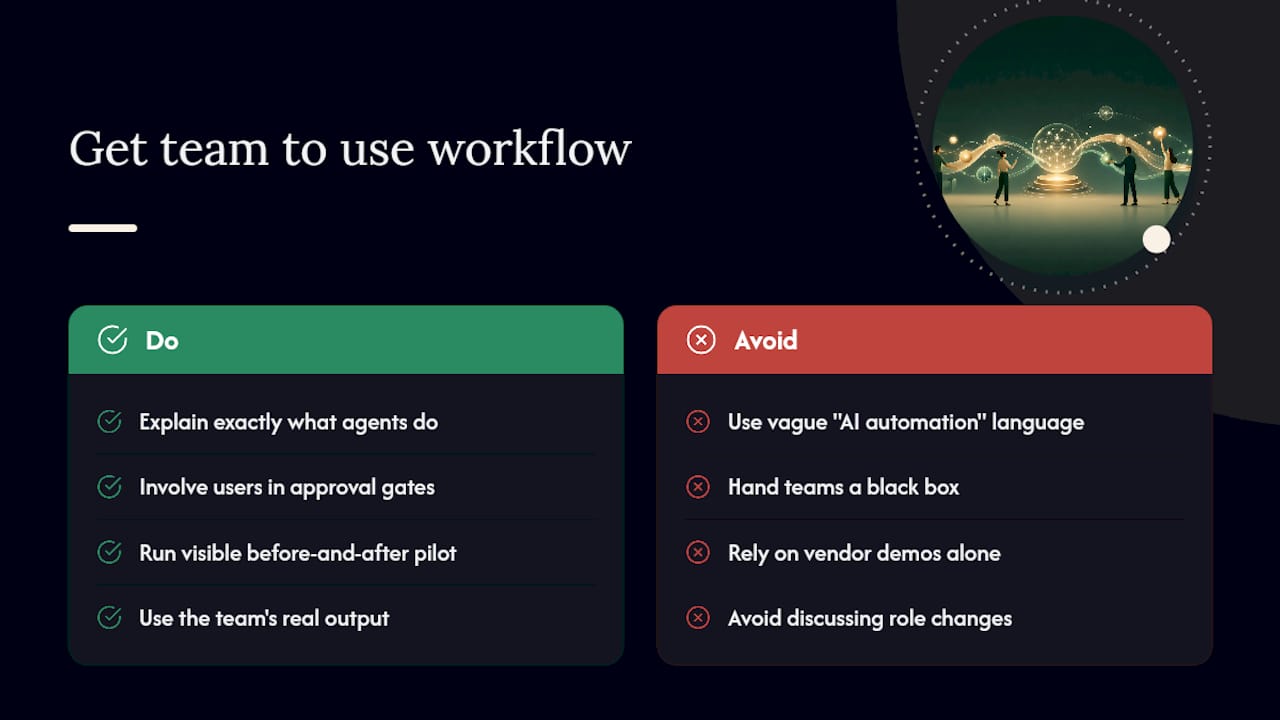
Start with transparency about what the agents actually do. Vague talk about “AI automation” breeds suspicion. Specific descriptions, “an agent drafts three subject line variants and a person picks one,” build trust because they’re concrete and non-threatening. People fear replacement more than they fear a defined tool with defined limits.
Involve the team that will use the workflow in defining its approval gates, not just in using the finished product. A creative team that helped decide what needs human review is far more likely to trust the system than one handed a black box and told to sign off.
Run a visible before-and-after comparison during the pilot. Show the team how long a task took manually versus with the workflow, using their own real output, not a vendor demo. Concrete proof from their own work beats any argument about efficiency in the abstract.
Finally, expect resistance from at least one stakeholder group, usually whoever’s role feels most directly automated. Address it directly rather than avoiding the conversation: clarify what shifts to higher-value work rather than disappearing entirely. Teams that skip this conversation tend to see quiet sabotage, like ignoring the agent’s output and redoing everything manually, which erases any efficiency gain the workflow was supposed to create.
Do AI Models Need Maintenance After Launch?
Yes, and skipping this step is why workflows that worked beautifully in month one degrade by month six. Agents built on models trained on past data will drift as your market, customer behavior, and even your own product line change underneath them.
Set a monitoring cadence, not just a launch date. Weekly checks in the first month, then monthly once a workflow stabilizes, should track output quality, not just uptime. Are subject lines still landing in the right tone? Is the segmentation agent’s grouping still matching how sales actually talks about accounts? Small drift is easy to catch weekly and hard to unwind after three months of silent decay.
Version everything. When you update a model or change an agent’s instructions, log what changed and when, so if performance dips, you can trace it to a specific update instead of guessing. This audit trail is the same infrastructure you built for governance during the pilot; maintenance is just its long-term use case.
Retrain or recalibrate agents against fresh data on a fixed schedule rather than waiting for a visible failure. Quarterly is a reasonable default for most marketing use cases, faster for anything tied to fast-moving inventory, pricing, or seasonal campaigns.
Keep a human reviewing a sample of agent decisions even after the workflow has proven stable. Not because you distrust it, but because the moment nobody’s watching is exactly when small errors compound into the kind of mistake that erodes the trust you spent months building.
What Should You Look For In An AI Marketing Platform?
Choosing a platform before you’ve defined your workflow is the single most common expensive mistake in this space. Tool selection should follow architecture, not precede it.
Prioritize integration depth over feature breadth. A platform with fewer flashy features but deep, reliable API connections to your existing CDP, ad platforms, and ESP will outperform a feature-rich tool that requires manual data exports. Check specifically whether the platform supports two-way sync or only one-directional data push, since agents need current information flowing back in, not just instructions going out.
Demand transparency into how the platform’s agents make decisions. If a vendor can’t explain, in plain language, why an agent reallocated budget or flagged a lead, you have no way to audit or defend that decision later. This transparency requirement matters more than any performance claim in a sales deck.
Confirm data residency and processing terms match your compliance obligations, particularly if you operate across the EU and other regions with different privacy frameworks. Ask directly whether your data trains the vendor’s broader models by default.
Finally, weigh vendor lock-in against flexibility. A platform that only works within its own ecosystem limits your ability to swap components later as better tools emerge. An automated marketing analytics workflow built on open connectors tends to age better than a closed system, even if the closed system looks more polished on day one.
Balancing Automation With Human Judgment
Hybrid models work because agents are consistent and fast, but judgment about what a brand should say, and when, still belongs to people. The cultural shift teams need isn’t learning new software. It’s getting comfortable delegating execution while staying accountable for outcomes. During a pilot, I’d invest time in defining your approval gates well before you touch any tool. Everything else follows from getting that boundary right.
— Kalle
Scope Your First Pilot With Align
Aligntcc gives you a scoped, six-week pilot built by senior specialists instead of a self-serve platform you have to configure and troubleshoot alone. That’s the concrete difference from building in-house: you get the marketing operations lead, creative reviewer, and data engineer roles already staffed, with governance and audit trails built in from day one rather than retrofitted after something breaks.

In an initial pilot, Align handles scoping, integration setup, agent deployment, daily monitoring, and a full handover with documentation your team can maintain going forward. Before reaching out, gather your current data sources, a shortlist of one or two candidate workflows, and whoever will own the pilot internally. From there, the Align approach page walks through how engagements are structured, and you can start a conversation through the Align homepage to scope your first workflow.
Sources
Reinventing marketing workflows with agentic AI — McKinsey (2026-04-21)
Agentic AI Marketing: Autonomous Campaign Workflows 2026 — House of Martech
Agentic orchestration and the marketing workflow revolution — Bloomreach
Recommended
What Is an AI Marketing Workflow, and Where Do You Start?
THE POINT
What Is an AI Marketing Workflow, and Where Do You Start?
KEY TAKEAWAYS
01
Discover how an AI marketing workflow can streamline tasks, boost efficiency, and personalize campaigns. Start maximizing your marketing efforts today!
02
Discover how an AI marketing workflow can streamline tasks, boost efficiency, and personalize campaigns. Start maximizing your marketing efforts today!
03
Discover how an AI marketing workflow can streamline tasks, boost efficiency, and personalize campaigns. Start maximizing your marketing efforts today!
RELATED INSIGHTS

LET’S TALK
What are you trying to grow next?
Brand, launch, market entry or performance. Book 30 minutes and tell us what you’re working on.