•

PR and Paid Integration: How to Make Both Work Harder
PR and paid integration means planning earned coverage and paid media as one program. PR wins the credibility. Paid puts that credibility in front of the right buyers, again and again. Run them in separate silos and you pay twice: once for coverage nobody sees, once for ads nobody trusts.
This guide covers how the two fit together, how the PESO model organizes them, a workflow you can start this quarter, how to measure the result, and what changes when you run it across several markets.
AligntccAlign PR and Paid Around One StrategyAlign TCC combines brand strategy, paid media and market-specific execution to help companies build visibility with the audiences they need to reach.Explore Align TCC
TL;DR
PR builds external validation. Paid media gives that validation reach, frequency and targeting. Together they do what neither does alone.
The PESO model (paid, earned, shared, owned) is the planning frame. Its point is that the four are complementary, not four separate budgets.
Integration starts at the brief: one audience, one message, one set of KPIs, shared by the PR and paid teams.
Measure across channels, not per channel. Coverage counts and click-through rates alone will not earn you a seat in the boardroom.
Across markets, keep the proof points constant and localize the platform, the voice and the validators.
Table of Contents
What PR and paid integration actually means
The PESO model: the frame behind the work
Where PR and paid meet: five integration plays
A workflow you can start this quarter
Measuring integrated results
Planning integration across markets
Common mistakes
Our perspective
Working with Align
FAQ
Sources
What PR and paid integration actually means
In most companies PR and paid media report to different people, use different vendors and are judged on different numbers. PR is judged on placements. Paid is judged on cost per click or cost per lead. Nobody owns the space between them.
Integration closes that gap. The Public Relations Society of America describes PR and marketing working together through joint planning sessions that align strategy, messaging and goals into one brand voice. PR builds trust and external validation. Marketing then amplifies it through paid and social channels to drive sales and engagement.
The same source puts a number on the effect: a strong PR foundation can lift marketing conversion rates by an estimated 20 to 40%. Treat that as an indicative range, not a promise. Your lift depends on how credible the coverage is and how well it matches the audience you are paying to reach. The direction, though, is what experienced marketers see in practice: ads that sit next to third-party validation convert better than ads that stand alone.
In plain terms, integration means three things:
Shared inputs. PR and paid teams work from the same audience definition and the same message hierarchy.
Shared assets. Coverage, quotes, data and spokespeople become paid creative. Paid audience insight shapes what PR pitches.
Shared outcomes. One scorecard, tied to commercial results.
The PESO model: the frame behind the work
If you searched for the PESO model, here is the short version. The Media Federation of Australia’s guide groups four media types as complementary parts of one communication plan:
Media type | What it is | Typical role in integration |
|---|---|---|
Paid | Media you buy to place an ad | Reach, frequency, precise targeting |
Earned | Editorial publicity from PR and media relations | Credibility, third-party proof |
Shared | Consumer interaction on social platforms | Conversation, social proof, amplification |
Owned | Channels and content you control | Destination, conversion, depth |
The guide’s core idea matters more than the labels: plan the four so they complement each other and the sum delivers a greater return than the parts. Most teams do the opposite. They fund paid generously, treat PR as a retainer line, and let owned and shared drift.
A useful way to apply the model is to ask one question of each channel: what is this one uniquely good at, and which other channel finishes the job?
Earned is good at trust but bad at control. It cannot guarantee the right buyer sees it.
Paid is good at control but bad at trust. People know an ad is an ad.
Owned converts, but only if someone arrives.
Shared multiplies the other three, but rarely starts a story on its own.
Put those together and the integration logic writes itself. Earned creates the proof. Paid delivers it to the people who matter. Owned closes the deal. Shared keeps the story moving.
Where PR and paid meet: five integration plays
These are the points where the two disciplines most often hand off to each other.
1. Amplify coverage with targeted paid
A strong feature in a trade or business outlet reaches a fraction of your buyers organically. Put a paid budget behind it and aim it at the accounts, titles or lookalike audiences you actually want. The article does the persuading. The ad buys the eyeballs. For B2B, this works best when the audience list is tight. Our guide to B2B PR strategy for reaching the right 500 buyers shows how to define that list so earned and paid chase the same people.
2. Turn proof into paid creative
Analyst quotes, customer results, awards and journalist pull quotes outperform self-description. Check usage rights first, since publications and analysts often set terms for reusing their material. Then rotate the proof through your ad formats: a headline from the coverage, a data point from the report, a founder clip from the interview.
3. Use paid data to sharpen the pitch
Paid media is a live test lab. Messages that win on click-through and conversion tell PR which angles resonate with buyers. Bring those findings to your next pitch meeting and your story angles get sharper and your media list gets smarter.
4. Support launches with a sequenced plan
A launch is where integration pays off fastest. Embargoed coverage lands on day one, paid picks it up the same morning, owned pages are ready to convert, and creators or spokespeople add shared reach. If a launch is on your calendar, our tiered product launch plan lays out a six-week pilot structure that fits this sequencing.
5. Bring in creators and talent
Creators sit across the PESO map. Their posts are earned when unpaid, paid when sponsored, shared when audiences react and owned when you license the content for your own channels. Treat them as a connective layer, not a side project. We cover the commercial and compliance side in our 90-day talent partnership strategy, and the Chinese-market version of the creator question in our KOL vs influencer brief.
A workflow you can start this quarter
You do not need a reorganization. You need a shared rhythm. Here is the sequence we recommend.
Write one brief. One audience, one commercial objective, three proof points, one primary message. PR and paid sign the same page.
Map each proof point to a channel. Which will be pitched, which will be paid, which lives on owned pages, which is built for social sharing.
Agree the calendar together. Coverage dates, ad flights and owned content releases should line up. Paid should be ready to switch on the day a story runs, not a week later.
Set the audience rules. Decide who is targeted by paid and who is the target of media relations, so you are reaching the same buyers from two directions.
Define the scorecard before launch. Pick the metrics for each stage (see the measurement section) and who reports them.
Meet every two weeks. Review what coverage landed, what the paid data says, and what to change. Shift budget and pitches accordingly.
Two habits make this stick. First, give someone the integrated outcome as their goal, not just the channel outcome. Second, share the data in one place, so nobody argues over whose numbers are right.
Measuring integrated results
Integration breaks down fastest at measurement. PR reports impressions and mentions. Paid reports clicks and cost. Neither explains the sales conversation that happened because a buyer read an article, then saw an ad, then visited your site.
AMEC, the international body for measurement and evaluation of communication, frames integrated planning as working across paid, earned, shared and owned media, then measuring effects across those dimensions rather than counting isolated activities. Its guide to measurement adds three practical steps: set measurable goals and KPIs, measure holistically across the four media types, and demonstrate outtakes, outcomes and organizational impact.
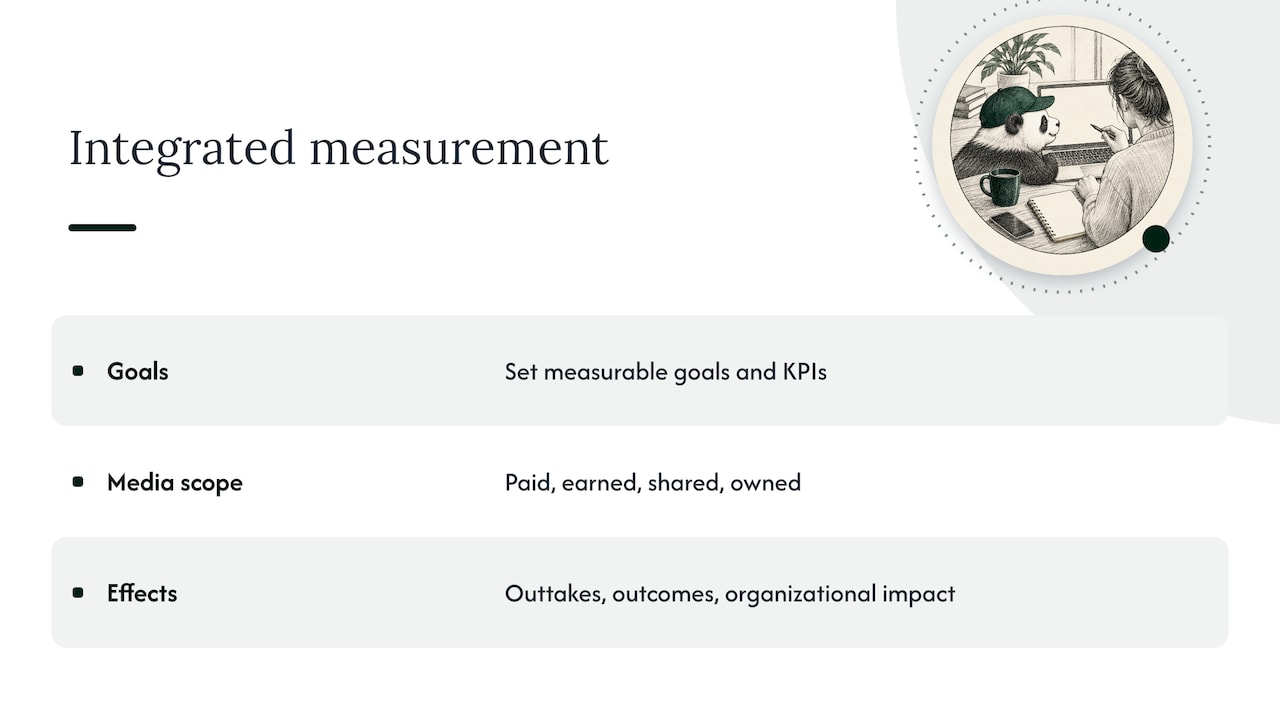
That last point carries weight. AMEC argues that communications must move beyond content analysis to show tangible outcomes if it wants a seat at the top table. For a CMO, that means your report to the CEO should talk about pipeline, share of voice among buyers and revenue influence, not clip counts.
A simple integrated scorecard
Stage | Question | Example measures |
|---|---|---|
Output | Did we deliver the work? | Placements, ad flights, content published |
Outtake | Did the audience notice and understand? | Qualified reach, message recall, brand search lift |
Outcome | Did behavior change? | Demo requests, qualified leads, conversion rate |
Impact | Did the business benefit? | Pipeline value, win rate, customer acquisition cost |
Measure the first row for accountability and the last two for credibility.
Tools and methods that help
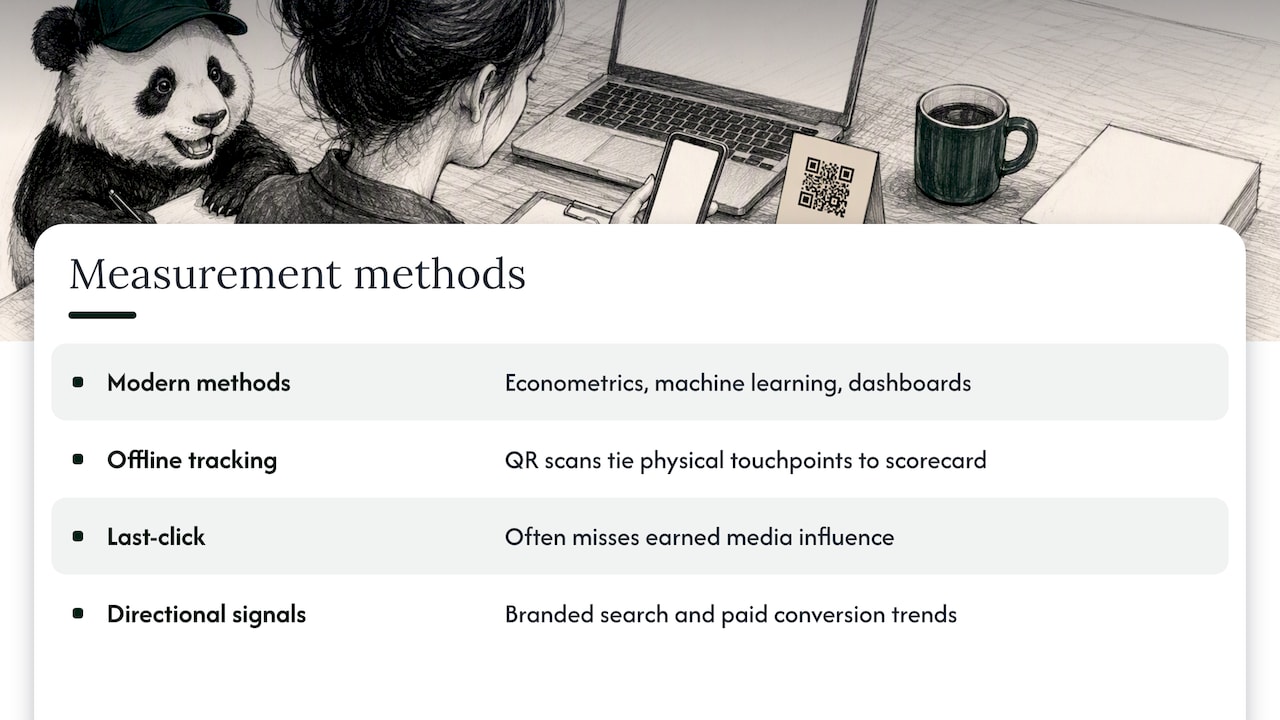
AMEC’s case study on integrated measurement notes that modern approaches increasingly use econometrics, machine learning and centralized dashboards to consolidate data from paid, owned and earned media for real-time optimization. You do not need a data science team to start. A single dashboard that pulls coverage, ad and site data side by side already beats three separate reports.
For offline touchpoints such as events, print and packaging, build tracking in from the start. Tactics like tracking QR code scans let you tie physical moments back to the same scorecard. If you want a statistical view of how each channel contributes to sales, our marketing mix modeling guide explains how to set it up.
One caution on attribution. Earned media is notoriously hard to credit in last-click models, because the buyer who read the article often arrives later through search or direct. Look at trends: did branded search rise during coverage weeks? Did paid conversion rates improve when proof points ran in the creative? Directional evidence, gathered consistently, is more honest than false precision.
Planning integration across markets
A program that works in New York does not simply translate to Shanghai, Stockholm or São Paulo. The structure transfers. The content and the channels do not.
Keep constant:
The commercial objective and the core proof points.
The scorecard, so results compare across markets.
The sequencing logic: validation first, amplification second, conversion third.
Localize:
Validators. The outlets, analysts and creators a local buyer trusts are not the ones your home market trusts.
Platforms. Paid and shared channels differ by market, and in China the creator and social ecosystem works on different mechanics and speeds.
Formats and tone. Multimedia matters in many newsrooms. One PR Newswire report cited by the research found that 32% of journalists in the 2025 State of the Media Report value PR professionals who supply multimedia such as video. Local newsrooms will have their own preferences, so ask.
Compliance. Disclosure rules for sponsored content and creator posts vary by country. Check them before the first flight.
Before committing a full budget, test fit in a small way. Our six-week cross-cultural marketing fit pilot is built for this: one market, a limited set of messages, clear pass or fail criteria. If you are rebuilding the brand itself for a new audience, read our rebranding strategy first so you test backlash before you commit.
For LinkedIn-driven B2B campaigns, which often carry the paid side of a PR program, our LinkedIn ads strategy shows how to size and build audiences so amplified coverage reaches decision-makers.
Common mistakes
Treating coverage as the finish line. A placement is raw material. If nobody sees it or uses it, it did little.
Letting paid run without the story. Ads that ignore what PR is saying create mixed messages. Buyers notice.
Separate agencies, no shared brief. Fine if they share the brief and the scorecard. Costly if they do not.
Reporting activity. AMEC’s guidance is clear that integrated value shows up in outcomes, not counts.
Skipping owned. If the landing page cannot convert the buyer who arrives, amplification just raises your bounce rate.
Our perspective
We see the same pattern in fast-growing companies. They invest in PR to look credible and in paid to grow, then wonder why neither compounds. The problem is rarely budget. It is that nobody engineered the layer of trust that connects them.
Our view is that validation should be designed backwards from the buyer. Decide who must believe you, find the voices they already trust, then use paid to make sure those voices are heard through the noise. That is strategic velocity: fewer handoffs, faster tests, one story.
We also think AI should speed up the work, not flatten it. It is excellent at clustering audiences, drafting variants, summarizing coverage and spotting which proof points carry the most weight. It does not replace the judgment about which story is true, which journalist cares, or which cultural cue will land. Cultural fluency stays human, and that matters most when a brand moves between East and West.
— Kalle
Working with Align
If you want PR, creators and paid media planned as one commercial program, that is what we do. Our team combines Scandinavian brand strategy with the speed of Chinese market execution, and uses AI to accelerate the work while senior people steer it. You can see the full range, from brand and positioning to go-to-market and demand and performance, on our services page. Ready to talk? Book a Strategy Call.
FAQ
How do PR and marketing work together?
They work best when they plan together. According to PRSA, joint planning aligns strategy, messaging and goals so the brand speaks with one voice. PR builds trust and validation, and marketing amplifies that through paid and social channels to drive sales and engagement.
What is the PESO model?
It is a planning model that groups paid, earned, shared and owned media. Paid is bought placement, earned is editorial publicity, shared is social interaction, and owned is what you control. The Media Federation of Australia’s guide says the four should be planned as complements so their sum delivers a greater return.
How do you measure integrated PR and paid results?
Set measurable goals first, then measure across paid, earned, shared and owned media together. AMEC’s framework says to track effects across those dimensions rather than counting isolated activities. Report outcomes and business impact, such as qualified leads and pipeline, instead of clip counts alone.
Should PR and paid sit with the same agency?
It can help, because one team shares one brief, calendar and scorecard. It is not required. What matters is that whoever runs each side works from the same audience, message and KPIs, and meets regularly to adjust.
Sources
PR vs Marketing: Key Differences Every Business Owner Should Know (PRSA)
The MFA Guide, Section 2: Media, The Process (Media Federation of Australia, 2024)
Best Use of Integrated Communication Measurement Insights (AMEC, 2025)
Recommended
RELATED INSIGHTS



LET’S TALK
What are you trying to grow next?
Brand, launch, market entry or performance. Book 30 minutes and tell us what you’re working on.