•

90 Day Talent Partnership Strategy for CMOs, AI Aware and Compliant
Align creator selection, contract rights, and measurement to the same business outcome, and the rest of your talent partnership strategy falls into place. Brands still cite finding the right creators as their biggest hurdle, according to the IAB Creator Ad Spend & Strategy Report 2025. The fix is a 90-day pilot built on audience fit, rights-first contracts, and KPIs tied to commercial results, not vanity reach.
TL;DR:
Prioritize audience fit, rights clarity, and measurable goals before launching creator campaigns to ensure alignment with business outcomes.
Use a structured 90-day pilot with gates for discovery, contracting, production, distribution, and measurement, supported by reusable templates.
Negotiate explicit usage rights, including AI-generated content and likeness rights, with clear scope, windows, territories, and tiered pricing.
Set KPIs such as reach, engagement, and conversion lift before content goes live to accurately track performance and justify spend.
Integrate creator content within broader marketing plans, maintain long-term relationships with top creators, and ensure compliance with disclosure and diversity standards.
AligntccBuild Stronger Creator PartnershipsAlign TCC helps brands combine creator programs, paid media, and market-specific execution across China, Europe, and North America.Explore Align TCC
Table of Contents
A Three-Pillar Framework: Discover, Collaborate, Measure
A 90-Day Playbook: Launch, Test, and Learn
Contract and Usage-Rights Playbook, Including AI and Likeness Clauses
KPIs, Attribution, and Reporting: What to Trust
Scale and Ops: Tooling, Fraud Prevention, and Governance
Defining Strategic Objectives Before You Brief a Single Creator
Integrating Talent Partnerships Into Your Broader Marketing Plan
Managing Long-Term Creator Relationships as They Evolve
Risk Management and Crisis Communication in Talent Partnerships
Diversity and Inclusion in Talent Selection
Author Perspective: Align TCC’s Checklist and Quick Wins
If You Need a Managed Program: How Align TCC Can Help
Authoritative Guidance and Industry Reports to Consult
Sources
FAQ
A Three-Pillar Framework: Discover, Collaborate, Measure
Every durable talent partnership strategy rests on three pillars, and each one maps to a business outcome rather than a marketing task. Discovery decides whether a creator’s audience matches your buyer. Collaboration decides whether the content produced can legally and creatively serve your brand. Measurement decides whether you can defend the spend to your CFO.
The IAB report found that brands rank creator discovery as their top challenge, with audience fit and platform presence driving most selection decisions. That single finding should reorder your priorities: spend more time vetting before you brief, not after.
Discovery filters: audience demographics, engagement quality, platform mix, and prior brand-safety history.
Collaboration terms: a creative brief with clear deliverables, usage windows, and territory scope written before any content is shot.
Measurement set: a fixed KPI list agreed with finance and marketing before the campaign launches, not after results come in.
Treat these three pillars as gates, not phases. A creator who passes discovery but fails a rights conversation should not move forward, and a campaign without an agreed KPI set should not launch at all. This sequencing is what separates a talent partnership strategy from a one-off influencer booking.
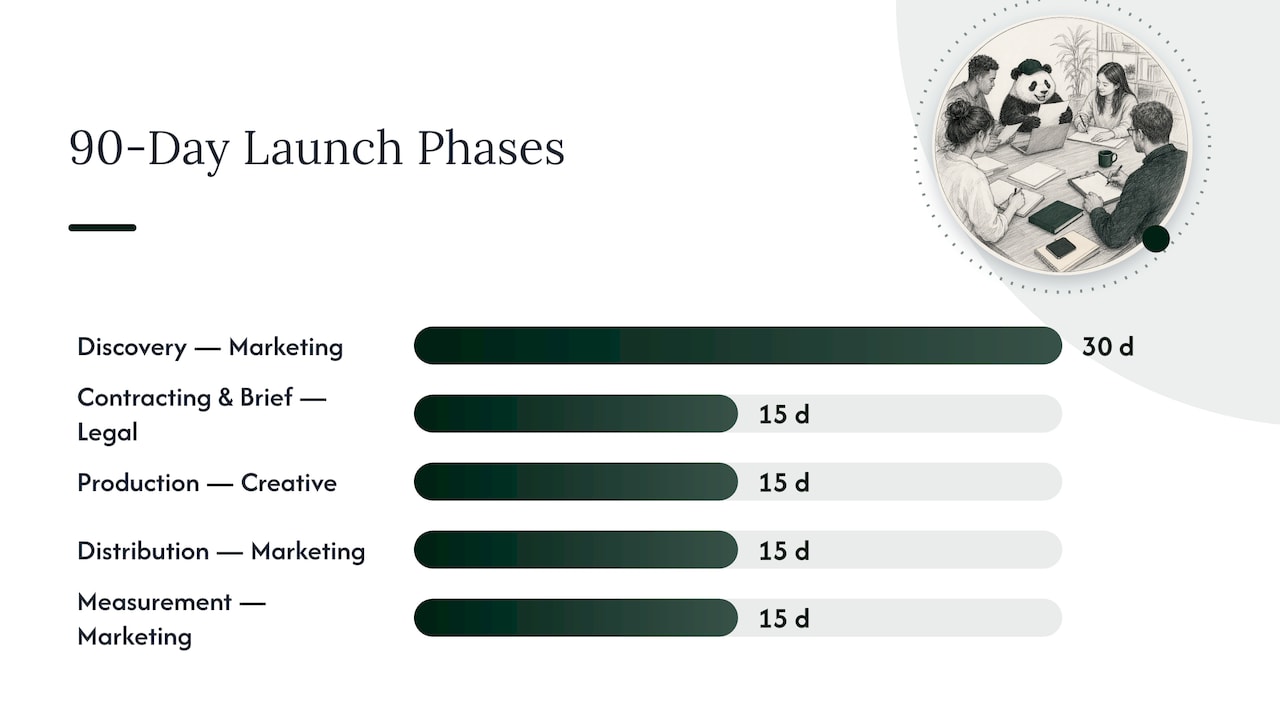
A 90-Day Playbook: Launch, Test, and Learn
A pilot works when it has decision gates, not just a calendar. Here is a sequence enterprise marketing teams can run without adding headcount.
Days 1 to 30, discovery and scorecard: Marketing builds a discovery scorecard covering audience overlap, content quality, and platform presence, then shortlists 8 to 12 creators. Legal reviews a standard contract template in parallel so there is no delay once creators are confirmed.
Days 31 to 45, contracting and briefing: Procurement and legal finalize usage windows, territories, and AI/likeness clauses for each creator. Marketing issues a brief checklist covering deliverables, tone, disclosure requirements, and approval steps.
Days 46 to 60, production: Creators produce content under the agreed brief. A pre-flight compliance checklist confirms disclosure labels, claim substantiation, and rights documentation before anything publishes.
Days 61 to 75, distribution: Content goes live across owned and creator channels. Paid amplification, where used, follows the usage tier negotiated in the contract.
Days 76 to 90, measurement and decision: Marketing and analytics review the agreed KPI set and present a go or no-go recommendation for scaling the program.
Pro Tip: Build the discovery scorecard and brief checklist as reusable templates from day one. Ad-hoc outreach without them is the single biggest cause of pilot delays.
Assign one owner per gate: marketing owns discovery and briefing, legal owns contract language, procurement owns payment terms, and your agency or in-house creative team owns production quality. Nobody should be waiting on an email to know what happens next.
Contract and Usage-Rights Playbook, Including AI and Likeness Clauses
Every talent contract needs the same backbone, no matter the creator’s size or platform. Scope, usage windows, territories, exclusivity terms, and usage tiers all need explicit numbers, not vague language like “ongoing use.”
Scope: exactly what content gets made, in what formats, and how many pieces.
Usage windows: a defined start and end date for how long the brand can run the content, paid or organic.
Territories: which countries or regions the content can run in, since a creator’s home market rights rarely cover global use.
Exclusivity: whether the creator is barred from competitor work during or after the campaign.
Usage tiers: separate pricing for organic posting, paid amplification, and whitelisting.
AI-generated content and likeness or training rights deserve their own clause, entirely separate from standard usage rights. Expert guidance on this is direct: AI-generated content and likeness training rights are a different asset class and should never be bundled into a broad “all-media” license. A creator’s voice or face used to train a model, or synthetic content generated in their likeness, is not the same right as a photo used in a paid ad, and treating them as equivalent invites disputes later.
Negotiation levers that work well here include staged buyouts (pay more as usage windows extend), pay-for-usage tiers tied to actual amplification spend, and clearly priced extensions rather than automatic renewals.
KPIs, Attribution, and Reporting: What to Trust
A talent partnership strategy without agreed KPIs is a guess dressed up as a campaign. Set the metrics before content goes live, not after.
Reach and impressions: baseline awareness, useful but never the whole story.
Quality engagement: saves, shares, and comments that signal genuine interest rather than passive scrolling.
Assisted conversions: how creator content contributes to a purchase path that includes other touchpoints.
Conversion lift: incremental conversions attributable to the partnership versus a holdout period or audience.
CAC impact: customer acquisition cost shifts where enough volume exists to measure it reliably.
A large majority of creator ad spend now comes from social media budgets, per the IAB Creator Ad Spend & Strategy Report 2025, which means most attribution data lives inside platform walled gardens rather than in a brand’s own analytics stack. That fragmentation is real: platform silos make single-touch attribution unreliable, and the IAB’s own recommendation is to invest in more advanced, assisted-attribution approaches rather than trust last-click numbers alone.
Before launch, agree on UTM naming standards across every creator link, confirm a Conversion API integration where paid platforms support it, and negotiate a data exchange arrangement with creators or their management so performance numbers are not locked inside a single dashboard.
Scale and Ops: Tooling, Fraud Prevention, and Governance
Moving from pilot to program means building repeatable infrastructure, not repeating manual work at a bigger size.
Discovery platforms: tools that filter by audience overlap and engagement quality, reducing reliance on manual outreach.
Contract management systems: centralized storage for usage windows, territories, and rights tiers so nothing expires unnoticed.
Rights libraries: a searchable record of what content each brand can use, where, and until when.
Content ops automation: scheduling and approval workflows that keep disclosure labeling consistent across every post.
Governance matters as much as tooling. EASA’s Best Practice Recommendation on Influencer Marketing recommends that disclosures appear instantly and that self-regulatory organizations train and certify creators where possible, a practical way to reduce brand risk at scale. Run periodic creator audits to catch drift in tone, audience, or compliance behavior.
On budgeting, the IAB report notes that flat fees still dominate creator payment structures, with performance pay and retainers used less often because budgets are often split across teams. Choose flat fees for predictable one-off content, retainers for ongoing relationships, and performance tiers when you can measure conversion lift reliably.
Defining Strategic Objectives Before You Brief a Single Creator
A talent partnership strategy only works when it starts from a business goal, not a content idea. Before any creative brief goes out, marketing leaders need a clear answer to what the partnership is meant to move: awareness in a new market, consideration for a specific product line, or direct conversion for a launch window.
That objective should trace back to a company-level goal, whether that is market share growth, a product launch, or expansion into a new region. A creator campaign aimed at brand awareness needs a different discovery filter, contract structure, and KPI set than one aimed at driving signups, and conflating the two is a common reason pilots produce content that looks good but does not move the number leadership actually cares about.
Write the objective down in a single sentence before the discovery scorecard is built. If the objective cannot be stated in one sentence with a measurable outcome attached, the brief is not ready. This discipline is what keeps a talent partnership strategy from drifting into content for its own sake, and it is the difference between a campaign that generates impressions and one that shows up in a quarterly business review.
Integrating Talent Partnerships Into Your Broader Marketing Plan
Creator content works best when it is not an island. A talent partnership strategy should slot into the same planning cycle as paid media, organic content, and product marketing, sharing calendars, messaging pillars, and launch windows rather than running on a separate track.
That means creator content should echo the same core message your paid social, search, and owned channels are carrying that quarter, adapted to each creator’s voice rather than copied verbatim. It also means creator assets, once rights allow it, can be repurposed into paid ads, website content, or sales enablement material, extending the value of a single production cycle well beyond the original post.
Coordination also prevents collisions: a creator campaign launching the same week as a major paid push can either amplify each other or compete for attention, and the difference usually comes down to whether the same team saw both calendars. Building the creator content plan inside the existing marketing calendar, rather than bolting it on separately, is the simplest way to make integration real rather than aspirational.
Managing Long-Term Creator Relationships as They Evolve
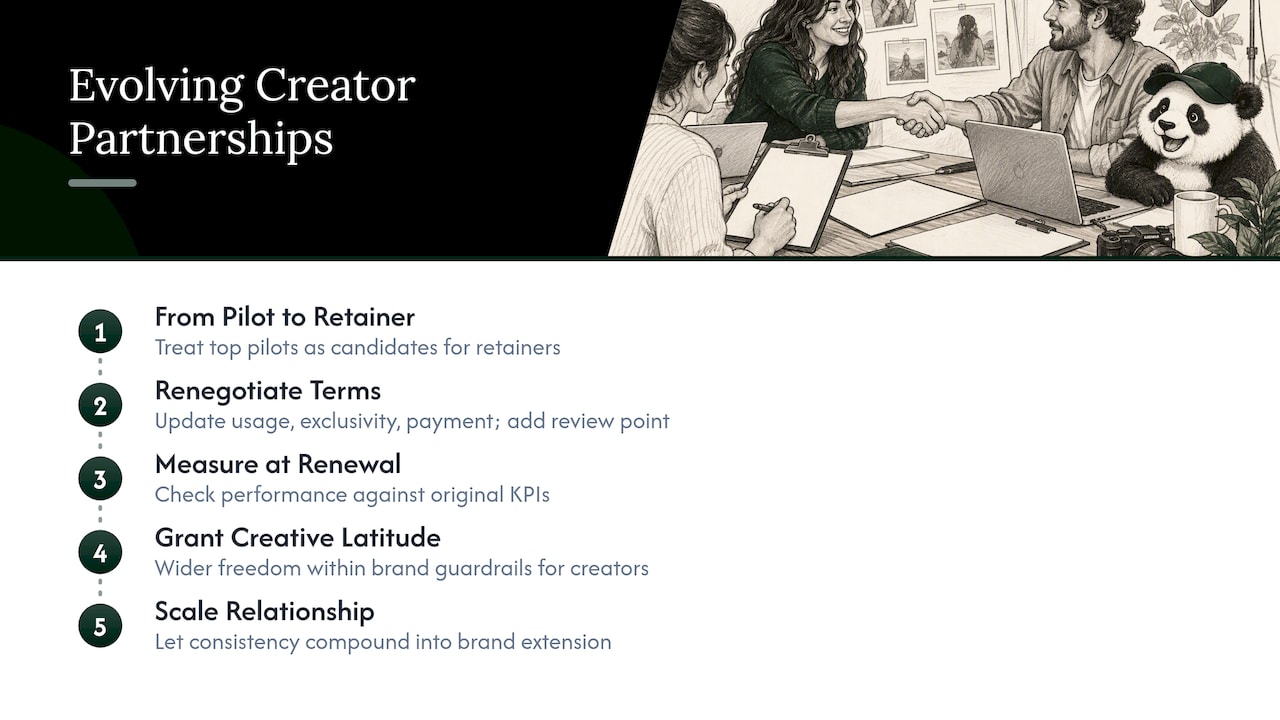
A single campaign proves a creator can deliver content. A long-term relationship proves they can deliver a brand’s voice consistently, and that consistency compounds. Treat your best-performing pilot creators as candidates for retainers rather than one-off bookings, since repeat collaborations tend to produce more authentic content as creators internalize brand tone and audience expectations.
Long-term relationships also change the negotiation. Usage rights, exclusivity terms, and payment structures that made sense for a single campaign often need renegotiation as the relationship scales, particularly around exclusivity against competitors and extended usage windows for evergreen content. Build a review point into every renewal, checking performance against the original KPI set rather than assuming past results guarantee future ones.
As a partnership matures, give creators more creative latitude within brand guardrails rather than tighter scripts. Creators who understand the brand well enough to improvise within guidelines usually outperform those following rigid talking points, and that latitude is often what separates a functional partnership from one that becomes a genuine extension of the brand’s voice.
Risk Management and Crisis Communication in Talent Partnerships
Every talent partnership carries reputational exposure, and planning for it before a problem happens is far cheaper than reacting after one. Regulatory scrutiny is real: the Federal Register’s 2023 update on endorser definitions expanded what counts as an endorser to include virtual or fabricated ones, and specifically warned that fake followers or fabricated endorsers can constitute deceptive practices.
A pre-flight compliance checklist, run before any content publishes, should confirm disclosure labeling, claim accuracy, and audience authenticity for every creator involved. When something does go wrong, whether a creator makes an unsubstantiated claim or faces unrelated controversy, having a pre-agreed response protocol matters more than having a perfect one. Decide in advance who has authority to pause a campaign, who drafts a public response, and what the threshold is for ending a relationship versus riding out a minor issue.
Build audience verification into your discovery process from the start rather than treating it as a crisis response. Catching inflated or fake followings during vetting is far less costly than discovering them after a campaign has run and a regulator or journalist asks questions.
Diversity and Inclusion in Talent Selection
A talent partnership strategy that only ever selects creators from the same narrow demographic misses large parts of its own addressable audience. Building genuine reach means actively including creators across different backgrounds, body types, abilities, and cultural contexts, not as a checkbox exercise but because audiences respond more to creators who reflect the range of people who actually buy the product.
This starts at the discovery stage: a scorecard that only screens for follower count and engagement rate will systematically favor certain creator profiles over others. Add audience representation and content authenticity as explicit criteria alongside reach and engagement metrics, and review shortlists specifically for diversity gaps before briefs go out.
Inclusion also extends to how creators are treated contractually. Payment terms, usage rights, and creative input should be consistent across creators regardless of background or platform size, and any disparity in how deals are structured is worth auditing as your program scales.
Author Perspective: Align TCC’s Checklist and Quick Wins
The partnerships that hold up under scrutiny share four traits: audience fit that survives a real vetting process, rights-first contracts that separate AI and likeness terms from standard usage, production that treats compliance as part of the brief rather than an afterthought, and KPIs agreed before launch. One pilot we have seen run this way moved from ad-hoc creator outreach to a scorecard-driven shortlist and saw its content approval cycle shrink by roughly a third, simply because legal and marketing were no longer negotiating terms after the shoot had already happened.
— Kalle
If You Need a Managed Program: How Align TCC Can Help
Running a compliance-first talent partnership strategy in-house takes coordination across legal, procurement, and creative that most marketing teams are not staffed for. An influencer and creator marketing service can handle discovery, rights-first contracting, and AI-aware production as a single workflow, supported by brand and positioning work that keeps creator content aligned to a broader narrative.

Influencer & Creator Marketing: discovery, vetting, and contract negotiation built around your commercial goals.
Brand & Positioning: ensures creator content reflects the same story your other channels are telling.
Go-to-Market & Market Entry: useful when a talent partnership is part of entering a new region or launching a product.
Most engagements start as a focused pilot and scale into an ongoing program once results are proven. Review the full services page or reach out to discuss what a pilot could look like for your team.
Authoritative Guidance and Industry Reports to Consult
For discovery and spend trends, consult the IAB Creator Ad Spend & Strategy Report 2025. For disclosure rules, see Gov and the ASA’s clear-labeling guidance. For rights language, review guidance on creator whitelisting practices and disclosure formatting examples.
Sources
FAQ
What is the most important part of a talent partnership strategy?
Aligning creator selection, contract rights, and measurement to a single business outcome matters most, since a creator with the right audience but ambiguous usage rights or no agreed KPIs still produces an unmeasurable campaign. Discovery, contracting, and measurement should be treated as linked decisions, not separate tasks.
How do AI and likeness rights differ from standard usage rights?
AI-generated content and likeness or training rights are a distinct license category and should never be bundled into a broad “all-media” usage clause, according to expert contracting guidance. Brands should negotiate and price these rights separately from ordinary content usage.
What KPIs should brands track in a talent partnership?
Reach, quality engagement, assisted conversions, and conversion lift form a reliable core KPI set, with customer acquisition cost impact added where volume allows. Attribution should account for platform silos, since a large share of creator spend and data now sits inside individual platforms rather than a brand’s own analytics.
How long should a talent partnership pilot run before scaling?
A 90-day pilot, split into discovery, contracting and production, and distribution and measurement phases, gives enough time to test a discovery scorecard and rights-first contract template against real results. Scaling decisions should follow a review of the agreed KPI set rather than a fixed calendar date.
Do brands need to disclose creator partnerships even for organic content?
Yes, disclosure requirements apply to incentivized content generally, not only paid advertising, and labels need to be prominent and immediately clear to the audience according to GOV.UK guidance. EASA’s recommendations add that disclosure should appear instantly and match the format of the platform being used.
Recommended
RELATED INSIGHTS



LET’S TALK
What are you trying to grow next?
Brand, launch, market entry or performance. Book 30 minutes and tell us what you’re working on.