Growth / Performance
Kalle Mobeck
•

Marketing Mix Modeling: A Practical Guide for 2026
Marketing mix modeling is a statistical method that measures how each marketing input, from paid media to pricing to distribution, drives sales, using aggregate historical data instead of individual user tracking. Its core outputs are decomposition, ROI curves, and response curves that show where budget is working and where it is wasted. Because it does not depend on cookies or device-level tracking, MMM has become the most durable way to defend budget decisions in a privacy-constrained advertising world.
TL;DR:
Decomposition separates base and incremental sales, enabling precise identification of which channels drove actual growth.
Response curves highlight diminishing returns, guiding marketers to scale, test, or shift budgets based on saturation levels.
Reliable models require at least 2 to 5 years of weekly data, careful calendar alignment, event flags, and outlier management during preprocessing.
Bayesian methods provide explicit uncertainty ranges, helping decision-makers assess confidence before reallocating budgets.
Combining MMM with experiments and attribution improves accuracy, especially for granular, real-time, or highly confounded measurement needs.
Table of Contents
What Does Marketing Mix Modeling Actually Tell You?
How Does a Marketing Mix Model Actually Work?
What Data Do You Need and How Long Does It Take?
Where Does Marketing Mix Modeling Fall Short?
How Do You Choose Between In-House, Vendor, or Hybrid MMM?
How Do You Turn MMM Outputs into Real Budget Decisions?
How Align Applies MMM Thinking in Practice
What Decisions Does MMM Actually Inform?
MMM vs. Attribution vs. Econometric Modeling: What’s the Difference?
How Do You Implement an MMM Program From Scratch?
Why Is MMM Data So Hard to Prepare?
What Are the Ethical Concerns With Using Sales and Customer Data in MMM?
Where Is MMM Headed, and What Should Leaders Prioritize?
Get Help Turning MMM Into a Working Measurement Program
Sources
What Does Marketing Mix Modeling Actually Tell You?
MMM’s job is to answer one question with numbers: how much of your sales would have happened anyway, and how much did your marketing actually cause? Everything else, the response curves, the reallocation scenarios, the ROI rankings, flows from that single split.
The first output you will see from any MMM engagement is decomposition. This breaks total sales into base sales (what would happen with zero marketing, driven by brand equity, seasonality, and distribution) and incremental sales (the lift attributable to specific channels, promotions, or pricing moves). A typical decomposition breaks total sales into base and incremental components, then further divides the incremental sales channel by channel. This is the foundation for every other output, because MMM quantifies the incremental and base components of sales, allowing you to see exactly which drivers moved the needle in a given period.
From decomposition, you get to ROI and marginal incremental ROAS (miROAS). Standard ROI tells you the average return across all spend in a channel. miROAS tells you something more useful: what happens if you spend one more dollar right now. A channel can carry a strong average ROI while its marginal return has already collapsed, which is the single most common reason marketers over-invest in a channel that looks great on a dashboard but is actually saturated.
That saturation shows up visually in response curves. Every channel has a point of diminishing returns, and the curve’s shape tells you where that point sits. Early on the curve, additional spend produces near-linear lift. Past the inflection point, each incremental dollar returns less and less until the curve flattens almost completely.
Steep, unsaturated curve: room to grow spend with strong marginal returns.
Curved, mid-range position: still efficient, but reallocation should be tested before scaling further.
Flat, saturated curve: additional spend mostly wastes budget; consider shifting dollars elsewhere.
Threshold effects: some channels show almost no lift below a minimum spend level, meaning small budgets get diluted.
Statistic Callout: MMM-mature organizations that invest in data quality and internal modeling capability are nearly three times more likely to integrate MMM into everyday decision-making than teams that treat it as a one-off study.
The last practical output is scenario forecasting. Once you have curves and elasticities for each channel, you can simulate “what if” budget moves before you spend a dollar. What is the revenue impact of cutting a channel entirely for a quarter? This is where MMM stops being a report card and starts functioning as a planning tool, letting budget owners stress-test decisions against modeled elasticities instead of gut instinct.
How Does a Marketing Mix Model Actually Work?
Underneath the outputs sits a set of statistical mechanics that determine whether a model’s conclusions are trustworthy or just confident-sounding noise. Understanding these components matters even if you never build a model yourself, because they are exactly what you should be questioning when a vendor or an internal team hands you results.
1. Adstock and carryover. Advertising rarely produces its full effect the moment it runs. A television spot or a display impression can influence a purchase decision two, four, even eight weeks later. Adstock modeling captures this decay mathematically, applying a carryover rate that spreads a channel’s impact across future periods instead of crediting it all to the week it aired. Get the decay rate wrong and you will misattribute sales that actually belonged to last month’s campaign to this month’s baseline, or vice versa.
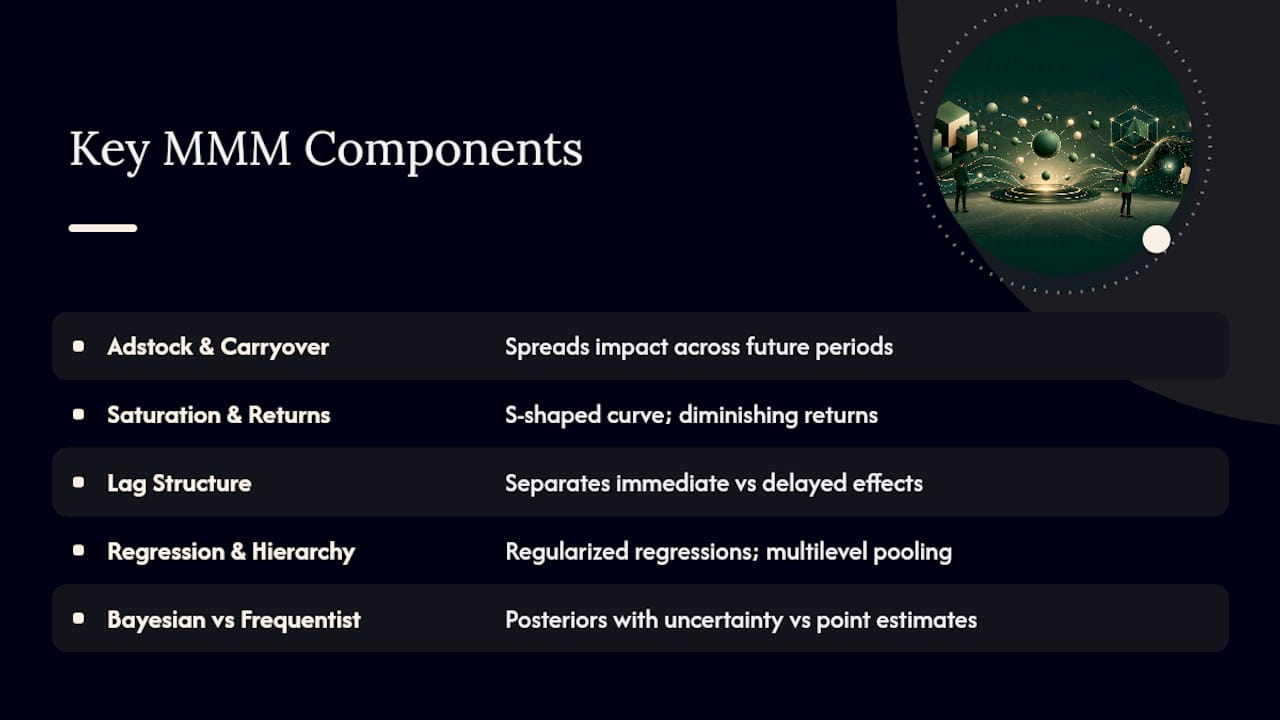
2. Saturation and diminishing returns. As covered in response curves, most channels follow an S-shaped or concave saturation function. Models typically use forms like the Hill function or a negative exponential curve to represent this mathematically, with parameters controlling both the inflection point and the steepness of the curve. Interpreting these parameters correctly is what separates a model that tells you “you’re already saturated in paid social” from one that just spits out a number nobody can explain.
3. Lag structure. Some effects are immediate; others are delayed. B2B categories in particular often show sales effects that lag brand investment by a full quarter or more. A model with a flexible lag structure can separate immediate-response channels (search, promotions) from slow-burn channels (brand campaigns, sponsorships) instead of forcing all of them into the same time window.
4. Regression families and hierarchical structures. Most MMMs are built on some form of regularized regression, ridge or Bayesian regression are common choices, because marketing spend across channels is often correlated, which creates instability in a plain ordinary least squares model. Hierarchical (multilevel) structures let you pool information across markets, brands, or product lines, so a smaller market with thin data can borrow strength from a larger one without pretending they behave identically.
5. Bayesian versus frequentist estimation. This is the single biggest methodological divide in modern MMM, and it is worth understanding on its own.
Frequentist models give you a point estimate: “paid social drove $2.1 million in incremental sales.” Bayesian models give you a full posterior distribution instead, so you get a range with explicit uncertainty, such as “we are 90% confident the true value sits between $1.7 million and $2.6 million.” Bayesian MMM’s posterior distributions and explicit uncertainty quantification let teams see exactly how confident a recommendation really is before betting a quarter’s budget on it.
Bayesian methods also let you incorporate priors, existing knowledge about a channel’s plausible effectiveness range, which matters enormously when your historical data is thin for a newer channel. Open source frameworks like PyMC-Marketing and Meta’s Robyn have made this approach far more accessible than it was even five years ago, giving analysts community-tested code instead of a black box.
Pro Tip: Ask any vendor to show you the model’s uncertainty intervals, not just the point estimate. A model that reports “$4.2 million in incremental revenue” with no confidence range is hiding information you need before reallocating real budget.
What Data Do You Need and How Long Does It Take?
Before any model gets built, you need to answer a less glamorous question: does your data actually support this? Most MMM projects stall not because the statistics are hard, but because the inputs are messier than anyone expected.
Core inputs required:
Sales or revenue time series, ideally at weekly granularity.
Spend by channel, broken out consistently across the full history.
Pricing and promotional calendars, including discount depth and duration.
Distribution and availability data, especially for retail and CPG categories.
External covariates: seasonality, weather where relevant, competitor activity, and macroeconomic indicators.
Weekly granularity has become the default because it balances enough data points against noise. Daily data is often too spiky and full of operational quirks (weekend effects, shipping delays) to model cleanly, while monthly data smooths away too much of the variation you actually need to isolate channel effects. On history length, practitioners generally recommend 2 to 5 years of weekly data so the model can separate short-term activation spikes from slower brand-building effects that only show up over multiple seasonal cycles.
Getting that data model-ready is where most of the real work happens. Calendars need aligning across finance, media, and sales systems that rarely use the same fiscal week definitions. Outliers from stockouts, price errors, or one-off events need flagging rather than left to distort the model. Holidays and major promotions need explicit event flags so the model does not confuse a Black Friday spike with organic channel lift. In practice, this preprocessing work commonly consumes the majority of an MMM project’s total timeline, far more than the actual model fitting.
Missing weeks in spend history, especially for newer or discontinued channels.
Mismatched reporting cadences between media platforms and finance systems.
Currency or regional inconsistencies for multi-market brands.
Double-counted spend when agencies report at different levels of granularity than internal finance.
On timelines, expect a focused single-market build to take roughly 8 to 12 weeks from data delivery to a validated model, assuming the inputs above are already reasonably clean. Enterprise programs spanning multiple markets, brands, or business units run considerably longer for the initial build, but the more important number is refresh cadence. A model that only gets updated once a year is stale within a quarter. Leading programs now favor continuous or monthly refresh cycles over static annual reports, which is the difference between MMM as an audit and MMM as a planning tool.
Where Does Marketing Mix Modeling Fall Short?
No measurement method is complete on its own, and MMM has real blind spots that deserve honest treatment rather than vendor spin.
1. Granularity limits. MMM works at an aggregate level, typically channel by market by week. It cannot tell you which specific ad creative, audience segment, or placement drove results within a channel. If you need to know whether Video A outperformed Video B on the same platform in the same week, MMM is the wrong tool.
2. Real-time optimization gaps. Because MMM depends on weeks or months of accumulated data, it cannot tell you today whether yesterday’s campaign is working. It is built for strategic, quarter-over-quarter decisions, not for the minute-by-minute bid adjustments that platform algorithms handle.
3. Confounding events. Price changes, competitor promotions, distribution shifts, and macro shocks can all move sales at the same time your media is running. A well-specified model accounts for these as covariates, but a rushed or poorly scoped one will misattribute their effect to whatever media happened to run that week, inflating or deflating channel ROI in ways that look plausible but are wrong.
4. Long B2B cycles. In categories where the path from first touch to closed deal spans months, MMM’s weekly cadence can struggle to connect cause and effect cleanly, since the lag between spend and revenue recognition stretches well beyond what typical lag structures assume.
The fix for all four limits is the same: pair MMM with methods built for granularity and speed. This is why MMM should be combined with incrementality testing and attribution, using each method for what it does best rather than asking one model to do everything.
Geo holdout tests withhold spend in a matched set of markets and compare sales lift against a control region, giving you a clean causal read on a specific channel’s true incrementality.
A/B and PSA (public service announcement) tests on digital platforms measure the lift from exposure versus non-exposure at a granular, near real-time level.
Multi-touch attribution fills the in-flight, campaign-level gap, showing which touchpoints preceded a conversion, even though it cannot establish causation the way an experiment can.
The practical workflow: let MMM set the strategic allocation across channels and markets each quarter, let experiments validate the specific, high-stakes reallocation decisions before you commit real budget, and let attribution inform in-flight, tactical adjustments within a live campaign. Unified measurement programs that triangulate all three consistently outperform any single method used alone.
How Do You Choose Between In-House, Vendor, or Hybrid MMM?
The build-versus-buy decision comes down to four evaluation criteria, and most organizations get the weighting wrong by prioritizing speed or price over the two that actually matter long term: transparency and integration.
Transparency and auditability should top your list. Analysts advise prioritizing transparent models over black-box solutions, because a growing wave of simplified MMM software has made it easy to generate a polished dashboard without showing the assumptions underneath. If a vendor cannot explain their priors, their adstock decay assumptions, or how they validated the model against a holdout period, you are buying a black box with a nice interface.
Refresh speed is next. Ask how long it takes from new data arriving to updated outputs reaching your dashboard. A vendor promising quarterly refreshes only is offering yesterday’s approach to today’s problem.
Data integration determines whether the model will actually get used. If pulling fresh spend and sales data into the model requires a manual export-import cycle every time, the model will quietly stop getting refreshed within two quarters, regardless of how good the initial build was.
Pricing transparency rounds out the list. Understand whether you are paying for a one-time build, a subscription with ongoing refreshes, or a hybrid, and whether scenario planning and custom queries cost extra.
Build in-house when:
You have a mature first-party data warehouse with clean, weekly-granular history across channels.
You already employ analysts with regression or Bayesian statistics experience.
Your business has a small number of markets or brands, keeping model complexity manageable.
Buy or partner when:
Data lives across disconnected systems and needs significant integration work.
You need multi-market or multi-brand hierarchical modeling and don’t have that specialized capability internally.
Speed to a validated first model matters more than owning the codebase.
Governance matters as much as the technical build. Decide up front who owns model refresh cadence, who signs off on reallocation recommendations, and how finance, media, and brand teams get looped into interpreting outputs. A model nobody trusts because no cross-functional stakeholder was involved in its validation is a wasted investment, no matter how sound the statistics.
Pro Tip: Before signing with any vendor, ask them to walk you through a holdout validation on your own historical data. If they can’t show you how the model performed against data it never saw during training, don’t trust the ROI numbers it produces.
How Do You Turn MMM Outputs into Real Budget Decisions?
A model that produces excellent outputs nobody acts on is not a marketing mix model. It is an expensive PDF. The gap between insight and action is almost always operational, not statistical.
Operating rhythm is the first decision. Static, once-a-year MMM reports get treated like an audit: interesting, but disconnected from the budget cycle that actually needs the information. Organizations that adopt a continuous-refresh operating model with automated data pipelines shift MMM from a static report into a living planning tool that budget owners check the way they’d check a sales dashboard.
Statistic Callout: Teams that treat MMM as an ongoing operating rhythm, rather than a periodic study, are the ones most likely to fold its outputs into actual decision-making, a finding that shows up consistently across mature measurement programs.
Three deliverables separate an MMM that drives decisions from one that sits in a slide deck:
Scenario playbooks that pre-model common budget moves (a 10% cut, a 20% shift toward a new channel) so decision-makers can pull an answer in minutes, not weeks.
Reallocation runbooks that translate model output into specific, approved actions, who moves what budget, by when, and under what sign-off.
Cross-functional dashboards that put decomposition, ROI, and response curves in front of media buyers, finance, and brand leads in a shared view, rather than trapped in an analyst’s notebook.
Training matters more than most programs budget for. A media buyer who does not understand what a saturation curve means will keep pushing spend into a channel the model has already flagged as flat. Define clear roles: who owns model interpretation, who owns the recommendation, and who owns the final budget call, because those are often three different people.
Finally, tie every model output back to the metrics budget owners are already measured on. A decomposition chart is interesting; a decomposition chart that maps directly to this quarter’s revenue target and next quarter’s media plan is what actually changes behavior in a budget meeting.
How Align Applies MMM Thinking in Practice
Aligntcc brings senior specialists together around each measurement challenge instead of routing it through a fixed department, which matters because MMM sits at the intersection of media, brand, and finance, exactly the kind of cross-disciplinary problem a traditional agency structure struggles to serve well.
Our AI-enhanced workflows speed up the unglamorous parts of measurement, data cleaning, calendar alignment, scenario generation, so analysts spend their time on interpretation rather than spreadsheet triage. When a client is entering a new market, MMM-style thinking shapes the plan before the first dollar spends: which channels are likely to saturate quickly in an unfamiliar market, and where does brand-building carry longer lag effects that a launch budget needs to account for.

We support clients through model co-design and validation, working alongside internal analytics teams rather than replacing them, then help embed the outputs into actual planning cycles and budget conversations. That’s the gap most measurement projects fail to close. Aligntcc’s approach treats measurement as connected to strategy from day one, not bolted on after the campaign is already live.
What Decisions Does MMM Actually Inform?
Is our promotional cadence cannibalizing full-price sales, or genuinely growing the category?
MMM also informs market entry sequencing. When a brand launches in a new country or region, historical MMM data from comparable markets can suggest which channel mix tends to activate fastest versus which builds slower, longer-term equity, informing how launch budget gets split between immediate demand generation and brand investment.
Pricing and promotion strategy is another major use case. Because MMM decomposes the sales impact of discounting alongside media, it can reveal whether a recurring promotion is genuinely incremental or simply pulling forward sales that would have happened anyway at full price.
Annual and quarterly budget planning cycles increasingly use MMM scenario outputs as the starting point for negotiation between marketing, finance, and channel owners, replacing the old approach of allocating budget based on last year’s spend plus a flat percentage increase. And for brands managing multiple product lines or regions, MMM helps identify which markets or categories are under-invested relative to their response curve, redirecting budget toward the highest marginal return rather than the loudest internal advocate.
MMM vs. Attribution vs. Econometric Modeling: What’s the Difference?
These three terms get used almost interchangeably in marketing meetings, and that confusion causes real strategic mistakes. Each measures something genuinely different.
Multi-touch attribution (MTA) tracks individual user journeys across touchpoints, assigning fractional credit to each interaction before a conversion. It offers granularity MMM cannot match, down to the individual campaign or creative, but it depends on tracking data that has grown less reliable as cookies deprecate and privacy regulation tightens. MTA also struggles with offline and brand-building channels that never generate a trackable click.
Econometric modeling is, in the strictest sense, the broader statistical family that MMM belongs to. Where people usually mean something narrower by “econometric models” in a marketing context, they are often referring to models that incorporate macroeconomic variables (interest rates, consumer confidence, unemployment) alongside marketing inputs, useful for categories highly sensitive to economic cycles, such as durable goods or financial services.
MMM sits between these two, aggregate rather than individual-level, causal rather than correlational, and durable regardless of tracking technology changes. Its weakness is exactly MTA’s strength: it cannot tell you which specific ad within a campaign performed best.
The practical answer is not to pick one. Use MMM to set strategic, cross-channel budget allocation each quarter. Use attribution to optimize within a live, digitally trackable campaign. Bring in macro-aware econometric variables when your category is genuinely sensitive to broader economic conditions. Treating these as competing methods rather than complementary layers is the most common strategic error marketing leaders make with measurement.
How Do You Implement an MMM Program From Scratch?
Rolling out MMM successfully depends more on organizational sequencing than statistical sophistication. Skip a step below and even a technically sound model will sit unused.
Step one: secure executive sponsorship and define decision rights. Identify who will actually act on model outputs, ideally a budget owner with real authority, before you build anything. A model with no designated decision-maker becomes an academic exercise.
Step two: audit and consolidate data sources. Pull spend, sales, pricing, and promotional data into a single accessible source ahead of any model build, and be honest about gaps now rather than discovering them mid-project.
Step three: select a modeling approach and build the first version. Decide between in-house, vendor, or hybrid based on the evaluation criteria in this guide, then build a scoped first model, ideally on a single market or business unit, before scaling.
Step four: validate against holdouts and known events. Before trusting any output, check the model against a period it never saw during training, and confirm it correctly identifies known events like a major price change or a documented stockout.
Step five: integrate outputs into existing planning cycles. Connect model dashboards to the systems finance and media teams already use, and build the scenario playbooks and runbooks that translate output into action, as covered earlier in this guide.
Step six: establish refresh cadence and ownership. Assign a named owner for ongoing model maintenance, not just the initial build, since a model that never refreshes decays into irrelevance within two or three quarters.
Cross-functional buy-in from finance, media, and brand teams at each step, not just at launch, determines whether the finished model actually changes how budget gets allocated.
Why Is MMM Data So Hard to Prepare?
Data preprocessing is the part of MMM that consumes the most time and causes the most project delays, and it deserves specific attention beyond the general data requirements covered earlier.
Calendar misalignment is the most common early obstacle. Finance often reports on a 4-4-5 fiscal calendar, media platforms report on standard weeks, and promotional calendars might track by campaign period rather than by week at all. Reconciling these into one consistent weekly grid is tedious, essential work that has to happen before any model can run.

Spend attribution across overlapping campaigns creates a second layer of difficulty. When a single campaign spans multiple channels and reporting systems, double-counting or under-counting spend is common unless someone builds explicit reconciliation logic between platform-reported numbers and finance’s actual invoiced spend.
Missing or sparse history for newer channels is a near-universal problem. A channel launched eighteen months ago simply does not have the multi-year history a model prefers, which is where Bayesian priors genuinely earn their keep, letting the model borrow reasonable assumptions from comparable channels rather than treating the sparse data as if it were the whole truth.
Outlier and event handling requires judgment calls that shape results significantly. A single stockout week, a viral moment unrelated to paid media, or a one-off PR crisis can distort a model if left unflagged, but over-flagging events risks stripping out real, if unusual, marketing effects.
None of this is exciting work, but skipping it is the single most common reason an MMM project produces results nobody trusts.
What Are the Ethical Concerns With Using Sales and Customer Data in MMM?
MMM’s aggregate, non-individual-level approach is often framed as inherently more privacy-friendly than user-tracking methods, and largely it is. But that framing can create a false sense that no ethical scrutiny is needed, which is not accurate.
The data feeding an MMM, sales transactions, loyalty program activity, regional demographic covariates, still originates from real customer behavior, even when aggregated. Organizations should be clear internally about data provenance: where sales data originates, whether any customer-level data gets aggregated up into the model, and whether that aggregation genuinely removes identifiability or just obscures it superficially.
Transparency with stakeholders matters here too, not just with customers. When a model’s recommendations affect budget decisions that touch jobs, markets, or entire product lines, the people affected by those decisions deserve to understand the model’s assumptions and limitations, not just its headline conclusions. This is another reason the earlier emphasis on model transparency and auditability is not just a technical nicety. A black-box model making high-stakes allocation recommendations, without anyone able to explain why, raises accountability concerns that go beyond statistics.
Finally, be cautious about using MMM outputs to justify decisions the data does not actually support. A model with wide uncertainty intervals that gets presented internally as a confident, precise recommendation misrepresents what the statistics actually show, which is a subtler but real form of misusing data.
Where Is MMM Headed, and What Should Leaders Prioritize?
The next few years of MMM will reward discipline over novelty. Every vendor is racing to ship faster automation and slicker dashboards, but the organizations getting real value are the ones asking harder questions about what sits underneath the interface.
Transparency and governance should be the priority, not feature checklists. A model you cannot audit is a model you cannot defend when a CFO asks why budget moved. Continuous validation matters more than a one-time build; markets shift, and a model frozen at last year’s data will quietly mislead you.
Data hygiene beats chasing the newest algorithm every time. I have seen more measurement programs fail from messy calendars and unflagged outliers than from an outdated regression technique. Get the operational plumbing right before worrying about which Bayesian package looks more impressive in a vendor pitch.
Use MMM for what it does best: setting strategic direction across quarters. Use experiments for what they do best: validating the specific, expensive bets before you make them. Leaders who blur that distinction end up either over-trusting a model’s precision or ignoring it entirely. Neither serves the budget.
— Kalle
Get Help Turning MMM Into a Working Measurement Program
Building a model is the easy part. Getting a media buyer, a CFO, and a brand lead to actually change behavior based on its output is where most MMM programs quietly stall, and that is the gap Aligntcc closes. Rather than handing you a dashboard and disappearing, Aligntcc’s senior specialists work alongside your team to co-design the model, validate it against your own historical data, and build the reallocation runbooks that connect outputs to the next budget meeting.

That means faster decision cycles because scenario planning happens before the meeting, not during it, clearer ROI conversations because the model’s assumptions are visible and defensible, and integrated planning because measurement sits inside the same team shaping your go-to-market and market-entry strategy rather than a separate analytics silo. If your team is weighing an in-house build against a vendor, a scoped pilot is usually the fastest way to find out which fits, and it lets you validate a single market or business unit before committing to a full rollout.
If you’re ready to see what a properly governed measurement program looks like for your business, book a strategy call with Align and bring your current data questions with you.
Sources
Recommended
Marketing Mix Modeling: A Practical Guide for 2026
THE POINT
Marketing Mix Modeling: A Practical Guide for 2026
KEY TAKEAWAYS
01
Discover how marketing mix modeling can optimize your budget by revealing the true impact of your marketing efforts in 2026.
02
Discover how marketing mix modeling can optimize your budget by revealing the true impact of your marketing efforts in 2026.
03
Discover how marketing mix modeling can optimize your budget by revealing the true impact of your marketing efforts in 2026.
RELATED INSIGHTS




LET’S TALK
What are you trying to grow next?
Brand, launch, market entry or performance. Book 30 minutes and tell us what you’re working on.