Growth / Performance
Kalle Mobeck
•
B2B Marketers: Build AI Aware Trust for Influencer Marketing
B2B influencer marketing uses credible practitioners, analysts, and customers to increase discoverability and accelerate pipeline among buying committees. Success looks like measurable movement through the funnel: more branded search, more sales conversations that reference a creator’s content, and shorter cycles because prospects arrive pre-sold on your category expertise. This guide covers how to plan, execute, and prove it.
TL;DR:
Building a successful B2B influencer program requires aligning objectives with funnel stage, not focusing solely on creator fame or reach.
Credibility and engagement quality matter more than follower counts; relevance to the ICP and genuine topic authority are key selection criteria.
Effective measurement depends on disciplined UTM tracking, CRM attribution, and linking influencer activity directly to pipeline and revenue.
Long-term relationships, regular engagement, and honoring creator independence foster trust and sustained value beyond initial campaigns.
Avoid common pitfalls such as treating influencer marketing as a one-time media buy, over-scripting creators, and relying on a single platform’s algorithm.
AligntccMake Influencer Marketing Work HarderAlign TCC helps brands combine creator programs, paid media, and market-specific execution across global markets.Explore Align TCC
Table of Contents
What Is B2B Influencer Marketing, and Why Isn’t It Just Smaller B2C?
Why Visibility, Credibility, and Deal Velocity All Improve
How to Build a B2B Influencer Strategy That Ties to Pipeline
Finding, Briefing, and Compensating B2B Creators
Measuring What Actually Moves the Pipeline
What Real B2B Influencer Programs Look Like in Practice
Where B2B Influencer Programs Go Wrong
Keeping B2B Creator Relationships Alive Past the First Campaign
Legal and Compliance Rules Every B2B Program Needs
Align TCC’s Perspective: Trust Architecture in an AI-Aware Market
Ready to Build a B2B Influencer Program That Moves Pipeline?
Sources
FAQ
What Is B2B Influencer Marketing, and Why Isn’t It Just Smaller B2C?
B2B influencer marketing means paying, partnering with, or amplifying credible voices in a professional niche so their audience trusts your brand by association. The mechanics diverge from consumer influencer work in three ways.
First, B2B sells to a buying committee, not an individual with a credit card. A creator’s post has to move a champion, a finance approver, and a technical evaluator at once. Second, sales cycles run for months, sometimes quarters, so a single viral post rarely closes anything on its own. Third, B2B buyers want operational proof. Gartner’s research found that buyers weigh third-party interactions more heavily than anything a supplier publishes about itself, which is exactly why credible outsiders carry more persuasive weight than your own sales deck.
Credible influencer types in B2B include:
Practitioners who use tools like yours daily and speak from operational experience
Industry analysts whose frameworks shape how buyers evaluate categories
Customers turned advocates, often the highest trust source available
Founders and executives with built-in audiences in adjacent or overlapping niches
Why Visibility, Credibility, and Deal Velocity All Improve
Three benefit buckets separate a real influencer program from a vanity content play.
Visibility shows up as branded search lift and impressions among your ideal customer profile, not raw follower counts. Credibility shows up in content-assisted engagement: comments from the right job titles, shares inside private Slack communities, inbound DMs asking who you work with. Velocity shows up in the sales pipeline itself, where deals sourced or touched by influencer content tend to move faster because trust was pre-built before the first call.
Influencer programs make sense once a company has:
A clear enough ICP to identify which creators actually reach it
Existing content or product proof worth amplifying
A sales team ready to reference creator content in outreach
The category itself is no longer a rounding error in marketing budgets. Statista’s tracking of the global influencer market shows sustained growth in influencer advertising spend worldwide, a signal that budget is shifting toward third-party voices across both B2B and B2C.
How to Build a B2B Influencer Strategy That Ties to Pipeline
Start with objectives, not creators. Chasing names before defining what you need them to do is the single most common way programs stall.
Set objectives by funnel stage. Visibility campaigns need reach among your ICP. Credibility campaigns need depth: long-form content, co-created frameworks, real endorsement. Velocity campaigns need creators embedded close enough to sales that their content shows up in active deal conversations.
Map your buying committee before you map creators. Identify who influences the purchase decision (technical buyer, economic buyer, end user) and find creators each segment already follows.
Match creator type to platform and objective. Practitioners and analysts tend to perform on LinkedIn and in newsletters. Founders and technical educators often win on YouTube and podcasts. Statista’s data on platform importance consistently ranks LinkedIn as the top channel for B2B marketers, though newsletters and podcasts often carry disproportionate influence for niche technical audiences.
Decide between an engine and a campaign. A campaign is a bounded sprint with a launch and an end date. An engine is an ongoing cadence, quarterly briefs, always-on relationships, that compounds credibility over time. Most mature programs run both: campaigns for launches, an engine for sustained share of voice.
Pro Tip: Budget for at least two quarters before judging results. B2B sales cycles mean the influencer content a prospect saw in month one often doesn’t surface in a closed deal until month four or five.
Resourcing matters more than most teams admit. A single person can manage discovery and relationship maintenance for a handful of creators, but scaling past that requires someone dedicated to briefing, contracts, and distribution.
Finding, Briefing, and Compensating B2B Creators
Discovery starts with fit, not fame. Directive’s analysis of B2B creator partnerships makes the case plainly: practitioner credibility and ICP alignment beat follower counts almost every time, because a creator with 3,000 highly relevant followers often outperforms one with 300,000 generic ones.
Run every candidate through this checklist:
Does their existing audience overlap with your ICP?
Do they demonstrate genuine topic authority, not just adjacent interest?
Is engagement substantive (comments, shares, saves) rather than just likes?
Did they show enthusiasm for your product before you approached them?
Brief creators on the problem, not the script. Handing someone a word-for-word post to publish strips out the voice that made them credible in the first place. A problem-first creative brief treats the creator as a strategic partner: give them the audience insight, the proof points, and the desired outcome, then let them write it in their own voice.
Contracts should specify deliverables, usage rights, disclosure requirements, and an approval window, ideally 48 hours or less so creators don’t lose momentum waiting on legal. Compensation runs three ways: flat fees for one-off content, hybrid models combining a base fee with performance bonuses, and ongoing retainers for creators embedded in a long-term engine. PartnerStack’s guidance on segmenting and commissioning creators recommends matching the compensation structure to the buying motion, transactional deals suit flat fees, while longer enterprise cycles justify retainers that keep a creator invested across the full sales journey.
Measuring What Actually Moves the Pipeline
Impressions alone will not survive a budget review. Tie every KPI to a funnel stage and a tracking mechanism that finance can trust.
Visibility KPIs include branded search volume and ICP follower growth on owned channels. Credibility KPIs include content-assisted website sessions and engagement quality among target job titles. Velocity KPIs include influenced opportunities and referral revenue traced back to specific creator activity.
The tracking stack behind those numbers needs three components:
UTM parameters on every creator link, campaign-tagged and creator-tagged separately
CRM attribution that flags deals touched by influencer content as a distinct source
Account tagging that connects engagement (comments, shares, saves) to known accounts in your pipeline
Objective | Primary KPI | Tracking mechanism |
|---|---|---|
Visibility | Branded search lift | Search console + UTM tagging |
Credibility | Content-assisted sessions | CRM attribution + engagement data |
Velocity | Influenced opportunities, referral revenue | CRM deal tagging by source |
Executive reporting should never lead with impressions. Lead with influenced pipeline and referral revenue, then use visibility and credibility metrics as supporting evidence for why the pipeline number moved. A dashboard built only on reach numbers invites the wrong question in a budget meeting: “so what?”
What Real B2B Influencer Programs Look Like in Practice
Three snapshot shapes illustrate how the mechanics play out.
Objective: category education. Creator: practitioner analyst. Channel: LinkedIn long-form posts plus a newsletter guest feature. Outcome: branded search lift and a measurable jump in content-assisted sessions from target accounts over one quarter.
Objective: product credibility. Creator: verified customer advocate. Channel: co-hosted podcast episode, repurposed into short clips and a written case study. Outcome: sales team reported prospects referencing the episode unprompted during discovery calls.
Objective: deal velocity. Creator: founder with a niche technical following. Channel: YouTube walkthrough distributed to an email list and reshared by the sales team in active deal threads. Outcome: shortened time-to-close on deals where reps shared the video directly.
The common thread: every example repurposed one core piece of content across at least two formats, stretching a single collaboration into weeks of distribution instead of a single post that disappears in a feed within a day.
Where B2B Influencer Programs Go Wrong
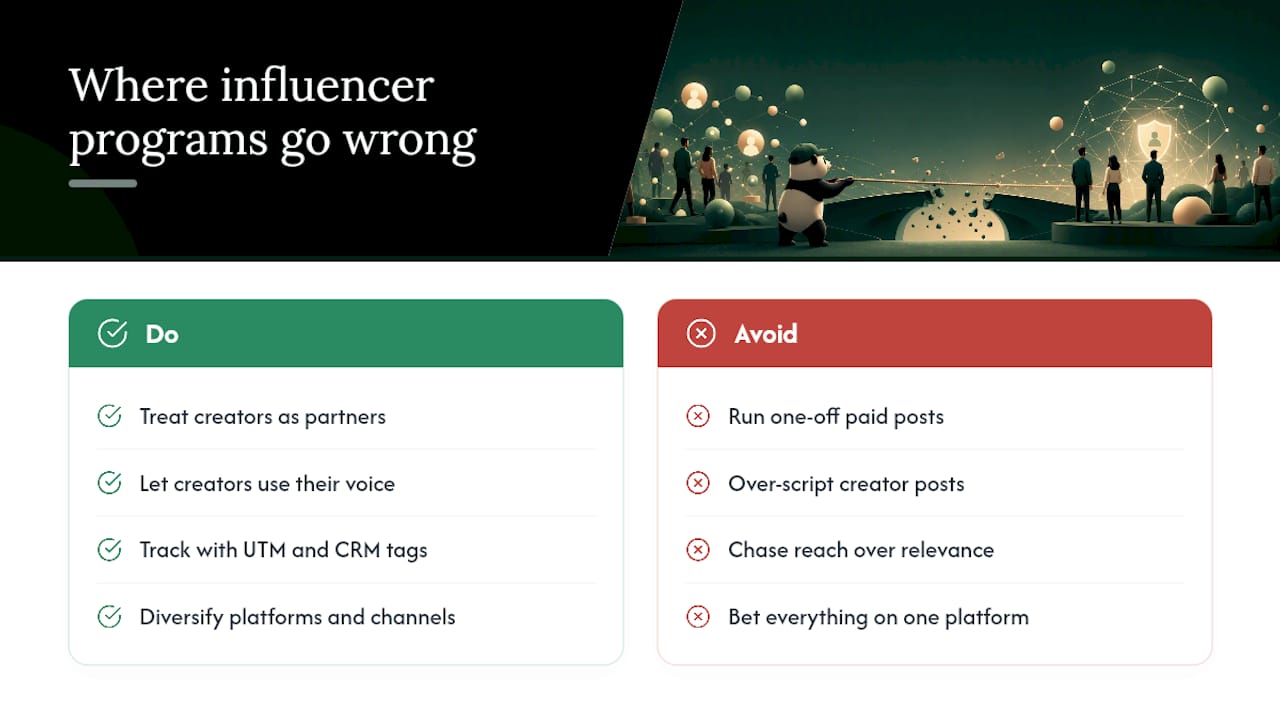
The most common failure is treating influencer marketing as a media buy instead of a relationship. Brands sign a one off deal, get one post, and walk away disappointed when nothing converts. Credibility compounds; it doesn’t spike.
A second pitfall is over scripting creators. Handing a practitioner a pre-written LinkedIn post kills the authenticity that made their audience trust them, and audiences notice immediately when a post doesn’t sound like the person who supposedly wrote it.
Chasing reach over relevance causes a third problem. A creator with an enormous but generic audience will produce impressive vanity numbers and almost no pipeline movement, because the people watching aren’t the people who buy.
Attribution gaps sink otherwise solid programs. Without UTM discipline and CRM tagging from day one, marketing can’t prove influenced pipeline even when it’s real, which makes the entire program vulnerable at the next budget cycle.
Platform dependency is a subtler risk. Reporting on Instagram’s ranking changes shows how quickly algorithm shifts can reshuffle which content actually gets seen, a reminder that B2B teams betting everything on one platform’s distribution are exposed to changes they don’t control. Diversify across LinkedIn, newsletters, podcasts, and owned channels so no single algorithm update can erase a quarter’s work.
Finally, teams often skip the enthusiasm check during discovery, partnering with a creator who’s technically qualified but lukewarm on the product. That lack of genuine interest shows up in the final content, however subtly, and audiences pick up on it.
Keeping B2B Creator Relationships Alive Past the First Campaign
The creators who compound value over years, not months, get treated less like vendors and more like an extended part of the team.
Start by paying on time and honoring usage terms exactly as contracted; nothing erodes a creator relationship faster than chasing an invoice. Beyond the transactional basics, give creators early access to product updates, roadmap previews, or executive time before a public launch. That access makes them feel like insiders rather than hired mouthpieces, and insiders produce sharper, more specific content.
Build a cadence instead of a one-off ask. A quarterly check-in, even a short one, keeps the relationship warm between formal briefs and surfaces new collaboration ideas organically. Some of the strongest B2B creator partnerships evolve from a single sponsored post into an ongoing advisory role, complete with a retainer that reflects the shift.
Credit creators publicly and specifically. A generic “thanks to our partners” post does less for the relationship than tagging someone by name in a case study or inviting them to co-present at an event. Partner content on influencer strategy and growth makes a similar point: recognition that goes beyond payment tends to buy more genuine enthusiasm in the next collaboration than a bigger check does.
Finally, protect creator independence. Resist the urge to tighten the script with every renewal. The moment a creator starts sounding like your brand’s marketing department instead of themselves, their audience’s trust in them, and by extension in you, starts to erode.
Legal and Compliance Rules Every B2B Program Needs
Disclosure obligations apply to B2B creator content just as they do in consumer influencer marketing. Any paid, sponsored, or product-gifted relationship needs a clear, conspicuous disclosure on the content itself, not buried in a bio or a linked terms page.
Contracts should spell out usage rights explicitly: whether the brand can repurpose creator content in ads, sales decks, or on the company website, and for how long. Without that clause in writing, a piece of content that performed well organically can become legally unusable the moment the brand wants to boost it as a paid ad.
Approval workflows need to balance legal review against creator momentum. A 48 to 72 hour turnaround window, agreed to in the contract, keeps compliance teams comfortable without letting a post go stale before it publishes.
Industry-specific regulations add another layer in regulated sectors like finance, healthcare, and legal services. A creator can’t publish claims about efficacy, compliance, or financial return without those claims going through the same review a company’s own marketing material would face. Building that review step into the brief timeline from the start, rather than bolting it on after a draft is finished, prevents last-minute rewrites that frustrate creators and delay launches.
Data privacy also matters when creator content includes customer testimonials or account-specific results; get explicit permission from the named customer before publishing, and confirm the creator has permission too if they’re quoting someone else’s experience.
Align TCC’s Perspective: Trust Architecture in an AI-Aware Market
The Norwest framework for a trust architecture gets something right that most agencies miss: influencer content now shapes what AI answer engines surface, not just what humans scroll past. That changes the calculus entirely.
Align TCC pairs brand positioning with AI-enabled execution precisely because scaling distribution without diluting a creator’s voice is the hardest part of this channel. A program built by a marketing team with no dedicated resourcing tends to plateau at one or two creator relationships. An integrated partner brings the structure, brief discipline, and measurement rigor to scale past that ceiling while keeping every voice authentic.
— Kalle
Ready to Build a B2B Influencer Program That Moves Pipeline?
An effective influencer program combines strong brand strategy with rapid execution methodologies, often enhanced by AI to sharpen creative output rather than replace it, so the creator program ties directly into positioning, demand, and go-to-market work instead of sitting in a separate silo.

If you’re evaluating whether to build an internal influencer engine or bring in a partner who already runs brand strategy, Influencer & Creator Marketing alongside go-to-market and positioning work, that overlap is exactly where Align operates. Teams expanding into APAC or exploring China-specific creator ecosystems can also look at Align’s Leadership Trips for first-hand market immersion before committing budget. Reach out through Align’s site to scope a pilot program built around your ICP and funnel stage.
Sources
Gartner marketing survey: buyers value third-party interactions — Gartner
B2B creator marketing partnerships: how creators reach buyers — Directive
FAQ
What Is B2B Influencer Marketing?
B2B influencer marketing is the practice of partnering with credible practitioners, analysts, or customers so their trusted voice increases your brand’s visibility and credibility among a business buying committee. Unlike consumer influencer work, it targets multiple stakeholders across a longer sales cycle rather than a single impulse buyer.
What Are the Four Types of B2B Marketing?
B2B marketing generally breaks into content marketing, account-based marketing, demand generation, and relationship or partnership marketing, which is where influencer and creator collaborations sit. B2B influencer marketing overlaps with all four, since credible voices can support content distribution, ABM outreach, and demand programs simultaneously.
What Is the ROI of B2B Influencer Marketing?
ROI varies widely by program maturity and measurement discipline, since B2B sales cycles delay when influenced revenue actually closes. Programs that tie UTM tracking and CRM attribution to influencer activity from day one can show a clear line from content-assisted engagement to influenced pipeline, though a specific universal return figure isn’t reliably established across the industry.
What Are the Three R’s of Influencer Marketing?
Definitions vary across sources, but a common version refers to Relevance, Reach, and Resonance, meaning a creator’s topic fit, audience size, and actual engagement depth. In B2B specifically, relevance and resonance tend to matter far more than raw reach, since a smaller, highly relevant audience usually outperforms a broad, generic one.
How Do I Find the Right B2B Influencers for My Brand?
Start by mapping your ideal customer profile, then search for practitioners, analysts, and customers who already discuss your category with genuine authority. Vet each candidate for audience overlap, engagement quality, and existing enthusiasm for your product before ever sending an outreach message.
Recommended
B2B Marketers: Build AI Aware Trust for Influencer Marketing
THE POINT
B2B Marketers: Build AI Aware Trust for Influencer Marketing
KEY TAKEAWAYS
01
For B2B marketers: an AI-aware playbook to build influencer marketing that truly moves pipeline. Learn strategy, creator discovery, CRM tracking,...
02
For B2B marketers: an AI-aware playbook to build influencer marketing that truly moves pipeline. Learn strategy, creator discovery, CRM tracking,...
03
For B2B marketers: an AI-aware playbook to build influencer marketing that truly moves pipeline. Learn strategy, creator discovery, CRM tracking,...
RELATED INSIGHTS


LET’S TALK
What are you trying to grow next?
Brand, launch, market entry or performance. Book 30 minutes and tell us what you’re working on.