Growth / Performance
Kalle Mobeck
•
Answer Engine Optimization for Brands: Prove Citation Lift in 90 Days
Answer engine optimization (AEO) is the practice of structuring content so AI systems, ChatGPT, Perplexity, Google’s AI Overviews, extract and cite your brand as the answer instead of routing a click to your site. Treat it as urgent: the engines already answer most questions before a reader hits a website. Start now with one BLUF-formatted page, and expand from there.
TL;DR:
To succeed in AEO, brands must focus on creating self-contained content chunks that answer key questions with clear subject naming and relevant statistics upfront.
External validation, such as citations from reputable sources and external signals like reviews, significantly influence whether AI systems trust and cite your content.
Technical setup, including schema markup and ensuring answer text is accessible in raw HTML, is essential for AI extraction and citation to occur reliably.
Measurement should track citation frequency, brand mentions in AI answers, and coverage across related queries, not just traditional search clicks.
Implementing AEO should start with rewriting high-impact pages, adding structured data, and monitoring citation trends before expanding to entire content ecosystems.
AligntccSharpen Your Brand’s Market PositionAlign TCC helps fast-growing companies build sharper positioning and targeted marketing strategies across shifting markets and audiences.Explore Align TCC
Table of Contents
What Is Answer Engine Optimization and Where Does It Apply?
Why Does Answer Engine Optimization Matter for Brands Now?
Answer Engine Optimization vs. SEO: What Actually Changes?
How Do You Write Content That AI Engines Actually Cite?
What Technical Setup Do Answer Engines Need to Find You?
How Do You Measure Answer Engine Optimization Results?
What’s Standing in the Way of Consistent AEO Results?
How Align TCC Maps to the AEO Checklist
The Real Priority Order for Brands Starting AEO
Where Align TCC Fits Into Your AEO Rollout
Sources
FAQ
What Is Answer Engine Optimization and Where Does It Apply?
AEO optimizes for citation, not clicks. The unit of optimization shifts from the whole page to the content chunk, a single H2 or H3 paired with the paragraph beneath it, because that is the piece a language model actually lifts and quotes.
Five surfaces matter, and each rewards a different extraction style:
AI Overviews (Google): favor short, factual answers with a clear subject and named entity in the first sentence.
Chat LLMs (ChatGPT, Claude, Perplexity): favor self-contained chunks with definitions, statistics, and dates that don’t require the reader to scroll for context.
Voice assistants: favor single-sentence answers under 30 words, phrased as a direct response to a spoken question.
Featured snippets: favor numbered steps or defined terms in the first 40 to 60 words of a section.
Knowledge panels: favor consistent entity data across schema, Wikipedia-style facts, and structured “about” content.
A citable chunk looks like this: “Answer engine optimization is the practice of structuring web content so generative AI tools extract and cite it directly in a conversational answer.” This sentence works alone, with no pronoun that needs a prior paragraph to resolve.
Why Does Answer Engine Optimization Matter for Brands Now?
Search behavior is moving past the click. Gartner projects a significant drop in traditional search-engine volume by 2026 as AI chatbots and virtual agents absorb queries that used to generate ten blue links and a click.
The stat that should reset your roadmap: OpenAI’s ChatGPT alone now reports a very large weekly active user base. That is not a niche channel anymore. It is a primary discovery surface running in parallel with Google.
When a buyer asks an AI tool “which agency handles brand repositioning for a Series B startup” and your brand isn’t in the answer, you don’t lose a ranking. You lose the conversation entirely. The zero-click era rewards presence inside the answer, and a citation there tends to arrive with more built-in trust than a standard search result, because the AI has already vetted and synthesized the claim before a prospect ever reads your name. For a brand in a competitive category, that’s the difference between being the recommendation and being invisible.
Answer Engine Optimization vs. SEO: What Actually Changes?
Ranking and citation are not the same outcome. A page can sit at position one on Google and still get skipped entirely when an LLM generates its answer, because the model is retrieving passages, not crawling a results page. That gap between “ranks well” and “gets cited” is the central operating fact of AEO.
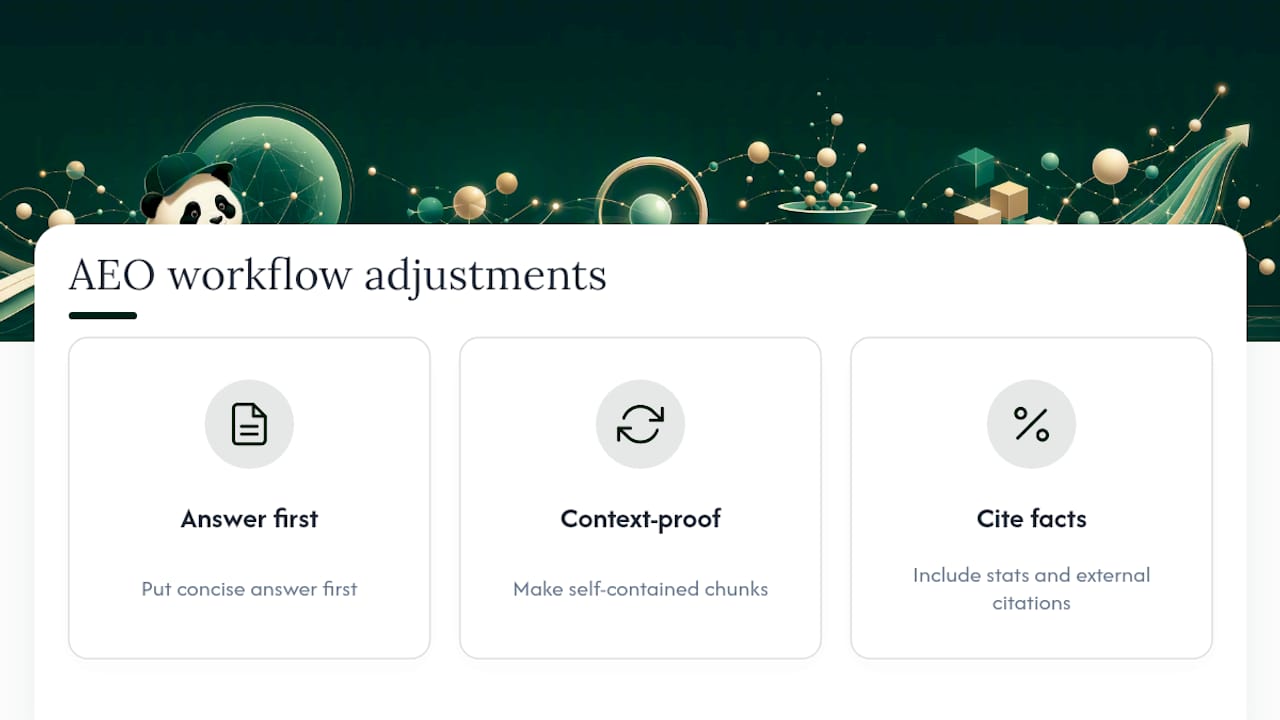
Traditional SEO optimizes a page for a search algorithm that returns a list. AEO optimizes a chunk for a retrieval system that returns a synthesized answer, often pulling from several sources at once. Your existing SEO workflow needs three adjustments: write the answer before the explanation, structure every section so it survives being lifted out of context, and treat statistics and cited sources as ranking factors in their own right, since pages with cited external sources see substantially higher citation rates in generative engines.
Generative engine optimization (GEO) and AEO overlap heavily. GEO is the broader discipline of shaping content for any generative AI system, including summarization and recommendation contexts beyond direct Q&A. AEO is the sharper subset focused specifically on getting cited as the answer. In practice, treat them as one workstream. The tactics, BLUF structure, fact density, schema, are nearly identical, and separating them into two backlogs just creates duplicate work for your content team.
How Do You Write Content That AI Engines Actually Cite?
Extractable content follows a discipline, not a vibe. Practitioner guidance from agencies working directly with generative engines converges on the same core moves, and none of them require a content rebuild from scratch.
Open every chunk with the answer. The first sentence under any H2 or H3 states the conclusion in plain language, no throat-clearing, no “in order to understand this, let’s first look at.”
Name the subject explicitly, every time. Replace pronouns like “it” or “this approach” with the actual noun. AI systems extract sentences that resolve on their own.
Keep sections self-contained. A reader, or a model, should understand the paragraph without needing the one before it.
Load in real numbers. Statistics measurably improve citation odds. One analysis found statistic-backed pages saw meaningfully higher citation rates than claim-only pages, and cited external sources produced the largest lift of any single tactic tested.
Quote and attribute. A direct quote from a named, real source gives a model something concrete to reproduce, rather than paraphrase into something less accurate.
Add FAQ or HowTo formatting where the content genuinely fits that shape. Don’t force it onto content that isn’t actually a step sequence or a Q&A.
Run an editorial pass for extractability, not just grammar, before publishing. Ask: could this paragraph be pulled out and understood with zero surrounding context?
Pro Tip: Write your H2s as the exact question your buyer would type into ChatGPT. Then answer it in the next sentence, not three paragraphs later. That single habit does more for citation odds than any schema markup.
Content teams running high output volumes should also look at how to optimize content for AI search for editorial-level tactics on structuring for retrieval, particularly around chunk length and fact placement.
What Technical Setup Do Answer Engines Need to Find You?
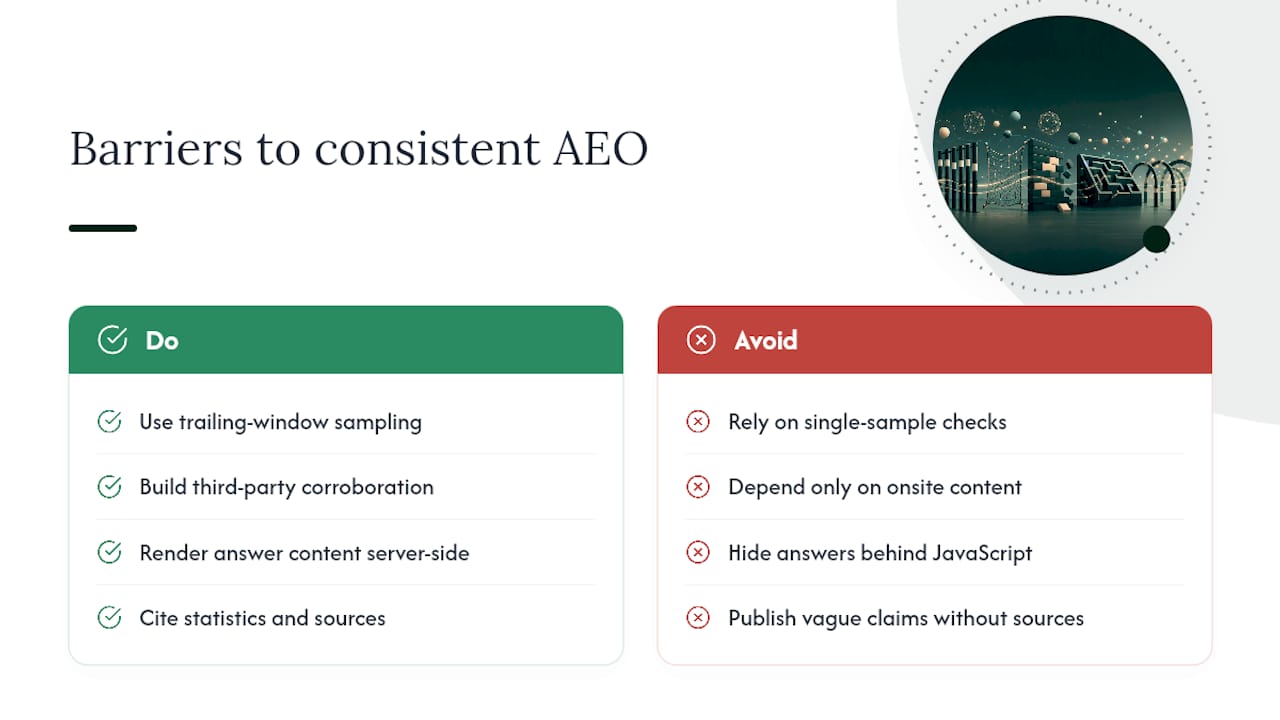
Extractable writing means nothing if the crawler can’t reach it. Answer engines, like search engines, generally read raw HTML, not JavaScript-rendered output, so anything injected client-side after page load risks going invisible to the systems that matter most.
Run this checklist before you publish anything you expect to get cited:
Mark up FAQ, HowTo, and Article content with the matching Schema types, FAQPage, HowTo, Article, and Speakable, placed as JSON-LD in the page head.
Confirm the actual answer text appears in view-source, not just in the rendered browser DOM.
Check your sitemap and robots.txt allow crawler access to every page you want cited, including any recently restructured URLs.
Keep the DOM around key answer chunks lean. Heavy nested divs and ad scripts between your heading and your answer text slow extraction and can cause a model to skip the passage entirely.
Watch page speed. Slow-loading pages get crawled less frequently, which delays how fast a new answer chunk enters an engine’s index.
Verification is manual but fast: view-source the page to confirm the answer text is really there, then run the exact query through Perplexity and ChatGPT to see whether your chunk shows up in the response, and repeat that sample a few days later since results shift over time. Schema pays off here specifically. FAQPage markup has been associated with meaningfully higher citation rates than unmarked pages carrying the same content, per schema.org’s structured data guidance.
How Do You Measure Answer Engine Optimization Results?
AEO needs its own KPIs, because click-through rate stops being a meaningful signal the moment a user gets their answer without visiting your site. Track these instead:
AI citation frequency: how often your brand or content gets quoted across a fixed set of queries in your category.
Brand mention rate: whether your brand name appears in the answer even without a direct link back.
Fan-out coverage: the share of related sub-queries around a topic where you get cited, not just the head query.
Share of voice across engines: your citation rate on ChatGPT versus Perplexity versus Google AI Overviews, since they often diverge sharply.
Zero-click trend: the rising share of impressions that generate no click, tracked against your overall visibility.
Search-planning research shows that separating the retrieval step from the answer-generation step improves both efficiency and answer accuracy. Translated for marketers, that means the engines are getting better and faster at deciding what to retrieve, which raises the cost of not being structured for retrieval in the first place.
Sample with a trailing three-of-five pull, running the same query set weekly and confirming a citation shows up in at least three of the last five checks before you trust the signal, since a single check can be noisy. Combine manual sampling in Perplexity and ChatGPT with a brand-monitoring tool for scale, and tie citation events back to assisted conversions in your analytics platform to prove the channel’s actual revenue contribution.
What’s Standing in the Way of Consistent AEO Results?
Citations are non-deterministic. The same query can pull a different set of sources on Tuesday than it did on Monday, which is exactly why single-sample checks mislead you and trailing-window sampling matters more than any one snapshot.
Off-site signals carry more weight than most brands assume. Forums, review platforms, and independent editorial mentions often determine whether a model trusts your page enough to cite it, not just what’s written on your own domain. A perfectly structured page with zero third-party corroboration still underperforms a messier page with real external validation.
The recurring failure modes: answer text hidden behind JavaScript rendering, vague claims with no statistic or source attached, and pages that never state who or what they’re actually about. Watch two trends closing in: agentic GEO systems that test tactics automatically using bandit-based optimization, Agent2UCB is one live example, and reinforcement-learning search planners that will keep raising the bar on how tightly structured a chunk needs to be to survive retrieval.
How Align TCC Maps to the AEO Checklist
Align TCC builds brand narratives designed to travel, across Commercial Strategy, Brand & Positioning, and content production, which is exactly the muscle AEO extraction rewards. An AI-enhanced process that pairs brand thinking with fast-moving execution can apply discipline to schema, chunk structure, and off-site corroboration in a coordinated pass rather than disconnected workstreams. A pilot engagement typically pairs rewritten content and monitoring against a defined query set, giving your team a real read on citation movement within a 90-day window.
The Real Priority Order for Brands Starting AEO
AEO is a citation layer sitting on top of the SEO foundation you already have, not a replacement for it. Start with your three highest-intent pages: rewrite the opening chunk, add real statistics, mark up FAQ schema. Expand only after you can measure a citation lift. Everything else is sequencing.
— Kalle
Where Align TCC Fits Into Your AEO Rollout
Most brands don’t need another framework. They need someone to actually rewrite the chunks, wire up the schema, and check the citations weekly, which is where a done-with-you engagement beats a checklist sitting in a shared drive. Align TCC’s Brand & Positioning and Demand & Performance services fold AEO directly into existing brand and content programs, so your team isn’t running a separate initiative on top of everything else already on the roadmap.
If your marketing team is weighing a market entry, a repositioning, or simply a sharper content operation, an AEO audit fits naturally inside that broader conversation. Align TCC’s leadership also runs immersive market trips for teams that want first-hand exposure to how AI-driven discovery is reshaping buyer behavior in APAC and beyond, direct input that sharpens exactly the kind of content decisions AEO depends on. Explore the services page and book a strategy call to scope a pilot for your highest-priority pages.
Sources
FAQ
How Do I Do Answer Engine Optimization?
Start by rewriting your top pages so each section opens with a direct answer in the first sentence, then add statistics, cited sources, and FAQPage or Article schema. Verify the answer text appears in raw HTML, not just rendered JavaScript, and sample your target queries in ChatGPT and Perplexity weekly to track citation movement.
What Is the Difference Between AEO and SEO?
SEO optimizes a page to rank in a list of search results; AEO optimizes a content chunk to get extracted and cited inside a generative AI answer. A page can rank first on Google and still never get cited by an LLM, because retrieval and ranking run on different logic.
What’s the Best Answer Engine Optimization Tool?
No single tool covers the whole workflow. Most teams combine manual sampling in ChatGPT and Perplexity with a brand-monitoring platform for scale, and an agency partner like Align TCC for the content rewrites, schema implementation, and ongoing measurement that the sampling data points toward.
What’s the Difference Between AEO and Generative Engine Optimization?
GEO is the broader discipline of shaping content for any generative AI output, including summaries and recommendations; AEO is the more specific practice of getting directly cited as the answer to a question. Most brands run them as a single combined workstream since the tactics overlap heavily.
Recommended
Answer Engine Optimization for Brands: Prove Citation Lift in 90 Days
THE POINT
Answer Engine Optimization for Brands: Prove Citation Lift in 90 Days
KEY TAKEAWAYS
01
Practical brand playbook for answer engine optimization: BLUF chunking, schema, crawlability, off site corroboration, and a 90 day citation pilot.
02
Practical brand playbook for answer engine optimization: BLUF chunking, schema, crawlability, off site corroboration, and a 90 day citation pilot.
03
Practical brand playbook for answer engine optimization: BLUF chunking, schema, crawlability, off site corroboration, and a 90 day citation pilot.
RELATED INSIGHTS

LET’S TALK
What are you trying to grow next?
Brand, launch, market entry or performance. Book 30 minutes and tell us what you’re working on.