•

Europe Influencer Marketing: A Market-by-Market Guide
Europe is not one influencer market. It is dozens of them, with different platforms, different disclosure rules and different spending habits. Brands that treat it as a single “EU campaign” pay for it in wasted creator fees and compliance risk. Brands that sequence markets, localize creator choices and build measurement in from day one move faster and spend smarter. This guide covers how big the market is, where it differs by country, what the rules require, and how to plan a multi-market program.
AligntccBuild Creator Programs for Each MarketAlign TCC combines brand thinking with market-specific execution to help companies shape creator and paid media strategies across markets.Explore Align TCC
TL;DR
The European creator economy was valued at €28 billion in 2025 and is projected to reach €135 billion by 2032, per a Coherent Market Insights study cited by BNP Paribas.
Instagram, TikTok and YouTube lead, but the order shifts by country. Plan creator mix market by market.
Disclosure rules are tightening: the EU’s Digital Services Act, France’s 2023 influencer law and Italy’s AGCOM guidelines all raise the bar on labeling.
Pick KPIs before you brief creators. Engagement rate is still the most used metric, but sales-linked measures are catching up.
Start with one or two lead markets, prove the model, then scale with local creators and local contracts.
Table of Contents
How big is influencer marketing in Europe?
Which platforms and formats work across Europe
Country differences that change your plan
The rules: disclosure, AI labels and privacy
A step-by-step plan for a multi-market campaign
Measuring performance and ROI
Challenges to expect
Our perspective
Working with Align on European creator programs
FAQ
Sources
How big is influencer marketing in Europe?
Big, and growing fast, though the headline numbers measure different things. Be careful which one you quote in a board deck.
The widest figure covers the whole creator economy. It was worth €28 billion in 2025 and is projected to grow about 25.1% a year to reach €135 billion by 2032, according to the BNP Paribas summary of the Coherent Market Insights study. That includes creator income beyond brand deals.
A narrower figure covers software. Grand View Research puts Europe’s influencer marketing platform segment at US$3,438.2 million in 2022, forecast to reach US$21,447.4 million by 2030. That is technology spend, not what brands pay creators.
The most useful numbers are national, because they reflect actual advertising investment:
Market | Figure | Period |
|---|---|---|
Italy | 2025 | |
Spain | 2025 | |
Sweden | 2025 | |
United Kingdom | Creator-partnership revenue up 20.1%; forecast to rise 26% to £1.2 billion | 2025, forecast 2026 |
The pattern: mature markets such as Italy are growing at single digits, while Spain and the UK are compounding faster. Sweden’s growth outpaced most other digital channels in the IAB’s reading.
Brand intent points the same way. In Kolsquare’s survey, 74% of European marketers planned to raise influencer investment for 2026. The same study reports a median annual spend of €175,000 across Europe, with 11% of brands spending more than €1 million. Use that median as a reality check: a serious multi-market program is a six-figure commitment, not a pilot with a few gifted products.
Which platforms and formats work across Europe
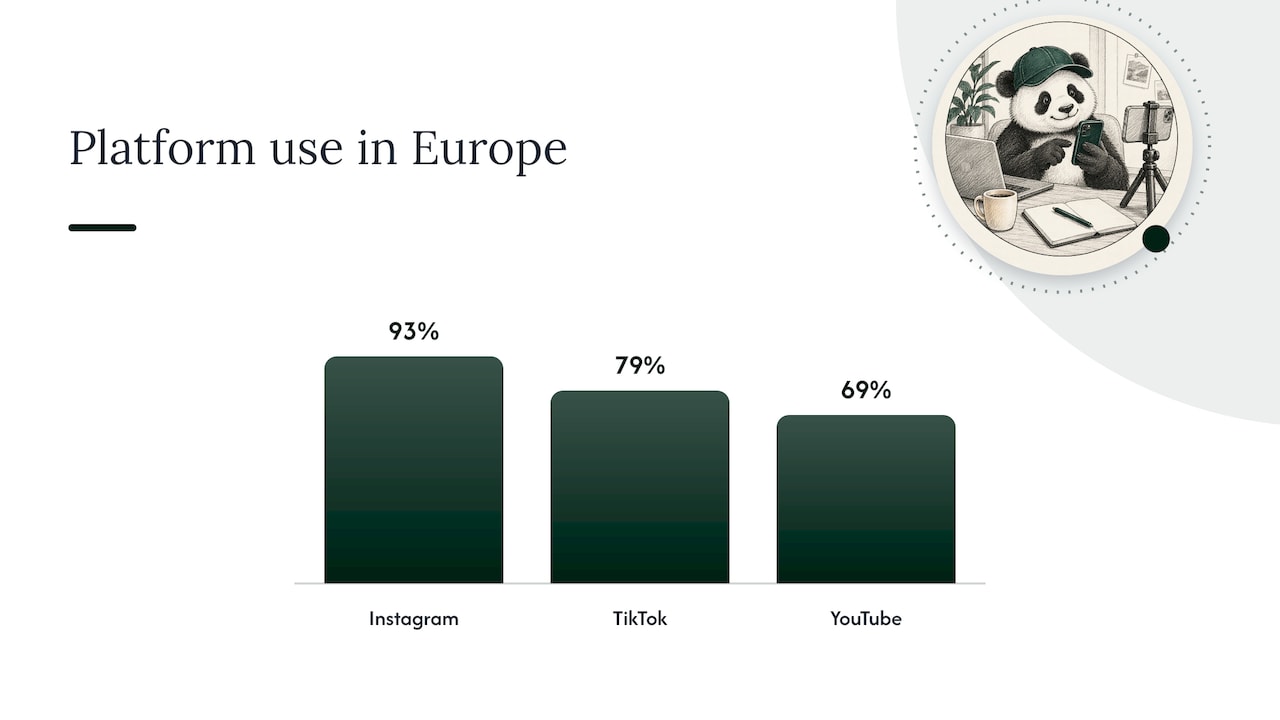
Instagram is the default. In 2025, 93% of European marketers used it, followed by TikTok at 79% and YouTube at 69%, per Kolsquare’s annual European study.
Those averages hide real differences:
Germany: YouTube edges out TikTok in the same study. Long-form review and explainer content carries weight with German buyers.
UK and Italy: sponsored posts dominate top-of-funnel activity.
France and Spain: experiential and collaborative formats are favored.
UK and Spain: UGC used inside paid ads is on the rise.
Across the region, sponsored posts lead for awareness and content co-creation is the most common mid-funnel format. Read that as a funnel design: use quick sponsored placements to get seen, then move the best-fit creators into co-created content that explains the product.
A practical rule: choose platform by funnel stage first, country second. Then check whether the country’s habits contradict the choice. For B2B and finance brands, the picture is different again. LinkedIn creators matter more, and trust is built differently. Our guide on building AI-aware trust in B2B influencer marketing covers that case.
Country differences that change your plan
Three differences matter most when you move from one market to the next.
Budget culture. German brands are known for heavy spending. A 2024 Kolsquare study reported by Meedia put average annual German spend at €5.74 million. Expect more competition for top creators there, and expect buyers to be used to seeing sponsored content.
Creator vocabulary. What counts as an “influencer” differs. In some markets the preferred label is creator, ambassador or talent. If your brief is built for Western audiences and sent unchanged to another region, the mismatch shows. Our KOL vs influencer brief lays out how to define the role before you contract.
Language and culture. Europe has 24 official EU languages and far more regional cultures. A creator with a large Spanish following may not travel to Latin America, and a French-language creator reaches Belgium and parts of Switzerland but not necessarily the same audience as a Paris creator. Match the creator’s actual follower geography to your sales territory, not their headline reach.
The rules: disclosure, AI labels and privacy
Compliance is where multi-market programs break. There is no single European influencer law yet, so you work with an EU baseline plus national rules. The European Parliament’s research service has a briefing on regulating influencer marketing in the EU that maps the patchwork.
EU baseline
The Digital Services Act requires clear information about online ads, including who paid for them. The European Commission’s questions and answers on the DSA say it covers whether content is sponsored or influencers are promoting commercial messages. It does not change GDPR rules. Data collected through giveaways, affiliate tracking or lead forms still needs a lawful basis.
France
France has the strictest national regime among major markets. Law No. 2023-451 requires influencer commercial content to be labeled explicitly as “Publicité” or “Collaboration commerciale”. It also requires “Images retouchées” where faces or silhouettes are digitally altered and “Images virtuelles” for AI-generated images, per the Journal officiel. Put those exact French labels in your French creator contracts.
Italy
Italy’s regulator AGCOM, in Delibera 197/25/CONS, requires “relevant influencers” to comply with industry codes and sets transparency standards for commercial communications.
Direction of travel
Consumer groups want more. BEUC advocates EU-wide rules, including mandatory disclosure of commercial content and bans on promoting harmful products to children. If your category touches minors, build to the stricter standard now.
What to do about it:
Write disclosure wording into every contract, per market and per language.
Require creators to keep proof of labeling and to correct posts on request.
Add AI and retouching disclosure clauses. Our influencer contract terms page has clause language you can adapt.
Have local counsel review the regulated-sector work (finance, health, alcohol).
This is a general overview, not legal advice. For campaigns in France, Italy or any regulated category, a lawyer in that country should review the final contract.
A step-by-step plan for a multi-market campaign
Choose lead markets. Pick one or two where you have product-market fit or retail presence. Use national spend data above to judge how competitive each is.
Set the objective by funnel stage. Awareness through sponsored posts, consideration through co-creation, conversion through creator content run as paid ads.
Build a creator shortlist locally. Vet follower geography, language, audience quality and past brand work. Use native speakers to review tone.
Run brand safety checks. Review past content, controversies and affiliations. Our brand safety checklist with AI monitoring shows six checks worth running before signing.
Contract with usage rights. Decide up front whether you will run creator content as paid ads. The whitelisting setup guide walks through access, permissions and contract points.
Launch, test and learn. Run a 6 to 8 week first wave, then reallocate budget to the formats and creators that perform.
Scale to adjacent markets with local creators, not translated versions of the first market’s content.
Brands often underbudget for localization. Our note on performance branding with AI localization explains how to adapt content and creative faster without losing brand coherence.
Measuring performance and ROI
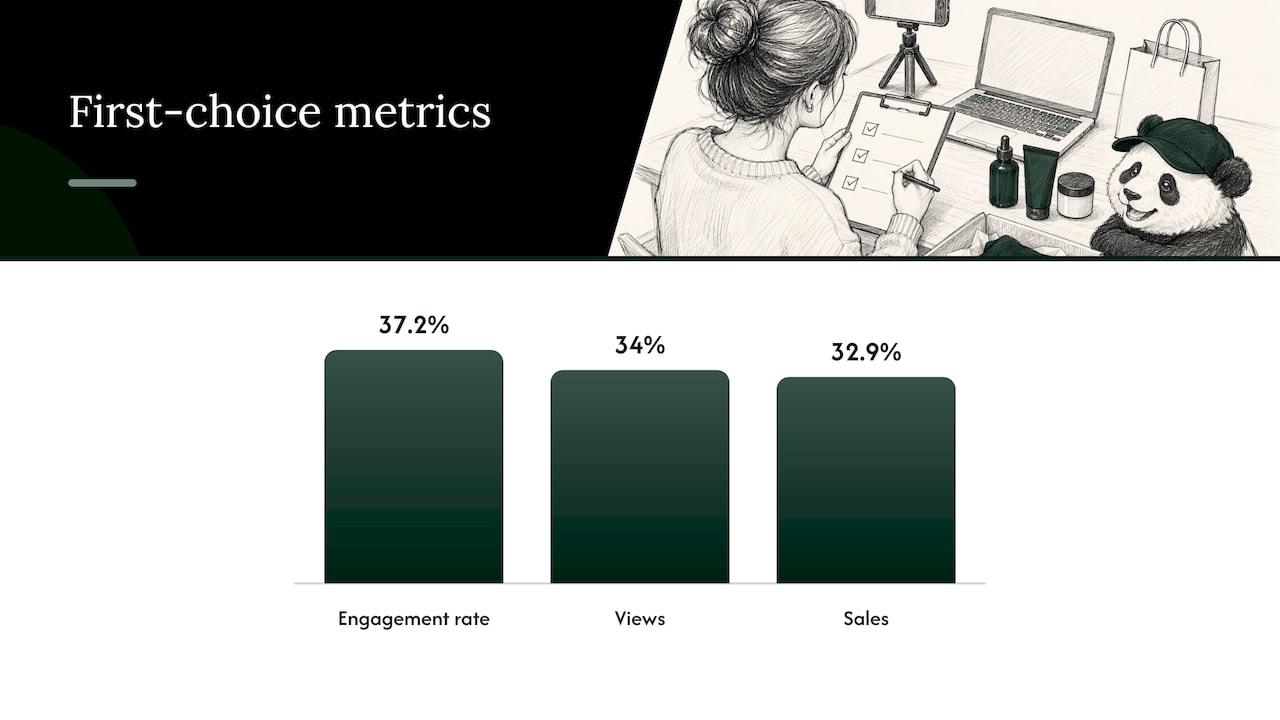
Engagement rate is still the metric marketers rely on most in Europe: 37.2% name it first, ahead of views (34%) and sales (32.9%). That tells you the industry is in transition. Engagement is easy to pull but weakly linked to revenue.
Italy’s advertiser body UPA makes the same point from the buyer side. It says advertisers need shared KPIs and research methods plus precise definitions of the cost components to quantify performance. Agree on definitions of reach, view, cost and attribution before the campaign, not after.
A workable measurement stack:
Awareness: unique reach, view-through rate, brand search lift.
Consideration: saves, shares, qualified clicks, content completion.
Conversion: tracked codes, links, and creator content run as paid ads with its own ROAS.
For short-form video, the first seconds decide everything. This piece on funnel-first video ad KPIs is a useful way to think about which signals to track at each stage.
Challenges to expect
The recurring problems, based on the German study reported by Meedia:
Finding suitable influencers for your category and market.
Balancing brand control with creative freedom.
Measuring ROI and ROAS accurately.
Rising costs.
The fix for most of these is the same: a clear brief, a short list of vetted creators who actually fit, contracts that cover usage rights, and a measurement plan agreed beforehand. Creators perform best when they have room to write in their own voice inside clear guardrails.
Our perspective
Most brands think about Europe as a translation problem. It is a trust problem. A creator in Stockholm, Milan and Madrid earns trust differently, and a campaign has to engineer that layer of trust market by market. The noise is only getting louder, so reach alone is not a strategy.
We come at this from two directions. Scandinavian brand thinking gives a campaign a clear position before a single creator is briefed. The speed of Chinese market methodologies, where creator content, commerce and paid media move as one system, gives it velocity. Combining them means a brand knows what it stands for, then tests fast and scales what converts.
We also use AI where it helps: sorting creator shortlists, monitoring brand safety, adapting content to local markets. It enhances the creative work. It does not replace the people who judge whether a creator is right for the brand.
One more point. Brands with Western and Chinese ambitions at the same time need a partner who understands both sides. That is where we sit.
— Kalle
Working with Align on European creator programs
If you are planning creator work across several markets, we can act as an extension of your team: brand and positioning, creator programs, paid amplification and market entry planning, with senior people involved throughout. You can see the full scope on our services page.
For leadership teams that want first-hand insight into how consumers and platforms behave in China, we also run Leadership Trips. To discuss a European program, book a strategy call through our site. More guides are in our Insights library.
FAQ
Is influencer marketing in Europe worth it for a non-European brand?
Yes, if you pick markets deliberately. Spending is rising across the region and 74% of surveyed marketers planned to increase budgets for 2026. Start with one or two lead markets, not all of Europe at once.
Which platform should I start with in Europe?
Instagram is used by 93% of European marketers, TikTok by 79% and YouTube by 69%. Start where your audience already is, then check country differences: Germany leans a little toward YouTube over TikTok, for example.
Do influencers have to disclose paid partnerships in Europe?
Yes. The EU’s Digital Services Act requires clear information about ads and sponsorship, and national rules go further. France requires labels such as “Publicité” or “Collaboration commerciale”. Check each market’s rules with local counsel before launch.
How much should I budget?
The median annual spend among European brands in Kolsquare’s 2025 study was €175,000, and 11% spent over €1 million. Your figure depends on the number of markets and creator tiers. Budget for production, usage rights and paid amplification, not only creator fees.
Sources
The Creator Economy is expected to be worth €135 billion in Europe by 2032 (BNP Paribas)
Europe Influencer Marketing Platform Market Outlook (Grand View Research)
Los influencers duplican su facturación publicitaria en España
The Drum: Commerce first, UK brands and influencer marketing
The State of Influencer Marketing in Europe 2025 (Kolsquare)
Influencer Marketing Study 2026/2027: 7 European Markets (Kolsquare)
Meedia: Deutschland ist Spitzenreiter im Influencer-Marketing
European Parliament: Regulating influencer marketing in the European Union
European Commission: Questions and answers on the Digital Services Act
Journal officiel de la République française, Law No. 2023-451
Recommended
RELATED INSIGHTS




LET’S TALK
What are you trying to grow next?
Brand, launch, market entry or performance. Book 30 minutes and tell us what you’re working on.