•
Six Step Influencer Whitelisting for Marketers: Setup & Contracts
Influencer whitelisting is when a brand gets a creator’s permission to run paid ads through that creator’s own social handle instead of the brand’s account. The payoff is straightforward: you combine a creator’s built-in credibility with your own targeting, budget, and measurement tools. It still requires a written license and a clear disclosure, so treat permission and compliance as one package, not two separate favors.
TL;DR:
Whitelisting allows brands to run paid ads directly from a creator’s social handle, leveraging authentic signals and existing organic performance.
Permission is limited to ad-running rights tied to specific posts, platforms, and timeframes, with no control over the creator’s account or unrelated content.
The most effective campaigns use well-performing organic content from ambassadors or repeat creators, focusing on short, testimonial-style videos.
Fees vary based on license duration, exclusivity, and media spend, with a written license and clear disclosures mandatory for legal compliance.
Proper setup includes platform-specific permissions, detailed licensing checklists, and ongoing tracking to ensure permissions do not lapse mid-campaign.
AligntccMake Creator Marketing Work HarderAlign TCC helps brands combine creators, paid media, and market-specific execution across China, Europe, and North America.Explore Align TCC
Table of Contents
What makes whitelisting different from boosting or UGC ads
How performance and limitations actually play out
Setting up whitelisted ads on Meta, TikTok, and YouTube
Choosing the right creators and content to whitelist
Pricing models and how to negotiate a whitelisting fee
Disclosure rules you can’t skip
Building a permissions and licensing checklist
Measuring whitelisted ads against brand-owned creative
Why whitelisting only works inside a bigger strategy
Turn whitelisting into a managed growth program
Where to verify the rules and platform mechanics
Sources
FAQ
What makes whitelisting different from boosting or UGC ads
Boosting means putting paid budget behind a post that already lives on the brand’s own account. Whitelisting means the ad runs from the creator’s handle, so the comments, profile, and social signals stay attached to a real person, which is what gives it an edge over brand-hosted content. Brand-hosted UGC sits in between: the brand owns a license to the footage but publishes it under its own name, losing the “from a real account” effect entirely.
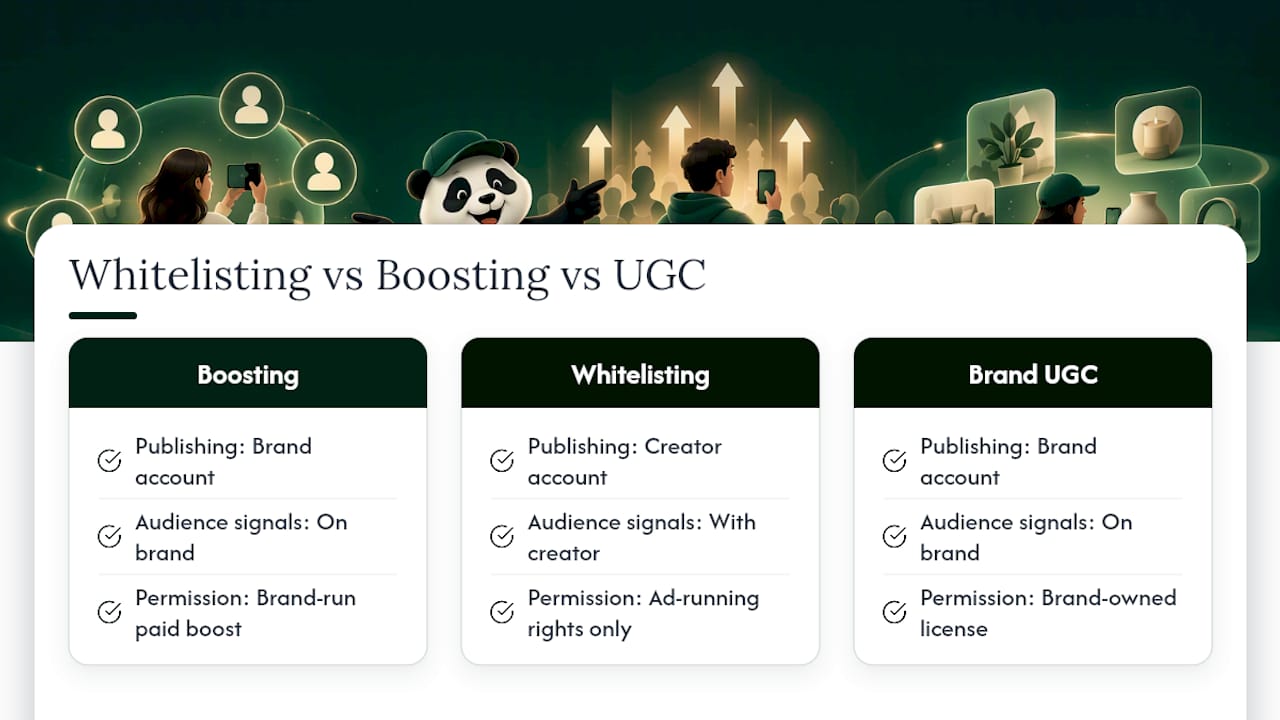
The permission granted is narrow. A brand gets ad-running rights (through Meta’s Partnership Ads or TikTok’s Spark Ads), never account login credentials or control over the creator’s other posts. Whitelisting tends to outperform other formats when a piece of organic content has already proven itself and a brand wants to scale it with paid spend behind the creator’s own audience signals.
How performance and limitations actually play out
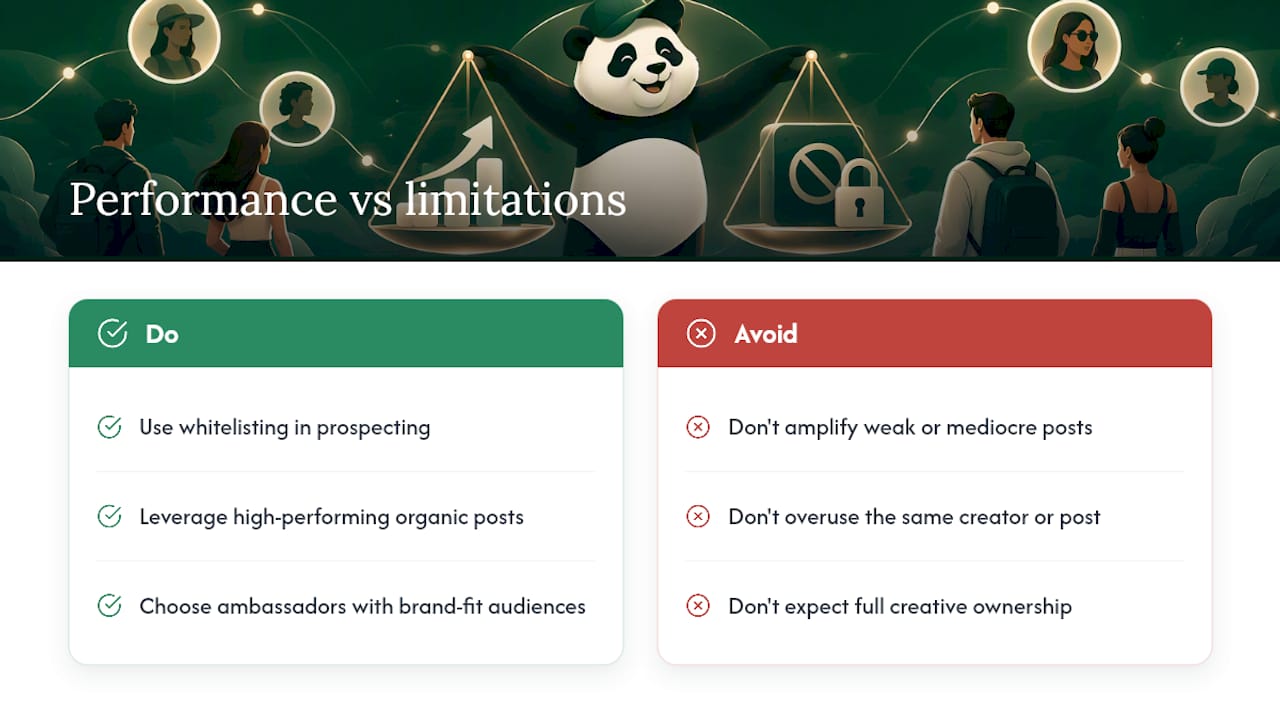
Whitelisted ads often win on click-through and engagement in prospecting campaigns, because a viewer sees a familiar creator rather than an obvious brand ad. The strongest lifts tend to come from content that already performed well organically, plus ambassadors whose audience has a track record with the brand. That combination gives you a pre-tested creative before you spend a cent on media.
The trade-offs are real. Creative control is shared, not owned, so edits typically need creator sign-off. Overusing the same creator or post invites fatigue, and whitelisting a mediocre post rarely fixes weak creative, it just adds budget to it.
Setting up whitelisted ads on Meta, TikTok, and YouTube
Each platform handles permission differently, and mixing up the mechanics is the fastest way to stall a launch.
Meta: the creator grants partner access in Business Manager, assigns Create Ads permission tied to a specific ad account, and often shares Pixel or reporting access so the brand can build audiences and track results, following Meta’s Partnership Ads setup flow.
TikTok: the creator generates a Spark Ads authorization code tied to one specific video, valid for a defined window; renewal means generating a fresh code before the old one lapses.
YouTube and Google: permission flows lean on brand partnership tools rather than a single standardized whitelisting product, and the line between whitelisting and straightforward branded content is blurrier than on Meta or TikTok.
Every platform ties permission to a specific post, account, and time window, and none of them let a brand touch unrelated profile content.
Pro Tip: Screenshot every permission grant and authorization code the day it’s issued. Platforms don’t always send renewal reminders, and a lapsed code mid-campaign means paused delivery.
Choosing the right creators and content to whitelist
Not every creator relationship is worth turning into a paid ad, and the tier should match the goal.
Nano creators work best for engagement-driven tests where authenticity outweighs reach.
Micro creators fit niche targeting, especially in categories with passionate, narrow audiences.
Macro creators suit broad awareness pushes where scale matters more than intimacy.
The best source material is rarely a one-off marketplace hire. Ambassadors, repeat customers, and creators whose organic posts already performed well give you a built-in performance signal before any media dollars are spent. Prioritize short reviews, demo clips, and testimonial-style content over polished brand-style creative. That’s the format viewers already trust from that creator, and it’s the format most likely to survive the jump into a paid feed.
Pricing models and how to negotiate a whitelisting fee
Whitelisting fees vary by license term, edit rights, exclusivity, and how much media spend the brand plans to run behind the content. A short license with no exclusivity and modest spend costs less than a long-term, exclusive grant tied to a large budget.
Flat fee per campaign: simplest to budget, common for one-off tests.
Percentage add-on to media spend: scales with ambition, common for larger paid pushes.
Bundled retainer: folds whitelisting into an ongoing ambassador relationship, useful once a creator has proven reliable.
Request explicit license length, edit rights, and a revocation clause in writing before spend goes live. Avoid open-ended terms with no expiry date, they create renewal confusion later.
Pro Tip: Fold whitelisting rights into ambassador retainers from the start. It’s cheaper than negotiating a fresh license every time a post performs well.
Disclosure rules you can’t skip
The FTC’s Disclosures 101 guidance requires any material connection between a brand and a creator to be disclosed clearly and conspicuously, placed with the endorsement itself rather than buried in a bio or a linked page. Words like “ad,” “advertisement,” or “sponsored” are the FTC’s recommended terms, and platform-native disclosure toggles alone may not meet that bar.
Pair the platform’s built-in sponsored label with an on-screen or in-caption disclosure.
Place disclosure at the start of a video or Story, not only at the end.
Use plain, unambiguous wording rather than vague terms like “partner” or “collab.”
The FTC has stated that a platform’s own sponsored-content marker does not automatically satisfy disclosure requirements. The Federal Register’s revised Endorsement Guides reinforce that fabricated endorsements and misleading indicators of influence carry legal risk, not just reputational risk.
Building a permissions and licensing checklist
Ad permission and content license are two different rights, and collecting only one is the most common operational mistake in whitelisting programs.
Confirm the specific post or content ID being licensed, not a general grant to “use my content.”
List every platform where the ad will run and the exact start and end dates of authorization.
Specify edit rights: can the brand crop, caption, or resize the asset.
Clear third-party elements like licensed music or guest appearances for paid use, since organic clearance often doesn’t extend to ads.
Confirm reporting access so the brand can see performance without needing full account login.
Define the revocation process and whether live ads must stop immediately or may finish their current delivery window.
Keep an expiry calendar tied to every authorization. A creator whitelisting program that loses track of renewal dates risks a campaign quietly losing its legal right to run mid-flight.
Measuring whitelisted ads against brand-owned creative
Whitelisted ads deserve the same testing discipline as any other creative variant, not a separate standard.
Track click-through rate and engagement early, then shift focus to cost per acquisition and return on ad spend once the test has enough data.
Run an A/B test with identical audience and objective settings, varying only the creative: a creator-handle ad against a brand-owned version of similar content.
Watch view-through conversions alongside click-through ones, since social proof often influences a purchase decision before the final click.
Measure total attributed revenue across both paid and organic activity, so a whitelisted ad doesn’t get credited for a sale that organic reach already drove.
Why whitelisting only works inside a bigger strategy
Whitelisting is a distribution tactic, not a brand strategy, and treating it as a standalone hack is where most programs stall. Some agencies build whitelisting into a broader system: brand positioning first, AI-enabled media buying second, and structured creator onboarding third, so the permission paperwork and the creative decisions move at the same pace as the media spend. Our six-week pilot approach applies the same logic: prove creative-market fit fast, then scale what works with paid budget behind it.
— Kalle
Turn whitelisting into a managed growth program
If your team is testing whitelisting one creator at a time, you’re doing the hard part manually. Align’s Influencer & Creator Marketing work sits alongside our paid media management and commercial strategy services, so permissions, creative testing, and spend decisions run as one coordinated program instead of three disconnected tasks.
Explore our services or get in touch through Align to talk through a pilot for your next campaign.
Where to verify the rules and platform mechanics
Start with the FTC’s Disclosures 101 guidance and the Federal Register’s Endorsement Guides for compliance, and platform partner-ads documentation for setup steps. For discovery and measurement tactics, BabyLove Growth’s influencer marketing guide is a useful companion read.
Sources
Guides Concerning the Use of Endorsements and Testimonials in Advertising — Federal Register
Creator Whitelisting: How to Run Ads From Creator Handles — Roster
How-To Guide: Influencer Whitelisting for Instagram and Facebook — Upfluence
FAQ
What does influencer whitelisting mean?
Influencer whitelisting means a brand gets a creator’s permission to run paid ads through that creator’s own social handle, rather than posting from the brand’s account. It requires both an ad-running permission from the platform and a separate content license from the creator.
How much should influencers charge for whitelisting?
Whitelisting fees depend on license length, edit rights, exclusivity, and the media budget running behind the content, and there’s no single published market rate. Brands typically negotiate a flat fee per campaign, a percentage tied to spend, or a bundled rate folded into an ongoing ambassador retainer.
What are examples of whitelisting?
Common examples include a brand running Meta Partnership Ads through a customer’s Instagram account to promote a product demo, or using TikTok Spark Ads to boost an ambassador’s organic review that already performed well. Both keep the ad attached to the creator’s real handle rather than the brand’s own account.
Is being whitelisted a good thing?
For creators, whitelisting is generally a positive arrangement since it usually comes with a paid license fee for content that’s already been made. For brands, it works best when paired with clear disclosure and a written agreement covering license term, edit rights, and revocation, so the arrangement stays compliant as it scales.
Recommended
RELATED INSIGHTS



LET’S TALK
What are you trying to grow next?
Brand, launch, market entry or performance. Book 30 minutes and tell us what you’re working on.