•
Marketers: Build a KOL vs Influencer Brief This Week
Choose a KOL when you need expert validation for a technical or regulated claim, and choose an influencer when you need culture-driven reach for a consumer launch. A medical device brand earns more from a credentialed clinician’s endorsement than from a lifestyle creator’s unboxing video, while a sneaker drop benefits far more from a trend-savvy creator with cultural pull. The sections ahead cover definitions, selection, budgets, and measurement so you can build a brief this week.
TL;DR:
KOLs are subject-matter experts with credentials that lend authority, while influencers build influence through content and audience relationships.
Campaigns for regulated or technical categories should prioritize KOL endorsements, whereas trend-driven launches rely mostly on influencer reach.
Vetting involves verifying credentials for KOLs and assessing engagement quality for influencers, with red flags including vague disclosures or suspicious follower growth.
Measurement should be tailored: track inquiries and lead quality for KOLs, and reach, engagement, and conversion for influencers, using UTM tags and holdout groups.
A six-week pilot pairing a KOL with micro-influencers offers critical data to decide whether to scale or adjust the creator mix.
AligntccBuild A Smarter Creator StrategyAlign TCC helps brands combine creator programs, paid media, and market-specific execution across China, Europe, and North America.Explore Align TCC
Table of Contents
What KOL and Influencer Actually Mean in a Brief
The Practical Differences That Shape Campaign Design
When to Choose a KOL, an Influencer, or Both
Vetting Checklist: Questions, Verification, and Red Flags
Measuring KOL and Influencer Campaigns Correctly
Budgeting for KOL Fees vs Influencer Tiers
Platform Fit and Regional Dynamics, Especially APAC
Practitioner Proof: What a 6-Week Pilot Can Show
Where Strategists Get This Wrong
How Align Can Help You Build the Right Creator Mix
FAQ
Sources
What KOL and Influencer Actually Mean in a Brief
Marketing teams throw “KOL” and “influencer” into the same slide deck, but the terms describe different sources of persuasion, and a brief that blurs them produces the wrong creator shortlist.
A key opinion leader (KOL) earns audience trust through professional expertise, credentials, or standing within a field. According to Shopify’s explainer on KOL marketing, KOLs build influence on demonstrated domain knowledge rather than personality, which is why a cardiologist, a civil engineer, or a Michelin-trained chef can function as a KOL even with a modest follower count.
An influencer builds a following through content, persona, and community, and that following is the asset a brand rents. Influence here comes from relatability, aesthetic consistency, or comedic timing rather than a credential.
For briefs and RFPs, copy these working definitions directly:
KOL: a subject-matter expert whose endorsement carries professional or institutional weight, often active beyond social platforms (speaking engagements, published work, clinical or trade credentials).
Influencer: a content creator whose audience follows them for persona, lifestyle, or entertainment value, with influence concentrated on social platforms.
Hybrid creator: someone who holds genuine credentials and also runs a high-engagement content channel, qualifying as both depending on which asset the campaign leans on.
The overlap matters most during vetting. A dermatologist with 200,000 TikTok followers is a KOL for a skincare ingredient claim and an influencer for a holiday gifting post, and your brief should specify which role you’re paying for.
The Practical Differences That Shape Campaign Design
Once the definitions are set, the operational differences decide your creative brief, your KPIs, and your budget line.
Source of influence separates the two cleanly. A KOL’s authority rests on expertise and third-party validation, while an influencer’s authority rests on parasocial connection built through consistent content. That distinction changes what the audience expects from the content itself.
Audience composition also diverges. KOL audiences often skew toward professional or high-intent viewers researching a decision, while influencer audiences skew toward general consumers browsing for inspiration or entertainment. A B2B software KOL might reach procurement managers; a beauty influencer reaches shoppers scrolling before bed.
Content format follows naturally from both:
KOL content tends toward long-form explainer video, panel discussion, written analysis, or webinar appearances.
Influencer content tends toward short-form video, styled photography, and trend-responsive formats like duets or challenges.
KOL content ages slower and gets referenced later; influencer content performs hardest in its first 48 hours.
Trust and engagement behave differently too. Shopify notes that KOLs often engage smaller, niche, professional audiences while influencers command broader, lifestyle-focused reach, meaning a KOL post might generate fewer comments but more qualified inbound inquiries. A 2025 meta-analysis in the Journal of the Academy of Marketing Science found that smaller creators tend to drive higher-quality engagement while larger influencers do more to lift purchase intention at scale, which means your creative brief should specify whether you’re buying engagement depth or reach breadth before you ever contact a creator.
When to Choose a KOL, an Influencer, or Both
Match the creator type to the objective, not the budget line you happen to have open.
Technical claims or regulated categories: pharmaceutical, financial, medical device, or B2B software campaigns need a KOL whose credentials can withstand scrutiny and whose endorsement reduces perceived risk.
Trend-driven consumer launches: apparel drops, beauty releases, and food and beverage launches benefit from influencers who can generate cultural momentum fast.
Category education followed by mass adoption: campaigns that need both credibility and volume should sequence a KOL first, then layer influencers on top once the expert validation exists.
Hootsuite’s guide to KOL partnerships notes that KOL endorsements often carry more weight than standard influencer endorsements specifically for credibility-driven objectives, which is why regulated categories default to KOL-first strategies.
The hybrid sequence works because it mirrors how people actually make decisions: they want expert reassurance before they’re swayed by social proof. A KOL video addressing safety or efficacy, published two to three weeks ahead of a broader influencer wave, gives the amplification phase something credible to amplify.
Use this checklist to decide between single and hybrid approaches:
Does the claim involve health, safety, finance, or technical performance? If yes, start with a KOL.
Is the purchase decision impulsive or trend-sensitive? If yes, influencers alone may suffice.
Do you have budget for sequencing, or only enough for one wave? Pick the creator type that matches your riskiest claim.
Vetting Checklist: Questions, Verification, and Red Flags
A strong shortlist still fails if the vetting process is sloppy, so build these checks into your outreach template before any contract is signed.
For audience fit, request a recent audience demographic export and three examples of comments on sponsored content, not just organic posts, since sponsored engagement quality is the number that predicts your campaign’s real performance.
For KOL credential verification, ask for a CV or professional bio, links to published work or speaking engagements, and any institutional affiliations relevant to your claim. A KOL who can’t produce verifiable credentials within a day or two is not ready for a credibility-driven campaign.
For influencer authenticity checks:
Compare the stated follower count against engagement rate; a steep mismatch suggests purchased followers.
Look for sudden engagement spikes with no matching content event, a common sign of engagement pods.
Review whether past sponsored posts disclosed properly, since inconsistent disclosure history predicts future compliance risk.
Red flags across both categories include vague answers about past brand partnerships, reluctance to share raw analytics, and values misalignment that only surfaces once you scroll their full post history rather than the curated grid.
Negotiation should cover usage rights explicitly: whether you can repurpose content in paid media, for how long, and across which platforms, since content-usage terms often cost more than the original post fee.
Pro Tip: Ask every creator for one piece of content that underperformed and their explanation for why; the answer reveals more about professionalism than any portfolio highlight reel.
Measuring KOL and Influencer Campaigns Correctly
KOL and influencer work should never share the same KPI sheet, because they’re built to move different parts of the funnel.
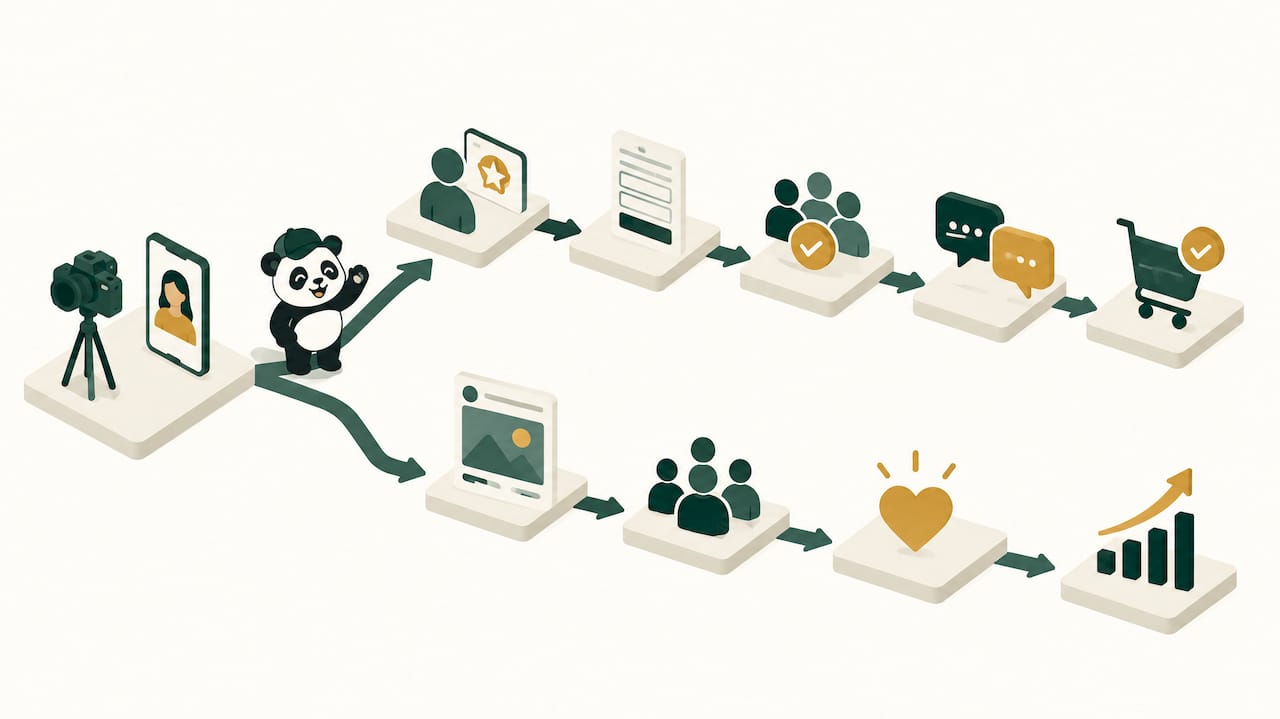
For KOL programs, track lead quality from trackable inquiry forms, expert-sourced conversions, inbound sales inquiries tied to the content, and any measurable shortening in time-to-purchase for prospects exposed to the KOL’s content.
For influencer programs, track reach, view-through rate, engagement rate relative to the creator’s historical baseline, and return on ad spend for any content pushed through paid amplification.
Useful measurement practices for both:
Run holdout tests where a comparable audience segment sees no creator content, then compare conversion lift.
Use consistent UTM tagging per creator and per content piece, not just per campaign, so attribution survives reporting rollups.
Set a reporting cadence of weekly checks during a pilot and monthly checks once a program scales, so decisions happen fast early and stabilize later.
Benchmark pilots against your own historical baseline rather than industry averages, since creator performance varies too widely by niche and platform for a single external number to mean much.
Budgeting for KOL Fees vs Influencer Tiers
KOL fees run higher per post than most influencer tiers because you’re paying for scarce expertise and the credibility that comes with it, not for reach volume. Hootsuite notes that KOL partnerships often carry higher price tags specifically because of that expertise and selectivity, and that cost buys faster trust-building in technical or regulated categories than volume-based influencer spend typically can.
Influencer pricing scales by tier and deliverable complexity:
Micro-influencers charge the least per post and typically deliver the strongest engagement rates relative to audience size.
Macro-influencers charge more and trade some engagement depth for broader reach.
Celebrity-tier creators command the highest fees and are usually bought for brand awareness rather than direct response.
When modeling cost per outcome, separate your math by objective: cost per qualified lead for KOL-driven campaigns, and cost per view or cost per engagement for influencer-driven awareness campaigns. Mixing the two formulas into one blended number hides which investment actually worked.
If budget is tight, pilot with one KOL and two or three micro-influencers before committing to a full-tier rollout, since a small test validates the creative angle before you scale spend into macro or celebrity fees.
Platform Fit and Regional Dynamics, Especially APAC
Platform choice changes which creator type performs best. LinkedIn and long-form YouTube favor KOL explainer content and panel-style formats, while TikTok, Instagram Reels, and short-form YouTube favor influencer-style trend content.
Regional dynamics matter even more, particularly across APAC. KOLs hold a more central role in Chinese and broader APAC marketing ecosystems than in many Western markets, with discovery often routed through local platforms rather than the global networks marketers default to. That shifts practical planning: expect different pricing norms, different negotiation customs, and the need for local platform fluency before a campaign launches.
Regional considerations worth building into any plan:
Confirm which disclosure rules apply in each market; requirements differ by country and platform, not just by creator type.
Budget extra discovery time for markets where KOL identification runs through platforms outside your usual toolkit.
Localize creative briefs rather than translating them, since cultural reference points shift what reads as authentic.
Regulatory and disclosure rules also deserve a consistent review cycle, since a clear and well-reviewed disclosure checklist, like the one in this FTC disclosure guide for affiliates, can save a legal review cycle later.
Practitioner Proof: What a 6-Week Pilot Can Show
A short pilot answers the KOL-versus-influencer question with real data instead of guesswork, and six weeks is enough time to see directional signal without committing a full year’s budget.
Our six-week pilot framework runs through four phases: objective-setting in week one, discovery and brief development in week two, a two-week test activation pairing one KOL post with a wave of influencer content, and a final two weeks of measurement and iteration.
A pilot brief worth testing includes:
One clearly defined objective tied to either validation or reach, never both without separate KPIs.
A shortlist of three to five vetted creators per category, built from the checklist above.
UTM-tagged content and a holdout segment, so the lift is measurable rather than assumed.
A decision gate at the end of week six: scale, adjust the mix, or stop.
AI-assisted discovery tools can speed up identifying niche KOLs and long-tail creators, but human vetting still determines campaign quality, since no algorithm can verify a credential or a creator’s actual values alignment.
Where Strategists Get This Wrong
Most teams treat KOL and influencer spend as competing budget lines instead of sequential tools, and that framing costs them both credibility and reach. The conventional wisdom says pick a lane: go expert-led for B2B, go creator-led for consumer. That advice ignores how real buying decisions actually form, with trust built first and momentum built second.
My steer: build a hybrid, always-on creator program with separate measurement tracks for validation and reach, rather than running one-off influencer bursts and hoping a KOL post somewhere adds credibility by accident.
Pro Tip: Design your pilot’s holdout group before you brief a single creator; retrofitting a control group after launch almost always produces unusable data.
Test one small pilot that pairs a single KOL with two or three influencers in sequence before scaling anything. The data from that pairing will tell you more about your category than another quarter of guessing.
— Kalle
How Align Can Help You Build the Right Creator Mix
We built our influencer and creator marketing work around exactly this validation-then-amplification sequence, pairing Scandinavian brand thinking with the speed of Chinese market methodologies so your pilot moves quickly.

Our relevant services include:
Influencer & Creator Marketing, covering KOL vetting, influencer sourcing, and sequenced campaign design.
Go-to-Market & Market Entry, for brands planning APAC or China-specific creator strategies.
UGC & Content and Demand & Performance, for turning validated creator content into paid amplification.
If you’re weighing whether to run this in-house or bring in a partner, our guide on choosing a marketing agency that delivers results walks through the tradeoffs. For brands exploring China or broader APAC creator ecosystems firsthand, our leadership trips put your team directly in the market before you commit spend. Book a discovery call through our services page to scope a six-week pilot built around your own objective.
FAQ
Is KOL the same as influencer?
No, a KOL and an influencer are not the same, though a single creator can sometimes qualify as both. A KOL’s authority comes from professional expertise and credentials, while an influencer’s authority comes from content, persona, and audience relationship, according to Shopify’s KOL marketing guide.
Is a KOL an influencer?
A KOL can act as an influencer if they also run a content channel with an engaged following, but the two roles serve different purposes in a campaign. Many KOLs have limited social reach and instead carry influence through publications, speaking engagements, or institutional standing.
Who is considered a KOL?
Anyone whose opinion carries weight because of demonstrated expertise, professional credentials, or recognized standing in a field can be considered a KOL, from a physician to an industry analyst. Hootsuite’s guide notes that KOLs often engage audiences through professional or institutional channels rather than mainstream social reach alone.
Does having about 10,000 followers classify someone as an influencer?
Follower count alone does not determine influencer status; engagement quality and audience relevance matter more than the raw number. A creator with a smaller, highly engaged, relevant audience can outperform one with a much larger follower count, as reflected in findings that smaller creators often drive stronger engagement outcomes according to the 2025 meta-analysis.
What does FTC disclosure require from KOLs and influencers?
Both KOLs and influencers must clearly and conspicuously disclose any material connection to a brand, with the disclosure placed inside the content itself rather than buried in a bio or hashtag string, per the FTC’s influencer guide. Video content requires disclosure in both audio and visual form, and brands share liability if they fail to monitor creator compliance.
Sources
What Is KOL Marketing? How To Use a KOL Marketing Strategy - Shopify
What are KOLs and how to get results from working with them - Hootsuite
Recommended
RELATED INSIGHTS



LET’S TALK
What are you trying to grow next?
Brand, launch, market entry or performance. Book 30 minutes and tell us what you’re working on.