•
AI in Crisis Monitoring: How It Works and Where Humans Stay in Charge
AI crisis monitoring uses machine learning and language models to scan news, social platforms and forums, then flags the signals that suggest a reputation problem is forming. It does not replace your communications lead. It shortens the gap between the first spark and the first decision. This guide covers what these systems track, how they differ from social listening and media monitoring, how to set up alerts and escalation, and where human judgment has to stay in the loop.
AligntccBuild a More Resilient BrandAlign TCC helps fast-growing companies sharpen positioning and engage audiences with market-specific strategies across platforms.Visit Align TCC
TL;DR
AI crisis monitoring watches for acceleration, hostility and coordination in conversations, not just mention counts. That is what separates an early warning from a dashboard.
Media monitoring tracks published coverage. Social listening tracks what people say. Crisis monitoring adds a judgment layer: is this becoming a threat, and how fast?
Research shows AI detects early signals faster, while humans reason better about context. A hybrid model beats full automation.
Build the workflow before you buy the tool: sources, thresholds, triage, named owners, and a clear escalation path.
Sentiment scoring misreads sarcasm, non-English content and images. Review anything high-stakes before you act or publish.
Table of Contents
What AI crisis monitoring actually tracks
AI crisis monitoring vs. social listening vs. AI media monitoring
How AI spots an emerging crisis early
What happens after the alert: AI in crisis communications
Limits and risks: where human review is essential
How to set up AI monitoring, alerts and escalation
Our perspective: velocity needs cultural fluency
Working with Align on monitoring and crisis readiness
What to look for in an AI monitoring tool
FAQ
Sources
What AI crisis monitoring actually tracks
A traditional monitoring setup answers one question: where were we mentioned? An AI-assisted crisis setup asks a harder one: what is happening to our reputation right now, and where is it heading?
According to IABC, AI can analyze social media feeds, news reports and digital content in real time to spot crisis indicators before they escalate. A sudden spike in negative comments is one example. Another is an emerging public relations issue or security threat. The same source describes machine learning and natural language processing used for sentiment analysis, noise filtering, source ranking and pattern detection, with models updating as new data arrives. It also notes that AI can help identify misinformation sources and influential voices.
In practice, a good system tracks five things:
Volume. How many posts and articles touch your brand, executives, products or category.
Velocity. How quickly that volume is growing, and whether the curve is bending upward.
Tone. Sentiment and emotion, including anger, distrust and ridicule.
Source quality. Whether the conversation sits with a few fringe accounts or with journalists, regulators and high-reach voices.
Coordination. Signs that the activity is organized or manufactured rather than organic.
The last point matters more each year. Many brand crises now involve some mix of real grievance and amplified noise. Distinguishing the two is the difference between a measured response and an overreaction that feeds the story.
AI crisis monitoring vs. social listening vs. AI media monitoring
The terms get blurred, and buyers end up with a tool that answers the wrong question. Here is the clean split.
Approach | Core question | What it covers | Typical output |
|---|---|---|---|
Media monitoring | What did the press publish about us? | News outlets, online publications, broadcast, print | Coverage reports, reach, share of voice |
Social listening | What are people saying? | Social platforms, forums, communities | Mention volume, sentiment, themes |
AI crisis monitoring | Is something becoming a threat, and how fast? | Both of the above, plus anomaly and narrative signals | Risk alerts, trajectory, escalation triggers |
Media monitoring is largely backward-looking. It reports coverage that already exists. Social listening is broader and faster but can drown a team in volume. Crisis monitoring sits on top of both and adds prioritization: which of these thousands of signals deserves a human’s attention in the next 30 minutes?
The useful distinction is between monitoring and intelligence. Monitoring collects. Intelligence interprets, adds context and connects findings to decisions. If your current tool hands you a weekly mentions report, you have monitoring. If it tells your team at 7:40 a.m. that a negative story is picking up pace across three markets and who is amplifying it, you are closer to intelligence.
The same logic applies to AI media monitoring and AI for PR monitoring. Automated tagging of entities, topics and sentiment saves hours. It becomes crisis-grade only when it feeds a decision process with thresholds and owners.
How AI spots an emerging crisis early
Anomaly and trajectory detection
The most dependable signal is change, not size. A brand with a steady baseline of complaints is in a different position from one whose negative mentions doubled in an hour. Research supports the principle. A peer-reviewed study on crisis detection found that combining sudden changes in email volume with daily sentiment predicted 62% of major news events and market responses in the Enron dataset. It is an older corporate dataset, not a social media study, but it shows why shifts in volume plus tone outperform either alone.
Speed of rumor spread
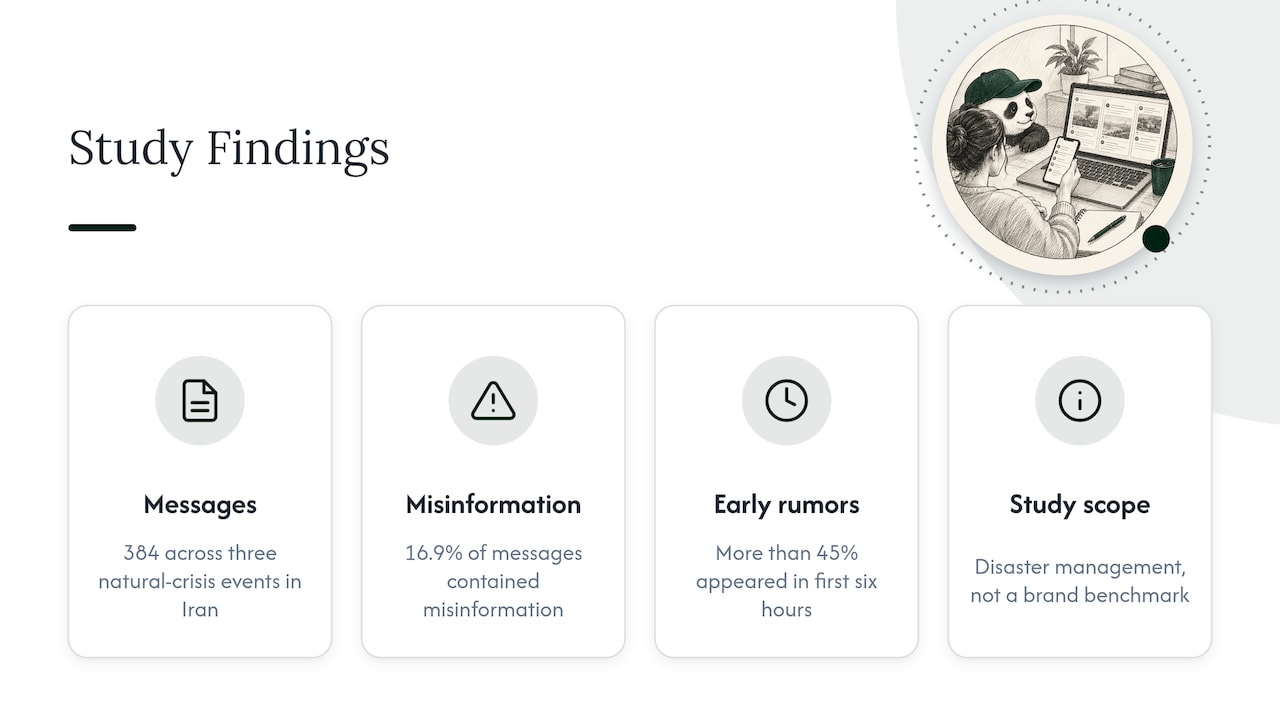
The window is short. A 2026 study of AI-supported social media monitoring in natural crises in Iran analyzed 384 messages across three events. It found 16.9% contained misinformation, and more than 45% of rumors appeared in the first six hours. The setting was disaster management, not brand reputation, so treat the numbers as an illustration of timing rather than a benchmark for your industry. The lesson travels well: early hours shape the narrative, and a team that learns about a problem the next morning is already responding to a story someone else has written.
Clustering conversations into narratives
Raw post counts mislead. Better systems group posts into narratives, such as “the product is unsafe” or “the CEO said something offensive,” and track each narrative over time. You then watch the story, not the individual posts. Cross-channel investigation adds another layer: linking originating and amplifying accounts, resolving identities across platforms and preserving the evidence trail for later reporting.
Multilingual, multi-source coverage
Crises rarely stay in one language. A complaint in a Chinese-language community can reach Western press within a day, and the reverse is equally true. If your monitoring only reads English, you will see the fire when it crosses the border. For brands operating across markets, language coverage and platform coverage matter more than any dashboard feature. We come back to this in our perspective below.
What happens after the alert: AI in crisis communications
Detection is half the job. Once an issue is flagged, AI helps communications teams with:
Triage. Ranking mentions by reach, author influence and risk so the team reads the right 20 items instead of 2,000.
Tracking. Showing how a story develops across markets and channels, so you know whether your statement is landing.
Drafting support. Producing first drafts of holding statements, Q&A documents and internal briefings for human editing.
Scenario testing. A 2026 peer-reviewed paper in MDPI Systems proposes a sentinel layer that turns social, news and forum text into topics, sentiment, anomaly scores and risk labels. Those signals then condition simulated stakeholder discussions, with human review gates between stages. The design shows where the field is heading: AI proposes, people approve.
Once your position is settled, distribution matters. Pushing a clear statement out through press release distribution puts your official account in front of journalists and readers quickly, which helps displace speculation with a primary source.
For a tactical playbook on the opening phase, see our guide to social media crisis management and the first 90 minutes. If influencers are part of your mix, our influencer brand safety checks cover how to monitor partners before they become the story.
Limits and risks: where human review is essential
AI monitoring is fast and wide. It is also fallible, and in a crisis, errors are expensive.
Sentiment misreads. A 2024 study from the HERMES journal compared automated sentiment analysis with manual tagging. It found that AI classifies large volumes of reputation data quickly but can misclassify pragmatic features, non-English content, emotional cues and multimodal communication. Sarcasm, memes, screenshots and regional slang are exactly where a crisis often brews.
Hybrid beats automated. A 2026 master’s research study found AI tools detected early reputation-crisis signals faster, while human evaluators gave stronger contextual reasoning. Its conclusion supports a hybrid human and AI model, not fully automated judgment.
Systemic gaps. A systematic review of 68 peer-reviewed studies describes AI-powered social listening as a strategic crisis capability, using transformer-based language models, multimodal AI and anomaly detection. It also names the limitations: bias, platform gaps, synthetic media and governance. Closed groups, private messaging and platforms that restrict data access sit outside most tools’ view.
Acting on unverified facts. The IAEA warns that AI tools can help authorities warn and inform people, including through translation, but become risky when deployed before facts are verified. It stresses privacy, transparency and clear opt-in mechanisms for public confidence. Its broader view is that AI is both an amplifier and a filter in misinformation-rich crises, so human judgment stays the anchor.
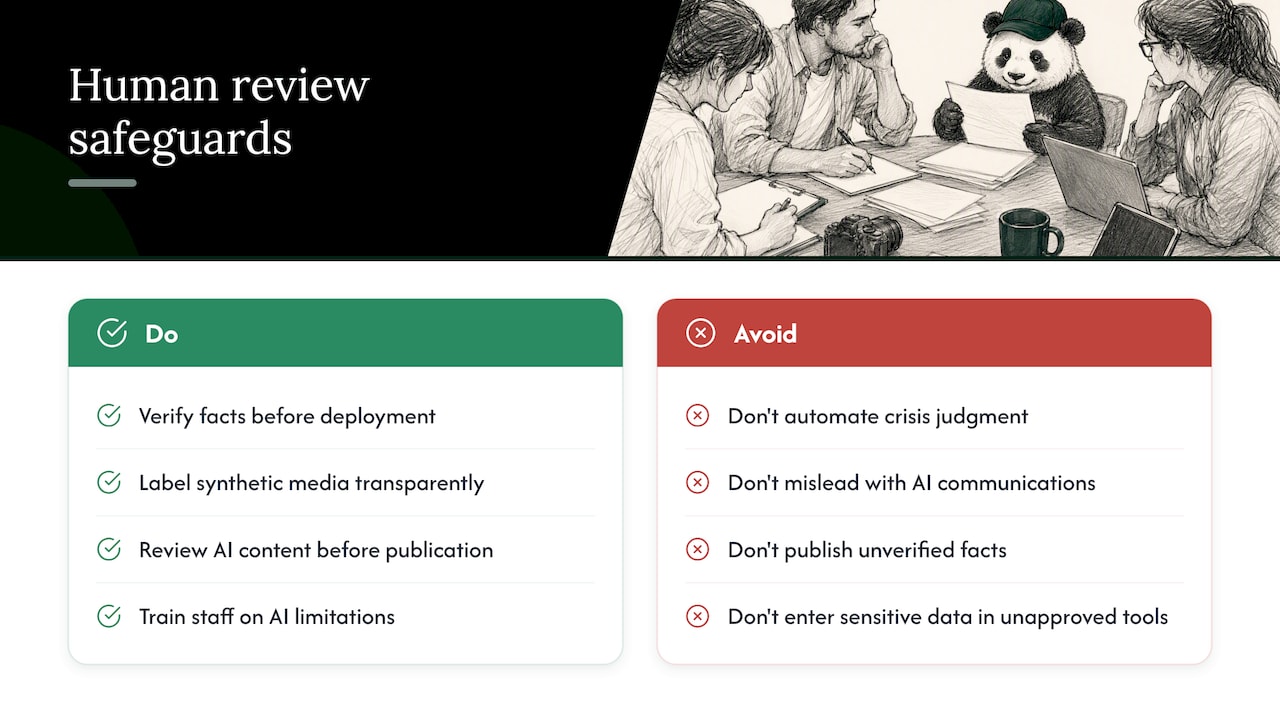
Synthetic content. Deepfakes, impersonation and fabricated screenshots are now part of the threat set. The U.S. Department of State’s May 2026 meeting summary recommends that official AI-assisted communications not intentionally mislead, that synthetic media be labeled transparently, and that practitioners be trained in AI limitations, bias and critical thinking.
Data hygiene. The World Council of Churches’ AI usage policy lists risks including bias, hallucinations, flawed reasoning, misrepresentation and disinformation. It requires human review of AI-generated content before publication and tells staff not to enter information they would not share with a stranger unless the tool is leadership-approved. That is a sound rule for any team pasting a draft statement into a chatbot at midnight.
The rule that follows: let AI decide what you look at first. Let people decide what you say, and when. For more on why human judgment matters when interpreting AI alerts, this perspective on AI informing decisions makes the same argument in a different industry.
How to set up AI monitoring, alerts and escalation
Tools come last. Start with the workflow. The College of Policing’s framework for managing information disorder is written for policing, but its sequence transfers cleanly to corporate teams: prepare monitoring, assessment, triage and timely escalation; log the source, time, channels, content and initial reach; assess likelihood, scale and impact; decide on a response; respond proportionately; then evaluate effectiveness.
Here is how we would translate that into a setup.
Step 1: Define what counts as a crisis
Write it down. Product safety claims, executive conduct, data breaches, regulatory action, viral customer complaints and partner scandals each carry different severity. Assign a tier (watch, elevated, critical) to each type.
Step 2: Choose sources by where your audience lives
List the news outlets, platforms, forums and languages that matter in each market. For companies operating in China and the West, that means covering both ecosystems, not assuming one feed tells the whole story.
Step 3: Set thresholds on trajectory, not totals
Alert on rate of change, new high-reach amplifiers and shifts in narrative, not only on raw negative counts. Add persistence rules so a one-hour blip does not wake the whole leadership team. Alert fatigue kills monitoring programs faster than missed alerts do.
Step 4: Name owners and handoffs
Every tier needs a named person who receives the alert, a deputy, and a deadline for the first assessment. Decide in advance who approves statements, who talks to legal, and who briefs the CEO.
Step 5: Log and review
Record each incident: source, time, channels, content, reach, decision, outcome. After the incident, test whether the alert fired early enough and whether the threshold was right. Adjust.
Step 6: Rehearse
Run a tabletop exercise each quarter with a realistic scenario. If the first time your team sees an escalation alert is during a real one, the workflow is untested. Our 90 day reputation plan with AI-aware monitoring lays out how to phase this in, and our guide to AI content governance covers the rules for AI-drafted communications.
Our perspective: velocity needs cultural fluency
Most conversation about AI crisis monitoring is about speed. Speed matters, but we see teams fail for a different reason: they detect the signal and misread it.
At Align, we work across Western and Chinese markets, and the same event reads differently depending on platform, language and audience norms. A joke that lands in one market can read as an insult in another. A creator controversy can start on one platform and be invisible on another until it reaches mainstream press. An English-only dashboard flags none of that.
So our view is simple. AI-driven execution handles the scanning, clustering and first-pass triage. Senior people with cultural fluency handle interpretation and the decision. We treat AI as the layer that clears the noise so leaders can spend their attention on judgment, which is the one thing the system cannot supply.
We also believe monitoring should not start on the day of the crisis. Brands with a clear corporate narrative and defined positioning recover faster, because they know what they stand for and can say it in the first hour. Monitoring tells you something is happening. Positioning tells you how to answer.
— Kalle
Working with Align on monitoring and crisis readiness
If you are a marketing or communications leader building crisis readiness across markets, we can help you design the workflow, set the escalation tiers and connect monitoring to brand strategy, creator programs and paid media. Our teams combine Scandinavian brand thinking with fast, market-specific execution, so your response is both consistent and local. See our services or book a strategy call to talk through your current setup.
What to look for in an AI monitoring tool
Whatever you buy, test it against these criteria:
Language and platform coverage. Does it read the languages and platforms your customers use, including video and image content?
Trajectory alerts. Can you set alerts on acceleration and narrative change, not just keywords?
Explainability. Can an analyst see why an item was flagged and trace it to the original post?
Source filtering. Can it separate journalists, regulators and high-reach accounts from background noise?
Audit trail. Does it preserve provenance so you can report on what happened and when?
Data handling. Where does your data go, and can it be used to train other models?
Run a trial on a past incident. Feed the tool the days before a real issue you faced and see whether it would have warned you, and how early. That test tells you more than any demo.
For measuring whether your reputation work is paying off over time, our guide to brand lift measurement is a good next step. If you are formalizing AI use more broadly, read about AI brand strategy.
FAQ
What is AI in crisis monitoring?
It is the use of machine learning and language analysis to scan news, social media and forums for signs that a reputation threat is forming. It flags spikes in negative comments, rising narratives and influential amplifiers so a team can assess them early. People still make the decisions about response.
How is AI crisis monitoring different from social listening?
Social listening describes what people are saying and measures things like mention volume, sentiment and themes. Crisis monitoring adds a risk layer focused on speed, hostility and coordination, and it triggers escalation when conditions change. Most crisis programs use social listening as one of their inputs.
Can AI replace a PR or communications team in a crisis?
No. Research points to a hybrid model: AI detects signals faster, while human evaluators reason better about context. Sentiment tools can misread sarcasm, non-English content and images, and AI-written statements need human review before publication.
How fast do I need to detect a crisis?
As early as you can. In one study of AI-supported monitoring during natural crises, more than 45% of rumors appeared in the first six hours. Corporate crises differ, but the pattern holds: the early hours shape the story, so set alerts and owners before you need them.
What should I do first if I have no monitoring in place?
Define your crisis types and severity tiers, list the sources and languages your audience uses, and name who receives alerts and who approves statements. Choose a tool after that, and test it against a past incident.
Sources
Nexus: AI-supported social media monitoring for natural-crisis management
IAEA: Artificial intelligence, misinformation and emergency communication
Recommended
RELATED INSIGHTS


LET’S TALK
What are you trying to grow next?
Brand, launch, market entry or performance. Book 30 minutes and tell us what you’re working on.