•

Build AI Content Governance in 6–8 Weeks for Marketing Teams
AI content governance is the set of policies, controls, and workflows that manage the lifecycle of AI-generated content. The goal is trust, accuracy, compliance, and a record you can defend later. Start this week with an output audit: log the model, the prompt, the generated output, the reviewer, and the final approval for every AI-assisted piece you publish.
TL;DR:
Most AI-generated content is scattered across various platforms, requiring inventorying tools and content types to manage risk effectively.
Risk tiers should be assigned based on content sensitivity, with higher tiers necessitating more rigorous review, sign-off, and provenance documentation.
Provenance records must include model details, prompts, sources, approvals, and publication info to support accountability and incident investigation.
Governance workflows need to involve legal, security, and marketing teams, with clear policies on acceptable use, disclosure, copyright, and bias prevention.
Regular monitoring, audit trails, and incident management are essential, especially for high-risk content, with disclosures mandated under the EU AI Act unless a human sign-off applies.
AligntccBring More Structure to AI MarketingAlign TCC helps fast-growing companies combine AI, creativity, and sharper positioning across changing markets and audiences.Explore Align TCC
Table of Contents
What AI content governance covers: definition and scope
Core pillars and policy areas teams must define
Operational implementation: inventory, classification, and tooling
Designing risk-tiered review workflows and quality gates
Monitoring, audit trails, incident management, and regulatory disclosure
Governance as a management system: roles, PDCA cycle, and KPIs
Align TCC perspective and practical starter templates
What the standards get right, and where teams still get stuck
How Align TCC can help you build this
Sources
FAQ
What AI content governance covers: definition and scope
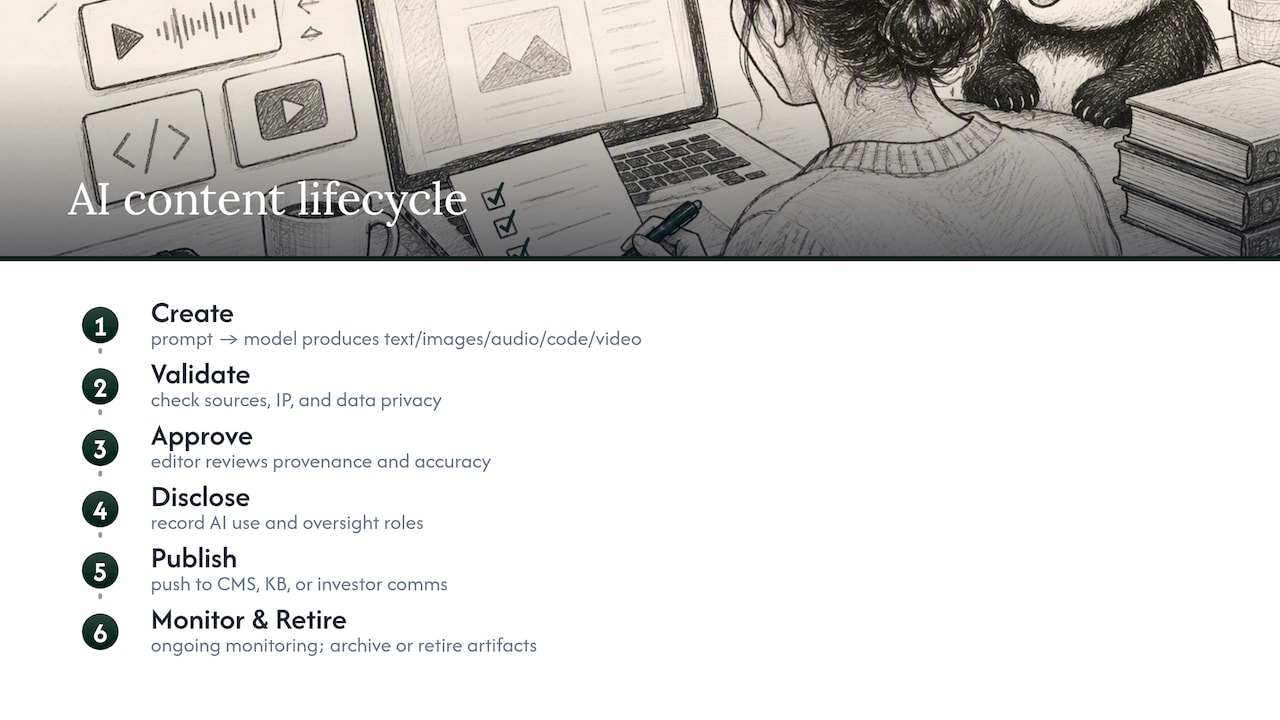
AI content governance is not model governance. Model governance asks whether a system is safe, fair, and well-tested before deployment. Content governance picks up after that: it tracks every artifact a model produces, text, images, audio, code, or video, from the moment a prompt is written to the moment the piece is published, archived, or retired. That lifecycle view matters because risk does not live in the model alone. It lives in the prompt someone typed at 11 PM, the source material an assistant pulled from, and the editor who approved the final draft without checking either.
NIST’s Generative AI Profile draws this distinction clearly, organizing risk management around Govern, Map, Measure, and Manage functions, and recommending inventories that record provenance, model versions, human-oversight roles, and intellectual property or sensitive-data considerations. Content governance operationalizes that thinking at the artifact level rather than the system level.
This is also why governance fails when one team owns it alone. A content piece touches your CMS, your brand guidelines, your legal review process, your customer support knowledge base, and sometimes your investor communications. A single marketing coordinator cannot police copyright risk, data privacy, and factual accuracy at once, and should not have to. AI content governance works as an organization-wide system of policies, roles, and review workflows governing how AI-generated material is created, validated, approved, disclosed, published, monitored, and eventually retired, which means ownership has to span legal, security, marketing, and the business units that rely on the output. Treat it as a cross-functional system from day one, or rebuild it as one later, usually after an incident forces the conversation.
Core pillars and policy areas teams must define
Every governance program rests on a handful of written policies. Skip any one of them and you are improvising under pressure later.
Acceptable use: name the approved tools, forbid pasting customer PII or confidential data into prompts, and specify which content types require human drafting versus AI assistance.
Provenance and disclosure: define what gets logged for every artifact and when a human-visible AI disclosure is required on the published piece.
Source and copyright: require a check for licensed, trademarked, or personal material before anything generated from retrieval or reference sources goes live.
Quality and accuracy: set a fact-check threshold, especially for statistics, dates, and claims about competitors or regulated topics.
Bias and harm: review generated content for stereotyping, exclusionary language, or claims that could mislead a protected group.
Sensitive data and security: restrict which systems can connect to generative tools and audit for data leakage quarterly.
For each artifact, the provenance record should capture the model name and version, the exact prompt and system instructions, any retrieval sources used, the generated output itself, the human editor, the reviewer, the approval status, and the final publication location. NIST’s Generative AI Profile recommends exactly this kind of record to support both governance and incident reconstruction after the fact. Build it as a simple spreadsheet or a CMS custom field before you build anything fancier.
Prohibited uses deserve their own short list rather than a buried clause: no AI-generated content impersonating a named executive without sign-off, no synthetic customer testimonials, no AI-drafted legal or financial guarantees without counsel review, and no unsupervised AI responses in regulated communications like investor updates. When someone breaks a rule, escalation should go to a named governance lead within one business day, not sit in a shared inbox.
Pro Tip: Write your acceptable-use policy as a one-page checklist your team can screenshot, not a ten-page document nobody opens before a deadline.
Operational implementation: inventory, classification, and tooling
Governance starts with knowing what you already have running. Most teams discover they have more AI-touched content than anyone tracked, scattered across blog posts, ad copy, social captions, and internal knowledge bases, making AI content repurposing workflows a valuable approach for managing and maximizing this material efficiently.
Build the inventory first. List every AI tool in active use, who uses it, what content type it produces, and whether it touches customer data or public claims.
Score each entry for risk. Weigh exposure to legal claims, brand reputation, regulated topics, and the size of the audience the content reaches.
Assign risk tiers. A low-risk tier might cover internal brainstorming drafts; a high-risk tier covers public statistics, executive quotes, or anything touching health, finance, or legal claims.
Match tooling to the tier. Low-risk content might need only a prompt log. High-risk content needs a response logger, a review queue, and CMS metadata fields that travel with the asset through publication.
Pilot before you scale. Run the inventory and tiering on one content stream, such as the blog or paid social, before rolling it out company-wide.
NIST’s framework recommends this same sequence at a program level: inventory systems and use cases, classify by risk, assign accountable owners, define acceptable inputs and outputs, specify human-review gates, and test for quality, bias, privacy, and intellectual property concerns before anything ships.
Minimal tooling does not require a new platform purchase. A prompt registry can be a shared document with version history. A response logger can be a CMS field that stores the model name and prompt alongside the draft. The review queue can live in your existing project management tool, provided someone owns moving items through it. Teams managing high content volume, including workflows built around tools like those discussed in AI-driven content strategy at scale, tend to find that the metadata fields matter more than the software wrapped around them.
Designing risk-tiered review workflows and quality gates
Not every piece of AI-assisted content deserves the same scrutiny. A tiered system keeps your reviewers focused on what actually carries risk.
Low tier covers internal brainstorming, first drafts, and meeting notes. A quick self-check is enough; no formal sign-off required.
Medium tier covers blog drafts, social captions, and internal documentation. This tier needs:
A fact-check pass on any statistic, date, or named claim
A brand voice and tone check against existing guidelines
A basic SEO review when the content targets search traffic
High tier covers public-facing claims, product comparisons, and customer-facing FAQs. Add to the medium checklist:
Subject-matter expert sign-off on technical or regulated claims
An intellectual property and source check for any retrieved or referenced material
A disclosure decision: does this need a visible AI-generated label
Critical tier covers executive communications, investor relations, crisis comms, and realistic synthetic media. Every item above applies, plus a named executive or legal sign-off before publication and mandatory provenance retention for audit purposes.
Retention matters as much as the checklist. Keep the full provenance record, the model and version, prompt, sources, editor changes, reviewer identity, and approval decision, for at least as long as your legal team requires record retention for marketing claims, and longer for anything in the high or critical tiers. That record is what lets you reconstruct exactly what happened if a claim gets challenged or a regulator asks questions.
Monitoring, audit trails, incident management, and regulatory disclosure
Publishing is not the finish line. Monitor published content for factual drift, broken claims as facts change, and unexpected audience reactions that suggest a piece landed wrong. Automated checks can flag outdated statistics, dead links, or flagged language patterns on a recurring schedule.
When something goes wrong, your retained provenance record becomes the investigation tool. Pull the model version, the original prompt, the sources used, and the approval chain to reconstruct exactly how the problematic content came to exist, then fix the gap in your process, not just the published piece. A reputation monitoring approach similar to the one outlined in AI-aware monitoring for growth teams applies the same logic: watch for signals, then trace them back to a cause.
Statistic callout: Article 50 of the EU AI Act requires providers and deployers to mark AI-generated audio, image, video, and text in a machine-readable, detectable format, and deployers publishing AI-generated text on public-interest topics must disclose that generation unless human editorial responsibility applies. That exception is the one most marketing teams miss: a human editor taking real responsibility for the final piece can change the disclosure requirement.
Internal provenance and public disclosure are two different decisions with two different triggers. Your internal record exists for your own accountability and for regulators who ask. Public disclosure exists for your reader, and the Code of Practice on transparency clarifies that these fields should be kept separate in your workflow, not merged into one checkbox.
Pro Tip: Build your disclosure decision into the same CMS field as your provenance log, so the question gets asked before publication, not after someone complains.
Governance as a management system: roles, PDCA cycle, and KPIs
Governance is not a document you file once. ISO 42001 frames it as a management system, built on a Plan-Do-Check-Act cycle, because models, vendors, and use cases keep changing underneath your policies.
A simple RACI works for most marketing teams: a governance lead is Accountable, content creators and reviewers are Responsible, legal and security are Consulted on high and critical tier items, and leadership is Informed through quarterly summaries. A small governance committee, pulling from marketing, legal, and security, should meet monthly to review flagged incidents and quarterly to update policy.
Track a handful of KPIs: the percentage of artifacts with complete provenance records, average time-to-review by tier, incidents discovered versus incidents prevented, and audit coverage across your content inventory. These numbers tell you whether the system is working or just exists on paper.
Align TCC perspective and practical starter templates
Some agencies build AI-enhanced content operations for growing brands, pairing Scandinavian brand thinking with fast commercial execution. A practical starting point: run a six to eight week audit and pilot, covering one content stream, a policy checklist summary, and a risk-tier mapping before scaling company-wide. Teams with simple workflows often manage this internally. Teams publishing at volume, across markets, or under regulatory scrutiny often benefit from outside expertise to build the system effectively the first time.
What the standards get right, and where teams still get stuck
The frameworks are sound. NIST, ISO 42001, and the EU AI Act’s Article 50 all point toward the same conclusion: log everything, tier your risk, and treat governance as ongoing rather than a one-time policy sprint. Where most teams stumble is not understanding the standards. It is assuming governance means slowing everything down.
The conventional advice treats governance as a brake. The more useful frame is a provenance habit: capture the model, the prompt, and the approval at the moment content is created, and the rest of the system becomes almost automatic. Teams that wait to build this until a legal question forces their hand spend months reconstructing records that should have taken seconds to log in real time.
Prioritize the output audit before anything else. Skip the elaborate tooling search. A spreadsheet with the right columns, used consistently, beats a sophisticated platform nobody fills out correctly.
— Kalle
How Align TCC can help you build this
Some firms pair AI-driven execution with brand strategy, content operations, and go-to-market work, so governance becomes part of how marketing content is produced, not a separate burden layered on top.

If you are weighing whether to build this internally or bring in support, our services page outlines where Commercial Strategy, Brand & Positioning, and content operations work meet. Book a conversation and we will map your content inventory against risk tiers together.
Sources
Artificial Intelligence Risk Management Framework: Generative Artificial Intelligence Profile — NIST
AI Content Governance: How to Manage Generative Output with Control and Accountability | Snowflake
FAQ
What is AI content governance in simple terms?
AI content governance is the set of policies, roles, and review steps that control how AI-generated text, images, audio, and video get created, checked, approved, and published. It covers the full lifecycle of a piece of content, from the prompt that created it to where it lives after publication, according to Snowflake’s governance framework.
How is content governance different from AI model governance?
Model governance evaluates whether an AI system itself is safe and reliable before anyone uses it. Content governance tracks individual outputs, the prompts, sources, reviewers, and approvals behind each published piece, which is the layer NIST’s Generative AI Profile addresses through its provenance and inventory recommendations.
When does AI-generated content need a public disclosure label?
Under Article 50 of the EU AI Act, deployers publishing AI-generated text on public-interest topics must disclose the generation unless a human editor takes real editorial responsibility for the content. Outputs like audio, image, and video generally require machine-readable marking regardless of topic.
What should a provenance record include for each piece of content?
A solid provenance record captures the model name and version, the exact prompt, any retrieval sources, the generated output, the human editor and reviewer, the approval decision, and the final publication location. This matches the recordkeeping NIST recommends for both governance and incident reconstruction.
How often should a governance policy be reviewed?
ISO 42001 recommends treating governance as a management system with a Plan-Do-Check-Act cycle, reviewed periodically rather than written once and left alone. A quarterly policy review paired with monthly incident check-ins keeps the program aligned with how fast AI tools and use cases change.
Recommended
RELATED INSIGHTS



LET’S TALK
What are you trying to grow next?
Brand, launch, market entry or performance. Book 30 minutes and tell us what you’re working on.