•

AI Brand Strategy for Ambitious Brands: Govern AI, Protect Brand DNA
Treat AI as a strategic layer that amplifies brand decisions, never a shortcut around them, and only when you feed it a governed, machine-readable Brand DNA. Without that foundation, AI defaults to generic outputs that sound like everyone else. The two moves that matter most right now: codify your Brand DNA in a format machines can read, and build trust controls before you scale anything.
TL;DR:
Document core claims, tone rules, category codes, and approved sources in Brand DNA that machines can read, so every agency and model follows consistent rules.
Use AI for discovery and early engagement, but keep people involved in decisive judgment calls because customer attitudes toward automation are polarized.
Assign named ownership, record asset provenance, test tone and factual accuracy before release, and monitor outputs through a defined incident disclosure process.
Pilot one campaign, score outputs against tone rules and factual accuracy, define human approval before launch, and track brand KPIs alongside efficiency measures.
Brands can move from a tested use case to monitored scale in 90 to 180 days, reviewing prompt and model updates for brand drift.
AligntccKeep AI Aligned With Your BrandAlign TCC combines brand thinking with AI-enabled marketing processes to help companies sharpen positioning and engage audiences across markets.Explore Align TCC
Table of Contents
How AI is changing brand strategy and positioning
Where AI changes brand outcomes, not just production speed
Governance leaders should adopt: ISO 42001 and the NIST AI RMF
A roadmap for integrating AI without losing distinctiveness
Ethical considerations beyond governance checklists
Our perspective on where AI earns its place in brand strategy
Put AI brand strategy to work with our team
FAQ
Sources
How AI is changing brand strategy and positioning
Brand strategy used to run on intuition, workshops, and a handful of annual research sprints. AI changes the tempo. Insight cycles that took quarters now take days, and decisions that once needed a committee can be tested against scenarios in an afternoon. That speed is real leverage, but it cuts both ways.
The risk is sameness. When brands lead with “we use AI” instead of what they believe, the outputs start to blur together, because the same models trained on the same data tend to produce the same tone, the same structure, the same safe choices. Positioning has to root in something that does not change every time a vendor ships a new model: a Brand Belief that is specific, durable, and yours.
There is a newer wrinkle too. AI agents now research, compare, and sometimes transact on a customer’s behalf, which means your brand needs to be legible to software as well as people. The World Economic Forum’s analysis of agentic AI found that brands need to encode their values and intent clearly enough that an agent acting for a customer represents them accurately, without a human ever reading the fine print.
What this means in practice:
Insight and testing cycles compress from months to days, raising the bar for how fast strategy teams need to validate decisions.
Brands that foreground tools over beliefs risk producing interchangeable messaging across a category.
Agentic commerce requires brand assets that are structured for machine parsing, not just human reading.
Where AI changes brand outcomes, not just production speed
The use cases that matter are the ones that move brand metrics, not just output volume. A few stand out as high-leverage starting points.
Customer research and trend detection. AI speeds up segmentation and lets teams run scenario tests against shifting consumer behavior far faster than traditional focus groups allow.
Message generation governed by Brand DNA. Generative tools can draft at scale, but only a documented set of tone rules, approved claims, and category codes keeps that output recognizably yours instead of generic.
Content systems and personalization. Templates and programmatic creative let a single campaign flex across channels and audiences while keeping brand expression consistent, something we cover in more depth in our breakdown of AI marketing workflows.
Customer experience design. Hybrid journeys now blend human staff with AI agents, which means CX design has to account for handoffs, not just automation.
The World Economic Forum’s research on consumer attitudes toward AI found that adoption is polarized. Some customers accelerate toward AI-driven discovery, while others insist on human involvement at decisive moments. A blended model, AI for discovery and early-stage engagement, humans for judgment calls, serves both groups without alienating either.
Pro Tip: Pilot message generation on a single campaign first and score outputs against your tone rules before scaling to always-on content production.
Governance leaders should adopt: ISO 42001 and the NIST AI RMF
Governance is not a compliance afterthought. It is what protects the brand trust you have spent years building. Two frameworks give leaders a practical structure to work from.
ISO/IEC 42001 is the global standard for AI management systems, built on a Plan-Do-Check-Act cycle that covers leadership, planning, operation, and continual improvement across the AI lifecycle. The NIST AI Risk Management Framework organizes trustworthy AI practice around four functions: govern, map, measure, and manage, and its Generative AI profile adds specific guidance on content provenance, testing, and incident disclosure.
Turning either framework into practice means a short list of operational commitments:
Assign clear ownership for AI decisions inside the brand or marketing team, not a vague “IT handles it.”
Document the datasets and provenance behind any AI-generated brand asset before it ships.
Run pre-deployment testing against brand tone rules and factual accuracy, not just grammar.
Monitor outputs continuously and define how incidents get disclosed internally and externally.
A World Economic Forum analysis of consumer industries identifies trust erosion as the most significant brand risk tied to AI outputs, which makes human-in-the-loop accountability a safeguard, not a brake on speed.
These are not bureaucratic checkboxes. A brand that can show provenance, testing, and human review has a defensible answer when a customer, regulator, or journalist asks how an AI-generated claim got made.
A roadmap for integrating AI without losing distinctiveness
Most brands can move through this in 90 to 180 day cycles without overhauling their entire marketing stack.
Build a machine-readable Brand DNA package. Document your core claims, tone rules, category codes, and approved data sources in a format that any AI tool, or any agency partner, can ingest consistently. This is the single highest-leverage step, because every downstream output depends on it.
Run a targeted pilot. Pick one use case, set brand KPIs alongside efficiency KPIs, and define exactly where a human reviewer has to sign off before anything publishes.
Scale with guardrails in place. Build prompt libraries tied to your Brand DNA, stand up monitoring dashboards, and set a cadence for reviewing model and prompt updates so drift gets caught early. Our notes on AI-aware reputation monitoring walk through what that cadence looks like in practice.
Measure brand signals alongside output volume. Track distinctiveness and trust metrics, not just content throughput, so you know whether AI is strengthening the brand or just producing more of it.
One practical note on channel rollout: Brand DNA only holds up if it travels consistently across physical and digital touchpoints. Signstream’s guidance on applying brand standards to digital screens is a useful reference for teams extending governed brand assets into signage and in-store displays, a channel that often gets overlooked until inconsistencies show up.
Pro Tip: Set your human-review gate before the pilot starts, not after the first output surprises you.
Ethical considerations beyond governance checklists
Governance frameworks cover process. They do not automatically cover judgment. A brand can pass every ISO 42001 checkpoint and still make choices that erode trust.
Representation is one example. AI-generated imagery and copy can flatten cultural nuance or default to stereotypes unless someone actively checks for it, especially when a brand operates across multiple markets with different norms around identity and representation. Transparency is another: customers increasingly expect to know when they are interacting with an AI agent rather than a person, and burying that distinction, even when legal, chips away at trust over time.
There is also a question of attribution and labor. Generative tools trained on existing creative work raise fair questions about originality and credit that a brand’s legal team may clear while its creative team still feels uneasy. Ambitious brands tend to get ahead of this by being explicit, internally and sometimes publicly, about where AI assists and where human judgment makes the final call.
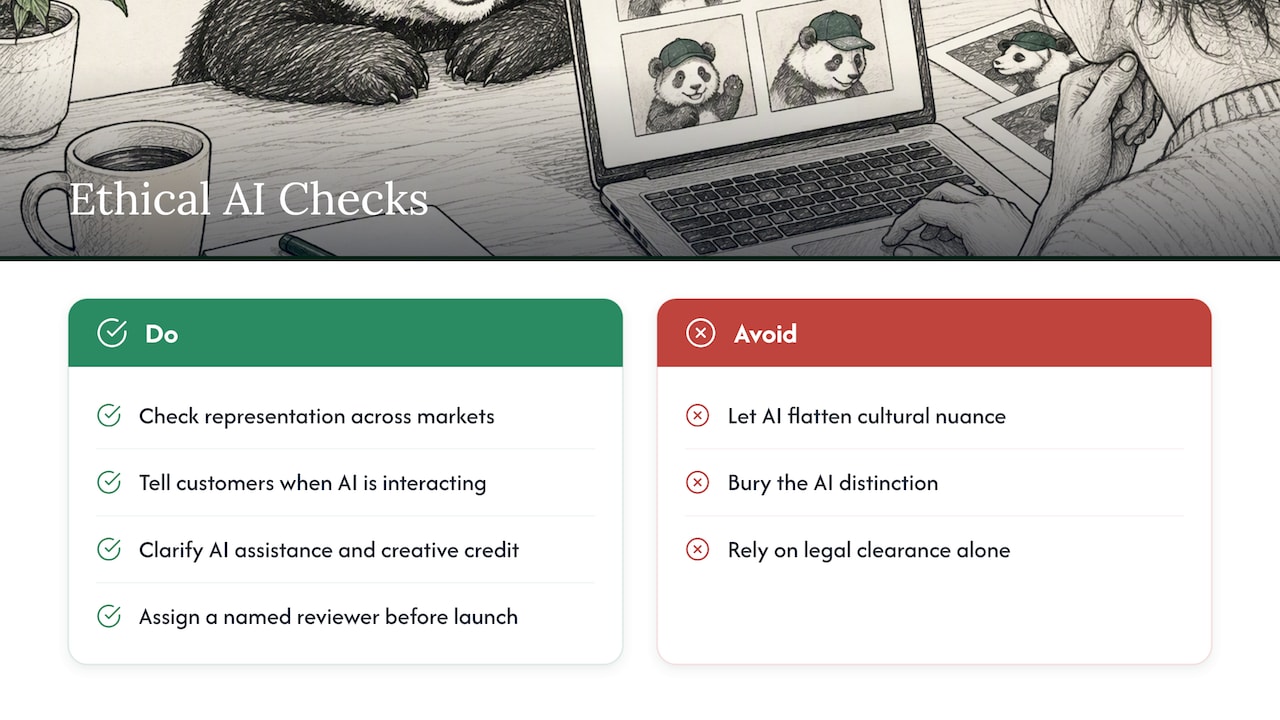
None of this is a reason to slow adoption. It is a reason to put a named person, not a policy document, in charge of asking these questions before a campaign ships. How AI describes your business online is worth reading alongside this, since the same legibility questions that apply to agentic commerce apply to how AI systems summarize and represent a brand to the public.
Our perspective on where AI earns its place in brand strategy
We build brand strategy by combining Scandinavian brand thinking, which prizes a clear, enduring belief, with commercial execution methods. AI fits into that combination as an amplifier, not a replacement for either discipline.
We treat Brand DNA as the governed layer every AI-assisted output has to pass through: documented claims, tone rules, and approved sources that keep messaging recognizable whether a human or a model drafted the first version. The discipline is less about the tool and more about what it is allowed to touch.
— Kalle
Put AI brand strategy to work with our team
We help ambitious brands turn AI from a production shortcut into a strategic layer, pairing Commercial Strategy and Brand & Positioning work with governance disciplines. If you are entering a new market, our related services and leadership trips pair well with the brand groundwork described above.
Ready to build a governed, AI-ready Brand DNA? Explore our services and get in touch to start the conversation.
FAQ
What does “AI brand strategy” actually mean?
AI brand strategy means using AI tools to accelerate research, messaging, and content decisions while keeping a documented Brand DNA, your core beliefs, tone rules, and approved claims, as the governing layer. Without that layer, AI tends to produce generic output that could belong to any competitor.
How do I keep AI from making my brand sound generic?
Feed AI tools a machine-readable Brand DNA package covering your tone rules, category codes, and approved messaging before using them for drafting or ideation. Review early outputs against that package, not just for grammar, and tighten the rules wherever the model drifts toward generic phrasing.
What is the NIST AI Risk Management Framework?
The NIST AI RMF is a voluntary framework organized around four functions, govern, map, measure, and manage, that helps organizations build trustworthy AI practices. It includes a Generative AI profile with specific guidance on provenance, testing, and incident disclosure.
Do I need ISO/IEC 42001 certification to use AI responsibly in marketing?
Certification is not required to start, but ISO/IEC 42001 offers a practical Plan-Do-Check-Act structure for governing AI across its lifecycle, even informally. Many brands adopt its principles, like documented ownership and continual review, before pursuing formal certification.
How does Align TCC help brands integrate AI into their strategy?
We combine Brand & Positioning and Commercial Strategy work with AI-enabled execution, using a governed Brand DNA to keep AI-assisted output distinctive rather than generic. Pricing depends on scope and is available by reaching out through our services page.
Sources
NIST AI Risk Management Framework (AI RMF) — Generative AI profile
Agentic AI requires a rethink of the customer experience | World Economic Forum
Recommended
RELATED INSIGHTS



LET’S TALK
What are you trying to grow next?
Brand, launch, market entry or performance. Book 30 minutes and tell us what you’re working on.