•

TikTok Ads for Brands: Formats, Spark Ads and Strategy
TikTok ads work for brands when they stop looking like ads. The platform rewards native, creator-led video with a clear hook and early branding, and it punishes polished spots that ignore how people scroll. This guide covers how to structure a TikTok advertising program: objectives, Spark Ads, creative, testing, measurement, how Douyin differs, and the disclosure rules to respect.
It is written for marketing leaders at ambitious brands who need a program that scales, not a one-off boosted post.
AligntccBuild TikTok Campaigns That Fit Your BrandAlign TCC combines brand strategy, creator programs and market-specific execution to help brands engage audiences across platforms.Explore Align TCC
TL;DR
Pick the objective first. TikTok Ads Manager organizes campaigns into Awareness, Consideration and Conversion, and your goal decides everything downstream.
Spark Ads turn organic posts, yours or a creator’s, into ads that keep their native feel. They are the default format for creator-led programs.
Creative quality drives results. Positive emotion plus branding in the first two seconds is the pattern that research ties to brand memory.
Test in a loop and refresh early. Fatigue shows up fast on TikTok, so plan new creative before performance drops.
TikTok and Douyin are separate ecosystems. Do not copy one playbook onto the other.
Table of Contents
What TikTok ads do for a brand
Objectives and campaign structure
Spark Ads: the format most brands should start with
Creative that earns the next three seconds
Building a TikTok ad strategy
TikTok vs Meta ads: where each fits
Douyin vs TikTok: same parent, different game
Adapting ads across markets and rules
Our perspective
Working with Align on TikTok and creator programs
FAQ
Sources
What TikTok ads do for a brand
TikTok ads are paid video placements that appear in the feed alongside organic content. For brands the draw is not only reach. It is the ability to build awareness and drive sales from the same creative system.
The evidence is stronger than most skeptics expect. A 2024 Nielsen analysis of ten CPG brands in Indonesia and Thailand found TikTok ads delivered a 1.7 short-term return on ad spend and 2.2 times more long-term sales through brand equity than other measured non-TikTok channels. The same analysis found that running TikTok alongside television for at least four weeks produced a 9.4% incremental sales lift, the highest synergy among the media channels tested.

Two cautions. The study covers CPG in Southeast Asia, so treat it as directional for a US software or finance brand, not a forecast. And it measures channel mix: TikTok is strongest when it is planned as part of the media plan, not bolted on.
Objectives and campaign structure
According to Zapier’s guide to TikTok Ads, Ads Manager offers three objective families: Awareness, Consideration and Conversion. Sub-objectives include app installs, TikTok Shop and video views. Targeting runs on demographics, interests and behaviors, and the TikTok Pixel tracks conversions and helps optimize delivery.
A practical way to choose:
Your goal | Start with | Judge it by |
|---|---|---|
Be known in a new market | Awareness | Reach, video views, brand recall |
Grow a high-intent audience | Consideration | Engaged views, clicks, site visits |
Drive pipeline or sales | Conversion | Conversion rate, ROAS, cost per acquisition |
TikTok has also pushed further into the middle of the funnel. Its Brand Consideration objective was introduced in 2025 to help brands grow a high-intent, mid-funnel audience pool. If your sales cycle is long, as in most B2B, that middle layer is where TikTok earns its budget.
For B2B teams, one honest note: TikTok is rarely where a procurement decision is made. It is where a buying committee’s members, as consumers, form a first impression. Pair it with account-based channels so the impression gets followed up.
Spark Ads: the format most brands should start with
Spark Ads let a brand run an organic TikTok post as an ad, keeping the post’s native look, comments and engagement. The post can come from your own account or from a creator.
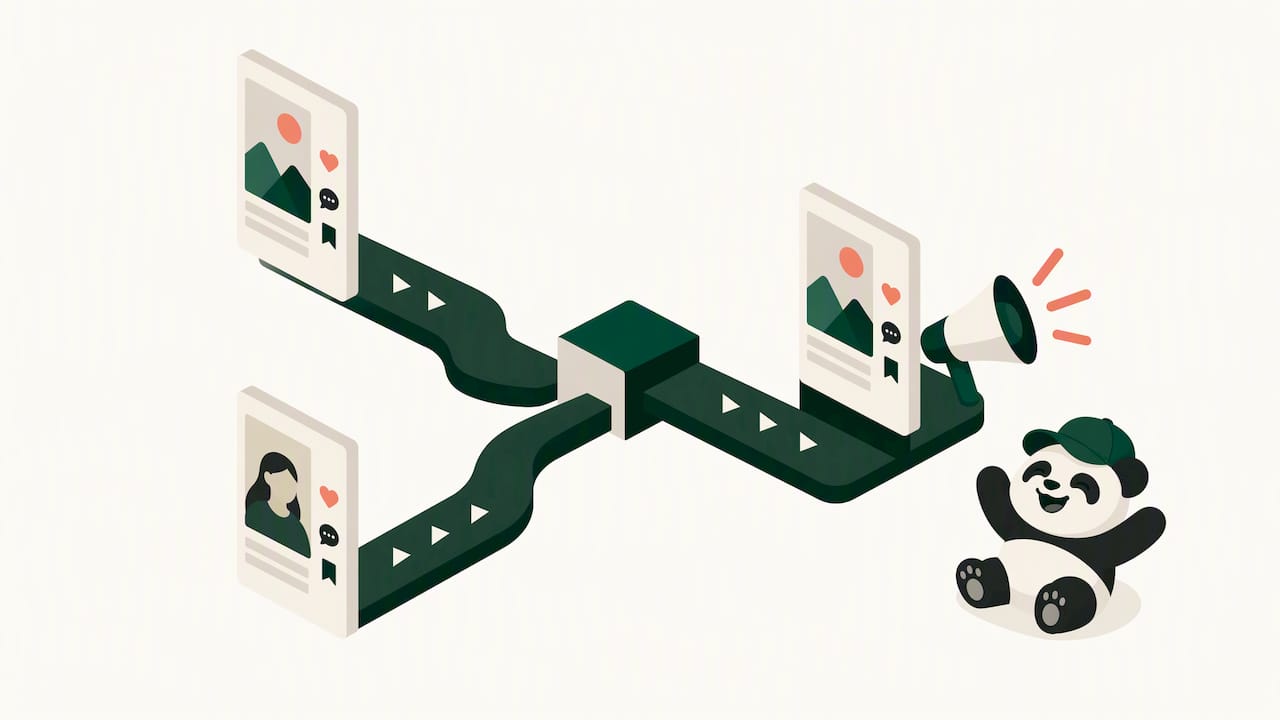
Why they work: TikTok told eMarketer in 2023 that Spark Ads can improve believability, perceived creator-brand alignment, engagement and view duration because the ad reads as native in-feed. Its advice was to let creators create rather than over-engineer the content. The logic is a halo: creator trust transfers to the brand, provided you keep the creator’s voice intact.
How to set up Spark Ads with creator content
The authorization flow, as laid out in JoinBrands’ help center, is short:
The creator posts the video and sends you the post URL and a Spark Code.
In Ads Manager, go to Assets, then Creative, then Spark Ads Posts, then Apply for Authorization.
Paste the code, search, review the post and confirm.
Create the campaign: choose an objective and configure campaign and ad group settings.
At ad level, enable the option to use a TikTok account to deliver Spark Ads, select the authorized account and post, complete the ad settings and submit.
Two details save headaches. Per Archive’s guide, captions cannot be edited after authorization, and creators choose the authorization window: 7, 30, 60 or 365 days. Settle the window and caption in the contract before posting, not after.
The contract is where most programs win or lose. Usage rights, exclusivity, authorization length and approval rounds all need to be in writing. We cover the full process in our guide to six-step influencer whitelisting.
When to use Spark Ads and when not to
Use them when you have creator content that already performs organically, when you want social proof (real comments and shares) attached to the ad, and when you plan to scale a proven post. Use standard in-feed ads when you need full control over the call to action, when the content is purely brand-produced, or when you have no creator relationship to authorize.
Creative that earns the next three seconds
Creative is the largest lever you control. Three findings are worth building into every brief.
Branding and emotion beat raw engagement. A WPP Media, System1 and TikTok analysis of 1,217 paid TikTok ads across eight markets found that Creative Quality, meaning positive emotion paired with early branding within two seconds, explained Brand Memory Lift 4.8 times better than the best engagement metric tested. Likes alone do not tell you whether people remember you.
Native beats polished. Ipsos reported that TikTok ads that look like native content are better received than traditional ads, with the brand still kept central. Ipsos also stresses that advertising fundamentals, strong branding and authenticity, still apply.
The hook is everything. The same Ipsos report notes that hooking viewers within three seconds is crucial, citing a Scrub Daddy ad that kept 86% of viewers for at least three seconds with a risqué, humorous opening.
Examples worth studying
Ipsos points to two. Scrub Daddy used humor and a strong hook to gain high recall. Duolingo used entertaining, humorous content featuring popular influencers. Different categories, same lesson: both blur the line between ad and organic content while keeping the brand unmistakable.
Steal the mechanics, not the jokes. Ask of any example: what happens in second one, when does the brand appear, and would this work with the sound on and the logo hidden?
A creative brief that fits the platform
Open with the payoff or the problem. No logo animation, no slow build.
Show the brand early, in product, voice, packaging or a verbal mention, inside two seconds.
Use real people. Shopify’s cited expert says creator testimonials with genuine on-screen feedback are common among best-performing ads.
Stay on-brand but stealthy. Admetrics argues the voice should match the brand while respecting the platform’s visual, authentic nature.
Shoot vertical, with sound, and write captions as if a friend posted them.
If you need volume without a studio shoot, our approach to outcome-first social content production shows how to plan one shoot into many cuts.
Building a TikTok ad strategy
A workable strategy has five parts, in this order.
Objective and audience. One primary goal per campaign, and a defined audience. Brandwatch’s guide frames a strategy as objectives, targeting, budget and content, then testing and measurement.
Budget. Fund testing separately from scaling. A common failure is judging a concept on too little spend, or scaling it on too little evidence.
Creative supply. Plan a steady pipeline of brand-made and creator content. One hero asset is not a strategy.
Testing. Treat it as a learning loop. One practitioner describes a matrix of hooks, angles and formats tested systematically rather than random variations. You can run this in a week; see our creative testing framework.
Refresh. TikTok recommends watching a fatigue index. According to eMarketer’s summary of TikTok’s advice, an index of 0.6 or higher, meaning high frequency but low reach, is a signal to refresh creative.
Measurement that holds up
The same eMarketer piece reports that TikTok advises a holistic attribution approach: combine click-through and view-through metrics, then add post-purchase surveys and conversion lift studies. That matters because TikTok often influences a purchase that closes elsewhere, in search or direct. Last-click alone will undercount it.
Track the metrics tied to your objective: reach and recall for awareness, engaged views and site visits for consideration, conversion rate and ROAS for conversion. Then bring spend, creative and outcomes into one view. A tool such as an AI-built PPC dashboard can turn exports from your ad platforms into charts and KPIs without a data team.
TikTok vs Meta ads: where each fits
The question is rarely which one wins. It is which job each does.
TikTok is strongest for discovery and attention, with creator-native video as the core unit.
Meta is strongest where you want mature retargeting, a broad mix of formats and an established conversion setup.
The Nielsen synergy result above is the useful frame: the best outcomes there came from combining channels, not replacing one with another. Run TikTok for the top and middle of the funnel, keep retargeting where your conversion data is deepest, and compare channels on incremental results, not platform-reported numbers.
Douyin vs TikTok: same parent, different game
Douyin is the short-video app for mainland China. TikTok is the app for markets outside it. They come from the same company but run as separate platforms, with separate accounts, audiences, content cultures and advertising systems. A TikTok account does not give you access to Douyin, and the reverse is also true.
For brands, the practical differences are these:
Audience and culture. Douyin audiences, trends and creators are local to China. A campaign built for US humor will not translate.
Commerce. Douyin is tied closely to in-app shopping and local commerce behavior in China, so creative often has to serve a purchase path, not only awareness. Confirm current features in the platform’s own business documentation before planning.
Market access. Advertising in China typically involves local entities, local partners, content review and regulatory requirements that US advertisers do not face on TikTok.
Ecosystem. In China, Douyin sits beside WeChat, Weibo and others. Our guides on WeChat marketing for brands entering China and Weibo and WeChat show how those pieces connect.
If you are a Western brand entering China, plan Douyin as a market-entry project with localized strategy, not an extension of your global TikTok budget. If you are a Chinese company expanding into the US or Europe, the reverse applies: TikTok creative needs local creators and local cultural fluency, not translated Douyin assets.
Adapting ads across markets and rules
Running one program across several markets takes more than subtitles.
Language and culture. Use local creators who speak the way the audience does. Check humor, gestures, colors and references.
Product and offer. Pricing, shipping, payment methods and claims differ by market.
Regulation. Advertising claims, data consent and sector rules (finance and health are the strict ones) vary by country. Have local counsel review before launch.
Measurement. Brand recall norms and conversion windows differ, so set market-specific baselines.
Disclosure basics
TikTok requires creators to switch on its content disclosure setting when a post promotes a brand, product or service. Beyond the platform setting, the law in your market may add its own requirements. In the US, the FTC’s endorsement rules apply to creator promotions, so write disclosure into the contract and check posts before they go live. Confirm current wording with TikTok’s policy pages and your legal team.
Brand safety belongs in the same checklist. Our six checks for influencer brand safety cover vetting creators before money moves.
Our perspective
Most brands treat TikTok as a media buy. We treat it as a creative and trust system with media attached.
Here is what we see. The brands that win decide early who their creators are, what rights they hold and how fast they can turn a winning post into paid reach. Media buying is the easy part. The hard part is cultural fluency: knowing why a hook lands in one market and falls flat in another. Our background in Scandinavian brand thinking and Chinese market execution shapes how we work. Brand clarity first, then speed.
We also use AI to speed up the work, not to replace the creative. It helps with briefs, variant production, monitoring and reporting, so your team spends its time on ideas and judgment. Our advice for any team starting out: run a small, disciplined test, protect the creator’s voice, measure beyond the last click and refresh before fatigue forces you to.
— Kalle
Working with Align on TikTok and creator programs
If you are building or fixing a TikTok program, we can help across brand and positioning, influencer and creator marketing, UGC and content, and demand and performance, in the US, Europe and China. Explore our marketing services, or see how our leadership trips to China give your team first-hand immersion in the platforms and consumer behavior shaping the market.
FAQ
What are TikTok Spark Ads?
Spark Ads are ads built from organic TikTok posts, either your own or a creator’s. They keep the post’s native look and engagement. For creator posts, the creator shares a Spark Code and you authorize the post in Ads Manager.
How long can I run a creator’s post as a Spark Ad?
Creators select the authorization window, and the options are 7, 30, 60 or 365 days, according to Archive’s guide. Agree the window in your contract before the post goes live. Captions cannot be edited after authorization.
Is TikTok better than Meta for ads?
It depends on the job. TikTok is strong for discovery and creator-native video, while Meta is strong for retargeting and mature conversion setups. Nielsen’s data suggests combining channels delivers the strongest results, so compare them on incremental outcomes.
Are Douyin and TikTok the same platform?
No. Douyin serves mainland China and TikTok serves other markets. They are run as separate apps with separate audiences and ad systems, so campaigns need to be planned separately.
Do I have to disclose paid TikTok promotions?
Yes. TikTok asks creators to turn on its content disclosure setting for brand promotions, and advertising law in your market may add requirements. In the US, the FTC’s endorsement rules apply, so confirm the details with your legal counsel.
Sources
Recommended
RELATED INSIGHTS



LET’S TALK
What are you trying to grow next?
Brand, launch, market entry or performance. Book 30 minutes and tell us what you’re working on.