Growth / Performance
Kalle Mobeck
•
One Week to Test Better: Creative Testing Framework for Marketers
A creative testing framework is a repeatable loop, hypothesis, isolate, design, read, tag, iterate, that turns unique ideas into ad winners you can prove and scale. It ties every creative decision to a metric and a threshold instead of a hunch. Run this loop consistently and you stop burning media spend on guesswork, and you start building brand assets that compound.
TL;DR:
Using a documented testing framework ensures each creative variable is tested with predefined hypotheses, thresholds, and decision rules, reducing wasted media spend.
The ideal test size varies by platform, with Meta requiring about 50 optimization events per ad set and short cycles for TikTok due to faster fatigue.
Tagging each creative element allows for deeper insights and reuse of successful ideas across channels, increasing long-term brand recognition.
Running underpowered tests or on overlapping audiences can produce misleading winners that do not reflect true creative quality.
Building continuous testing into the marketing calendar and aligning brand strategy with testing processes helps develop a sustainable pipeline of high-performing, recognizable creatives.
Table of Contents
Why Creative Testing Matters for Brand Building and Media Efficiency
The Canonical Creative Testing Loop: A Checklist You Can Run
3-3-3, 3-2-1, or 3-Phase: Which Framework Fits Your Team?
Sample Size, Run Length, and Platform Rules by Channel
Which Metrics Should You Read First, and When?
How to Tag and Log Creative Elements for Compound Learning
Common Pitfalls That Produce False Positives
Why Align Treats Unique Ideas as Brand Infrastructure, Not One-Off Wins
One Week to a Better Creative Testing Habit
Ready to Build a Test-Ready Creative Pipeline?
Sources
Why Creative Testing Matters for Brand Building and Media Efficiency
Creative is the single biggest lever on paid media performance, and testing is how you find out which unique idea actually earns that leverage. Most brands treat creative as an art department problem and media as a science problem. That split is exactly why so much spend gets wasted on concepts nobody validated before they went live.
A documented testing framework forces you to define the hypothesis, the isolated variable, the variant count, and the decision threshold before a single dollar hits the platform. That discipline shortens the distance between “we had an idea” and “we know if it works.”
The payoff shows up in three places:
Higher click-through rates, because you stop running five lookalike hooks and start running one hook proven against a real audience
Better return on ad spend, because kill rules cut losing variants before they drain budget
Creative assets that survive past one campaign, because a winning hook or visual style becomes a reusable brand template instead of a one-off
The strategic upside is bigger than any single campaign. A validated unique idea, a hook, a visual language, a tone, becomes part of how your audience recognizes you. That is brand building disguised as media optimization.
The Canonical Creative Testing Loop: A Checklist You Can Run
Every reliable test follows the same sequence. Skip a step and you get a result you cannot trust, or worse, one you trust wrongly.
Do the gap analysis first. Look at what you already know, past test logs, competitor patterns, category benchmarks, and decide what you genuinely need to learn. Testing without a knowledge gap is just spending money to confirm what you already believed.
Write a falsifiable hypothesis. State the metric and the expected direction: “A user-generated-content hook will lift thumb-stop rate by at least 15% over our current polished-studio hook.” Vague hypotheses produce vague readouts.
Isolate one variable, or commit to a multivariate plan on purpose. Changing the hook, the visual style, and the CTA all at once tells you something worked, never which piece did the work.
Size the test before launch. Decide impressions or conversions per arm based on what you’re measuring, not on whatever budget happens to be left over.
Predefine the decision rules. Minimum sample, test duration, primary metric, benchmark, and win threshold, all written down before you look at a single number.
Run it, read for significance, tag every creative element, and log the decision. SIGNAL-style loops that end in tagging are what let you compound learning instead of relearning the same lesson every quarter.
Promote the winner to control and sequence the next hypothesis. Testing never stops. The winning creative becomes the new baseline everything else has to beat.
Pro Tip: Separate concept testing from production testing. Validate the idea itself with cheap static images or overlay tests before you spend a production budget on a full video build of a concept that might not survive contact with your audience.
The teams that get the most out of this loop treat the log as a living asset, not paperwork. Logging wins and nulls together in one shared dashboard is what prevents your team from re-testing a hypothesis someone already killed eight months ago.
3-3-3, 3-2-1, or 3-Phase: Which Framework Fits Your Team?
Three practitioner matrices dominate how experienced teams structure their tests, and each one answers a different resourcing question.
The 3-3-3 framework runs three concepts, three body variations, and three hooks in a grid, isolating which layer, concept, execution, or hook, actually drives performance. It needs real production capacity: nine or more distinct assets before you even get to iteration. Pick it when you have an in-house creative team or an agency partner that can turn assets fast and your account has the spend volume to feed all nine arms enough impressions.
The 3-2-1 framework shrinks that matrix for teams without the budget to produce nine variants. Three hooks, two body executions, one concept keeps the test focused on the variable most likely to move performance, the hook, while conserving production hours. It’s the right call for lean marketing teams or accounts still building spend history.
The 3-Phase approach structures testing by campaign maturity rather than variant count: Pre-Flight (small-budget validation before scaling), BAU (business-as-usual ongoing refresh testing), and Scaling (aggressive multivariate testing once a concept has proven itself). This is a risk-management structure more than a matrix.
The strongest operators combine all three: run a 3-3-3 or 3-2-1 matrix inside the Pre-Flight phase, then graduate winners into BAU rotation, then feed proven concepts into Scaling once they’ve earned the spend.
Sample Size, Run Length, and Platform Rules by Channel
Every platform has its own physics, and testing rules that work on one channel will mislead you on another.
Meta needs roughly 50 optimization events per ad set to exit the learning phase, which sets a practical floor for how many variants you can run concurrently without diluting each one into noise. Run cycles of 7 to 14 days, choose ABO when you need clean isolation between variants and CBO when you want the algorithm to allocate spend toward winners faster. Cap variants at 4 to 6 per ad set; fewer than three reads noisy, more than six splits your budget too thin to reach significance on any of them.
TikTok fatigues faster than Meta, often within days, not weeks. Shorten your read window accordingly and stay closer to platform trends, since a hook that feels stale by TikTok’s clock can still be fresh on a slower-moving channel.
Google and Performance Max isolate creative at the asset-group level rather than the individual ad. Lean on the platform’s native asset reporting to see which headline, image, or video is actually pulling weight inside the group.
Amazon and retail media run on a different clock entirely. Controlled product-detail-page tests typically need multiple weeks to reach a reliable read, and only certain ASINs qualify for true split testing. Lower-volume listings should borrow learnings from your highest-velocity ASINs rather than running a proxy test that will never accumulate enough traffic to mean anything. Partner reporting tools like Osellpa’s bid optimization reports can help visualize how creative changes move performance across a catalog.
The unifying heuristic across every channel: size your test by expected conversions, not by whatever creative budget happens to be sitting unspent. Convert that conversion estimate into the maximum number of variants you can actually read cleanly, then stop adding arms past that number.
Which Metrics Should You Read First, and When?
Reading conversion metrics before engagement metrics is the fastest way to kill a good idea for the wrong reason.
Thumb-stop rate tells you if the creative earns attention in the first place. If this number is weak, nothing downstream matters.
Hold rate tells you if the creative keeps that attention past the hook.
Click-through rate tells you if the message translates into intent.
Cost per acquisition tells you if that intent converts efficiently.
Return on ad spend tells you if the whole funnel, not just the creative, is profitable.
This order matters because a creative can have a strong hook and weak CPA for reasons that have nothing to do with the ad, landing page friction, pricing, seasonality. Reading CPA first blinds you to which layer actually needs fixing.
Statistic Callout: Meta’s practical learning-phase floor sits around 50 optimization events per ad set. Below that threshold, any performance difference you see between variants is more likely noise than signal.
Predefine your kill and scale rules before launch: kill a variant if its CTR runs 50% behind the leader or its CPA runs twice the leader’s, scale a variant only after it clears your minimum sample and holds its advantage across the full read window, not just a strong first 24 hours. Write these thresholds down. A rule you invent after seeing the data isn’t a decision rule, it’s a rationalization.
How to Tag and Log Creative Elements for Compound Learning
Tagging is the difference between a test that teaches you something and a test that just tells you which ad won.
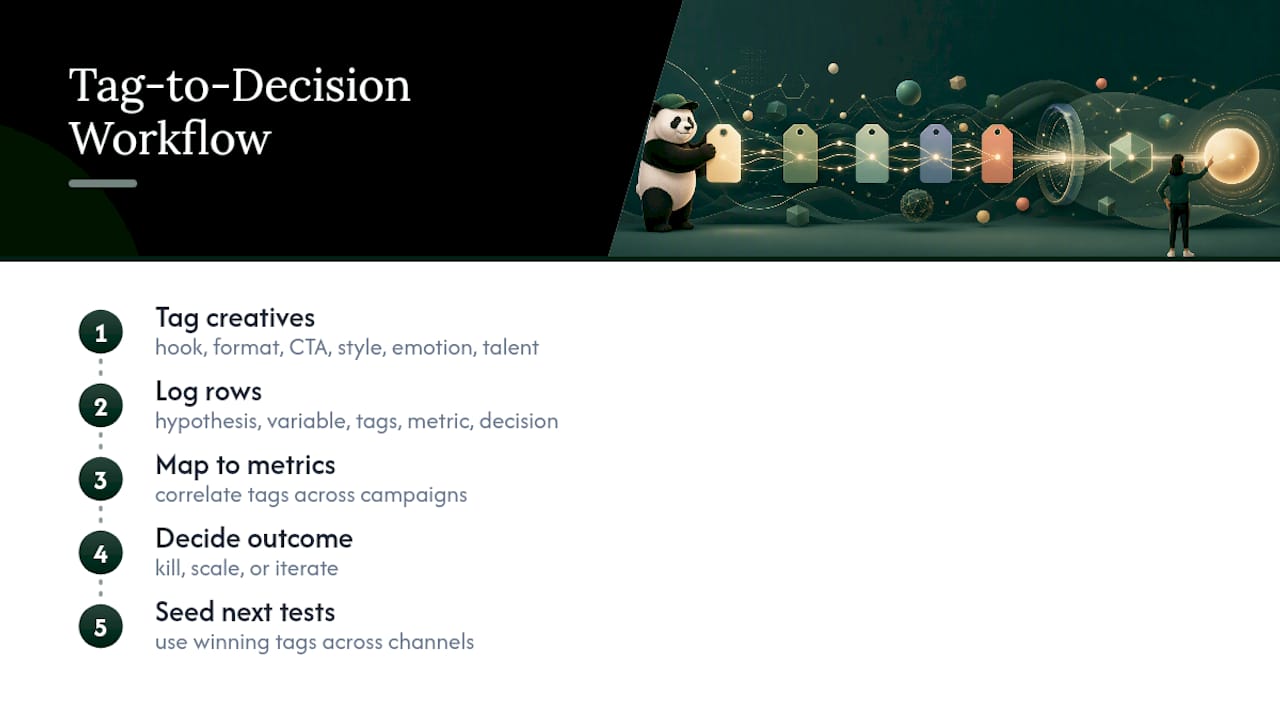
Tag every creative by hook type, format, call-to-action, visual style, emotional register, and talent or spokesperson. Without element-level tagging, teams routinely burn hours manually mapping which piece of a winning ad actually drove the result, and half the time they guess wrong.
Once tags exist, map them against your metrics hierarchy: does the “founder-led talking head” tag correlate with higher hold rate across every campaign it appears in, or was that one result a fluke tied to a single strong hook? A simple log needs five columns: hypothesis, variable isolated, tags applied, primary metric result, and decision (kill, scale, or iterate).
Winner tags become the seed for your next round of hypotheses, and often for hypotheses on a completely different channel. A hook that wins on Meta is a legitimate starting hypothesis for TikTok, even though the execution has to change.
Common Pitfalls That Produce False Positives
Most inconclusive creative tests trace back to one of a handful of repeatable mistakes.
Underpowered tests. Splitting a modest budget across eight variants guarantees none of them reach significance.
Platform bias and audience overlap. Running two variants to overlapping audiences on the same platform can produce a “winner” that’s really just an artifact of auction dynamics, not creative quality.
Premature reads. Calling a winner at day two of a 10 day test almost always reverses by day seven.
Inconsistent decision rules. Changing your threshold after you see the data isn’t optimization, it’s bias.
Pro Tip: When a test comes back noisy or null, don’t discard it. A null result on a strong hypothesis is data too, log it as a rejected hypothesis so nobody wastes another cycle testing the same idea six months from now.
Why Align Treats Unique Ideas as Brand Infrastructure, Not One-Off Wins
A unique idea that clears your testing thresholds isn’t just a winning ad. It’s raw material for the brand itself. The approach blends Scandinavian brand thinking with the speed of Chinese market methodologies, which means creative testing never stops at “did this ad perform.” It asks whether the winning idea can become a signature the audience recognizes across every channel and market you enter next.
AI is used to run that loop faster, not to replace the judgment that spots a genuinely differentiated hook in the first place. Consumer behavior shifts fast, and a testing rhythm built into your production calendar, not bolted on after a campaign launches, is what lets a brand catch that shift before competitors do. That’s the difference between a team that tests occasionally and a team that treats testing as strategy.
One Week to a Better Creative Testing Habit
Start Monday by picking one active campaign and writing three falsifiable hypotheses, not fifteen. By Wednesday, build your tagging sheet: five columns, no more. Thursday, get your creative lead and performance lead in the same room for thirty minutes to agree on one decision rule before launch, misalignment there kills more tests than bad creative ever does.
The habit that matters most isn’t the spreadsheet. It’s protecting space for a genuinely unique idea to get tested at all, instead of letting the safest, most familiar concept win by default because nobody challenged it.
— Kalle
Ready to Build a Test-Ready Creative Pipeline?
An alternative to running creative testing as a side project squeezed between campaign launches is to build the tagging systems, hypothesis rhythms, and production pipelines into your actual marketing calendar, so unique ideas get a fair shot before they get killed by inertia.
That means brand strategy and creative testing working from the same playbook, not two departments guessing at each other. Services can span AI-enhanced creative production, brand strategy, and full campaign execution, built for marketing leaders at scaling brands who need performance and brand equity to grow together, not compete for budget. See how the approach applies to your category and book a strategy call to map your first test cycle.
Sources
The frameworks in this guide draw on Rocketium’s testing methodology for sizing and logging, Segwise’s six-step SIGNAL loop for tagging discipline, Eonik’s breakdown of the 3-3-3 matrix for framework selection, and Adrio’s Meta-specific heuristics for variant counts and kill rules. Each one fills a different gap the others leave open.
Creative testing framework: lessons from brands testing creatives at scale
What is creative testing? A 2026 framework for Meta static ads | Adrio Blog
Recommended
One Week to Test Better: Creative Testing Framework for Marketers
THE POINT
One Week to Test Better: Creative Testing Framework for Marketers
KEY TAKEAWAYS
01
Creative testing framework for marketers. Start one week testing habits, size tests by conversions, set kill and scale rules, and tag winners.
02
Creative testing framework for marketers. Start one week testing habits, size tests by conversions, set kill and scale rules, and tag winners.
03
Creative testing framework for marketers. Start one week testing habits, size tests by conversions, set kill and scale rules, and tag winners.
RELATED INSIGHTS

LET’S TALK
What are you trying to grow next?
Brand, launch, market entry or performance. Book 30 minutes and tell us what you’re working on.