•
Outcome First Social Content Production Using AI to Drive Pipeline
Professional social content production delivers platform-native short-form video and visual assets designed to move business KPIs, engagement, pipeline, and retention, faster than ad-only tactics. Marketing managers get a repeatable system: brief, shoot, edit, review, repurpose, measure. The rest of this guide breaks down formats, timelines, budgets, and how to choose the right partner for the outcome you actually need.
TL;DR:
Effective social content production requires clear mapping of assets to specific business objectives, such as pipeline, retention, or brand authority.
Different platforms demand tailored creative approaches: fast cuts and native feel for TikTok, polished edits for YouTube, and captioned thought leadership for LinkedIn.
Budgeting depends on scope, usage rights, and production complexity, with scope-based pricing and upfront negotiation for rights preventing cost surprises.
Using AI in workflows accelerates ideation and editing, but human oversight remains essential for maintaining brand voice and content quality.
Successful vendors provide platform-specific case studies, clear approval workflows, and detailed success metrics aligned with campaign KPIs.
AligntccAlign Your Content With GrowthAlign TCC combines AI-enabled marketing workflows with market-specific strategy to help fast-growing brands sharpen positioning and engage audiences.Explore Align TCC
Table of Contents
What social content production includes and the outcomes it should drive
Which platform norms should shape your video and visual formats
How the production process runs from brief to repurposed asset
What pricing models and budget brackets should you expect
Should you build in-house, hire an agency, or run an AI-assisted hybrid
Which KPIs should social content actually move
What to look for when picking an agency or freelancer
What questions separate a strong provider from a weak one
What red flags signal trouble before you sign a contract
How to compare quotes and proposals without losing the plot
How leading agencies run social content production at scale
Start a social content production project with Align TCC
Sources
FAQ
What social content production includes and the outcomes it should drive
Social content production covers more than a camera and an edit suite. It spans a stack of formats, each built for a different stage of the funnel:
Short-form video: reels, TikToks, and shorts built for fast attention and shareability.
Long-form video: brand films, interviews, and explainer content for consideration and trust-building.
Static visuals: carousels, quote cards, and product shots for feed presence and paid amplification.
Motion and animation: data visualizations and product demos that simplify complex ideas.
UGC shoots and creator-managed content: authentic, relatable footage that performs well on TikTok and Instagram.
The mistake most brands make is chasing reach as the finish line. Reach without a path to pipeline or retention is a vanity number. A documented content plan ties every asset to a business objective, whether pipeline, retention, or brand authority, so content stops behaving like a cost center and starts behaving like an engine tied to revenue. Map assets to the funnel: awareness content builds reach, consideration content builds trust, and conversion or retention content closes the loop and keeps customers engaged after the sale.
Which platform norms should shape your video and visual formats
TikTok, Instagram, LinkedIn, and YouTube each reward different creative instincts, and a provider who treats them identically is leaving performance on the table. The universal rule: hook viewers in the first one to three seconds and caption everything for sound-off viewing, since most feeds default to muted playback.
TikTok: raw, native-feeling UGC beats polished ads; vertical 9:16, fast cuts, text overlays.
Instagram Reels: a blend of UGC energy and brand polish, often reusing TikTok assets with tighter edits.
LinkedIn native video: captioned thought leadership and behind-the-scenes footage that reads as insight, not advertising.
YouTube Shorts and long-form: hero edits with higher production value, built for retention and discovery search.
Plan every shoot to generate multi-platform assets from a single production day: one hero video, several vertical cutdowns, a handful of static frames pulled from the footage, and a caption set adapted per channel. That single-shoot, multi-output approach is what separates efficient production from constant reshoots.
Pro Tip: Shoot one extra “safe” take of every key line, unedited and undistracted, purely for repurposing into static quote cards later.
How the production process runs from brief to repurposed asset
A social content production project moves through five stages, and each one has a typical lead time depending on project size.
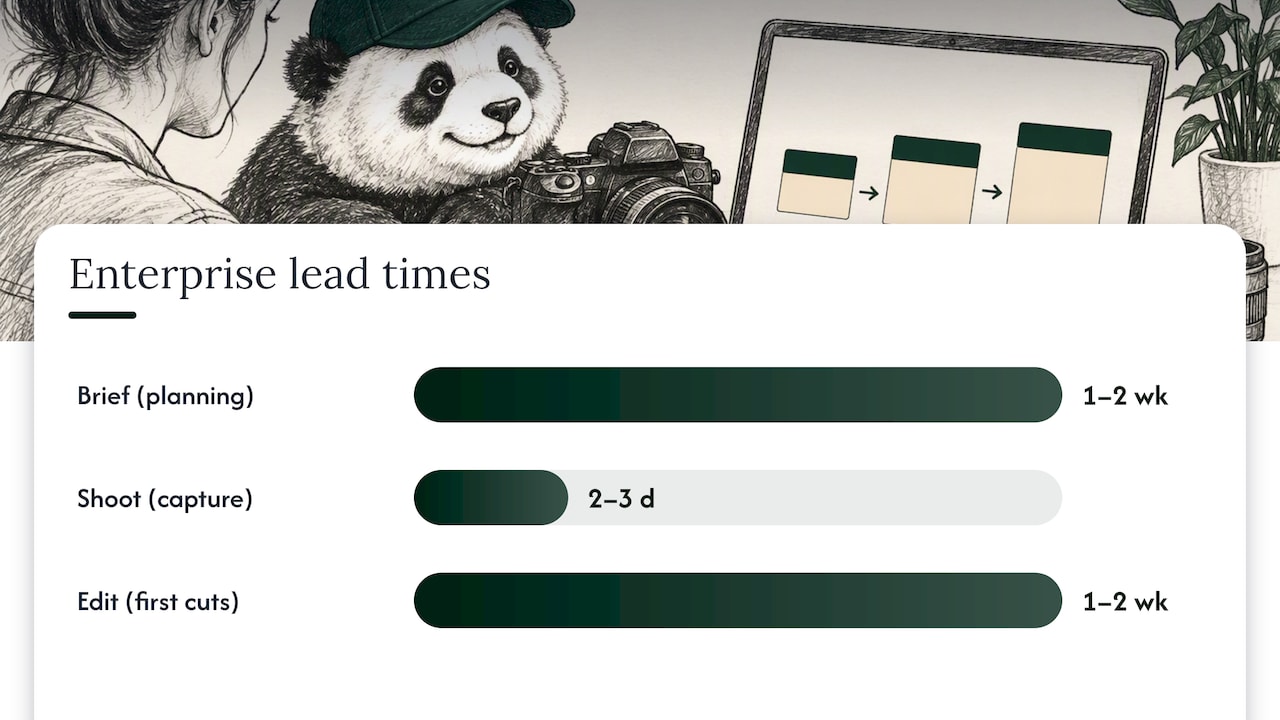
Brief: define objective, audience, platform mix, KPIs, and usage rights upfront. Small projects: 1 to 2 days. Enterprise: 1 to 2 weeks with legal and brand review.
Shoot: on-location or studio capture, typically 1 day for small campaigns, 2 to 3 days for multi-asset enterprise shoots.
Edit: first cuts within 3 to 5 business days for small teams, 1 to 2 weeks for enterprise programs with multiple deliverables.
Review: stakeholder feedback and revisions, the single biggest source of delay in larger organizations.
Repurpose: cutdowns, captions, and platform-specific versions, ideally planned into the original brief rather than treated as an afterthought.
Approval layers are where enterprise timelines stretch. Consolidating feedback into one platform with role-based approvals and version control, rather than scattering comments across email threads, recovers real time on every campaign and is a core recommendation for enterprise content operations. Build your calendar around a shared board rather than static documents; planning tools built for content calendars make version control and stakeholder visibility far easier to manage than spreadsheets.
Pro Tip: Put usage rights, platform list, and approval deadline in writing inside the brief itself. Verbal agreements are the most common cause of scope creep.
What pricing models and budget brackets should you expect
Social content production is priced a few different ways, and each shape fits a different kind of engagement.
Day rates: common for one-off shoots with a defined crew and location.
Per-asset pricing: a flat fee per finished video or static graphic, useful for smaller, predictable scopes.
Packages: a bundle of assets (say, one hero video plus five cutdowns and three static posts) priced as one deliverable set.
Monthly retainers: ongoing production for brands publishing consistently across multiple platforms.
Budgets scale with scope, crew size, and usage rights rather than runtime alone. A single-location UGC-style shoot for a small campaign sits at a modest bracket; a multi-day, multi-location brand film with paid amplification rights sits considerably higher; enterprise programs spanning several markets and quarterly retainers land highest of all. Treat any number you hear from a provider as scope-dependent rather than fixed.
Usage rights are the quiet cost driver most marketers underestimate. Rates shift substantially depending on whether footage runs organically only, gets boosted as paid media, or carries exclusivity and whitelisting clauses, and skipping this conversation upfront is what leads to expensive renegotiation later. Negotiate usage and reuse terms before the shoot, not after you see the footage.
Should you build in-house, hire an agency, or run an AI-assisted hybrid
The right model depends on how much control, scale, and cost flexibility you need, and those three rarely maximize together.
In-house: best when brand voice is highly specialized and volume is manageable, but it caps scale and platform range.
Agency: buys speed, platform expertise, and crew access, at a higher cost per asset than DIY.
AI-assisted hybrid: blends AI-sped ideation and editing with human creative decisions, often the fastest path to volume without losing point of view.
AI genuinely compresses production time on ideation, drafting, and editing passes; most marketers now build it into their workflows. But expert oversight still shapes the creative decisions that make content distinctive, and brand voice checks remain a human job, not an automated one. AI drafts fast; a person still decides what’s worth publishing.
Before you commit to a model, run through a short checklist:
Does the provider ask sharp questions about your brief, or accept it at face value?
Who owns approvals, and how many rounds are included before extra fees apply?
Are KPIs (engagement, pipeline, retention) defined before the first shoot?
Does the provider show platform-specific expertise, not just generic video work?
Are usage rights and case studies part of the initial conversation?
Which KPIs should social content actually move
Engagement is the easiest metric to report and the least useful one on its own. Likes and views tell you content got noticed, not whether it did anything for the business. The more useful frame ties every asset back to a stage of the funnel it’s meant to influence.
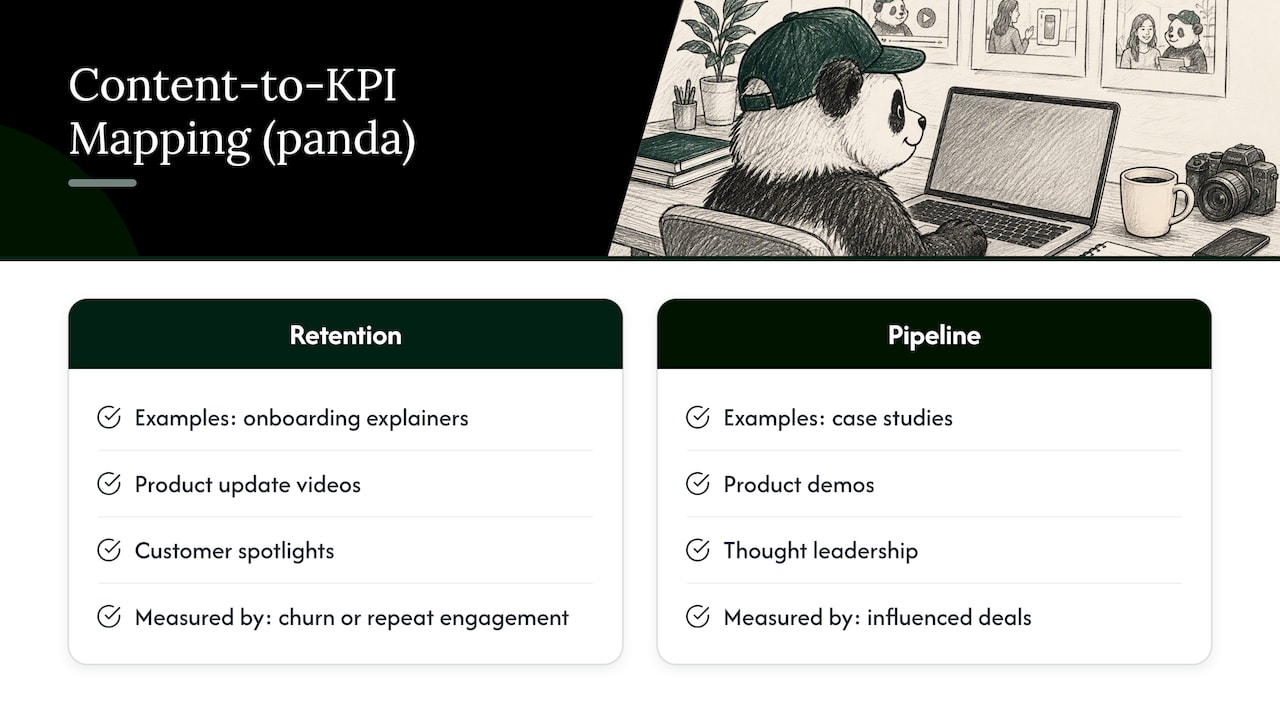
A documented plan that connects content to CRM and commerce data, rather than treating social as a standalone reporting silo, is what turns content into a measurable growth lever instead of a vanity report. Retention content, think onboarding explainers, product update videos, and customer spotlights, should be tracked against churn or repeat engagement, not reach. Pipeline-facing content, case studies, product demos, and thought leadership, should be tracked against influenced deals, not impressions.
A tactical way to sharpen this: interview recently closed and recently lost deals to find out which content actually shaped the decision, and map the questions buying committees asked at each stage. That research becomes the brief for your next quarter of production, replacing guesswork with a direct line from content to revenue. Centralized planning boards that connect content calendars to performance data give marketing teams the visibility needed to tie output to KPIs rather than reporting on activity alone. Set the KPI before the shoot, not after the analytics come in.
What to look for when picking an agency or freelancer
Portfolio quality matters, but portfolio relevance matters more. A beautifully shot fashion reel tells you little about whether a provider understands B2B LinkedIn norms or e-commerce TikTok pacing.
Look for platform-specific case studies, not just a generic highlight reel. A provider who can point to outcomes on the specific platform you need, TikTok engagement, LinkedIn thought leadership reach, YouTube retention, is a stronger bet than one with a single polished showreel and no platform breakdown. Ask how they structure briefs: a provider who pushes back on a vague brief and asks about KPIs, audience, and usage rights upfront is signaling operational maturity.
Check how they handle approvals and revisions. Providers who build role-based sign-off and version control into their process, rather than relying on scattered email threads, tend to hit deadlines more consistently, a pattern well documented in enterprise content operations guidance. Confirm crew and equipment fit the scope: a one-person creator setup won’t deliver a multi-location brand film, and an agency crew may be overkill for a scrappy UGC campaign.
Finally, weigh cultural and platform fluency. A provider fluent in the visual language of TikTok trends or the more restrained tone LinkedIn rewards will save you rounds of revision that a generalist wouldn’t anticipate.
What questions separate a strong provider from a weak one
The questions you ask in a discovery call reveal more than any portfolio page.
Ask how they define success for a project like yours: a strong answer names specific KPIs (engagement rate, click-through, pipeline influence) rather than vague reach numbers. Ask for a platform-specific example with results attached, not just a general show reel; if they can’t speak to outcomes on your priority platform, that’s a gap worth noting.
Ask directly about their production workflow: how briefs turn into shoot plans, how many revision rounds are included, and who owns final sign-off. A provider without a clear answer here is likely to blow past your timeline. Ask how they use AI in their process. The honest answer involves AI speeding up ideation or first-pass edits with a person making the final creative call, not a fully automated pipeline producing unreviewed output.
Ask about usage rights and exclusivity terms before you see a contract. Providers experienced with creator content will bring this up unprompted, since usage terms are a major driver of final cost and a common source of disputes later. Finally, ask what happens when a shoot goes wrong: weather, a no-show talent, a corrupted file. Their answer tells you how they handle risk, not just how they handle a good day.
What red flags signal trouble before you sign a contract
Some warning signs show up before you’ve spent a dollar. A provider who quotes a price without asking about usage rights, platform mix, or exclusivity is either inexperienced or planning to renegotiate later, and renegotiation almost always costs more than clarity upfront.
Watch for vague deliverables. “A social media package” with no defined asset count, platform list, or revision limit is an invitation to scope disputes. Be cautious of anyone who can’t explain their approval workflow. If feedback happens over scattered emails or texts with no version control, expect missed deadlines, especially on multi-stakeholder enterprise projects.
Be wary of a portfolio with no platform context. A single polished reel says nothing about whether the same team understands TikTok’s raw aesthetic or LinkedIn’s more restrained tone. Also flag any provider dismissive of AI entirely or overly reliant on it. The strongest teams treat AI as a speed tool for ideation and editing, not a replacement for the judgment that keeps content on-brand.
Finally, be skeptical of guaranteed virality or fixed engagement numbers promised in advance. No provider controls platform algorithms, and anyone promising specific reach figures is setting up an excuse for a future miss.
How to compare quotes and proposals without losing the plot
Two quotes with wildly different prices often aren’t quoting the same thing. Before comparing numbers, line up scope: asset count, platform list, revision rounds, usage rights, and turnaround time. A cheaper quote missing usage rights for paid amplification isn’t actually cheaper once you need to run the content as an ad.
Check what’s included in post-production. Does the quote cover captions, platform-specific aspect ratios, and repurposed cutdowns, or just one master file? Repurposing built into the original brief tends to lower the cost per published asset compared to commissioning cutdowns separately later.
Compare how each proposal ties back to your KPIs. A proposal that only lists deliverables (three videos, five graphics) without connecting them to engagement, pipeline, or retention goals is missing the piece that matters most. Ask each provider to walk through how they’d measure success for your specific campaign.
Finally, weigh timeline realism against your internal approval capacity. A fast quote from a provider who hasn’t accounted for your legal or brand review cycle will slip regardless of what the contract says. The strongest proposals name assumptions plainly: number of revision rounds, who signs off, and what happens if a deadline moves.
How leading agencies run social content production at scale
Some agencies build social content production around a single operating principle: Scandinavian brand thinking paired with the commercial speed of Chinese market methodologies, with AI used to compress production time without replacing creative judgment. That combination shapes their approach to briefing, shooting, and approving work.
Every brief starts with the business outcome, not the asset list. Pipeline, retention, or brand authority gets defined before a single shoot day is booked, and approval workflows are built around version control so enterprise clients don’t lose weeks to email threads. Our approach to AI-driven content production treats AI as an accelerant for ideation and first drafts, with senior creative review before anything ships. Repurposing gets planned into the brief itself, including distribution through channels like employee advocacy programs, so one shoot generates weeks of platform-native assets.
— Kalle
Start a social content production project with Align TCC
Social content production often sits inside a full commercial stack: brand strategy, influencer and creator marketing, and AI-enhanced workflows that speed production without flattening the point of view. This ensures video and visual assets connect to positioning and go-to-market work, rather than being standalone shoots with no strategic thread.

A discovery call typically covers campaign goals, target KPIs, and any sample assets or past campaigns worth reviewing before scoping a brief. It’s helpful to come with a rough sense of platform priorities and timeline to shape the production plan accordingly.
Relevant services to bring into that conversation:
UGC & Content: creator-led and in-house production across short-form and long-form formats.
Brand & Positioning: ensures every asset ties back to a consistent narrative.
Commercial Strategy: connects content output to pipeline and retention goals.
Review the full services lineup or head to the Align TCC homepage to start the conversation.
Sources
FAQ
What is the 5-5-5 rule on social media?
Definitions vary across marketers, but a common version suggests posting five different content types across five platforms over five days to test format performance. It’s a planning heuristic rather than a fixed industry standard, so treat it as a starting framework rather than a rule to follow rigidly.
What does a social media content producer do?
A social content producer manages the full cycle from brief to finished asset: planning shoots, directing filming, editing for platform-specific formats, and often handling repurposing into multiple cutdowns. Many also advise on captions, posting times, and usage rights tied to the footage they create.
Is content creation still worth it in 2026?
Content remains a core growth lever when it’s tied to specific business outcomes like pipeline and retention rather than reach alone, according to enterprise content operations guidance. AI has sped up production, but brands that skip strategic planning still see content perform as a cost center rather than a growth driver.
How much should you pay a social media content creator?
Cost depends heavily on format, usage rights, and exclusivity rather than a single flat rate; a static post costs far less than a multi-platform video package with paid amplification rights. Negotiating usage terms upfront, rather than after the shoot, is what keeps final costs predictable.
Recommended
RELATED INSIGHTS



LET’S TALK
What are you trying to grow next?
Brand, launch, market entry or performance. Book 30 minutes and tell us what you’re working on.