Growth / Performance
Kalle Mobeck
•
Tiered Launch That Scales: Product Launch Plan for PMs, Six Week Pilot
A product launch plan is the operational “how and when” that puts your strategy into motion. Your first move: classify the launch as Tier 1, Tier 2, or Tier 3, then lock 2 to 3 SMART success metrics before anything ships. The rest, from RACI charts to dashboards, follows from that one decision.
TL;DR:
Most launches fail after day 30 due to lack of structured review and continuous follow-through, risking missed insights and improvements.
A clear tier classification determines scope, timeline, team size, and governance level, preventing over- or under-investment in each launch.
Setting only 2 to 3 outcome-focused metrics like activation, retention, and business impact ensures meaningful tracking and decision-making.
Post-launch reviews at 7, 30, and 90 days, along with a documented playbook, are essential to sustain success and inform future launches.
Using templates, dependency mapping, and dedicated tools for ownership, asset tracking, and communication keeps cross-functional teams aligned and accountable.
AligntccBuild A Launch Strategy That TravelsAlign TCC helps growing companies sharpen positioning and connect brand, creators, paid media, and market-specific execution across regions.Explore Align TCC
Table of Contents
How Do You Decide Launch Tier and Scope?
What Belongs in Each Launch Phase?
Which Templates and Tools Keep a Launch on Track?
Which Launch Metrics Actually Matter?
How Should You Set Goals and Assign Ownership?
What Does a 90-Day Post-Launch Playbook Look Like?
What Can Align’s Pilot Approach Teach You About Launch Validation?
Why Does Positioning Come Before the Plan, Not Inside It?
What Risks Should You Plan for Before Launch Day?
How Do You Collect and Act on Post-Launch Feedback?
What Tools Keep Cross-Functional Teams Aligned During Launch?
How Does Competitive Analysis Fit Into the Launch Plan?
How Should You Budget and Allocate Resources for a Launch?
The Template Trap: Why Most Launch Plans Fail on Follow-Through
How Align Runs a Launch When You Don’t Want to Build the Capability In-House
Sources
FAQ
How Do You Decide Launch Tier and Scope?
Not every release deserves a war room. Treating a minor feature update like a flagship launch burns budget and stakeholder patience. Treating a category-defining product like a routine update wastes an opportunity, and it can cost you market position you don’t get back.
The tier you assign determines your timeline, your team size, and how much governance the launch actually needs.
Tier 1: New product category, major revenue driver, or brand-defining move. Requires cross-functional teams, executive sponsorship, PR and analyst outreach, and a 6 to 12 week runway.
Tier 2: Significant feature launch or expansion into a new segment. Needs a smaller cross-functional squad, targeted campaigns, and roughly 3 to 6 weeks of preparation.
Tier 3: Incremental update, minor feature, or internal-facing change. A single owner with light marketing support can run this in 1 to 2 weeks.
These timelines are ranges, not mandates. A product launch strategy framework only works if you resist the urge to inflate every launch to Tier 1 status just because the team is excited about it. Map stakeholders early: Tier 1 needs a dedicated launch manager and budget owner, Tier 2 needs a product marketing lead with executive visibility, and Tier 3 needs one accountable owner who reports status, not a committee.
What Belongs in Each Launch Phase?
A launch isn’t an event. It’s a sequence: pre-launch, launch, and post-launch, each with distinct owners and deliverables. Atlassian frames this as a continuous process, not a single day on the calendar, and that framing changes how you staff it.
Pre-launch (the longest phase, and the one teams shortcut at their own risk):
Finalize the positioning document. What problem does this solve, for whom, and why now?
Build the messaging hierarchy. One core message, three supporting proof points, no more.
Define target segments and validate demand with real prospects or existing customers, not just internal conviction.
Run a pre-mortem. Ask the team: “If this launch fails, why did it fail?” Surface the answers now, not in the retrospective.
Assign the RACI. Every deliverable needs exactly one accountable owner.
Build the asset tracker and assign due dates against the launch date, working backward.
Instrument analytics before go-live. If you wait until launch day to add tracking code, you lose your baseline.
Launch (the compressed, high-visibility window):
Coordinate external comms: press release, website updates, email campaigns, and social content, all timed to the same hour if the tier warrants it.
Brief internal teams first. Sales and support should never learn about a launch from a customer.
Run sales enablement sessions so reps can answer objections on day one, not day five.
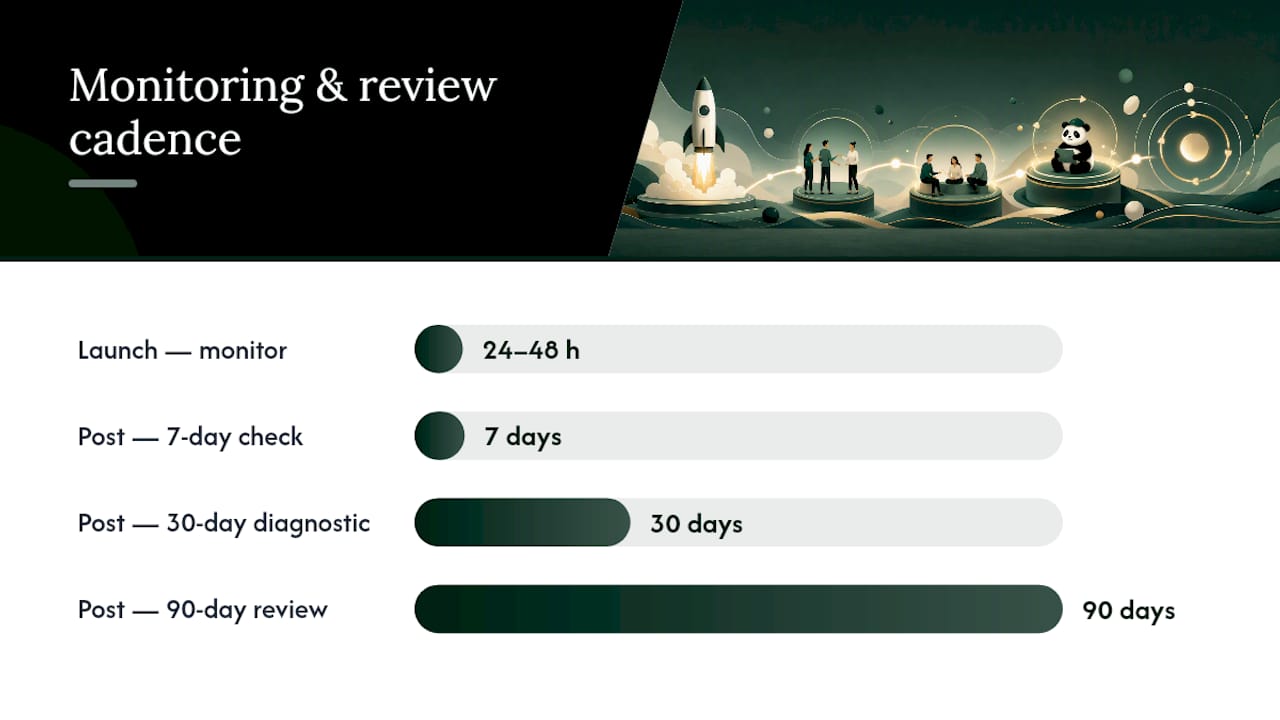
Monitor in real time. Assign someone to watch support tickets, social mentions, and system performance for the first 24 to 48 hours.
Handle PR and analyst outreach if the tier justifies it. Tier 3 launches rarely need this step.
Post-launch (where most teams under-invest):
Run a 7-day quick check. Are activation numbers tracking toward the target?
Run a 30-day diagnostic. Retention and early revenue signals live here.
Run a 90-day strategic review. Did the launch move the business metric you cared about?
Hold a retrospective and document what worked, what didn’t, and what the team would change.
Update the launch checklist template and playbook so the next launch starts smarter than this one did.
Skipping steps 13 through 17 is the single most common failure pattern. Teams sprint through pre-launch and launch, then treat post-launch as an afterthought, which means the lessons from this launch never make it into the next one.
Which Templates and Tools Keep a Launch on Track?
Templates aren’t busywork. They’re what prevents the same three arguments (who owns this, what’s the deadline, and did anyone tell sales) from recurring on every single launch.
Your launch brief should fit on one page: positioning statement, top three proof points, 2 to 3 success metrics, target segments, and the top three risks with a one-line mitigation for each. If it doesn’t fit on one page, it’s a strategy document, not a brief.
Your RACI should list every deliverable in one column and four roles across the top: Responsible, Accountable, Consulted, Informed. The point isn’t the framework itself. It’s that when a marketing manager asks “who signs off on this landing page copy,” the answer is one name, not a group chat.
Your asset tracker needs six columns at minimum:
Asset name
Owner
Due date
Status (not started, in progress, in review, approved)
Channel
Upstream dependency (what has to finish before this can start)
Your timeline template should define milestones by gating criteria, not just dates. “Positioning finalized” is a milestone. “Week 3” is not, because it tells nobody what has to be true for the launch to proceed.
For tools, a shared spreadsheet handles Tier 3 launches fine. Tier 1 and Tier 2 launches benefit from a project tracker with dependency mapping and a lightweight analytics dashboard that pulls activation and retention data automatically, so nobody is manually exporting numbers the week of launch.
Pro Tip: Build your asset tracker and RACI as one linked document, not two. When ownership and deadlines live in separate files, someone always ends up chasing an asset that was already “in review” three days ago.
Which Launch Metrics Actually Matter?
Instrument five to eight metrics before launch, no more. Practitioner guidance on launch metrics consistently warns against tracking vanity numbers that look good in a slide but don’t inform a decision. If you can’t name the action a metric would trigger, drop it.
Here’s the core set worth instrumenting:
Activation rate: the percentage of new users who complete a defined “aha” action within a set window.
Time-to-value: how long it takes a user to reach that activation event from signup.
Day 1 / Day 7 / Day 30 retention: cohort based, not aggregate. Day 7 retention in particular tends to predict long-term adoption better than raw signup counts.
Initial NPS, captured around Day 14, once users have had enough exposure to form a real opinion.
Error rate or support ticket volume: a quality signal that catches problems before they show up in churn.
One business metric: pipeline influence for B2B launches, revenue for consumer launches.
Cohort-based Day 7 retention is one of the clearest early predictors of whether a launch will hold up past its first month, according to Ideaplan’s analysis of launch metrics.
Define your activation event with a specific, loggable action: “created first project,” not “logged in.” Vague activation events produce data nobody trusts.
Cadence matters as much as the metric list. Check Day 1 numbers for system stability. Check Day 7 for early retention signal. Check Day 30 for whether the product is sticking. Check Day 90 to decide if the launch met its business case. Set up cohort instrumentation and NPS timing before launch day, not after someone asks why the dashboard is empty.
How Should You Set Goals and Assign Ownership?
Pick 2 to 3 SMART metrics tied to outcomes leadership actually cares about, adoption, revenue, or pipeline, not activity metrics like “number of emails sent.” A launch with seven equally weighted goals has no goals. It has a wish list.
Assign a launch manager for Tier 1 launches, someone whose job is coordination, not execution of every task themselves. McKinsey’s research on launch performance found that companies centralizing launch capability into a dedicated center of excellence consistently outperform those that treat every launch as a one-off project built from scratch.
A useful RACI pattern for Tier 1:
Accountable: Launch manager or VP of product marketing
Responsible: Product marketing lead (messaging), engineering lead (readiness), sales enablement lead (training)
Consulted: Customer success, legal, finance
Informed: Executive team, broader company
For ROI, estimate it directionally rather than to the decimal point. Compare projected pipeline or revenue contribution against the cost of the launch team’s time plus paid media spend, then use that ratio to decide whether the next launch in the pipeline gets Tier 1 or Tier 2 treatment.
What Does a 90-Day Post-Launch Playbook Look Like?
Launch day is the midpoint of the work, not the finish line. What you do in the following 90 days determines whether the launch becomes a case study or a cautionary tale.
Day 7: Quick triage. The core team reviews activation and error rates. Look for anything breaking at scale that pilot testing missed. Fix blockers immediately; defer everything else.
Day 30: Diagnostic review. Product, marketing, and customer success review retention cohorts and initial NPS together. This is where you separate a slow start from a real problem.
Day 90: Strategic review. Leadership joins. The question isn’t “did we launch,” it’s “did this move the business metric we committed to.”
Run a structured retrospective at the 30-day mark, not just at day 90. Ask three questions: what worked, what would we change, and what should go into the playbook for the next launch. Document the answers somewhere the next launch team will actually find them.
Decision rules keep this from turning into endless debate: a broken workflow gets an immediate fix, a missing feature that surfaces repeatedly in feedback becomes a roadmap item, and a channel underperforming its cost-per-result gets reallocated budget within two weeks, not two quarters.
Pro Tip: Assign one person to own the Day 30 retrospective document from day one of pre-launch. If ownership is unclear, the retro either doesn’t happen or happens too late to change anything.
What Can Align’s Pilot Approach Teach You About Launch Validation?
Most launch plans assume the market fit question is already settled by the time positioning gets locked. That assumption is often wrong, especially when a brand is entering a new region or cultural context. Align’s six-week pilot approach treats cross-cultural fit as something to test in weeks, not assume from a boardroom slide.
A short, structured pilot, running real creative and messaging against a real audience for a fixed window, gives you a validated signal on demand and positioning before you commit a full Tier 1 budget to a market you haven’t tested.
The same logic applies to speed. Align’s work on AI-assisted localization shows how automating the mechanical parts of market entry, translation, format adaptation, channel-specific asset variants, frees the strategy team to focus on the judgment calls that actually determine whether messaging lands. Technology handles the repetitive work; people handle the parts that require cultural fluency.
Why Does Positioning Come Before the Plan, Not Inside It?
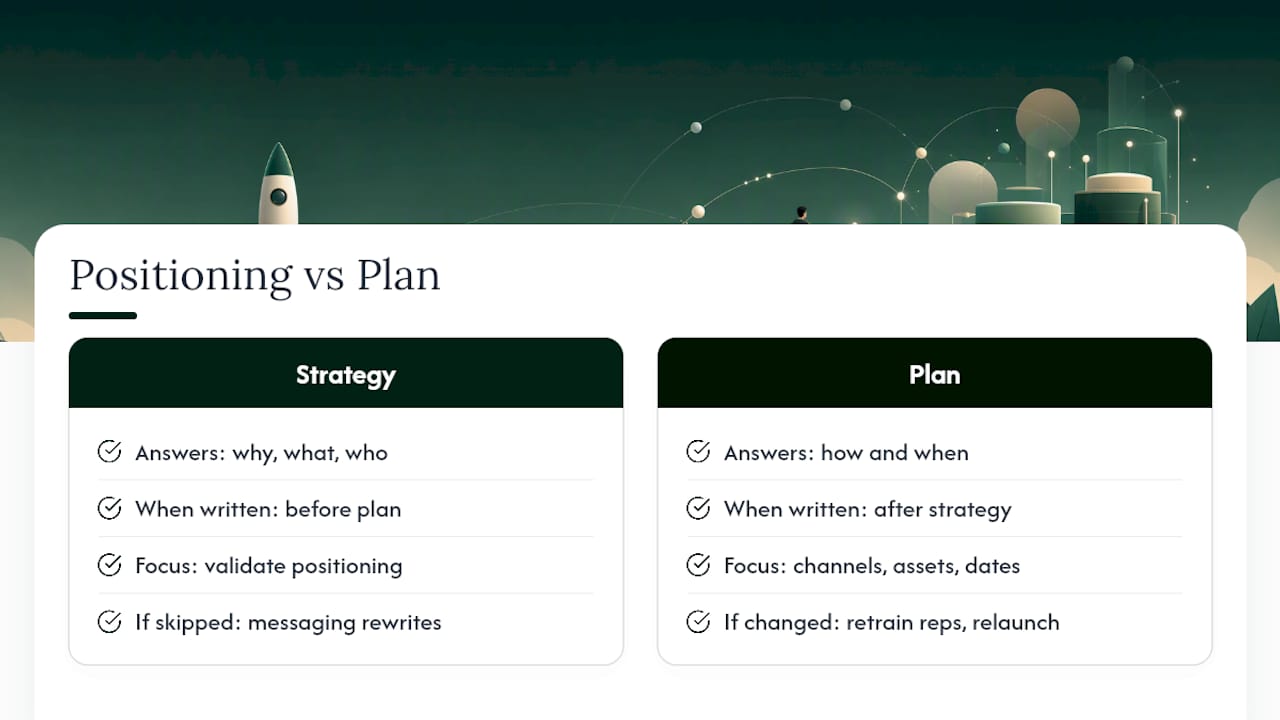
Confusing strategy with plan is where launches quietly go wrong. Strategy answers why, what, and who: why this product, what problem it solves, who it’s for, and why now. Plan answers how and when: which channels, which assets, which dates, which owner.
Teams that skip straight to building a timeline without locking positioning first end up rewriting messaging mid-execution, which cascades into rewritten landing pages, retrained sales reps, and a launch date that quietly slips. Productside’s guidance on launch plan structure treats the executive summary and product description as foundational sections that get written before the tactical calendar, not alongside it.
The practical test: if your positioning statement could change based on feedback you get during the launch, you haven’t finished strategy work, you’ve started plan work prematurely. Lock the answer to “why this, why now, for whom” with actual customer input before a single asset gets built. A messaging hierarchy built on an unvalidated assumption doesn’t just risk a weak launch. It risks a launch that has to be re-messaged in week two, which costs more time than getting it right before day one ever would have.
For B2B product launch strategy specifically, this distinction matters even more because sales enablement material, pitch decks, competitive positioning, and objection handling, all inherit directly from the strategy layer. Change the strategy after those materials ship, and you’re not tweaking a plan. You’re rebuilding it.
What Risks Should You Plan for Before Launch Day?
Every launch carries three recurring risk categories: execution risk, market risk, and readiness risk. Naming them explicitly during pre-launch, rather than discovering them live, is what separates a managed launch from a reactive one.
Execution risk covers missed dependencies: a landing page that isn’t approved, a sales deck still in review, an integration that hasn’t passed QA. The pre-mortem exercise during pre-launch exists specifically to surface these before they become launch-day fires. Ask the team directly: “If this fails, what broke?” Then fix the most likely answers now.
Market risk covers demand assumptions that don’t hold. A segment you assumed was ready may not be, or a competitor may ship something similar first. Building a lightweight kill switch, a predefined threshold where the team pauses paid spend or delays a wider rollout, protects budget from a launch that isn’t landing.
Readiness risk covers your own organization: support teams untrained, sales reps unable to answer basic objections, infrastructure that hasn’t been load-tested. This is the risk category teams underestimate most often because it’s less visible than a competitor move.
Mitigation isn’t a document you write once. Assign an owner to each top risk in the launch brief, with a one-line trigger and response, and review that risk list at every checkpoint from Day 1 through Day 90. Risks that don’t materialize get archived. Risks that do get escalated immediately, not at the next scheduled meeting.
How Do You Collect and Act on Post-Launch Feedback?
Feedback collection needs to start before launch day, not after. Instrument in-product surveys, a support ticket tagging system, and a direct channel for sales and customer success to flag recurring objections or confusion they’re hearing from prospects and customers.
Structure feedback into three buckets: bugs and blockers, feature gaps, and message-market mismatch. A bug gets fixed on the next release cycle, no debate. A feature gap gets logged and prioritized against the roadmap, evaluated by frequency and revenue impact, not by whoever asked loudest. A message-market mismatch, where customers describe the product differently than your positioning does, is the most important signal and the easiest one to miss because it doesn’t show up as a ticket. It shows up in call transcripts and review language.
Initial NPS captured around Day 14 gives you a quantitative baseline, but the open-text comments attached to that score usually carry more useful information than the number itself. Read them, don’t just average them.
Iteration cadence matters. Weekly triage during the first 30 days catches urgent issues fast. Monthly prioritization reviews after that keep the feedback loop from stalling once launch excitement fades and the team moves to the next project. The biggest failure mode here isn’t collecting too little feedback. It’s collecting plenty and never closing the loop on what changed because of it.
What Tools Keep Cross-Functional Teams Aligned During Launch?
A launch touches product, marketing, sales, support, and often legal, all of whom need visibility into the same timeline without living in the same meeting all day. The tools matter less than the discipline of using one source of truth, but the right stack removes friction.
A project tracker with dependency mapping (the same tool holding your asset tracker) should be the single place status lives. If Slack threads, email chains, and the tracker all show different “current” states, nobody trusts any of them. A dedicated launch channel, one per launch, not one giant ongoing channel, keeps discussion searchable and scoped.
For synchronous coordination, a standing 15-minute daily check-in during launch week catches blockers faster than an async status update ever will. For sales enablement specifically, a shared, centrally updated deck and objection-handling doc prevents the common failure where reps in different regions end up pitching slightly different versions of the same launch.
Document approvals need a clear trail. If a tagline changed three times in the final week, the RACI should make it obvious who approved the final version and when, so nobody is chasing down “who signed off on this” after assets already shipped.
How Does Competitive Analysis Fit Into the Launch Plan?
Competitive analysis isn’t a slide you build once during positioning and forget. It’s an input that should touch messaging, pricing, timing, and even your tier decision.
Before finalizing positioning, map what direct competitors claim, what gaps exist in their messaging, and where customers describe frustration with existing options. That gap is often your sharpest proof point, more useful than a generic “better, faster, cheaper” claim.
Timing matters too. If a competitor has a launch scheduled or rumored for the same window, that can shift your tier decision upward (to secure share of voice) or push your date earlier or later depending on what your sales team is hearing in active deals. Ignoring competitive timing is how two companies end up launching nearly identical positioning in the same week, diluting both.
During post-launch reviews, revisit the competitive landscape again. Did a competitor respond to your launch? Did their messaging shift? Competitive monitoring shouldn’t stop at go-live. It should feed directly into your 30-day and 90-day reviews as a standing agenda item, not an afterthought someone remembers to check.
How Should You Budget and Allocate Resources for a Launch?
Budget follows tier, not the other way around. Deciding your spend before deciding your tier is how Tier 3 updates end up with Tier 1 budgets and vice versa.
For Tier 1 launches, allocate budget across four buckets: paid media and PR, creative production, sales enablement and training, and a contingency reserve, typically the bucket teams forget until week two when something unplanned comes up. A launch with zero contingency budget is a launch that will cut corners the moment something breaks.
Resource allocation isn’t just money. It’s people-hours. A launch manager needs to know, going in, how many hours engineering, design, and content can realistically commit during launch week, not just whether they’re “supportive” of the launch in principle. Vague commitment is how deadlines slip.
Tier 2 and Tier 3 launches need proportionally smaller budgets, but the same discipline: know your total spend before day one, know which bucket a request comes out of, and revisit budget against actual performance at the 30-day mark. If paid acquisition is underperforming its cost target, that’s the moment to reallocate, not after the full budget is already spent.
The Template Trap: Why Most Launch Plans Fail on Follow-Through
The conventional wisdom on launch planning obsesses over the pre-launch phase: the perfect positioning doc, the flawless asset tracker, the beautifully gated timeline. That work matters, but it’s not where most launches actually fail. They fail in the gap between Day 30 and Day 90, when the initial excitement fades and nobody owns the follow-through.
What the research consistently supports is this: launches that get reviewed on a fixed cadence, backed by a documented playbook, outperform launches run as one-off heroics. That’s not a controversial claim, it’s what separates a launch center of excellence from a team reinventing the wheel every quarter. The overrated part of most launch advice is the emphasis on the launch day itself. Launch day is the easiest part to plan for because it has a fixed date and an obvious checklist.
If you take one thing from this guide, make it the tiering discipline. Most teams either treat every release like a Tier 1 event, burning out the team, or treat every release like a Tier 3 update, missing real opportunities. Match effort to actual impact, lock two or three metrics you’ll actually check, and build the review cadence into the plan before launch day, not after someone asks why nobody followed up.
— Kalle
How Align Runs a Launch When You Don’t Want to Build the Capability In-House
One alternative to building an internal launch function from scratch is to work with an experienced team that has already run a pilot-to-scale playbook across cross-cultural markets.

This approach handles the tasks that consume the most internal bandwidth: validating market fit through a structured six-week pilot, running AI-assisted localization to enter new markets without waiting on a full in-house translation and adaptation process, and executing performance branding once the pilot confirms demand. Clients may start with the six-week pilot to de-risk a new market or segment, then move into a full launch execution retainer once positioning and channels are validated.
If your next launch involves a new region, a skeptical internal stakeholder asking for proof before full budget commitment, or a timeline too tight to build launch capability from zero, look at how Align has approached similar work for other clients and get a scoped conversation started.
Sources
Cited throughout: McKinsey on launch drivers, Atlassian’s launch process guide, Ideaplan’s metrics template, and Asana’s launch checklist. For a deeper checklist walkthrough, see Aha!’s launch checklist guide.
FAQ
What Are the 7 Steps of a Product Launch?
A common sequence covers positioning, messaging, stakeholder RACI, asset production, launch-week execution, real-time monitoring, and post-launch review at 7, 30, and 90 days.
What Should Be in a Product Launch Plan?
A launch brief with positioning, top proof points, and 2 to 3 success metrics, a RACI, an asset tracker, a timeline with gated milestones, and a defined metrics dashboard.
What Are the 4 P’s of Product Launch?
Product, price, place, and promotion form the classic marketing mix; a launch plan applies them tactically through positioning, channel selection, pricing decisions, and coordinated promotional timing.
What Is the Roadmap of a Product Launch?
It runs pre-launch (positioning, validation, asset prep), launch (coordinated comms and monitoring), and post-launch (7/30/90-day reviews and retrospective), with governance scaled to the launch tier.
How Long Should a Product Launch Plan Take to Build?
It depends on tier: Tier 1 launches need 6 to 12 weeks of pre-launch preparation, Tier 2 needs 3 to 6 weeks, and Tier 3 can run in 1 to 2 weeks.
Recommended
Tiered Launch That Scales: Product Launch Plan for PMs, Six Week Pilot
THE POINT
Tiered Launch That Scales: Product Launch Plan for PMs, Six Week Pilot
KEY TAKEAWAYS
01
Product launch plan for managers. Scale effort to impact with Tier 1–3 guidance, checklists, a six week pilot, and a 90 day post launch playbook.
02
Product launch plan for managers. Scale effort to impact with Tier 1–3 guidance, checklists, a six week pilot, and a 90 day post launch playbook.
03
Product launch plan for managers. Scale effort to impact with Tier 1–3 guidance, checklists, a six week pilot, and a 90 day post launch playbook.
RELATED INSIGHTS



LET’S TALK
What are you trying to grow next?
Brand, launch, market entry or performance. Book 30 minutes and tell us what you’re working on.