Growth / Performance
Kalle Mobeck
•
7 Sprints to Align Marketing and Sales for B2B Revenue
Marketing sales alignment is a shared operating model where both teams work from the same definitions, data, and rituals so revenue grows faster and more predictably. It replaces guesswork handoffs with a governed process. B2B revenue leaders who build it see shorter sales cycles, higher win rates, and fewer lost deals to internal confusion rather than external competition.
TL;DR:
Proper alignment requires shared goals, data, rituals, and accountability, all based on clear definitions of terms like ICP and lead stages.
Many organizations face misalignment issues such as inconsistent lead definitions, siloed technology, and weak handoffs that slow deal velocity and reduce win rates.
Building alignment benefits from an iterative, sprint-based approach starting with defining roles, establishing rituals, and creating shared dashboards over several weeks.
Key metrics like MQL to SQL conversion and marketing-influenced revenue must be tracked in a unified dashboard to confirm alignment.
Involving a third-party partner can accelerate the process by conducting audits, drafting charters, and establishing accountability structures.
AligntccBuild A Sharper Revenue StrategyAlign TCC helps fast-growing companies develop targeted commercial strategies that connect brand thinking, audience insight, and market execution.Explore Align TCC
Table of Contents
What Marketing Sales Alignment Actually Means
Why Alignment Matters Now for B2B Revenue Teams
Common Misalignment Problems and How to Spot Them
Step-by-Step Playbook: A Concrete Build Sequence to Achieve Alignment
How to Measure Alignment: Metrics, Dashboards, and Reporting
Technology and Process: The Minimal Stack That Supports Alignment
Operating Model and Governance: Who Owns Alignment
How Align TCC Applies These Principles
Where To Start This Week
How Align TCC Can Help You Build This
Primary Sources and Further Reading
Sources
FAQ
What Marketing Sales Alignment Actually Means
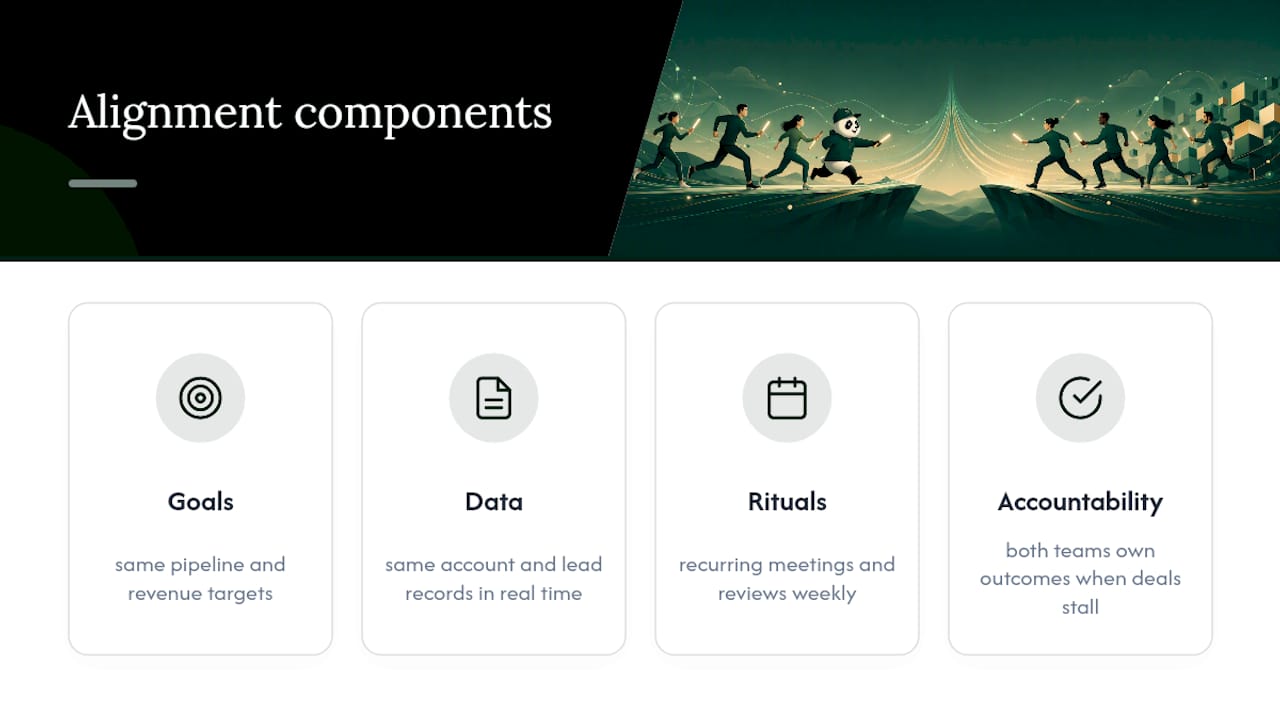
Alignment is not a slogan or a quarterly kickoff slide. It is an operating structure built on four components: shared goals, shared data, shared rituals, and shared accountability. Each piece has to exist simultaneously, or the whole thing collapses back into two departments trading blame over a spreadsheet.
Shared goals mean marketing and sales are measured against the same pipeline and revenue targets, not vanity metrics like impressions or call volume in isolation. Shared data means both teams see the same account and lead records in real time, not exported reports from last Tuesday. Shared rituals are the recurring meetings and reviews that keep the two teams synchronized week over week. Shared accountability closes the loop: when a deal stalls or a lead goes cold, both sides own the outcome.
None of that works without a common vocabulary, which is why definitions come first. Before you touch a tool or a meeting cadence, agree on your ideal customer profile (ICP), and what separates a marketing qualified lead (MQL) from a sales accepted lead (SAL) and a sales qualified lead (SQL). Define what counts as a “named account” in your target account list, and write down exact stage definitions for every point in the funnel. Salesforce’s alignment framework treats these shared definitions, along with shared target account lists, as the foundation on which everything else sits. Skip this step and every later meeting becomes a definitions argument in disguise.
Why Alignment Matters Now for B2B Revenue Teams
The gap between how aligned leaders think their teams are and how aligned those teams actually feel is larger than most executives want to admit.
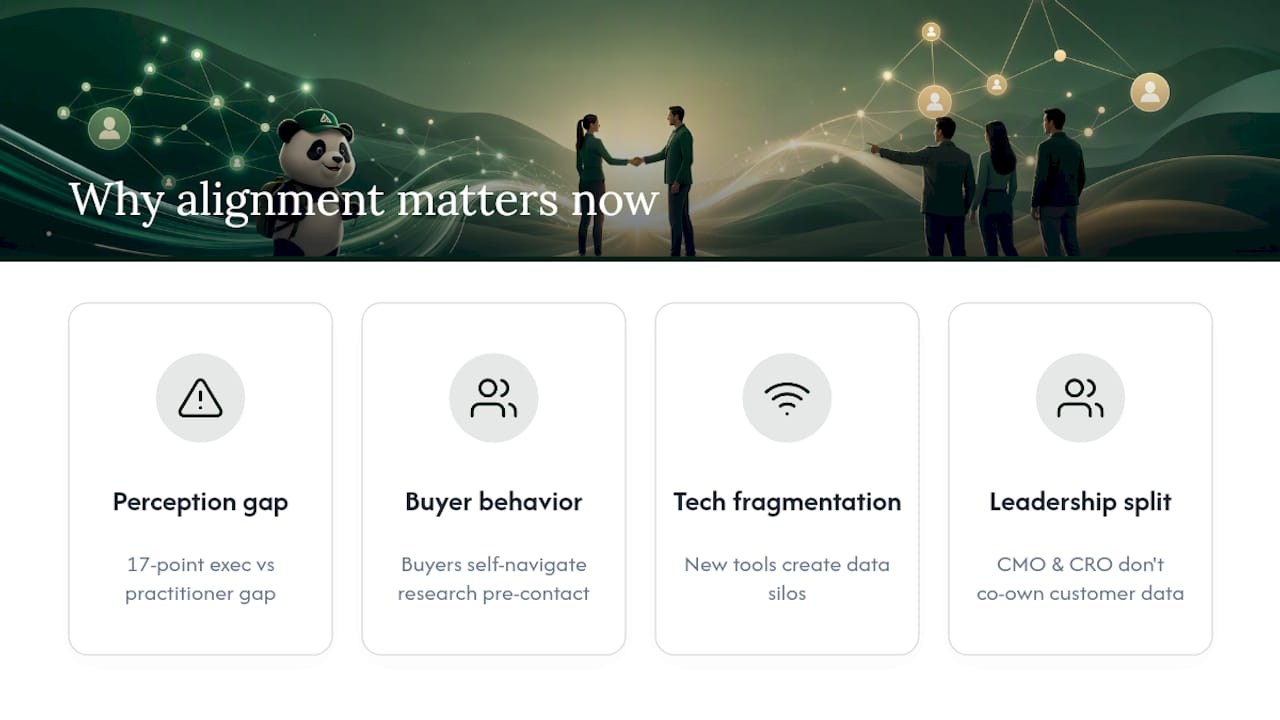
Forrester’s research found a strong perception among C-level executives that their product, sales, and marketing teams are aligned, while many sales and marketing practitioners report a lack of alignment.
That 17-point perception gap is where deals die quietly. Executives sign off on strategy while frontline reps and campaign managers are working from different playbooks, different lead definitions, and different incentive structures.
Three forces are making this gap more expensive every quarter. Buyers now self-navigate most of their research before ever talking to a rep, which means marketing’s content and signals have to do heavier lifting earlier in the cycle. Technology keeps fragmenting, adding new tools that create new data silos unless someone actively integrates them. And the relationship between the CMO and CRO has become the defining axis of revenue performance. KPMG’s research found that many organizations still don’t have their CMO and CRO co-owning customer strategy or customer data, which leaves the two most powerful revenue functions in the building working from separate playbooks.
Organizations that close this gap report faster deal velocity, stronger win rates, and cleaner pipeline. Organizations that don’t tend to blame the market, the product, or the reps, when the real problem is structural.
Common Misalignment Problems and How to Spot Them
Misalignment rarely announces itself. It shows up as a slow accumulation of friction that everyone notices but nobody owns.
The most common failure modes include:
Inconsistent definitions: Marketing calls something an MQL that sales considers a spam form fill, and the argument repeats every week.
Incentive mismatch: Marketing is paid on lead volume while sales is paid on closed revenue, so each team optimizes for a different number.
Siloed technology and data: The CRM and the marketing automation platform don’t sync in real time, so reps work from stale account histories.
Weak handoffs: Leads pass from marketing to sales with no context, no engagement history, and no clear next action attached.
Missing feedback loops: Sales never tells marketing which leads closed and why, so campaigns keep generating the same low-quality volume.
HBR’s coverage of sales and marketing friction documents how this dysfunction hurts both functions at once. Marketing looks ineffective because leads don’t convert; sales looks unresponsive because follow-up lags.
Watch for operational signals rather than waiting for a formal complaint. Contradictory messaging between a campaign and a sales pitch is one. Ongoing disputes over lead quality, especially the phrase “these leads are garbage” showing up in Slack, is another. Slow follow-up times on hot leads, more than a day or two, usually indicate the handoff process itself is broken, not that reps are lazy. Any of these signals, sustained for more than a month, means the fix needs to happen at the process level, not through another motivational email.
Step-by-Step Playbook: A Concrete Build Sequence to Achieve Alignment
Alignment fails most often when teams try to build it all at once. Break it into sprints, and treat each one as a deliverable with a deadline, not an ongoing aspiration.
Sprint 1: Charter and definitions. Draft a one-page charter naming your shared ICP, your named-account list, and exact stage definitions from MQL through closed-won. Get both the marketing and sales leads to sign it.
Sprint 2: Rituals and governance. Stand up a weekly pipeline standup, a biweekly named-account review, and a monthly retro where both teams discuss what worked and what didn’t.
Sprint 3: Shared metrics and dashboards. Build a single dashboard tracking MQL to SQL conversion rate, marketing-influenced revenue, and SLA adherence, visible to both teams at once.
Sprint 4: SLA and feedback loop. Write a formal service level agreement: marketing commits to lead volume and quality thresholds, sales commits to follow-up speed, and both commit to a structured feedback format on every closed or lost deal.
Sprint 5: Enablement and content library. Build a library of sales enablement content that reps can actually use in live conversations, including objection-handling one-pagers and case studies mapped to specific buyer stages.
Sprint 6: Instrumentation. Standardize CRM fields, automate lead routing rules, and connect engagement tracking so a prospect’s website behavior updates their record without manual entry.
Sprint 7: Controlled launch and quarterly refresh. Launch with one segment or region, measure results against your dashboard, and decide quarterly whether to scale, extend, or kill each initiative.
Your one-page charter should be short enough to fit on a single screen: ICP criteria, the named-account list, stage definitions, and the names of both executive sponsors. Your SLA should be equally concrete: “Marketing delivers 150 SQLs per month meeting X criteria; sales contacts every SQL within four business hours; both teams review lost-deal reasons every two weeks.”
Pro Tip: Run Sprint 1 and Sprint 2 in the same two-week window. Definitions without a ritual to enforce them just become a forgotten document in a shared drive.
This sprinted structure matters because alignment breaks down when it’s treated as a single big-bang project instead of an iterative build. Industry playbooks on sales and marketing alignment consistently recommend the quarterly refresh cadence over a set-and-forget launch, since buyer behavior and team composition both shift faster than a static agreement can track.
How to Measure Alignment: Metrics, Dashboards, and Reporting
Alignment is only real if it shows up in numbers both teams agree to look at. A handful of core metrics do most of the work.
MQL to SQL conversion rate: measures whether marketing’s qualification criteria actually predict sales-ready leads.
Marketing-influenced revenue: ties campaign activity directly to closed-won deals, not just lead counts.
SLA adherence: tracks whether marketing hit its lead commitments and sales hit its follow-up speed.
Sales cycle length: shortens when handoffs are clean and enablement content answers objections early.
Win rate by lead source: reveals which channels and campaigns actually produce deals, not just volume.
Build these into a single dashboard both teams pull from, rather than marketing running its own report and sales running another. That single source of truth is the entire point: if either team can dispute the numbers because they’re looking at different data, the metrics program has already failed.
Run a monthly tactical review to catch drift early, and a quarterly strategic review to decide whether targets, definitions, or incentives need to change. A healthy benchmark to watch for is a rising MQL to SQL conversion rate quarter over quarter. A flat or declining rate, even with growing lead volume, usually means the definitions from Sprint 1 have drifted out of sync with what sales actually wants.
Technology and Process: The Minimal Stack That Supports Alignment
You don’t need a dozen tools to make alignment work. You need a small stack that talks to itself reliably.
The minimum viable setup is a CRM as the single source of truth, a marketing automation platform synced to it in real time, and a layer of engagement or intent signal tracking that feeds both systems. Required CRM fields include lead source, lifecycle stage, account owner, and last engagement date, with automation rules that route leads based on score thresholds rather than manual review.
Predictive scoring and AI-assisted routing genuinely help here. Analyst research on B2B buying behavior notes that AI-driven scoring reduces subjectivity in how leads get prioritized, but only when the underlying data is clean and the process around it is already mature. The common pitfall is bolting a scoring model onto messy, duplicate-riddled CRM records and expecting it to fix a data problem it was never built to solve. Fix your fields and your definitions first. Add intelligence to a stack that already works, and it becomes an accelerant. Add it to a broken one, and it just automates the confusion faster.
Operating Model and Governance: Who Owns Alignment
Alignment needs two owners at the top and one operator in the middle, or it drifts within two quarters.
The CMO and CRO should co-own the customer strategy and the data behind it. KPMG frames this pairing as the defining relationship for modern revenue growth, and that co-ownership must be structural, not a standing invitation to a meeting. Below that executive layer, a RevOps function should operate the day-to-day mechanics: the dashboard, the SLA tracking, and the meeting cadence. Gartner’s research on commercial function alignment points to RevOps adoption accelerating specifically because someone neutral needs to run the machine.
Set a three-tier cadence: weekly operational standups for pipeline issues, monthly tactical reviews for metrics and process tweaks, and quarterly strategic sessions for target and definition changes. The most common governance trap is letting alignment become “a marketing initiative” that sales quietly opts out of. If sales leadership isn’t in the room signing off on every sprint, the charter is decoration.
How Align TCC Applies These Principles
An agency builds its client engagements around the same discipline it recommends here: shared definitions before shared tools, and shared rituals before shared dashboards. The methodology blends Scandinavian brand thinking, which favors clarity and long-term positioning, with the speed and market responsiveness common to Chinese growth methodologies. That combination is designed to keep strategy sharp while execution moves fast.
On the technology side, AI is used to handle repetitive layers of campaign execution and lead routing, freeing strategists to focus on positioning and creative decisions rather than manual data cleanup. The goal is tighter handoffs between brand strategy and commercial execution, the same handoff problem that breaks most internal marketing and sales relationships.
Where To Start This Week
Fix your definitions before you touch a single new tool. Most teams reach for a scoring model or a shiny integration when the real problem is that marketing and sales still disagree on what an MQL is. That disagreement will survive any software purchase.
Get your CMO and CRO in the same room this week and put the first governance ritual on the calendar, even if it’s just a 30 minute pipeline review. Momentum starts there, not in a procurement cycle.
— Kalle
How Align TCC Can Help You Build This
Fixing the gap between marketing and sales rarely happens through willpower alone. It usually needs an outside partner who can run the audit, write the charter, and hold both teams accountable to the SLA neither wants to enforce on themselves. An external team with experience building this operating model for other companies can compress the timeline.

Relevant services can include brand strategy, RevOps enablement, account-based marketing, AI-driven localization, and full campaign execution, all built to connect commercial strategy directly to pipeline outcomes. Teams needing a structured starting point might consider an alignment audit to diagnose breakdowns, a six-week pilot to test a new operating rhythm on one segment, or a 90-day conversion strategy built around existing traffic and lead flow.
Review outcomes from past engagements on Aligntcc’s client work page, then explore the full service offerings to find the right starting engagement for your team’s current stage.
Primary Sources and Further Reading
The claims in this playbook draw on five primary sources worth reading directly. Forrester’s research documents the perception gap between executives and practitioners. KPMG’s analysis frames the CMO-CRO relationship as central to revenue growth. Gartner’s guidance supports the case for RevOps as a governance model. HBR’s coverage explains how misalignment damages both functions simultaneously. Salesforce’s framework outlines the shared definitions and account lists that anchor the playbook above. For a deeper look at nurture sequencing that supports the handoff process, see this lead nurturing guide.
Sources
FAQ
What Is Marketing Sales Alignment?
Marketing sales alignment is a shared operating model where marketing and sales use the same definitions, data, and meeting rituals to drive pipeline and revenue together, rather than working from separate goals and reports.
What Is a Marketing SLA?
A marketing SLA is a written agreement where marketing commits to a specific lead volume and quality standard, and sales commits to a follow-up speed and disposition process, with both sides reviewing results on a set cadence.
How Long Does It Take to Align Sales and Marketing?
Most teams can stand up definitions and initial rituals within two sprints, roughly four weeks, but full instrumentation and a stable SLA typically take a full quarter to mature.
What Metrics Prove Sales and Marketing Are Aligned?
MQL to SQL conversion rate, marketing-influenced revenue, SLA adherence, and win rate by lead source are the core metrics that show alignment is producing revenue, not just cooperation.
Can an Agency Help With Marketing Sales Alignment?
Yes. An experienced partner like Aligntcc can run the initial audit, draft the charter and SLA, and implement the enablement and technology pieces faster than most internal teams building the process from scratch.
Recommended
7 Sprints to Align Marketing and Sales for B2B Revenue
THE POINT
7 Sprints to Align Marketing and Sales for B2B Revenue
KEY TAKEAWAYS
01
Seven sprints to align marketing and sales for B2B revenue teams: set SLAs, build a shared dashboard, enforce governance, plus an Align TCC agency case.
02
Seven sprints to align marketing and sales for B2B revenue teams: set SLAs, build a shared dashboard, enforce governance, plus an Align TCC agency case.
03
Seven sprints to align marketing and sales for B2B revenue teams: set SLAs, build a shared dashboard, enforce governance, plus an Align TCC agency case.
RELATED INSIGHTS


LET’S TALK
What are you trying to grow next?
Brand, launch, market entry or performance. Book 30 minutes and tell us what you’re working on.