Growth / Performance
Kalle Mobeck
•

Reach the Right 500 Buyers: B2B PR Strategy That Moves Pipeline
A high-impact B2B PR strategy prioritizes evidence-led narratives, targeted distribution to a concentrated audience, and measurement tied to pipeline, not clip counts. The three levers to move first: build a living messaging matrix, publish one piece of original research, and put a spokesperson governance model in place. Do this well, and PR starts influencing deals, not just impressions.
TL;DR:
Focusing on audience mapping reveals that half of existing media efforts target outlets that do not influence B2B purchase decisions.
Developing a narrow, authoritative messaging matrix aligned with specific pain points significantly improves sales team consistency and messaging clarity.
Prioritizing relationship-building with a small cluster of relevant publications and analysts accelerates credibility more than broad coverage efforts.
Effective measurement links PR outputs and signals directly to pipeline impact, emphasizing qualified mentions and discoverability over volume.
Establishing clear spokesperson roles, message hierarchies, and practice interviews before crises ensures consistent and rapid communication responses.
AligntccSharpen Your Brand PositioningAlign TCC helps fast-growing companies develop targeted commercial strategies that engage audiences and strengthen market impact.Explore Align TCC
Table of Contents
What Are the Core Components of a B2B PR Strategy?
Who Should Your B2B PR Strategy Actually Target?
How Do You Build a Messaging Matrix That Sales Will Actually Use?
Which PR Tactics Actually Move B2B Buyers?
How Should You Sequence and Time PR Distribution?
How Do You Measure Whether B2B PR Is Working?
How Do You Set Up Spokesperson Governance Before You Need It?
How Align Puts This Framework into Practice
What Trips Up Most B2B PR Programs in the First Year?
Ready to Put This Framework to Work?
Sources
What Are the Core Components of a B2B PR Strategy?
Every durable B2B communication strategy rests on the same six pillars, and skipping one is usually why programs stall out at “we got some press” instead of “we influenced revenue.” A governing narrative, audience mapping, channel architecture, spokespeople governance, and pipeline-linked measurement work together, not in sequence.
Objectives: what business result PR is expected to move
Audiences: the buyers, influencers, and analysts worth your time
Narrative: the point of view you own and defend
Channels: media, analysts, events, customer voice, employees
Evidence: proof assets that back every claim you make
Measurement and governance: how you track impact and who speaks for the company
B2C PR chases reach. B2B PR chases the right 500 people, which means every pillar above has to be built around precision, not volume.
Who Should Your B2B PR Strategy Actually Target?
Objectives come before outreach. If you skip straight to pitching journalists, you’re optimizing for coverage instead of commercial outcomes, and the two are not the same thing.
Translate business goals into 2 to 3 PR objectives. “Grow revenue” becomes “increase share of voice in three trade publications our ICP reads” or “generate five analyst references by Q3.”
Map your audience by role, not just title. Separate economic buyers, technical evaluators, industry analysts, and the specific outlets and communities each group actually consumes.
Prioritize by impact times attention concentration. In most B2B niches, a small cluster of publications and analysts reaches the majority of your decision-makers. Chasing broad trade coverage outside that cluster wastes budget.
This mapping exercise usually surfaces an uncomfortable truth: half your existing media list has never influenced a single closed deal.
How Do You Build a Messaging Matrix That Sales Will Actually Use?
Pick a few topic areas where your company has real authority. Depth on a narrow set of positions beats a scattered point of view every time, because reporters and analysts remember companies that own something specific. Depth on a narrow set of positions beats a scattered point of view every time, because reporters and analysts remember companies that own something specific.
From there, build a one-page, living messaging matrix mapping audience to pain point to point of view to proof to asset.
Audience: VP of Operations at mid-market manufacturers
Pain: manual reporting delays quarterly close by two weeks
POV: automation removes the bottleneck without adding headcount
Proof: customer benchmark data or a named case study
Asset: a one-page sales sheet or bylined article
A copy-ready messaging artifact like this keeps sales, comms, and executives saying the same thing in the same words, whether they’re on a sales call or answering a reporter’s question.
Pro Tip: Store the matrix somewhere sales actually opens, like a shared drive linked in your CRM. A messaging document buried in a comms folder never makes it into a sales call.
Which PR Tactics Actually Move B2B Buyers?
Not every tactic deserves equal budget. Rank them by how directly they build trust with a buyer who is already evaluating options, not by how easy they are to execute.
Media relations: pitch trade and niche publications with a specific data point or customer result, not a generic announcement. Editors need a reason to care, and proprietary data compresses that decision considerably.
Thought leadership and executive bylines: secure placements by pitching a contrarian, specific argument tied to a trend the outlet already covers, then structure the piece around one clear claim with two supporting examples.
Analyst relations: brief analysts on a regular cadence, keep two or three reference customers ready, and follow up quickly. Deliberate analyst engagement accelerates credibility faster than most other single tactic.
Customer evidence: case studies, benchmark data, and speaker references turn abstract claims into something a skeptical buyer can verify.
Employee advocacy: your team’s networks extend the life of an earned placement well past its publish date, at close to zero cost.
How Should You Sequence and Time PR Distribution?
A single strong asset, poorly sequenced, underperforms a mediocre asset distributed well. The order matters as much as the content.
Insight first. Nail down the data point or point of view before you write anything else.
Earned outreach. Pitch media and analysts before the asset goes live, under embargo where it makes sense.
Owned asset. Publish the full piece on your own site so it has a permanent home to link back to.
Social and paid amplification. Push the earned coverage and owned asset to the audience segments that matter, not everyone.
Sales activation. Hand reps a one-line summary and the asset link so they can use it in active conversations.
Time major launches around analyst briefing windows and industry conferences, and build in a two-week buffer before big events so coverage lands ahead of, not during, the news cycle crush.
How Do You Measure Whether B2B PR Is Working?
Clip counts tell you almost nothing about revenue impact. A tiered model does.
Outputs: placements secured, bylines published, analyst briefings held
Mid-funnel signals: referral traffic, branded search lift, content downloads tied to a placement
Outcomes: influenced pipeline, sales cycle acceleration, win rate in accounts exposed to coverage
Weight coverage by audience relevance and domain authority, not raw volume. A single mention in a publication your ICP actually reads outranks ten mentions in outlets nobody in your buying committee opens.
B2B buying behavior is increasingly zero-click in parts of the research journey, which means discoverability and third-party credibility now double as SEO signals. A backlink from a respected trade outlet does double duty: it builds trust with a human reader and authority with a search algorithm.
Report monthly on outputs and mid-funnel signals, quarterly on outcomes, and always in the same dashboard revenue leadership already uses. If your PR metrics live in a separate deck from your pipeline metrics, nobody upstream is reading them.
How Do You Set Up Spokesperson Governance Before You Need It?
Governance gets built after a crisis exposes its absence, and by then it’s too late. Defining a spokespeople roster, message hierarchy, and approval workflow before anything goes wrong is what separates a fast, consistent response from a scramble.
Name a primary and backup spokesperson for each major topic area
Build a one-page message hierarchy ranking your top three claims by priority
Create a briefing template and an embargo playbook so nothing new gets drafted under deadline pressure
Pro Tip: Run a 30-minute mock interview with each spokesperson twice a year. The goal isn’t polish, it’s catching the moment someone drifts off message under pressure.
How Align Puts This Framework into Practice
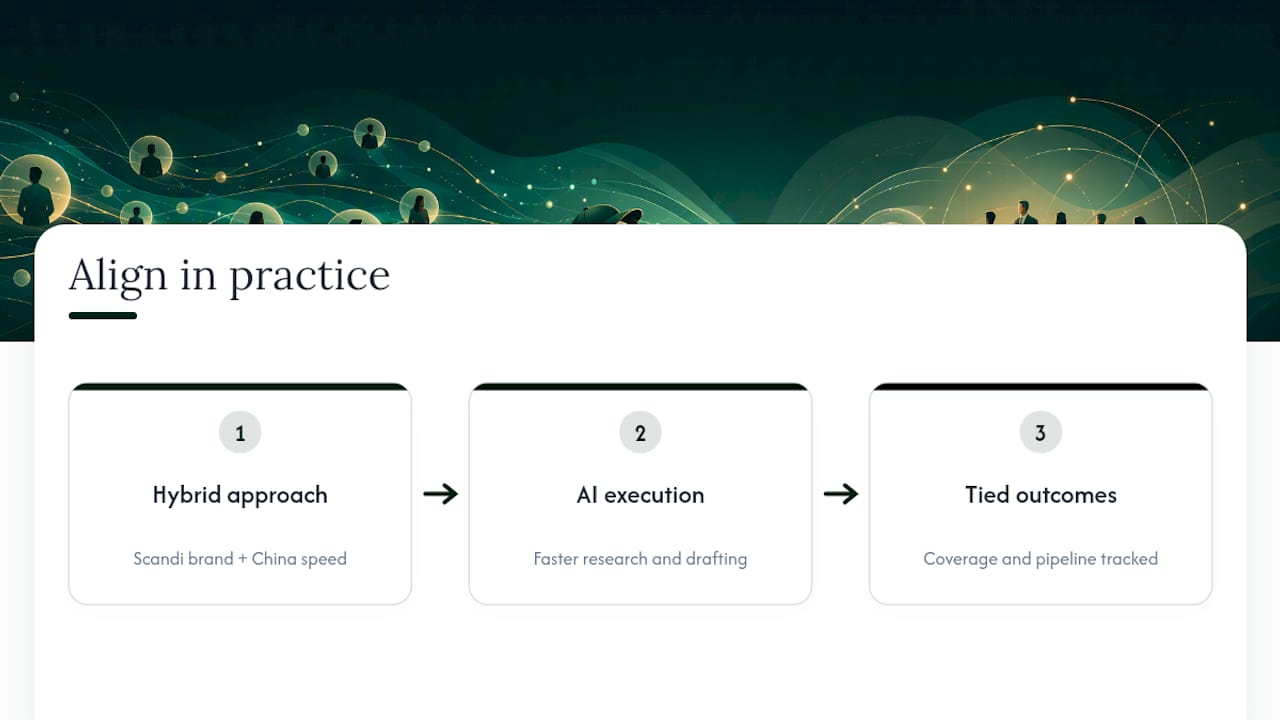
A living messaging matrix only pays off when the workflow around it moves fast, which is where AI-enabled execution changes the math. Align’s approach pairs Scandinavian brand thinking with the speed of Chinese market methodologies, using AI to accelerate research and drafting cycles while keeping creative judgment human.
That combination shortens the gap between “we have a point of view” and “that point of view is in front of the right analyst.” PR activity gets tied back to demand generation and account-based programs, so coverage and pipeline get tracked in the same conversation instead of two separate ones. Case examples and team credentials for specific engagements are available on request.
What Trips Up Most B2B PR Programs in the First Year?
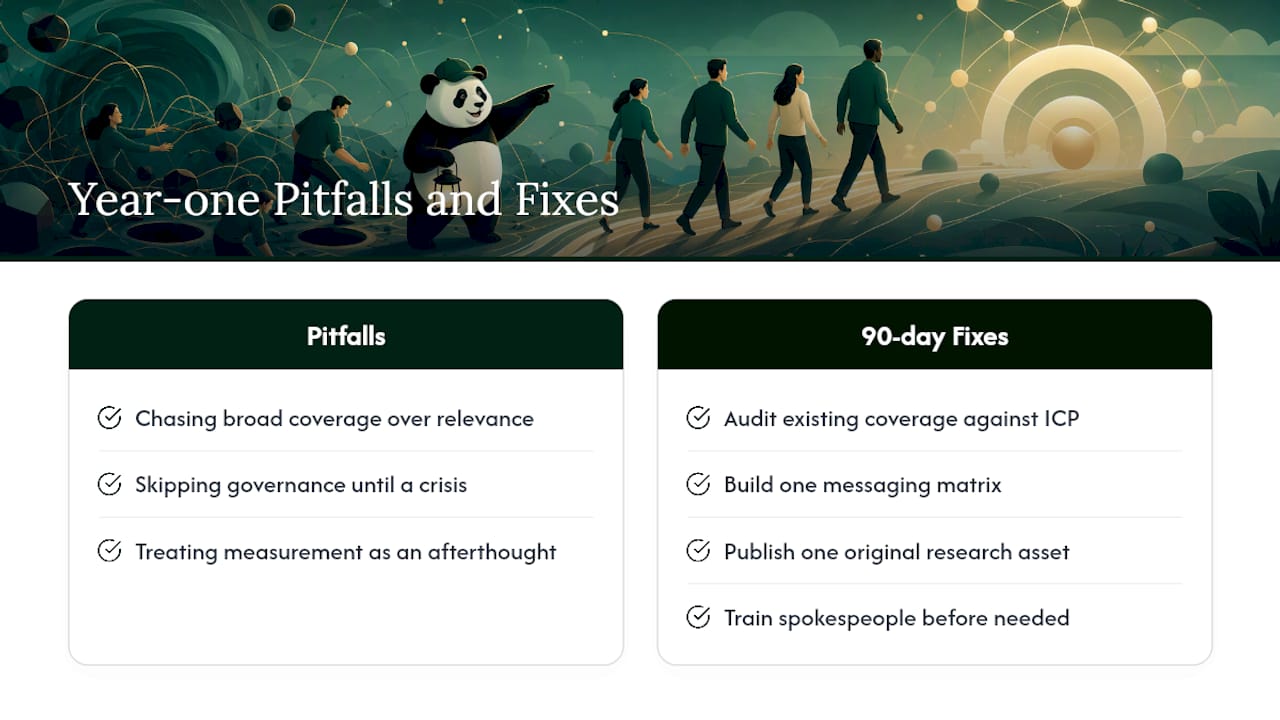
Three mistakes repeat constantly: chasing broad coverage over concentrated relevance, skipping governance until a crisis forces it, and treating measurement as an afterthought instead of a design input. Fix those first.
Your 90-day priority list: audit existing coverage against your actual ICP, build one messaging matrix, publish one original research asset, and train your spokespeople before you need them. Everything else in this framework builds on those four moves.
— Kalle
Ready to Put This Framework to Work?
Building the framework is one thing. Executing it at the speed B2B buying cycles now demand is another, and that gap is exactly where most internal teams stall out. Some agencies work with growth-stage and enterprise B2B companies to turn a messaging matrix into live media relationships, analyst briefings, and customer evidence programs, backed by AI-enabled workflows that cut the time between insight and outreach.

If your PR function needs sharper positioning, faster execution, or a governance structure that holds up under pressure, Align’s B2B approach is built around exactly that. Book a strategy call to audit your current program against the framework above and leave with a prioritized 90-day plan.
Sources
Recommended
Reach the Right 500 Buyers: B2B PR Strategy That Moves Pipeline
THE POINT
Reach the Right 500 Buyers: B2B PR Strategy That Moves Pipeline
KEY TAKEAWAYS
01
Practical sales aligned B2B PR that turns evidence and a living messaging matrix into pipeline. Learn sequencing, measurement, and a 90 day playbook.
02
Practical sales aligned B2B PR that turns evidence and a living messaging matrix into pipeline. Learn sequencing, measurement, and a 90 day playbook.
03
Practical sales aligned B2B PR that turns evidence and a living messaging matrix into pipeline. Learn sequencing, measurement, and a 90 day playbook.
RELATED INSIGHTS




LET’S TALK
What are you trying to grow next?
Brand, launch, market entry or performance. Book 30 minutes and tell us what you’re working on.