•

B2B ABM Orchestration: Six Elements to Turn Contact Signals Into Sales
ABM orchestration is the coordination layer that turns account and contact signals into consistent, sales-ready action across marketing and sales, and it’s what separates a pipeline that compounds from one that stalls. Teams that orchestrate rather than just automate see faster-moving pipeline and higher average contract values because every touch reflects real buying-committee behavior, not a static campaign calendar. This piece breaks down the components, gives you an implementation playbook, and shows how to measure what actually works.
TL;DR:
Large, high-value accounts with four or more stakeholders benefit most from orchestration, especially when sales and marketing lack a shared trigger system.
Predefined signals, account profiles, and clear ownership roles are critical for automation to avoid manual rework and improve decision accuracy.
Multi-touch attribution models like fractional, sequence-aware methods provide significantly more accurate insight into which signals actually drive revenue compared to last-touch or linear models.
Scaling ABM orchestration requires governance, modular content, and speed over complex personalization, prioritizing ownership and fast action.
Partnering with a strategic provider like Align helps implement, measure, and improve orchestration through proven frameworks and AI-supported execution.
AligntccSharpen Your Go-To-Market StrategyAlign TCC helps fast-growing companies build sharper positioning and targeted marketing strategies across changing markets.Explore Align TCC
Table of Contents
What ABM orchestration is and how it differs from ABM automation
Core elements of an effective ABM orchestration program
Step-by-step implementation playbook for ABM orchestration
Measuring success: account-level metrics and attribution for ABM orchestration
Common challenges and how to fix them
Concrete ABM plays and use-case examples
How Align TCC approaches ABM orchestration
Lessons from running ABM orchestration at scale
Why work with Align on your ABM orchestration program
Sources
FAQ
What ABM orchestration is and how it differs from ABM automation
Orchestration is the decisioning layer. Automation is the execution layer. Confusing the two is the most common reason ABM programs plateau after a promising pilot.
ABM automation runs the mechanics: sending the email sequence, triggering the ad, logging the activity in your CRM. It’s necessary, but it has no judgment. ABM orchestration decides what should happen next based on account- and contact-level signals: who on the buying committee just engaged, what intent surged, whether a champion went quiet. Orchestration is the strategy that tells automation what to do and when to hand off to sales.
Vendor and platform guidance on ABM consistently frames orchestration around a few connected disciplines: cross-functional alignment, deliberate account selection, and personalized multichannel engagement tied to real-time signals rather than static segments.
You should favor orchestration over plain automation when:
Your buying committee has four or more stakeholders with different priorities.
Deal sizes justify custom plays instead of one-size-fits-all nurture tracks.
Sales and marketing already share account ownership but lack a shared trigger system.
Smaller deals with a single buyer rarely need this level of coordination. Complex, high-ACV accounts almost always do.
Core elements of an effective ABM orchestration program
A program that holds up under scale rests on six connected parts. Skip one and the others start compensating for it, usually with more manual work.
Cross-functional alignment and shared KPIs. Sales and marketing need one dashboard, one definition of a qualified account, and one scorecard, not two versions of the truth.
Account selection and buying-committee mapping. Your ideal customer profile should name roles, not just firmographics, so you know who to target inside each account.
Signal taxonomy. Intent data, product engagement, firmographic fit, technographic stack, and customer events all need a common structure before they can trigger anything reliably.
Playbook design. Every play needs a trigger, a defined action, a sales handoff point, and a feedback loop back into the data.
Content and channel personalization patterns. Personalization works best as modular blocks (industry proof point, role-specific pain, regional context) assembled per account, not bespoke copy for every single one.
Governance. Roles, service-level agreements, and escalation paths decide who acts on a signal within hours instead of letting it go stale for a week.
The pattern that trips up most teams is treating personalization as a content problem. It’s really a governance problem: who owns the decision when a signal fires, and how fast do they have to act. Get that right and the content follows.
Step-by-step implementation playbook for ABM orchestration
Building an orchestration program in the right order saves months of rework. Here’s the sequence that holds up across most B2B teams.
Define objectives, account tiers, and success metrics. Decide what “working” looks like (pipeline influenced, velocity, ACV) before you touch any tooling.
Build account and contact profiles. Map the buying committee for each tier-one account: economic buyer, champion, technical evaluator, blocker.
Choose your signal set and normalize it. Pick a manageable number of signals (intent surges, page visits, product usage, event attendance) and define what counts as meaningful versus noise.
Set trigger thresholds. A single page visit shouldn’t open a sales play. Require persistence, such as a signal appearing across two sessions or two different signal types, before it counts.
Design plays and decisioning rules. Write out the trigger, the automated action, the sales handoff criteria, and who owns each step.
Integrate the tech stack. Connect CRM, marketing automation, and your signal sources so data flows both ways, not just into a dashboard nobody checks.
Run a small pilot. Choose one tier, one or two plays, and a fixed measurement window.
Measure, iterate, scale. Compare pilot results against your baseline, fix the weak points, then expand to more accounts and plays.
The biggest mistake in this sequence is starting with the tech stack. Tooling should follow a defined play, not the other way around. Vendor academy content and consultancy guidance consistently recommend starting with a small pilot and clear success criteria rather than a big-bang rollout across every account tier at once, because it’s faster to spot a broken assumption in a ten-account pilot than in a five-hundred-account rollout.
Pro Tip: Pilot with your best-fit accounts first, not your most urgent ones. A clean signal-to-play test tells you more than a rushed one on a deal that’s already stalling.
Measuring success: account-level metrics and attribution for ABM orchestration
The metrics that matter for orchestration are account engagement score, pipeline influenced, sales velocity, and average contract value, tracked at the account level rather than the lead level. A single contact converting means little if the rest of the buying committee never engaged.
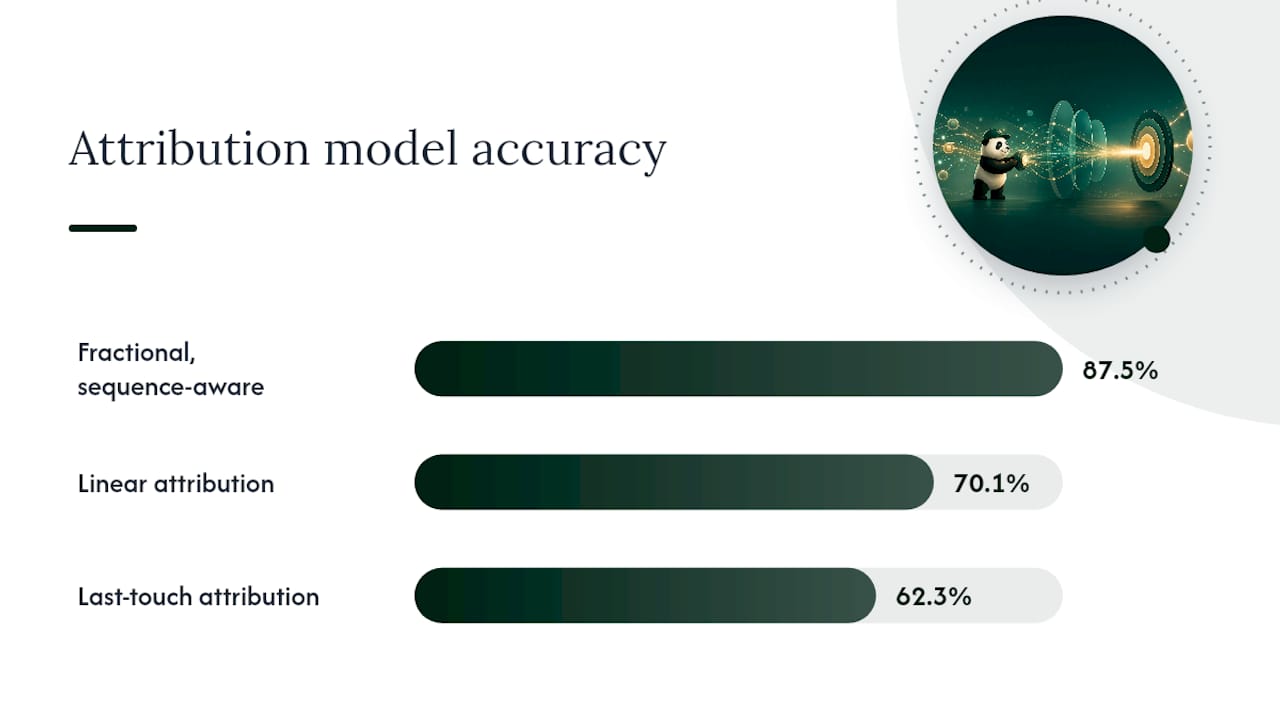
Last-touch and linear attribution models routinely mislead B2B teams because they either credit one moment (last touch) or spread credit evenly across a journey (linear) that, in reality, involves multiple decision-makers acting at different times with different weight.
A comparative study on multi-touch B2B attribution found that a fractional, sequence-aware attribution model reached roughly 87.5% conversion attribution accuracy and a 0.82 pipeline ROI correlation, compared with 62.3% for last-touch and 70.1% for linear models. That gap is the difference between a report that flatters your top-of-funnel spend and one that tells you which touch actually moved a deal.
More advanced approaches worth knowing:
Shapley value models distribute credit based on each touchpoint’s marginal contribution across possible sequences.
Markov chain models estimate the removal effect of a channel by simulating what happens if that touch never occurred.
Fractional, sequence-aware models weight touchpoint order, account-level influence, and engagement intensity together, which is where the study above showed the strongest results.
Adopt one of these once your pilot has enough closed deals to test against. A model with no volume behind it is just a guess with better math. The practical rollout is to baseline your current attribution, implement the new model in parallel, and validate it against a batch of already-closed deals before trusting it going forward.
Common challenges and how to fix them
Most orchestration programs stall for the same handful of reasons, and none of them require new technology to fix.
Bad data. Canonicalize account and contact records before you build a single play; garbage signals produce garbage triggers.
Sales and marketing drift. Joint dashboards and written SLAs on response time close the gap faster than another cross-functional meeting.
Personalization that doesn’t scale. Build modular content blocks (industry proof points, role-specific messaging, regional context) and assemble them per account instead of writing from scratch every time.
Noisy intent signals. Require persistence across multiple sessions or signal types before a play opens, or you’ll bury sales in false positives.
Pro Tip: When intent data feels unreliable, the fix is usually the threshold, not the vendor. Raise the bar for what counts as a real signal before you swap providers.
Concrete ABM plays and use-case examples
These four play patterns show up repeatedly because they’re measurable and easy to pilot.
Intent surge play. Trigger: a target account shows a spike in third-party intent data. Action: coordinated ad push plus SDR outreach within 24 hours. Handoff: sales engages once two or more contacts from the account show activity. Measure: response rate and meetings booked.
Contact expansion play. Trigger: one contact engages repeatedly but no other buying-committee members appear. Action: targeted content and outreach aimed at adjacent roles identified in your buying-committee map. Measure: number of new contacts engaged per account.
Defend and retain play. Trigger: a customer account shows competitor-related search or content signals. Action: customer success and account management coordinate a proactive touch. Measure: retention rate and expansion pipeline.
Event follow-up play. Trigger: an account attends a webinar or trade show session. Action: personalized follow-up referencing the specific session, timed within 48 hours. Measure: meeting conversion rate.
Each play needs the same checklist: a defined trigger, an owner, a time-bound action, and a metric tied back to pipeline, not just activity.
How Align TCC approaches ABM orchestration
A strong approach to ABM orchestration blends Scandinavian brand thinking with the commercial speed of Chinese market methodologies, pairing sharp positioning with execution that moves at the pace B2B pipelines demand. AI can play a supporting role throughout: processing signals faster and helping personalize content at scale, while the creative judgment and account strategy stay human-led.
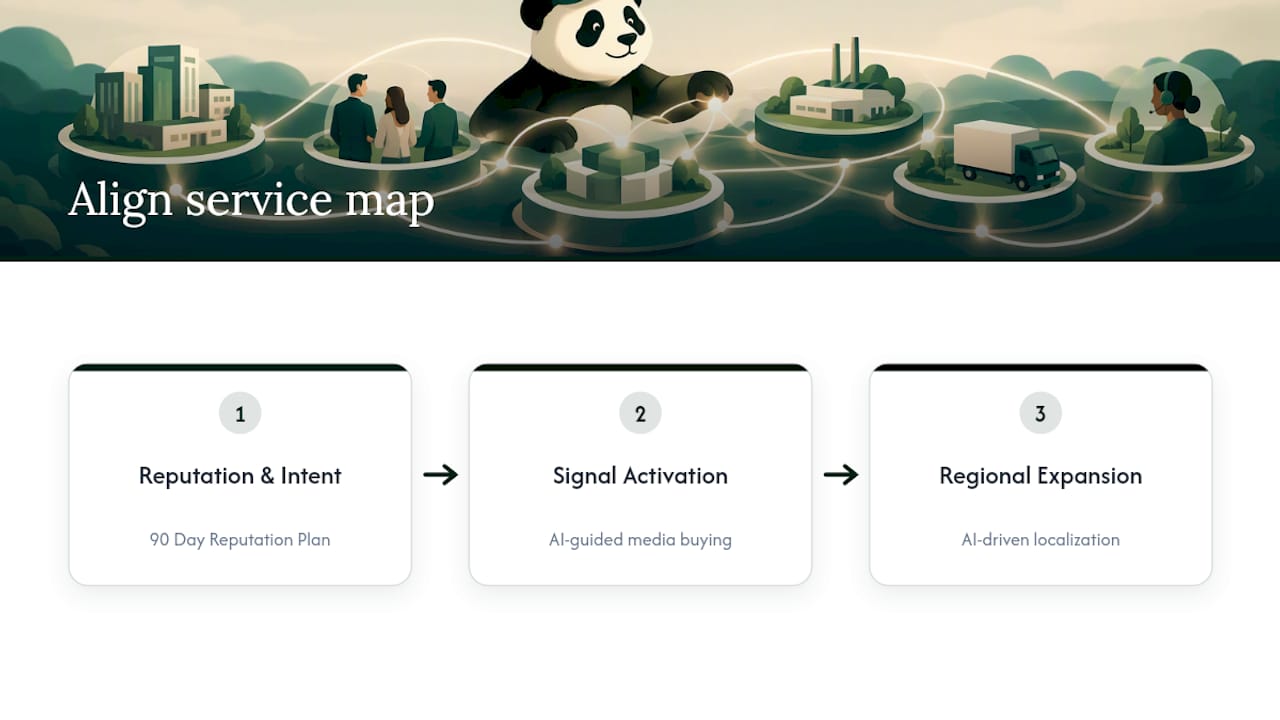
Align’s service map lines up with each stage of an orchestration program. Early-stage reputation and intent monitoring draws on the 90 Day Reputation Plan, while AI-guided media buying supports the signal-to-activation stage once accounts are already engaged. For teams expanding into new regions, AI-driven localization keeps messaging coherent across markets without slowing down the plays already in motion.
Lessons from running ABM orchestration at scale
Three things hold up across most deployments. First, governance beats tooling: teams with clear ownership and SLAs outperform teams with better software and no decision rights. Second, a small set of well-run plays beats a broad program of undifferentiated personalization every time. Third, partner when speed matters more than control, and build in-house only once you know exactly which signals actually predict revenue.
Pro Tip: The account that outperforms the model. Watch it closely, because it usually reveals a signal you haven’t formalized yet.
— Kalle
Why work with Align on your ABM orchestration program
Align TCC turns the orchestration playbook above into a working program instead of a slide deck, combining strategic positioning with the AI-supported execution that keeps signals moving into real sales actions. If your team already has the account list but not the coordination layer, that’s the gap Align closes.

Align capability | Where it fits in orchestration |
|---|---|
Account tiering, objective setting, KPI design | |
Brand & Positioning | Messaging blocks for personalization at scale |
Go-to-Market & Market Entry | New-region plays and localization |
Demand & Performance | Signal-driven paid media and activation |
Explore the full service offerings or see how past engagements have shaped orchestration programs on the client page to find the starting point that matches where your program stands today.
Sources
FAQ
What does ABM stand for?
ABM stands for account-based marketing, an approach that targets specific high-value accounts rather than broad lead pools. It aligns sales and marketing around a shared list of named accounts and coordinates outreach to the people who make up each buying committee.
What is ABM software?
ABM software is the category of tools that support account selection, intent tracking, personalization, and coordinated multi-channel engagement for account-based programs. It typically includes or connects to a CRM, a marketing automation platform, and one or more intent data or identity resolution sources.
What are ABM tools in marketing?
ABM tools in marketing cover the working stack of a program: CRM, marketing automation, intent data providers, ad platforms for account-based paid media, and sales engagement tools. Orchestration is the layer that decides how these tools act together based on account and contact signals.
What is ABM in tech?
In technology companies, ABM usually targets accounts with complex buying committees spanning technical evaluators, economic buyers, and end users, often with longer sales cycles and higher contract values. Orchestration matters more in tech because these buying groups tend to be larger and signals more fragmented across product usage, intent data, and sales activity.
Recommended
RELATED INSIGHTS



LET’S TALK
What are you trying to grow next?
Brand, launch, market entry or performance. Book 30 minutes and tell us what you’re working on.