•
Six Week AI Market Research Pilot With R² Checks for Marketers
AI for market research adds speed, scale, and directional pattern-finding to tasks that used to take weeks: reading thousands of reviews, running early concept tests, or moderating dozens of interviews at once. It excels at aggregate signals and early-stage screening, not individual-level decisions where the cost of being wrong is high. Every workflow we recommend keeps a human in the loop, because that is what separates a useful shortcut from a risky one.
TL;DR:
AI excels at analyzing large volumes of unstructured data, such as reviews and transcripts, significantly speeding up pattern detection and theme extraction.
Synthetic respondents provide directional insights but tend to overstate positivity and underrepresent variability, requiring human validation for critical decisions.
Combining AI tools with a structured, objective-driven workflow ensures reliable outputs, including diagnostic tests like R², before applying findings to strategic decisions.
Traditional market research remains essential for high-accuracy, demographic-specific, or high-stakes questions, with AI serving as an efficient early screening tool.
Future innovations will focus on integrating AI reliability scores and hybrid inference models to balance synthetic convenience with human-level accuracy and oversight.
Aligntccaligntcc.comTurn Market Signals Into StrategyAlign TCC combines AI with human creativity to shape sharper positioning and commercial strategies for changing markets.Explore Align TCC
Table of Contents
Core use cases: where AI adds the most value in market research
How it works: key techniques and architectures used in market-research AI
Practical toolkit and recommended multi-tool workflow for professional research teams
Limitations, bias modes, and validation diagnostics you must run
How to adopt AI responsibly: step-by-step implementation checklist
Align TCC perspective: AI-augmented research applied to brand and go-to-market strategy
Integration of AI-driven market research insights into business decision-making processes
Comparison of AI-based market research methods with traditional market research approaches
Future trends and emerging innovations in AI for market research
Author perspective: balancing speed with epistemic safety
How Align TCC can help: pilot AI-augmented market research
FAQ
Sources
Core use cases: where AI adds the most value in market research
The fastest wins come from tasks that involve volume, not nuance. Generative AI methods excel at synthesizing unstructured data like social mentions, open-ended survey fields, and call transcripts, turning thousands of scattered comments into coded themes in hours rather than weeks. From there, teams layer in synthetic respondents and AI-moderated formats for exploration, while reserving verification for anything that touches a real budget decision.
Unstructured data analysis: AI reads reviews, social posts, and transcripts at a scale no analyst team can match manually.
Rapid concept testing: Synthetic respondents give directional reads on messaging or packaging before you commit to a full human study.
AI-moderated interviews: Scaled qualitative exploration lets you run dozens of conversational interviews in parallel instead of sequentially.
Survey coding and theme extraction: Open-ended responses get classified and summarized automatically, surfacing churn signals and persuasion triggers faster than manual tagging.
Generative AI compresses typical research timelines from months to days for many of these tasks, but that speed is a screening advantage, not a substitute for validation. Anything that informs a pricing decision, a product launch, or a market-entry bet still needs a human-verified follow-up before it reaches a boardroom.
How it works: key techniques and architectures used in market-research AI
Understanding the mechanics behind AI research tools helps you evaluate vendors instead of taking their claims at face value. Large language models (LLMs) generate and interpret text through prompting, while retrieval-augmented generation (RAG) grounds those outputs in your own documents or a live data source rather than letting the model guess from training data alone. Embeddings and semantic search cluster responses by meaning, which is how tools map sentiment or group similar complaints without manual tagging.
LLMs and prompting: The foundation for generating summaries, personas, and synthetic responses.
Retrieval-augmented generation: Grounds AI answers in your actual source documents instead of general training data.
Embeddings and semantic search: Power clustering, theme mapping, and sentiment analysis across large text sets.
Supervised classifiers vs. unsupervised segmentation: One sorts data into categories you define, the other discovers groupings on its own.
Synthetic respondents and persona conditioning: AI simulates a demographic or psychographic profile to generate plausible answers.
One framework worth knowing is Generative Augmented Inference, which treats AI outputs as auxiliary features rather than direct substitutes for human labels. A 2026 working paper found this approach can substantially cut estimation error and reduce the need for human-labeled data by a large margin, depending on the task. That distinction, feeding AI output into a statistical model instead of trusting it outright, is what separates careful implementation from guesswork.
Practical toolkit and recommended multi-tool workflow for professional research teams
No single tool covers every stage of a research project well. Research-first answer engines are built for citation-driven quick facts. Deep-research agents handle multi-step synthesis across dozens of sources. Document analyzers excel at parsing long reports or transcripts. RAG platforms let you query your own proprietary data instead of the open web. Matching the tool to the task matters more than picking a single favorite.
Quick fact-find: Use a citation-first answer engine to confirm a market size, a competitor claim, or a regulatory detail fast.
Deep analysis: Switch to a deep-research agent for multi-page synthesis across industry reports, forums, and news coverage.
Formal report generation: Use a tool built for longer structured outputs when you need a shareable summary for stakeholders.
Document inspection: Run long transcripts, PDFs, or survey exports through a dedicated document analyzer for extraction and tagging.
Pro Tip: Assign each research stage to the tool category best suited to it rather than forcing one platform to do everything.
Choosing by objective keeps the workflow efficient: speed favors a quick-answer engine, verifiability favors RAG platforms tied to your own source documents, and shareability favors a dedicated report generator. Once outputs are ready, export them in formats your analysis team already works in, spreadsheets, structured JSON, or coded transcripts, so the handoff from AI tool to human analyst does not create a second translation step. Teams exploring broader automation around these handoffs can look at how AI automation services approach integration and connector design.
Limitations, bias modes, and validation diagnostics you must run
AI research tools fail in specific, repeatable ways, and knowing the pattern is half the defense. Synthetic respondents tend to flatten variability and overstate positive sentiment, producing answers that sound plausible but cluster more tightly than real human responses do.
Reduced variability: Synthetic panels underrepresent the genuine spread of human opinion.
Positivity bias: AI-generated responses skew more favorable than real respondents.
Recency gaps: Models trained on older data struggle with timely or newly emerging topics.
Hallucination: AI can generate confident-sounding answers that have no basis in real data.
Pew Research Center’s 2026 synthetic-survey experiments found an average error of around 12 percentage points versus human panels on timely or niche trend questions, reinforcing that synthetic data works best on stable, well-established topics rather than fast-moving ones.
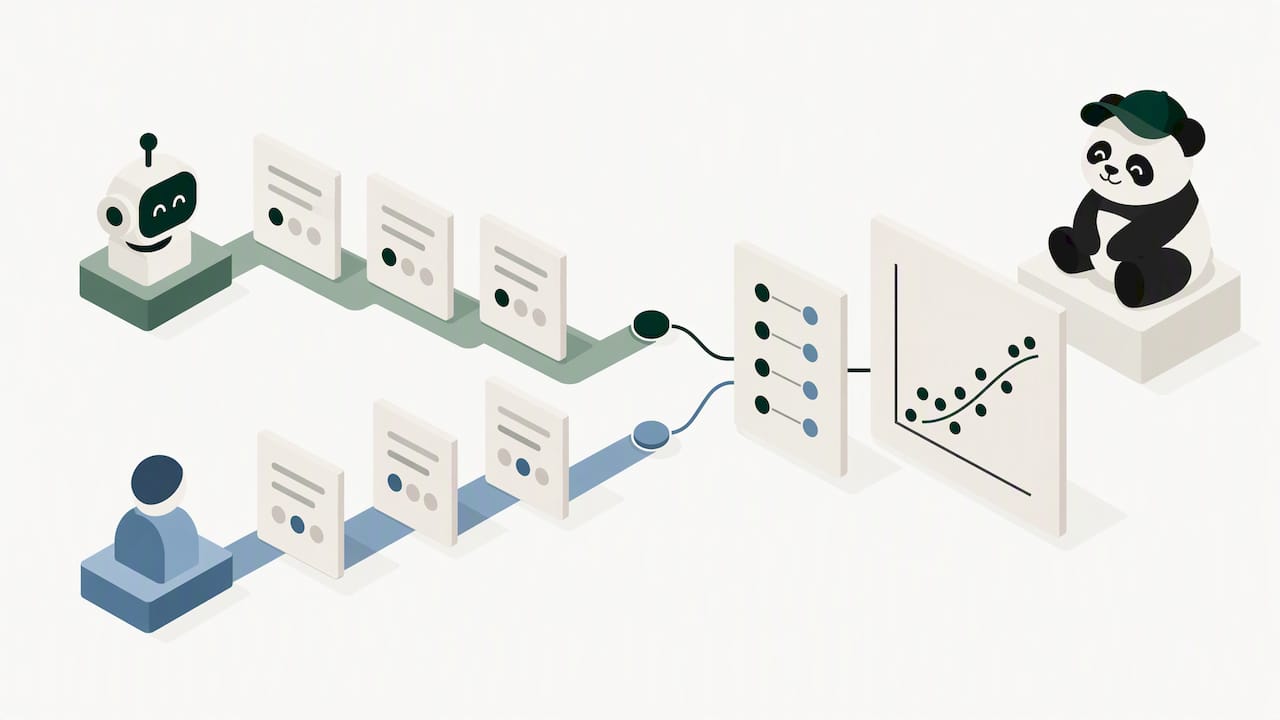
The strongest diagnostic available is a screening R² test. An R² fit diagnostic for digital twins predicts whether a synthetic respondent will answer an omitted question the way the real person would. Use synthetic data for aggregate, directional questions; reserve human panels for individual-level or high-stakes decisions, and separate the person who builds the prompts from the person who evaluates the outputs to limit confirmation bias.
How to adopt AI responsibly: step-by-step implementation checklist
A pilot succeeds or fails based on what you measure before you start, not what the AI produces afterward. Define the business decision the research needs to inform and the success metric up front, whether that is a go/no-go on a concept or a prioritized shortlist of messaging angles.
Define the decision and success metrics before selecting any tool or prompt structure.
Ground the pilot in matched human data, then compute the R² diagnostic on a held-back set of “forgotten questions” to test reliability.
Document every prompt, scoring rubric, and probing threshold so results are reproducible and auditable later.
Set up quality monitoring, including periodic audits, drift alerts, and a clear separation between the team designing prompts and the team grading output.
Set budget and timeline expectations and define exactly how outputs hand off to human analysts for final interpretation.
Pro Tip: Run your first pilot on a question you already have human survey data for, so the R² diagnostic has something real to compare against.
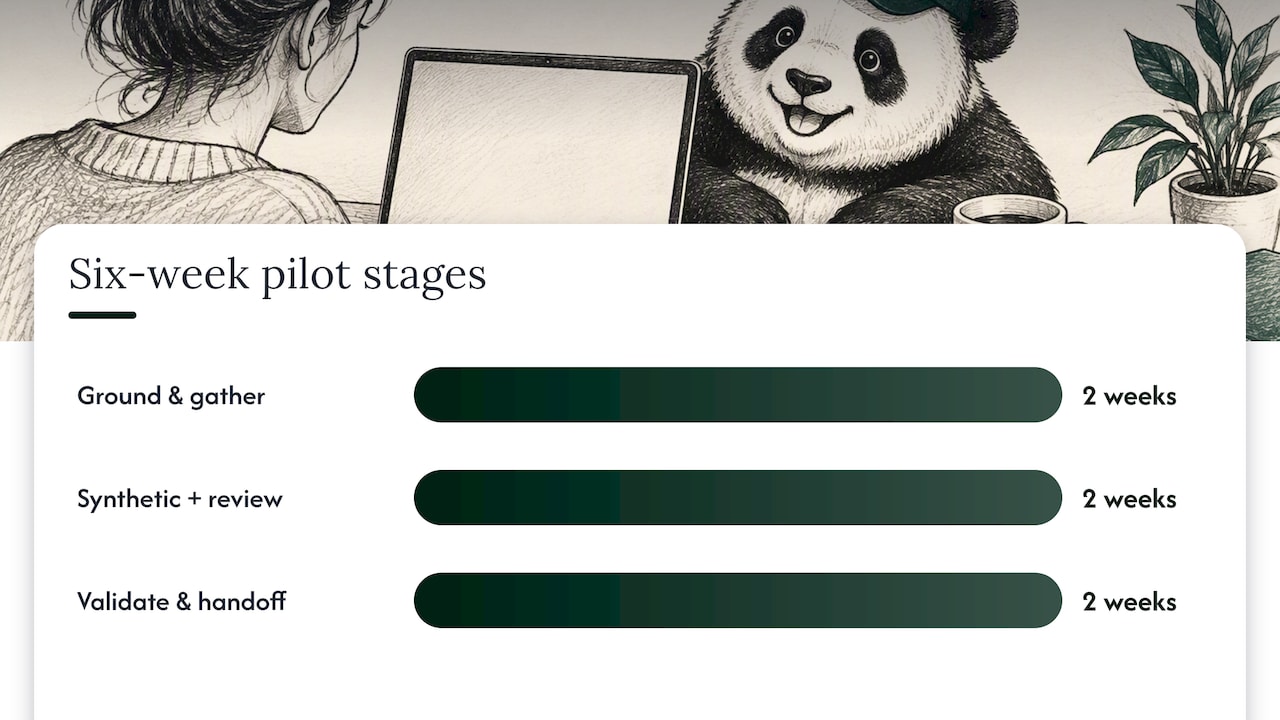
A six-week structure works well for most pilots: two weeks to ground the model and gather matched human data, two weeks to run synthetic and human-reviewed rounds in parallel, and two weeks to validate, document, and hand off findings to the analysts who will act on them.
Align TCC perspective: AI-augmented research applied to brand and go-to-market strategy
We combine established brand thinking with agile market methodologies, and AI sits inside that process as a way to move faster without flattening the creative judgment that makes a brand distinct. When we run early-stage concept testing or market-entry diagnostics, synthetic respondents help us prioritize which messaging angles deserve real human validation, rather than replacing that validation outright.
A typical pilot output includes a rapid concept-testing report, a prioritized insight dashboard, and a governance checklist that flags where synthetic findings need human confirmation before they inform a launch decision. For readers who want more on how we apply AI across the marketing process, our insights on AI marketing strategy go deeper into the workflow.
— Kalle
Integration of AI-driven market research insights into business decision-making processes
Research output only matters once it changes a decision, and that handoff is where most AI-augmented research efforts stall. The fastest-compressed timelines mean nothing if insight dashboards sit unread while a launch date approaches. Building a direct path from AI-generated findings to the people making pricing, positioning, or product calls matters more than the sophistication of the analysis itself.
Practically, that means treating AI output as an input to a decision framework, not the decision itself. A prioritized list of themes from thousands of reviews becomes useful once it is translated into a ranked set of recommendations with confidence levels attached, so a product lead can see which findings are directional and which are validated. Teams that connect research tools directly to planning tools, shared dashboards, structured exports, or recurring synthesis meetings tend to act on findings faster than teams that treat research as a separate, siloed function.
The organizational point MIT Sloan raises matters here too: separating the people who design the AI prompts and personas from the people who evaluate the outputs reduces the risk that a team simply confirms what it already believed. That separation also makes it easier to trace a business decision back to the specific research finding that supported it, which matters when results need to be defended later. The same logic that shortens a research timeline can shorten the path from insight to execution, something we have also seen in how AI reshapes media buying once research findings move into campaign planning.
Comparison of AI-based market research methods with traditional market research approaches
Traditional market research, recruited panels, moderated focus groups, fielded surveys, remains the gold standard for individual-level accuracy and demographic representativeness. It is also slow and expensive relative to AI-based alternatives, often taking weeks to field and analyze a single study. AI-based methods flip that trade-off: they compress timelines dramatically and scale to volumes no human panel could match affordably, at the cost of the variability and nuance that real human respondents provide.
The practical answer is not choosing one over the other but sequencing them. Use AI for the early, high-volume stages, screening hundreds of concepts, coding thousands of open-ended responses, or surfacing themes across months of social commentary. Reserve traditional, human-fielded research for the decisions where Pew’s synthetic-survey testing shows the biggest gaps: timely, niche, or fast-moving questions where synthetic panels drift furthest from real opinion.
Cost and timeline differences reinforce this split. A traditional study measured in weeks and real fielding costs becomes a same-day directional read when AI handles the first pass, but that speed only holds value when the findings feed into a validation step rather than a final decision. Teams that try to replace traditional research outright, rather than sequence it, tend to rediscover the positivity bias and flattened variability that synthetic panels are known to produce.
Future trends and emerging innovations in AI for market research
The next wave of development centers on closing the gap between synthetic convenience and human accuracy rather than chasing more synthetic volume. Diagnostic frameworks like the R² forgotten-question test point toward a future where every synthetic panel ships with a built-in reliability score, rather than being treated as uniformly trustworthy.
Hybrid inference approaches, where AI outputs function as auxiliary features inside a statistical model instead of standalone answers, are likely to spread beyond the academic papers that introduced them. That shift changes how research teams staff projects: fewer people manually coding survey responses, more people designing the statistical frameworks that combine AI signal with human ground truth.
Expect tighter integration between AI research tools and the platforms where decisions get made, shared dashboards, planning tools, and campaign systems, so insight and execution move closer together in time. The organizations that adopt governance early, documented prompts, role separation, audit trails, will be positioned to scale AI research responsibly as the tools mature, rather than retrofitting oversight after a bad decision gets made on ungrounded synthetic data.
Author perspective: balancing speed with epistemic safety
AI for market research is augmentation, not replacement. The speed is real, the cost compression is real, and the risk of mistaking a plausible synthetic answer for ground truth is just as real. Every workflow in this piece assumes a diagnostic step, an R² check, a held-out human sample, a documented prompt, because without one, a team is simply trusting a confident-sounding guess. Build the evaluation layer before you scale the convenience layer. That order matters more than which tool you pick.
— Kalle
How Align TCC can help: pilot AI-augmented market research
We run AI-augmented research pilots for brands that want speed without losing the judgment a real strategist brings to the table. Our approach pairs synthetic screening with human validation at every stage, so the findings that reach your leadership team have already been stress-tested.
A focused pilot structure covering concept testing, prioritized insight reporting, and a governance checklist built around the diagnostics in this article.
Direct access to our commercial approach that shapes how we translate research into go-to-market decisions.
Ready to see what a structured pilot looks like for your brand? Visit our services page to start the conversation.

FAQ
Which AI is best for market research?
No single tool wins every task: citation-first answer engines suit quick fact-checks, deep-research agents suit multi-source synthesis, and document analyzers suit long transcripts or reports. Most professional teams get better results from a multi-tool workflow matched to each research stage than from relying on one platform for everything.
Can ChatGPT do market research?
General-purpose AI assistants can summarize reviews, draft survey questions, and generate directional synthetic responses, but they carry the same positivity bias and reduced variability seen across synthetic respondent tools. Treat their output as a starting point for exploration, not a validated finding, especially on timely or niche topics.
Is ChatGPT the best AI for research?
“Best” depends on the task: general-purpose assistants are strong for reasoning through unstructured text and drafting synthesis, while dedicated deep-research agents and document analyzers often outperform them on multi-source verification or long-document extraction. A workflow that assigns the right tool to each stage tends to outperform relying on any single assistant.
How accurate are AI synthetic respondents compared to real people?
Synthetic respondents track broad directional trends reasonably well but diverge from human answers on 75% to 80% of specific survey questions, with systematically more positive ratings and less variance than real panels. A screening diagnostic with an R² above 0.7 can reduce poorly answered questions from about 25.9% to 4.3%, which is why validation matters before trusting synthetic output for strategic decisions.
When should a team use human panels instead of AI for research?
Human panels remain necessary for timely, niche, or fast-moving questions, where Pew Research Center found average errors around 12 percentage points versus synthetic polling, and for any individual-level or high-stakes decision. AI-based methods work best for aggregate, directional, early-stage research where speed and scale matter more than individual precision.
Sources
Leaving Insight to Digital Twins? Promise, Progress and Limits of Synthetic Respondents | NIM
Synthetic surveys and timely and topical questions | Pew Research Center
Recommended
RELATED INSIGHTS



LET’S TALK
What are you trying to grow next?
Brand, launch, market entry or performance. Book 30 minutes and tell us what you’re working on.