•
Marketers: 5 Checks to Localize Brand Names in China and Scandinavia
Prioritize defining your localization goals and running a short linguistic and trademark audit before changing your brand name. Sequence matters: set goals, research the market, audit your current name, choose an adaptation strategy, lock in governance, roll out in phases, then measure. WIPO’s Madrid System guidance on transliteration requirements makes an early legal check non-negotiable, and some firms build that check into the first sprint, not the last.
TL;DR:
Test pronunciation with native speakers before focus groups, then check recall, sentiment, competitor conventions, and trademark and domain availability in the target market.
Names rated high risk on at least two audit dimensions should be prioritized, especially flagship products with disproportionate revenue exposure.
Use transliteration to preserve sound, translation to carry meaning, or phonosemantic adaptation when the name must balance recognition with local relevance.
For marks in scripts other than Latin, Madrid System filings require transliteration; Chinese names need checks across simplified and traditional characters and regional dialects.
After launch, track recall, search click through rates, conversion lift, sentiment, and trademark incidents; set a threshold and wait one full sales cycle before judging.
Aligntccaligntcc.comBuild a Brand That ResonatesAlign TCC combines Scandinavian brand thinking with Chinese market methodologies to help companies sharpen positioning and engage audiences across markets.Explore Align TCC
Table of Contents
Solidify Your Localization Goals and Scope
Know Your Market: Research Methods and Segmentation for Naming Decisions
Analyze Your Brand: Audit Checklist for Name Readiness
Adapt Brand Names: Transliteration, Translation, and Phonosemantic Approaches
Brand Governance: Guidelines, Approvals, and Asset Management
Plan and Implement: Rollout Phases, Timeline, Stakeholders, and IP Steps
Measure and Iterate: KPIs and Testing Approach After Launch
Align TCC Perspective and Practical Offer
Collaboration With Local Experts and Linguists for Localization Accuracy
Three Managerial Priorities Worth Remembering
How Align TCC Can Help You Execute This Playbook
FAQ
Sources
Solidify Your Localization Goals and Scope
A name change is a commitment, not a creative exercise. Before any adaptation work starts, we recommend pinning down exactly what success means for this market and whether the brand name itself needs to move, or whether supporting assets can carry the weight instead.
Common goals worth separating out:
Market fit: the name needs to sound natural and avoid awkward or negative associations in the local language.
Legal clearance: the current name is blocked or unregistrable in the target jurisdiction.
Premium positioning: the name should signal quality or origin cues that resonate locally.
Search discoverability: the name needs to be searchable and typeable in the local script or input method.
From there, decide between a full rename, a localized alias used alongside the global name, or keeping one consistent global name everywhere. Weigh each option against expected commercial upside and legal risk: a full rename carries the highest cost and highest payoff, while a consistent global name is cheapest but can leave meaning or pronunciation problems unresolved.
Know Your Market: Research Methods and Segmentation for Naming Decisions
Research should answer two questions: does the name work, and does the market even require a change. Running both primary and secondary research before committing avoids expensive rework later.
Phonetic testing: have native speakers read the name aloud and flag mispronunciations or unintended sound-alikes.
Focus groups and recall studies: measure how easily people remember and repeat the name after a single exposure.
Sentiment studies: check for emotional associations, positive or negative, tied to specific syllables or characters.
Secondary landscape scans: review competitor naming conventions and category norms in the target market.
Social listening and trademark/domain checks: confirm the name isn’t already claimed, mocked, or associated with something unrelated online.
Academic work on determinants of brand localization found that firm size, internationalization level, and R&D intensity predict how far companies localize, while market uncertainty and similarity to the home market also shape that decision. A market that closely resembles your home market may need lighter adaptation; a market with high linguistic or cultural distance usually needs deeper testing. For structured fieldwork, Veridata Insights’ market research methods cover questionnaire design and qualitative recruitment that translate directly into naming studies.
Pro Tip: Run phonetic testing before focus groups: a name that fails on pronunciation rarely recovers in sentiment scoring.
Analyze Your Brand: Audit Checklist for Name Readiness
A short audit tells you whether the existing name is an asset or a liability in the new market. We recommend scoring each item as low, medium, or high risk before any naming workshop begins.
Phonetic fit: does the name map cleanly onto local sounds, or does it require forced pronunciation?
Semantic risk: does the name or a close homophone carry an unintended or negative meaning?
Dialect variance: does the name read consistently across regional dialects, particularly in markets like China where a single character can shift meaning by dialect?
SEO and domain implications: is a clean, available domain and search-friendly spelling achievable?
Trademark availability: is the mark, or its likely local transliteration, free to register?
Items scoring high on two or more dimensions should move to the top of the localization queue, especially flagship product names that carry disproportionate revenue exposure.
Adapt Brand Names: Transliteration, Translation, and Phonosemantic Approaches
Three strategies dominate brand name localization: transliteration, translation, and phonosemantic adaptation. WIPO guidance on Madrid System filings distinguishes transliteration, which renders sound in a new script, from translation, which carries meaning across languages, and notes that non-Latin marks require a transliteration when filed internationally, with a translation recommended but optional.
Phonosemantic adaptation blends the two: it selects characters or syllables that approximate the original sound while also carrying a positive or relevant meaning. Academic research on Chinese naming strategy documents all three methods in practice, with transliteration the most common approach for Chinese market entries. Marvel’s Chinese name, 漫威, is a frequently cited phonosemantic example, built to echo the English sound while carrying connotations of power.
Choosing between the three comes down to what the brand needs to protect:
Preserve sound when global recognition across markets matters more than local meaning.
Prioritize meaning when cultural resonance, clarity, or category signaling matters most.
Combine both when the brand can afford the extra naming cycles a phonosemantic search requires.
Script-specific issues complicate each path. Chinese character selection requires checking meaning across simplified and traditional script and across spoken dialects, since research on new energy vehicle naming in China documents cases where one name read differently depending on regional dialect. Arabic transliteration carries its own complications, since research on Arabization in technical texts shows transliteration is often favored for proper nouns specifically to preserve recognizability where a direct translation would obscure it.
For non-Latin script marks, the Madrid System requires a transliteration at the time of filing, which means the naming and legal workstreams cannot run in isolation from each other.
For a deeper comparison of what localization covers versus straight translation, see our breakdown of localization versus translation for marketers.
Brand Governance: Guidelines, Approvals, and Asset Management
Once a name is chosen, governance determines whether it stays consistent across markets or drifts within a year. We recommend building four governance pieces before launch.
Naming policy: a written document defining what can and cannot change locally.
Approval gates: clear sign-off points between local marketing, legal, and global brand leadership.
Localization playbook: a reference guide covering tone, naming conventions, and prohibited terms by market.
Asset registry: a central log of every localized name, logo variant, and trademark filing by jurisdiction.
A simple RACI works well here: global brand owns the naming policy and final approval, legal owns trademark clearance, and local teams own in-market testing and cultural review. Template fields worth standardizing include the naming brief (goal, target market, constraints), an approval checklist (legal, phonetic, semantic, SEO), and the asset registry itself.
Pro Tip: Store every rejected name candidate alongside the reason it failed. It saves the next market team from repeating the same dead end.
Plan and Implement: Rollout Phases, Timeline, Stakeholders, and IP Steps
Rollout works best in three phases: a pilot in one market, staged expansion to adjacent markets, then harmonization once the name proves stable. Each phase needs its own stakeholder map and legal checklist.
Pilot phase: marketing and legal validate the name in one controlled market with limited media spend.
Staged expansion: creative and local ops adapt supporting assets, media teams build market-specific launch plans.
Harmonization: global brand aligns messaging and visual identity once the localized name is confirmed working.
IP tasks to schedule early: trademark searches in every target jurisdiction, transliteration filings under the Madrid System, and domain reservation before any public announcement.
Scheduling legal work in parallel with creative development, rather than after it, is what keeps a pilot from stalling at the filing stage. For a structured look at sequencing market entry workstreams, see our China market entry playbook.
Measure and Iterate: KPIs and Testing Approach After Launch
Launch is not the finish line. Track brand recall, search click-through rate, conversion lift, sentiment shift, and trademark incident reports as your core KPI set. Research on localization and brand recognition finds that localization strategies strengthen brand recognition for multinational firms, with advertising and promotion spend acting as a key mechanism rather than the name change alone.
Test with A/B landing pages, phonetic recall surveys repeated after initial exposure, and paired ad-copy variants running the old and new name side by side. Give the market at least one full sales cycle before reading results, and set a decision threshold in advance so a weak early signal doesn’t trigger a premature reversal.
Align TCC Perspective and Practical Offer
Our approach is built around the observation that Scandinavian brand thinking brings clarity and restraint, Chinese market methodologies bring speed, and AI handles repetitive testing work, so creative teams can focus on judgment calls. We run pilots in-house for clients ready to move fast, and lean on structured audits first for clients carrying heavier legal exposure. Our services map directly to audit, naming, and rollout stages.
Collaboration With Local Experts and Linguists for Localization Accuracy
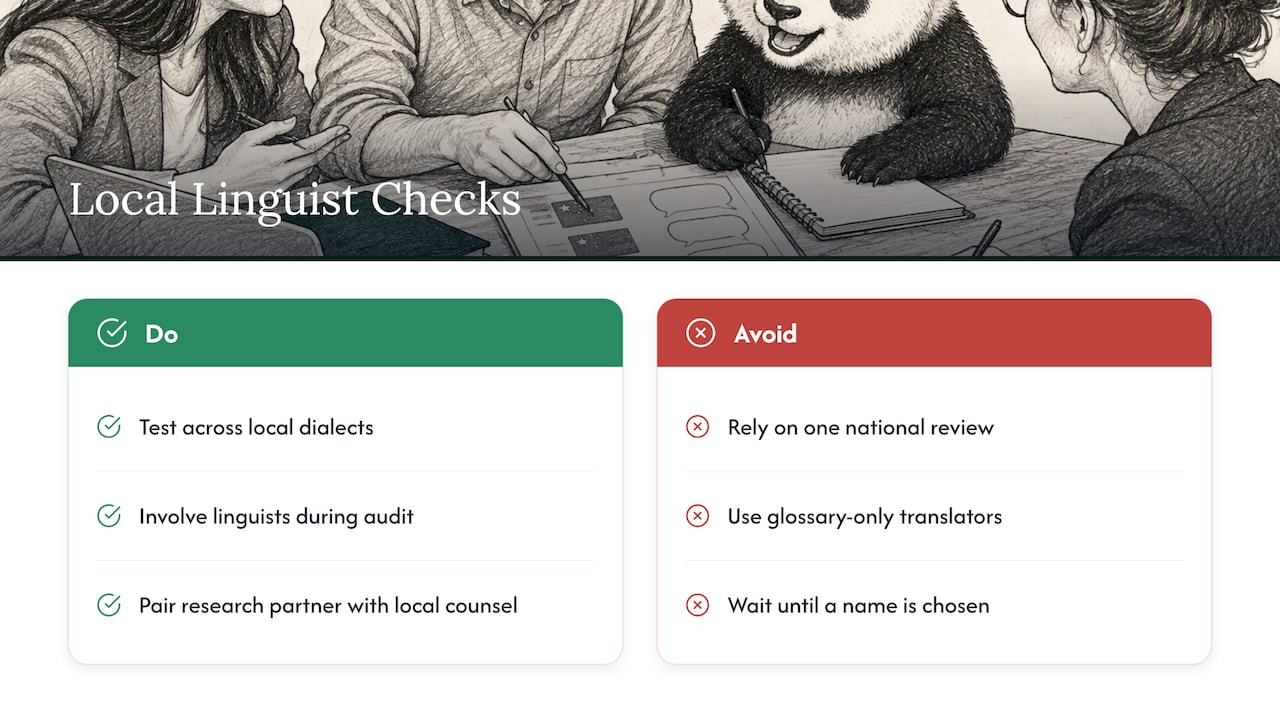
No naming framework replaces a native speaker’s ear. Phonetic testing, dialect checks, and semantic risk reviews all depend on linguists who live inside the target market’s language, not translators working from a glossary. A character that reads as neutral in Mandarin can carry an entirely different weight in Cantonese or Hokkien, which is exactly why research on naming across Chinese dialects recommends dialect-aware testing rather than a single national review.
Local experts also catch what desk research misses: slang shifts, generational differences in how a name is read, and regional sensitivities that a search engine won’t surface. Bringing in linguists early, during the audit phase rather than after a name is chosen, keeps the adaptation workstream from becoming a rescue mission. Academic case studies on Chinese market naming point to companies that registered multiple name versions specifically to protect against unauthorized or unintended local adaptations, a step that only makes sense once local experts have mapped out the realistic range of interpretations.
For teams without in-house linguistic resources, pairing an external market-research partner with local legal counsel covers both the cultural and trademark sides of the same question. The goal isn’t a committee for its own sake. It’s making sure the person approving a name actually understands how it lands in the mouths of the people who’ll say it.
Three Managerial Priorities Worth Remembering
Sequence beats speed: skipping research to launch faster usually costs more later. Protect the name legally before you fall in love with it creatively. Test with real speakers, not assumptions.
— Kalle
How Align TCC Can Help You Execute This Playbook

We map each stage, audit, naming, governance, rollout, measurement, to specific Align TCC services. Reach out for a discovery call to scope your next market.
FAQ
What are examples of brand positioning?
Brand positioning examples include competing on price (value positioning), on quality or craftsmanship (premium positioning), or on a specific use case or audience segment (niche positioning). The right positioning for a localized name depends on which of these signals the target market already associates with your category.
What is an example of localization?
A localization example is adapting not just language but cultural references, imagery, and naming conventions so a product feels native to a market rather than imported. Brand name localization specifically covers choosing between transliteration, translation, or a phonosemantic blend, as documented in WIPO’s Madrid System guidance.
What is Coca-Cola’s brand identity?
Coca-Cola’s brand identity centers on consistent visual elements like its script logo and red color scheme paired with a globally recognized name that has been adapted phonetically across many scripts and languages. Its approach is frequently cited as an example of preserving core brand recognition while allowing local pronunciation and script adaptation.
What are the different types of brand names?
Brand names generally fall into categories such as descriptive, suggestive, invented, and founder or place names, and localization strategy interacts with all of them. Academic research on naming methods documents transliteration, translation, and phonosemantic adaptation as the three dominant strategies for moving any of these name types into a new market.
How long does brand name localization typically take?
Timelines vary by market complexity and legal requirements, but a pilot phase with proper linguistic testing and trademark clearance typically needs several months before a staged expansion begins. Scheduling trademark searches and transliteration filings early, as required under the Madrid System, keeps legal work from delaying the creative timeline.
Sources
Recommended
RELATED INSIGHTS



LET’S TALK
What are you trying to grow next?
Brand, launch, market entry or performance. Book 30 minutes and tell us what you’re working on.