•

6 Steps to Make Your Brand Positioning Strategy Drive Growth
A brand positioning strategy is the plan you use to own a unique, defensible place in customers’ minds, one that drives preference, pricing power, and faster marketing decisions. It pairs a clear positioning statement with the research, proof points, and activation needed to make that place real. Below you get the frameworks, copy-ready templates, a six-step process, and the metrics to check it works.
TL;DR:
Build the statement around a specific target, category, customer benefit, and proof; keep it internal, then express it consistently across every customer touchpoint.
Run 10 to 15 customer interviews, follow with a perception survey, then test two or three statements using forced choice and creative experiments.
Lead with customer outcomes rather than specifications; research finds positioning based on benefits or users often beats feature claims, though no approach wins every dimension.
Set baselines before launch, review salience and consideration monthly, survey perception quarterly, and change one major variable at a time to identify what drives movement.
Reposition only when preference falls, the category shifts, or competitors erase your edge; pilot changes in one segment or channel before wider rollout.
AligntccTurn Brand Positioning Into GrowthAlign TCC helps fast-growing companies sharpen their positioning and build marketing strategies that connect with audiences across markets.Explore Align TCC
Table of Contents
What brand positioning is and what goes into a positioning statement
Why brand positioning drives growth, pricing, and retention
Core components: how to build a defensible positioning statement
A practical 6-step brand positioning strategy you can run this quarter
Frameworks and tools: perceptual maps, the positioning triangle, and quick diagnostics
Brand positioning examples and one-line templates you can adapt
How to implement your position across product, price, place, promotion, and people
Measuring and testing your positioning: KPIs and perceptual methods
When to reposition, and a short playbook
How we operationalize brand positioning at Align
Adapting brand positioning for different cultural markets
Where we land on resourcing positioning
How we can help you put this strategy to work
FAQ
Sources
What brand positioning is and what goes into a positioning statement
Brand positioning is the place a brand owns in customers’ minds relative to competitors. It answers one blunt question for the buyer: why should I choose you? Harvard Business School’s marketing reading frames it as a defendable value proposition that aligns the consumer, the company, and the competitive set. The strategy is the plan that turns that claim into reality. The statement is the one-paragraph version of it.
Academic definitions of positioning vary. A literature review in PSU Research Review shows useful perspectives combine competition, the empty slot in the mind, consumer perception, differentiation, and competitive advantage. Pick the combination that fits your category and stay consistent.
A working positioning statement carries several elements:
Target: the specific customer segment you are built for, not “everyone with a budget.”
Category: the competitive frame of reference that tells the buyer what you are and what you replace.
Benefit: the outcome the customer gets that alternatives deliver less well.
Reason to believe: the evidence that makes the benefit credible, such as data, technology, provenance, or partnerships.
Harvard Business School Online offers a template for this statement: for [target market], our brand is the only one among [competitive set] that [unique value claim] because [reasons to believe]. A simpler neutral version works well for early drafts: we help [target] do [benefit] by [differentiator].
Treat the statement as an internal compass, not ad copy. It guides what you build, price, and say. Customers should never see it verbatim, but they should feel it in every touchpoint.
Why brand positioning drives growth, pricing, and retention
Positioning is the decision that makes every other marketing decision cheaper. When you know who you serve and why you win, channel choices, creative briefs, and sales pitches stop being debates and start being filters. Wasted spend usually traces back to a fuzzy position: campaigns aimed at several audiences at once, claims that any competitor could make, and messages that change by quarter.
Poor positioning does real damage downstream. The same PSU Research Review literature review notes that poor positioning decisions can misguide the marketing mix, meaning the product, price, place, and promotion choices that follow inherit the original error.
Preference and price are where the payoff shows. A brand that owns a distinct, relevant benefit gets chosen without a discount, because the buyer is not comparing like with like. Retention follows the same logic: customers stay with brands whose promise they can repeat back and whose experience matches it.
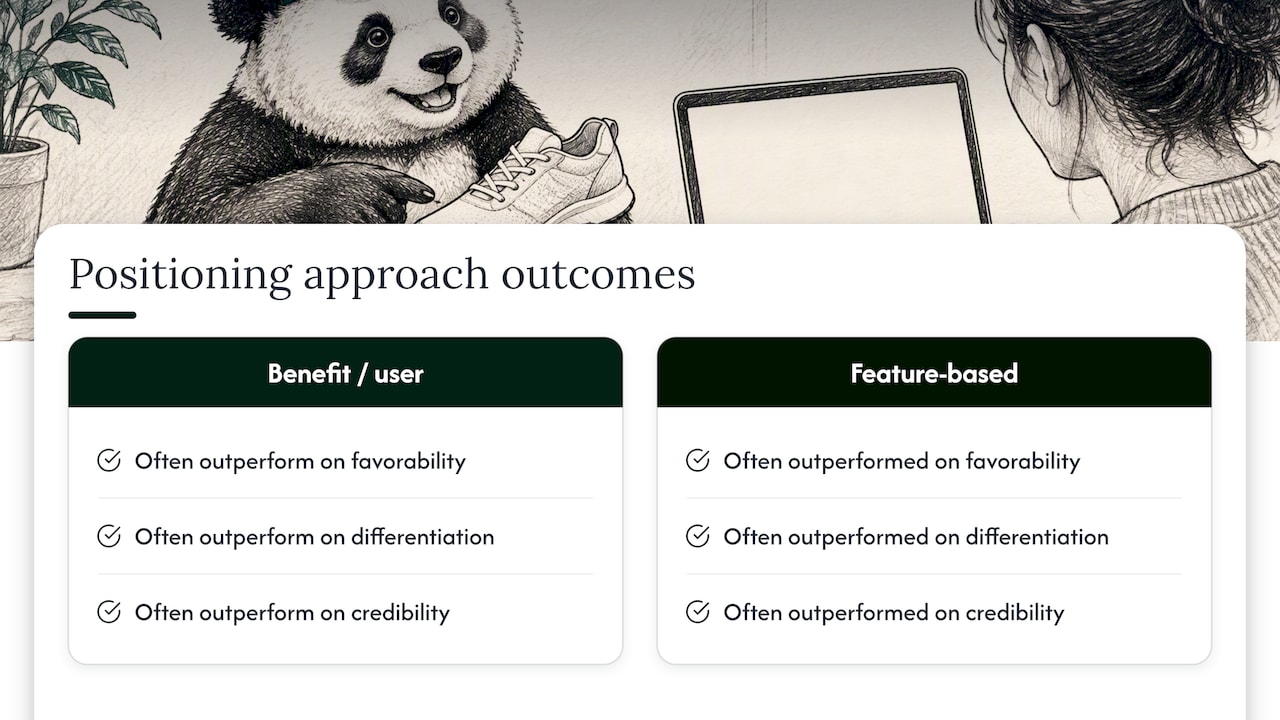
The evidence on which positioning approach performs best is nuanced. Empirical research reported in the European Journal of Marketing finds that benefit-based positioning and user or surrogate positioning often outperform feature-based approaches on favorability, differentiation, and credibility.
Benefit-based and user-based positioning often beat feature-based positioning on favorability, differentiation, and credibility, though no single strategy wins on every dimension. Lead with what the customer gets, not with a spec sheet, and expect to trade strengths against each other.
The business case is simple. Positioning does not cost more to run than vagueness. It costs more to decide. That decision is the work, and it pays back every month after.
Core components: how to build a defensible positioning statement
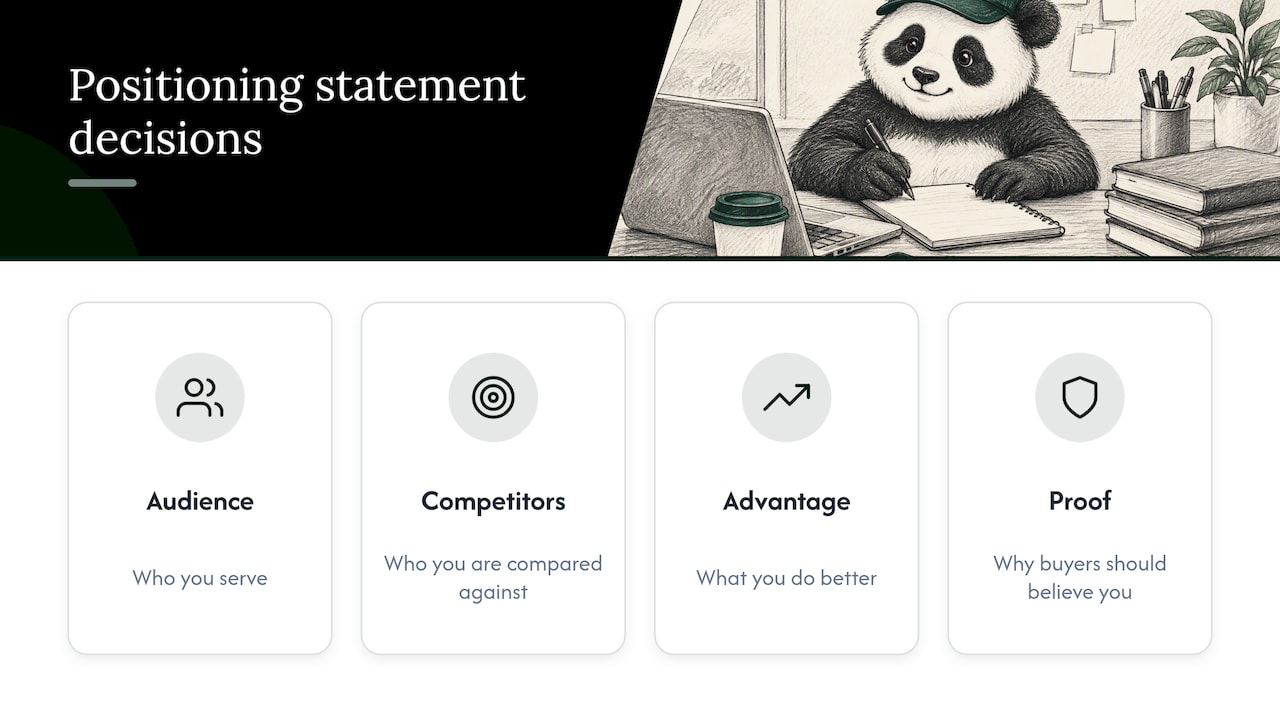
A defensible position rests on decisions about who you serve, who you are compared against, what you do better, and why anyone should believe you.
Define the segment and the competitive set
Start with the buyer, then the alternatives. Your competitive set is whatever the customer would choose instead of you, which is often broader than your industry. Include the status quo, the in-house option, and the “do nothing” choice. A tight segment helps: the narrower the target, the sharper the benefit can be.
Surface the differentiated benefit
Use consumer insight to find the benefit. Customer interviews built around jobs-to-be-done reveal what people are trying to accomplish and where current options fail them. Sales call recordings, churn reasons, and support tickets add the same signal at scale. Look for the benefit that is important to the buyer, weakly served by competitors, and plausible for you.
Integrated brand analysis can sharpen the choice. A recent MDPI study on strategic decision guidelines combines how relevant an attribute is with how a brand performs on it across buying stages. The result sorts attributes into stars, question marks, cash cows, and poor dogs, which tells you which to push and which to leave alone.
Turn features into reasons to believe
A claim without proof is a slogan. Build a short proof list for every benefit:
Data: performance results, benchmarks, or customer outcomes you can show.
Technology or method: a proprietary process or capability competitors lack.
Partnerships and endorsements: credible third parties who vouch for you.
Provenance: origin, heritage, or founder story tied directly to the benefit.
Experience: product, service, and packaging details that let customers feel the promise.
Pro Tip: Write the reason to believe before the benefit. If you cannot prove a claim in one sentence, it does not belong in your positioning yet.
A practical 6-step brand positioning strategy you can run this quarter
This process follows the same arc as the six-step approach Adobe recommends: understand where you stand, identify competitors, build a unique value proposition, draft the statement, test it, and activate. We organize it for a single quarter so it ships instead of stalling.
Audit your current position. Collect brand signals (website copy, sales decks, social content, reviews) and market performance data. Interview internal stakeholders separately and compare answers. If leadership describes five different positions, you have found the first problem.
Research customers and the competitive landscape. Run 10 to 15 qualitative interviews to learn how buyers describe the problem and the alternatives. Follow with a quantitative perception survey so you can measure how you and competitors are seen on the attributes that matter.
Map your options. Plot brands on a perceptual map and test your candidates against the positioning triangle. Look for whitespace that is both open and relevant.
Draft the value proposition and positioning statement. Write two or three alternative statements with reasons to believe for each. Keep them short enough to repeat from memory.
Validate with the target audience. Use forced-choice tasks, small-scale message tests, and A/B creative experiments. Let customers pick, not the loudest voice in the room.
Activate and measure. Translate the winning statement into identity, channels, budgets, and sales enablement, then set a measurement cadence with baselines.
A realistic quarter breaks down like this:
Weeks 1 to 3: audit and stakeholder alignment.
Weeks 4 to 6: customer interviews and the perception survey.
Weeks 7 to 8: mapping and drafting.
Weeks 9 to 10: validation tests and revisions.
Weeks 11 to 13: activation plan, launch of priority assets, and baseline measurement.
Practitioners at NIQ stress that positioning is ongoing: it must be monitored and adapted after the statement exists. Treat the quarter as the first lap, not the finish line.
Two failure modes show up repeatedly. Teams skip step 5 because the draft “feels right,” then discover in market that customers do not perceive the claim. Or they stop at step 4 and produce a beautiful document that never changes a campaign, a price, or a sales script. Step 6 is where positioning becomes commercial.
Frameworks and tools: perceptual maps, the positioning triangle, and quick diagnostics
Perceptual maps
A perceptual map plots brands on two axes that matter to buyers. Choose attributes that are important to the customer and on which brands genuinely differ, such as price against sophistication or speed against depth of service. Plot your brand and competitors using survey data, not internal opinion. Empty quadrants are candidate whitespace, but only if buyers care about that corner.
The positioning triangle
Harvard Business School’s reading describes positioning as a balance of differentiation, consistency, and relevance. A practitioner textbook, Brand Positioning: Connecting Marketing Strategy and Communications, makes a similar case: desired associations must be relevant, distinctive, and deliverable. Use the triangle as a diagnostic by scoring a candidate position on each corner. A position that is distinctive but irrelevant gets ignored. One that is relevant but not distinctive gets copied. One that cannot be delivered gets punished.
Perceivability checks
A position only works if customers can perceive it. Experimental work using Signal Detection Theory, published in the Journal of Sensory Studies, shows consumers can struggle to notice positive attributes such as sustainability, so brands need stronger perceptual cues and coherent visual and experiential signals. Audit your own signals: if you claim “premium,” does the packaging, site, and service tone say it without words? Creative analysis frameworks can help here, such as this memorability framework for ecommerce creative.
Quick diagnostics to run on any draft:
Five-second test: can a stranger name the benefit after five seconds on your homepage?
Swap test: could a competitor paste your statement into their deck unchanged?
Proof test: does every claim have a visible reason to believe?
Consistency test: do sales, product, and support describe you the same way?
Tool | Question it answers | Output |
|---|---|---|
Perceptual map | Where is whitespace that buyers value? | Plot of brands against relevant attributes |
Positioning triangle | Is the position distinctive, relevant, and consistent? | Score per corner |
Attribute analysis | Which attributes should we push or drop? | Stars, question marks, cash cows, poor dogs |
Perceivability check | Can customers actually notice the claim? | List of weak signals to strengthen |
Brand positioning examples and one-line templates you can adapt
Most positions fall into a handful of archetypes. Pick the one that matches your truth, then adapt the line.
Quality-luxury: “For [target] who expect the best, we are the [category] crafted with [standard of excellence].” It tends to work where status, craft, and scarcity matter, and where customers will pay for certainty.
Value-accessible: “We give [target] [core benefit] at a price that removes the barrier.” It suits categories with price-sensitive buyers and the scale or cost structure to back the promise.
Purpose-led: “We exist so [target] can [outcome that serves a bigger cause], and we prove it by [specific practice].” It works when the cause is tied to the product and you can show proof. Remember the perception problem: consumers may only weakly perceive attributes like sustainability, so the cues must be strong.
Underdog narrative: “We are the challenger for [target] who are tired of [incumbent behavior], and we win by [scrappy advantage].” Research in the Journal of Product & Brand Management finds that underdog brand biographies, built on adversity, striving, and persistence, can increase brand affinity and purchase intention, especially when consumer self-identity and brand trust align.
Innovation-led: “For [target] who want what is next, we are the first [category] to [new capability].” It suits fast-moving categories and brands with real technical edge, and it demands continuous proof.
Convenience-first: “We make [outcome] effortless for [target] by [simplifying mechanism].” It fits categories where time and friction are the real cost.
Match the archetype to your situation:
Company size: challengers and early-stage brands often lean underdog or innovation-led, while scaled players can credibly own value-accessible or convenience.
Category dynamics: crowded, commoditized categories reward a sharply benefit-based claim, consistent with the finding that benefit-based positioning often outperforms feature-based.
Customer profile: match the archetype to what your best customers say they value, not to what flatters the founders.
For a gallery of how well-known brands frame their differentiators, this roundup of brand positioning examples shows practitioner approaches you can adapt. Steal the structure, not the words.
How to implement your position across product, price, place, promotion, and people
A position that lives only in a document is a wish. Push it through the marketing mix and into the org chart.
Product: features, packaging, and portfolio breadth should reinforce the claim. A premium position with a cluttered, discount-heavy range sends contradictory signals.
Price: price is a message. Quality-luxury demands pricing that signals it, while a value position needs a visible, defensible cost advantage.
Place: distribution should put you where your target expects to find the brand. The wrong retailer or marketplace can undermine the position overnight.
Promotion: write creative rules: tone, proof points to feature, claims to avoid, and visual cues. Prioritize the channels where your segment actually pays attention.
People: sales enablement, customer success scripts, and leadership governance carry the position into live conversations.
Governance matters as much as creativity. NIQ points to competitor identification, channel planning, and governance as part of making the position real. Name one owner for the position, review it on a fixed cadence, and require major campaigns to pass the triangle test before launch.
For businesses entering new regions, implementation includes localization choices. Our insight on performance branding with AI localization shows how a position travels across markets without losing its core. How the position sits within a larger portfolio is covered in our guide to brand architecture models.
Pro Tip: Run a “position audit” on one live asset per channel each month. If a stranger could not guess your position from it, rewrite it.
Measuring and testing your positioning: KPIs and perceptual methods
Measure whether customers perceive the position you intended, then whether that perception changes behavior.
Brand salience: how quickly your brand comes to mind in the category.
Consideration: the share of your target that would consider you.
Preference: how often you are chosen over alternatives in forced-choice tasks.
Willingness to pay: whether the premium or value claim holds in price tests.
NPS or brand affinity: whether customers repeat your promise in their own words.
Testing techniques stay inexpensive. Forced-choice tasks reveal which statement buyers actually prefer. A/B creative tests show which framing earns attention and action. Perceptual maps rebuilt from fresh survey data show whether you moved toward the intended space.
Perception is the metric that matters: experiments using Signal Detection Theory show consumers can fail to perceive even positive brand attributes unless the cues are strong and consistent. A claim you made is not a claim customers received.
Set baselines before launch, run the perception survey quarterly, and review leading indicators such as salience and consideration monthly. Change one major variable at a time so you know what moved the numbers.
When to reposition, and a short playbook
Reposition when the evidence says your current place no longer wins. Common signals include declining preference or consideration, a category shift that makes your claim table stakes, new technology or entrants that erode your edge, and a sales team that has stopped using the official story. The PSU literature review is a useful reminder that positioning lives in consumer perception, so when perception moves, your position has to follow.
A low-risk playbook moves through a series of phases:
Diagnose. Rerun the audit, perception survey, and attribute analysis. Confirm that the problem is positioning, not product quality or distribution.
Pilot. Test the new position in one segment, region, or channel. Measure salience, consideration, and preference against the control.
Roll out. Extend in waves, updating identity, messaging, sales materials, and pricing in a planned sequence so signals stay coherent.
Defend. Monitor the metrics, watch for competitor response, and protect the new claim with fresh proof points.
Avoid two common pitfalls. Do not abandon the core promise that loyal customers value, because repositioning should move you toward a stronger version of what made you chosen. And do not dilute distinctiveness by trying to appeal to a bigger audience, since a position that tries to be everything again collapses into noise.
How we operationalize brand positioning at Align
Our approach combines Scandinavian brand thinking, Chinese commercial execution, and AI-enhanced processes. AI helps streamline marketing processes so that technology supports creative judgment rather than replacing it. Here is how that maps to the six steps above:
Research: we audit signals and read shifting consumer behavior across platforms before we propose anything.
Mapping and definition: we turn research into a value proposition and a positioning statement with proof points.
Activation: we carry the position into identity, content, paid media, and market entry, with our work on performance branding as a worked reference.
Measurement: we set baselines and a review cadence so the position keeps earning its place.
To see how our team thinks, read our story and browse our insights pages for applied examples.
Adapting brand positioning for different cultural markets
A position that works in one market does not export unchanged. The target, benefit, and reason to believe each carry cultural assumptions: what counts as premium, which proof is credible, and how directly a brand may speak.
Scandinavian brand thinking contributes restraint and clarity. It favors a single, honest idea expressed consistently, with design and tone that signal quality without shouting. That discipline is valuable for the core of a position, the part that should survive every border.
Chinese market methodologies contribute speed and platform fluency. Consumer behavior and platforms shift quickly, so positioning is tested in live conditions, in short cycles, with creators and content formats native to each platform. That agility is valuable for the expression of a position, the part that must flex locally.
The practical rule is to hold the core and localize the cues:
Keep the target, category, and core benefit stable across markets.
Re-validate reasons to believe locally, since a credential that impresses in one country may mean nothing in another.
Rebuild the perceptual map per market, because competitors and whitespace differ.
Adapt channels, creators, and tone, while keeping visual and verbal signals coherent.
Leadership teams that experience a market firsthand make better calls, which is why immersion, such as our Leadership Trips, belongs in market-entry positioning work.
Where we land on resourcing positioning
Kalle’s take: most growth companies underinvest in positioning and overinvest in channels, then wonder why every channel feels expensive. Treat distinctiveness and relevance as a trade-off you actively manage. The sharper your claim, the fewer people it excites, but the more strongly it lands with the right ones. Spend the first quarter on research, mapping, and validation, the second on activation of your priority assets, and the third on measurement and refinement. Hold back budget for testing, because a position nobody has tested is a guess with a logo on it. Measure early, change one variable at a time, and let customer perception overrule internal taste.
— Kalle
How we can help you put this strategy to work
We deliver this strategy in practice through Brand & Positioning, Commercial Strategy, and Go-to-Market & Market Entry. You get research-led positioning, an activation roadmap, and a measurement plan your team can run. Book a strategy call and let’s sharpen your position.
FAQ
What is a brand positioning strategy?
A brand positioning strategy is the plan for owning a distinct, valued place in your target customers’ minds. It combines a positioning statement with the research, proof points, and activation that make the position real. Qualtrics describes it as owning a unique position in the mind of the target consumer and aligning the experience to match.
What are the four components of brand positioning?
A positioning statement can include the target, the category, the benefit, and the reason to believe. The target says who you serve, the category sets the frame of reference, the benefit states the outcome, and the reason to believe supplies proof. Together they make the claim specific and credible.
What is the difference between positioning and messaging?
Positioning is the strategic decision about the place you want to own. Messaging is how you express that decision in words across channels and audiences. Positioning guides messaging, so the same position can produce different messages for different segments without changing the core claim.
How do you test whether your positioning works?
Test whether customers perceive the position you intended, then whether it influences choice. Use forced-choice tasks, A/B creative tests, and a perception survey with baselines set before launch. Track salience, consideration, and preference over time, since experimental research shows even positive attributes can go unnoticed without strong cues.
How do B2B positioning examples differ from consumer ones?
B2B positioning leans on proof, risk reduction, and measurable business outcomes because the buyer is accountable for the decision. The same archetypes apply, but reasons to believe usually involve case results, methodology, and credibility with multiple stakeholders. Consumer positioning leans more on emotion and identity.
Sources
Recommended
RELATED INSIGHTS


LET’S TALK
What are you trying to grow next?
Brand, launch, market entry or performance. Book 30 minutes and tell us what you’re working on.