Growth / Performance
Kalle Mobeck
•

95:5 B2B Rule: Align’s Brand to Demand Plan to Prove Pipeline
Brand-to-demand is a unified B2B marketing approach that builds mental availability across the out-of-market majority while converting the small in-market cohort. It treats brand and demand as one continuum, not two departments with separate budgets and scoreboards. The single most important action for any marketing leader is to unify measurement and reporting before touching channel mix, because a shared scorecard is what forces brand and demand teams to finally agree on what “working” means.
TL;DR:
A unified scorecard linking brand awareness and demand metrics is essential to measure success and align marketing, sales, and RevOps efforts effectively.
Most B2B buyers are not actively in-market, making brand investment crucial for long-term recall and reducing reliance on demand campaigns alone.
Implementing the six interconnected pillars, including continuous brand presence and audience mapping, ensures an integrated system that drives pipeline growth.
Tracking four key metrics—quality reach, high-intent actions, pipeline influence, and velocity—enables transparent measurement and shared accountability.
Early-stage companies should skew toward brand, while mature firms can prioritize demand, with a focus on governance and shared definitions from the start.
Table of Contents
What Does Brand to Demand Actually Mean?
Why the 95:5 Rule Changes Everything for B2B
The Six Pillars That Connect Awareness to Pipeline
How Do You Build a Unified Measurement Scorecard?
Getting RevOps, Sales, and Marketing on the Same Page
A 90-Day Playbook to Launch an Integrated Program
Common Pitfalls in Brand-to-Demand Programs
Which Tools Support Brand-to-Demand Orchestration?
How Brand-to-Demand Reshapes the Sales Funnel
Why Integration Beats Optimization
How Align Turns Brand Investment Into Pipeline
Sources
What Does Brand to Demand Actually Mean?
Brand-to-demand rejects the old split where brand teams chase awareness metrics and demand teams chase leads, each reporting to leadership in a different language. Instead, every campaign is judged on a single continuum: does it build memory now, and does it convert intent later? The two motions are inseparable, because the buyer who clicks your ad today was shaped by six months of ignored LinkedIn posts, a webinar they half-watched, and a case study a colleague forwarded.
Getting this right starts with standardizing vocabulary internally, because teams that use different words for the same thing can’t share a scorecard:
Mental availability: how easily your brand comes to mind when a buying need arises
Always-on brand: continuous, low-intensity brand presence rather than campaign bursts
Activation: the demand-side trigger that converts stored memory into a pipeline action
On budget, Les Binet and Peter Field’s B2B research suggests a balanced brand to demand split as a starting benchmark, tailored by company maturity and goals. Early-stage companies chasing category creation often skew that further toward brand; mature companies defending share can lean demand.
Why the 95:5 Rule Changes Everything for B2B
Only a small fraction of B2B buyers are actively in-market at any given moment, according to Ehrenberg-Bass Institute research reported by Marketing Week. That means most of your total addressable audience is not ready to buy today, next week, or possibly next quarter. Demand-only marketing ignores that majority entirely, which is exactly why so many pipelines run dry the moment a paid campaign pauses.
The 95:5 problem in one line: if you only market to buyers who are ready to buy right now, you’re fishing in a pond that holds 5% of the fish.
A few consequences follow directly from this:
Brand investment is what makes you the obvious call when a buyer finally enters the 5%.
Unified brand-to-demand execution, pairing programmatic and content syndication with coordinated orchestration, has been shown in platform case narratives to lower cost per lead and lift conversion effectiveness compared with demand-only approaches, though the exact size of that lift varies by market and execution quality.
Heading into 2026, buying committees have grown larger and more research-driven, which makes long memory windows more valuable, not less.
The Six Pillars That Connect Awareness to Pipeline
A brand-to-demand program isn’t a campaign. It’s a system with six interlocking parts, and skipping any one of them is how “integrated” marketing quietly reverts to two separate teams running parallel campaigns.
Always-on brand presence — continuous share of voice through thought leadership, executive visibility, and category-defining content, so recall compounds instead of resetting every quarter.
Demand capture infrastructure — the forms, landing pages, and sales handoffs that convert intent the moment it appears, whether that’s a spike in branded search or a competitor-comparison page view.
Channel orchestration — programmatic and LinkedIn for reach, content syndication for scaled distribution, SEO for compounding organic pull, events for high-trust in-person moments, and ABM for named-account precision.
Content architecture by buyer role — a CFO needs risk mitigation and ROI framing; a technical evaluator needs implementation detail; a champion needs internal-selling ammunition. One asset can’t serve all three.
Audience mapping — segmenting not just by firmographic but by where each account sits in awareness versus intent, so messaging matches mindset.
Feedback loops — weekly signal review that feeds channel and content decisions back into the system, rather than waiting for a quarterly retro.
Pro Tip: Map every piece of planned content against both a buyer role and a funnel stage before production starts. If a content brief can’t answer “who is this for and what stage are they in,” kill the brief.
How Do You Build a Unified Measurement Scorecard?
The single biggest operational failure in brand-to-demand marketing is running two scorecards that never talk to each other. DemandWorks recommends linking a brand scorecard (mental availability, quality reach) directly to a demand scorecard (meetings, opportunities) and reporting both as one monthly narrative to leadership, not two competing decks.
A workable scorecard tracks four rows:
Quality reach: impressions and engagement among defined ICP accounts, not vanity reach
High-intent actions: content downloads, pricing page visits, demo requests
Pipeline influence: percentage of closed-won deals touched by brand channels before the first sales conversation
Velocity: time from first brand touch to sales-qualified opportunity
None of this works without shared definitions. UTMs, attribution windows, and ICP tiers need to be agreed on once and then locked, because a marketing team and a RevOps team arguing over what counts as a “qualified” touch will burn more time than any campaign saves. Improvements in customer experience and message consistency also show up here indirectly. Qualtrics research links consistent messaging to higher repeat-purchase rates, a signal that belongs on the same scorecard as new pipeline, not a separate loyalty report nobody reads.
Getting RevOps, Sales, and Marketing on the Same Page
Brand-to-demand collapses the moment teams operate on separate assumptions about what a lead, a stage, or a win even means. Governance has to be explicit, and it works best under one of two models: a cross-functional “tribe” with rotating ownership by initiative, or a single accountable owner who reports the unified scorecard monthly and adjudicates disputes.
Either model needs the same rituals underneath it:
A weekly signal review where marketing, sales, and RevOps look at the same dashboard together
A 90-day cadence for revisiting budget splits and channel performance against the original hypothesis
Public, auditable definitions for UTMs, attribution windows, and ICP tiers that sales and finance can check without asking marketing to translate
Brand-to-demand targets written directly into OKRs and sales service-level agreements, not left as a marketing-only KPI
Keeping definitions visible and auditable does more than prevent disputes. It gives finance a reason to trust marketing’s numbers instead of discounting them by half before a board meeting.
A 90-Day Playbook to Launch an Integrated Program
Most teams that attempt brand-to-demand fail not on strategy but on sequencing. Here’s the order that actually works:
Weeks 0 to 2: Build the unified scorecard and lock shared definitions before any creative work begins.
Weeks 2 to 4: Map your ICP tiers and audit existing content against buyer role and funnel stage.
Weeks 4 to 8: Launch always-on brand content alongside a demand-capture layer (retargeting, forms, sales alerts) so the two motions go live together, not sequentially.
Weeks 8 to 10: Review first-signal data weekly; retire underperforming channels fast rather than waiting for a full campaign cycle to prove itself.
Weeks 10 to 12: Publish a mini-case internally showing pipeline influence from brand touches, to keep sales and finance bought in.
Ongoing: Layer in retention and referral mechanics. Loyalty and personalization tactics extend customer lifetime value and feed new pipeline through advocacy, which closes the loop back into brand.
Pro Tip: Treat each channel as a hypothesis, not a commitment. Cohort performance by ICP tier and give underperformers a maximum of one full review cycle before you pull the budget.
The most common failure mode is rushing step three before step one is finished. Launching creative without locked definitions guarantees a fight over attribution in month two.
Common Pitfalls in Brand-to-Demand Programs
The most damaging mistake isn’t a bad channel choice. It’s running a hard-sell message against an out-of-market audience, which erodes the exact brand equity you’re trying to build and tanks conversion when that buyer finally does enter the 5%. A CFO who sees three aggressive retargeting ads before they’ve even opened a discovery conversation remembers the pressure, not the product.
A second recurring pitfall is what practitioners call marketing whiplash: brand budget gets cut the moment a quarter’s pipeline number dips, even though brand touches from six months earlier are what’s filling this quarter’s pipeline. Without a unified scorecard connecting the two, finance sees brand spend as a cost to trim rather than an input to protect.
Attribution conflict is the third trap. Sales credits the last touch; marketing credits the first; nobody credits the fifteen touches in between that actually built the recall. This gets resolved only through the shared definitions and public dashboards described earlier, agreed before the fiscal year starts, not renegotiated mid-quarter when numbers look bad.
Finally, plenty of teams launch an integrated strategy on paper but keep siloed teams, siloed budgets, and siloed Slack channels underneath it. Structure has to follow strategy. If the brand team and demand team still report through different chains with no shared ritual, the “integration” is cosmetic, and it will collapse under the first budget review.
None of these pitfalls require a bigger budget to fix. They require agreement, written down, before the campaign brief goes out.
Which Tools Support Brand-to-Demand Orchestration?
Technology doesn’t create alignment, but the right stack removes the excuses for not having it. Four categories matter most.
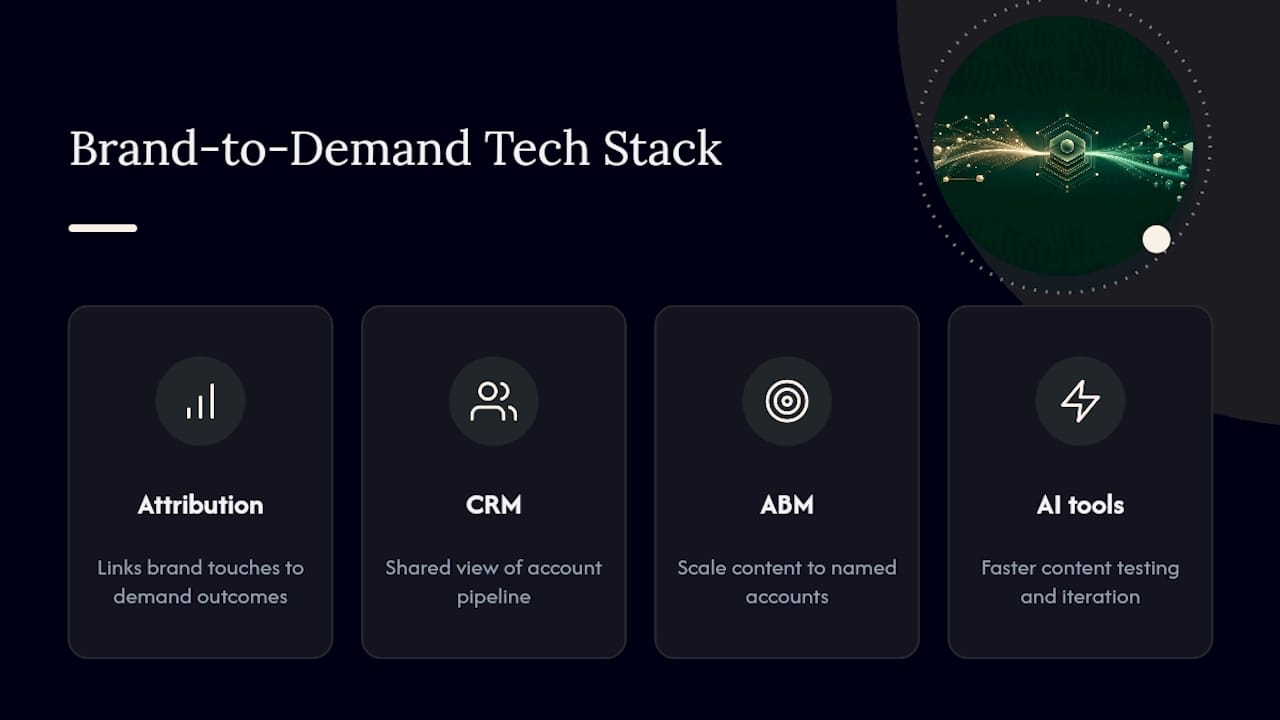
Attribution and analytics platforms stitch together brand touches (impressions, content engagement, event attendance) with demand outcomes (form fills, meetings, closed deals) into one dataset both teams can query. Without this layer, the unified scorecard is just a spreadsheet someone updates manually and everyone eventually distrusts. Understanding return on ad spend as a shared metric, rather than a paid-media-only number, is part of getting this right.
CRM and pipeline visibility tools give sales and marketing the same view of where an account sits, which matters enormously once brand touches start counting toward pipeline influence. Clear pipeline visibility is what lets a sales leader trust that a brand-sourced meeting is real, not a vanity metric marketing invented to justify its budget.
Content syndication and ABM platforms handle the scaled distribution and named-account targeting that make the six pillars operational rather than theoretical, letting one content asset reach the right buyer role at the right funnel stage without manual list-building.
AI-enabled research and production tools increasingly compress the time between insight and content, letting teams test more messaging hypotheses per quarter instead of committing months of budget to a single creative bet. AI-driven content operations are changing how quickly a brand-to-demand program can iterate, though the discipline of shared measurement still has to come first. No tool fixes a governance problem. It just makes a well-governed program faster.
How Brand-to-Demand Reshapes the Sales Funnel
The traditional funnel assumes a straight line: awareness, consideration, decision, purchase. Brand-to-demand breaks that assumption on purpose, because real B2B buying committees don’t move in a line. They circle back, loop in new stakeholders mid-cycle, and often start evaluating a solution long before anyone books a sales call.

Under a brand-to-demand model, the funnel becomes less of a pipe and more of a reservoir. Awareness activity fills the reservoir continuously, so that by the time a buying committee forms and moves into active evaluation, your company is already one of the two or three names anyone mentions. That changes what the “top of funnel” is actually for: it stops being a lead-generation stage and becomes a trust-building stage, measured by quality reach and message recall rather than raw volume.
The practical effect on sales is significant. Deals that start with prior brand exposure tend to move through evaluation with fewer objections, because the credibility work happened before the first call. Sales conversations shift from “convince me you’re legitimate” to “show me the implementation details,” which shortens cycles and reduces the discount pressure that comes from being an unfamiliar vendor. This is also where customer experience research becomes relevant to funnel design: consistent messaging pre-purchase correlates with stronger retention and advocacy post-purchase, meaning the funnel doesn’t actually end at the close. It loops back into the reservoir through referrals and renewal.
Why Integration Beats Optimization
Most B2B marketing leaders don’t fail because they picked the wrong channel. They fail because they optimized the wrong layer. Demand teams get very good at squeezing conversion rate out of a shrinking pool of in-market buyers, while the 95% who aren’t ready to buy get ignored until they finally search and land on a competitor who’s been quietly building recall the whole time.
The uncomfortable truth is that most “brand versus demand” budget fights are really disputes over incomplete information. Neither side has bad instincts. Demand teams are right that a lead needs to convert. Brand teams are right that recall has to exist before conversion is even possible. What breaks the standoff isn’t a bigger budget. It’s a shared scorecard that lets both sides see the same number and argue about strategy instead of arguing about whose metric counts.
Working across Stockholm and Shenzhen has made one pattern obvious: companies that separate market entry from brand building almost always relearn the 95:5 lesson the hard way, usually after a costly quarter of demand-only spend that produced leads nobody trusted. The teams that get this right treat brand and demand as one motion from day one, with governance built before the first campaign brief, not bolted on after attribution disputes start.
If there’s a single contrarian point worth making, it’s this: brand-to-demand isn’t a bigger version of demand generation with better storytelling. It’s a fundamentally different operating model, and most companies claiming to run it still haven’t built the unified scorecard that makes it real.
— Kalle
How Align Turns Brand Investment Into Pipeline
Aligntcc runs brand-to-demand as one commercial motion, not two departments sharing a logo. That means one team, one scorecard, and one narrative to leadership, spanning go-to-market strategy, brand positioning, ABM, paid media, and the RevOps enablement that makes the numbers trustworthy to finance.

Where Aligntcc differs from a traditional agency setup is structural: instead of a fixed brand department and a separate performance department billing separately, senior specialists are brought together around your specific commercial challenge, whether that’s entering a new market, defending share against a faster-moving competitor, or finally proving that brand spend is producing pipeline. That’s especially relevant for companies expanding between Western markets and China, where messaging, channel mix, and buyer expectations shift enough that a bolted-together approach shows its seams fast.
If your brand and demand teams are still reporting on separate scorecards, the fastest fix is a short discovery session to map where the two motions are currently disconnected. Explore Align’s approach or start with a discovery conversation to see what a unified brand-to-demand program would look like for your pipeline.
Sources
Marketing Week — Ehrenberg‑Bass: 95% of B2B buyers are not in market
Brand to Demand Marketing: The Complete 2026 Strategy Guide | SalesboxAI Blog
Recommended
95:5 B2B Rule: Align's Brand to Demand Plan to Prove Pipeline
THE POINT
95:5 B2B Rule: Align's Brand to Demand Plan to Prove Pipeline
KEY TAKEAWAYS
01
Pair the Ehrenberg Bass 95:5 insight with Align's practitioner playbook. Build one unified scorecard and a 90 day launch plan to turn awareness into pipeline.
02
Pair the Ehrenberg Bass 95:5 insight with Align's practitioner playbook. Build one unified scorecard and a 90 day launch plan to turn awareness into pipeline.
03
Pair the Ehrenberg Bass 95:5 insight with Align's practitioner playbook. Build one unified scorecard and a 90 day launch plan to turn awareness into pipeline.
RELATED INSIGHTS

LET’S TALK
What are you trying to grow next?
Brand, launch, market entry or performance. Book 30 minutes and tell us what you’re working on.