•
Founders: Experiment First Go to Market Strategy Validated in 30 Days
A go to market strategy is the repeatable system that decides who you sell to, why they should care, and which channels put your product in front of them. The core claim of this article: treat your GTM as a hypothesis-driven system, not a static launch plan. Start with one prioritized experiment this week and let the results, not your assumptions, decide what comes next.
TL;DR:
Validating assumptions through short, targeted tests is faster and more effective than long-term planning, especially for key channels and segments.
Most companies need to achieve repeatable conversion rates and healthy retention before scaling their sales efforts or increasing budget.
A successful GTM requires clear ownership of each task, aligned incentives, and a unified data system to prevent fragmentation and confusion.
Buyers now utilize multiple channels during purchasing, making omnichannel, hybrid sales, and marketplaces essential for maximizing market share.
Relying on only one GTM tactic limits growth; combining multiple modern strategies doubles the likelihood of expanding market share beyond 10%.
AligntccSharpen Your Go to Market StrategyAlign TCC helps fast-growing companies build sharper positioning and targeted commercial strategies for changing markets and audiences.Explore Align TCC
Table of Contents
The five components every GTM plan needs
How do you validate your GTM before scaling it?
Which metrics tell you the GTM is actually working?
When are you ready to scale your GTM?
Which channel model fits your buyers in 2026?
Who owns each part of GTM execution?
How a performance branding agency runs GTM in practice
What most founders get wrong about GTM
How Align turns GTM strategy into market share
Primary sources and further reading
Sources
FAQ
The five components every GTM plan needs
Before you launch anything, get five decisions on paper. This is the checklist stage, the audit you run before spending a dollar on media or hiring a rep.
Ideal customer profile: Define your ICP by firmographics, trigger events, and buying behavior, then build two or three micro-segments inside it for sharper targeting.
Customer value proposition: Write one sentence that names the outcome you deliver and the reason you deliver it better, then build three messaging pillars underneath it.
Channel roles: Pick one primary channel to carry volume and one or two experimental channels to test upside, and assign each a distinct job rather than duplicating effort.
Pricing shape: Set a rough price band based on value delivered, then model an early cost of customer acquisition before you commit to paid spend.
Sales model: Match your model to buyer complexity: self-serve for low-friction purchases, inside sales for mid-complexity deals, field sales when the buying committee is large.
This structure mirrors Gartner’s go-to-market framework, which ties target market identification, demand generation, sales compensation, and voice of the customer into one connected system. Gartner also flags a common failure mode: misalignment between growth strategy and the GTM plan itself, which is exactly why each component above needs to map back to how you actually intend to grow.
How do you validate your GTM before scaling it?
Every component above is an assumption until you test it. The fastest path to a working GTM is a disciplined experiment loop, not a longer planning document.
Write the hypothesis. State it plainly: “If we target [segment] with [message] on [channel], we expect [conversion rate] within [timeframe].”
Pick your test type. Run a landing-page funnel test, a small paid channel pilot, a targeted outbound sprint, a pilot partnership, or a limited paid trial.
Prioritize by expected value. Score each test on expected value, your confidence in the assumption, and cost or speed to run it, then run the highest scorers first.
Read the outcome honestly. A test that fails to hit its threshold is a learning, not a loss, and should reshape the next test rather than get repeated unchanged.
Aggregate learnings. Roll validated assumptions into the working plan and discard the ones the data killed.
This sequence follows the structure Harvard Business School Online lays out for building an actionable strategy: hypothesis, test design, prioritization, execution, and aggregation of learnings. HBS also notes that small-budget, audience-specific pilots run over short windows with cohort tracking produce faster signal than broad campaigns. For a deeper conversion-focused version of this loop, see our 90-day conversion strategy for B2B teams.
Pro Tip: Run your riskiest assumption first. A cheap test that kills a bad idea in week one saves months of wasted spend.
Which metrics tell you the GTM is actually working?
Vanity metrics lie. The funnel and the unit economics behind it tell the truth.
Funnel metrics: Track traffic through MQL, SQL, activation, retention, and revenue, and watch for the stage where the drop is steepest.
Unit economics: Calculate cost of customer acquisition, lifetime value, payback period, and gross margin per customer before you scale spend.
Channel-level KPIs: Run cohort analysis per channel so a strong blended average doesn’t hide one channel quietly losing money.
Leading indicators: Define one or two early behaviors, such as a second login or first repeat purchase, that reliably predict long-term retention and watch those before revenue catches up.
An HBR podcast on GTM strategy makes the case for leading indicators of retention over late-stage revenue: they surface problems, or confirm wins, weeks before the revenue number would.
Companies that combine five modern GTM tactics — advanced sales technology, hybrid sales, hyperpersonalization, marketplace tailoring, and full-funnel e-commerce — are about twice as likely to grow market share beyond 10% compared with companies running just one tactic. The takeaway: a single-channel GTM caps your upside no matter how well that one channel performs.
When are you ready to scale your GTM?
Scaling too early is the most common way founders waste a working GTM. Readiness has a checklist, not a feeling.
Repeatable close rates. Your sales motion converts at a consistent rate across at least two consecutive cohorts, not just one lucky quarter.
Predictable activation. New customers reach your leading retention indicator at a steady rate without heroic onboarding effort.
Retention holding up. Cohorts from month one still show healthy retention by month three, not just at signup.
Hiring cadence tied to signal. Add reps or budget incrementally, one or two at a time, and confirm each new hire hits ramp targets before adding the next.
Use a simple stay, go, or slow model: stay means keep testing without new spend, go means the signal is strong enough to add headcount or budget, slow means retention or economics are shaky and you pull back before compounding the mistake. This framing comes from the same HBR analysis that treats GTM as continuous optimization. The most common mistake at this stage is scaling on top-line revenue while ignoring a payback period that’s quietly getting worse.
Which channel model fits your buyers in 2026?
Buyers no longer pick one channel and stick to it. They expect to move between channels without friction, and your GTM model has to support that.
Omnichannel as the default: B2B buyers use an average of ten channels during a purchase, and companies that orchestrate those interactions rather than treating them separately tend to win share.
Hybrid sales: Add hybrid reps, part digital, part human, once self-serve volume shows demand but deal size or complexity justifies a human touch.
Marketplaces vs owned e-commerce: Use third-party marketplaces to reach buyers who already shop there, and invest in owned e-commerce when you need control over pricing, data, and the full customer relationship.
Match model to buyer archetype: Enterprise buyers need hybrid sales and account-based motion, mid-market often responds to a blended self-serve and inside-sales model, and long-tail buyers convert best through owned e-commerce or marketplace listings.
Governing all of this with one identical playbook rarely works. HBR’s research on digital strategy found that companies who tailor engagement by segment and GTM model outperform those running a single monolithic approach across every buyer type.
Who owns each part of GTM execution?
A GTM system falls apart when everyone assumes someone else owns the next step. Assign ownership before you launch, not after something slips.
Recurring task ownership: Give one named owner to lead scoring, channel budget decisions, pricing changes, and retention monitoring, with clear input from adjacent teams.
Comp plans that match behavior: Align sales compensation and marketing KPIs to the outcomes you actually want, not just pipeline volume, or you’ll get pipeline volume and nothing else.
One source of truth: Keep buyer signals, lead scores, and cohort data in a single system so sales, marketing, and ops are reacting to the same numbers.
External partners for gaps: Bring in outside expertise for market entry, localization, or brand positioning work that would take your internal team months to build from scratch.
Pro Tip: If two teams both think they own retention, no one does. Name one owner and route every retention question to them.
How a performance branding agency runs GTM in practice
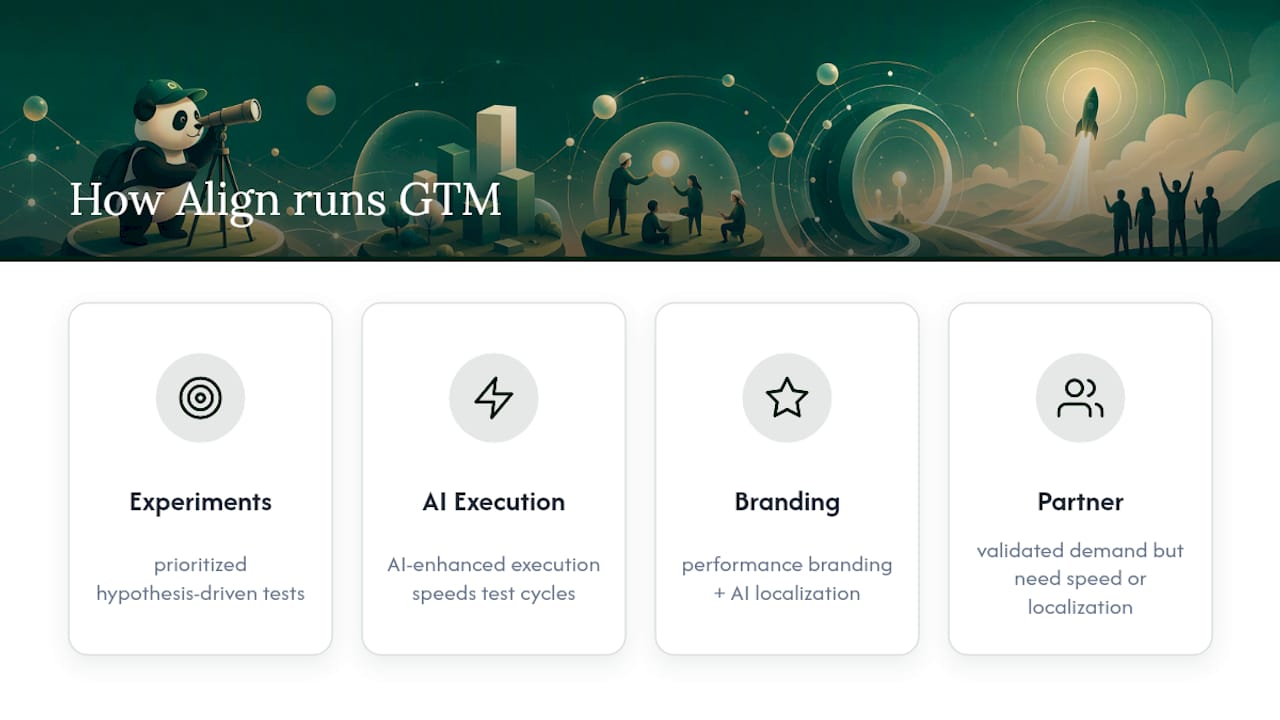
Align treats GTM the same way this article argues you should: as a hypothesis-driven system, not a document. Its practice runs on prioritized experiments, AI-enhanced execution to move faster through testing cycles, and performance branding paired with AI localization to shorten market entry timelines, detailed in Align’s approach to entering Europe faster. Bringing in a partner like this makes sense when your team has validated internal demand but needs speed, localization expertise, or market-entry experience your team doesn’t have in-house yet.
What most founders get wrong about GTM
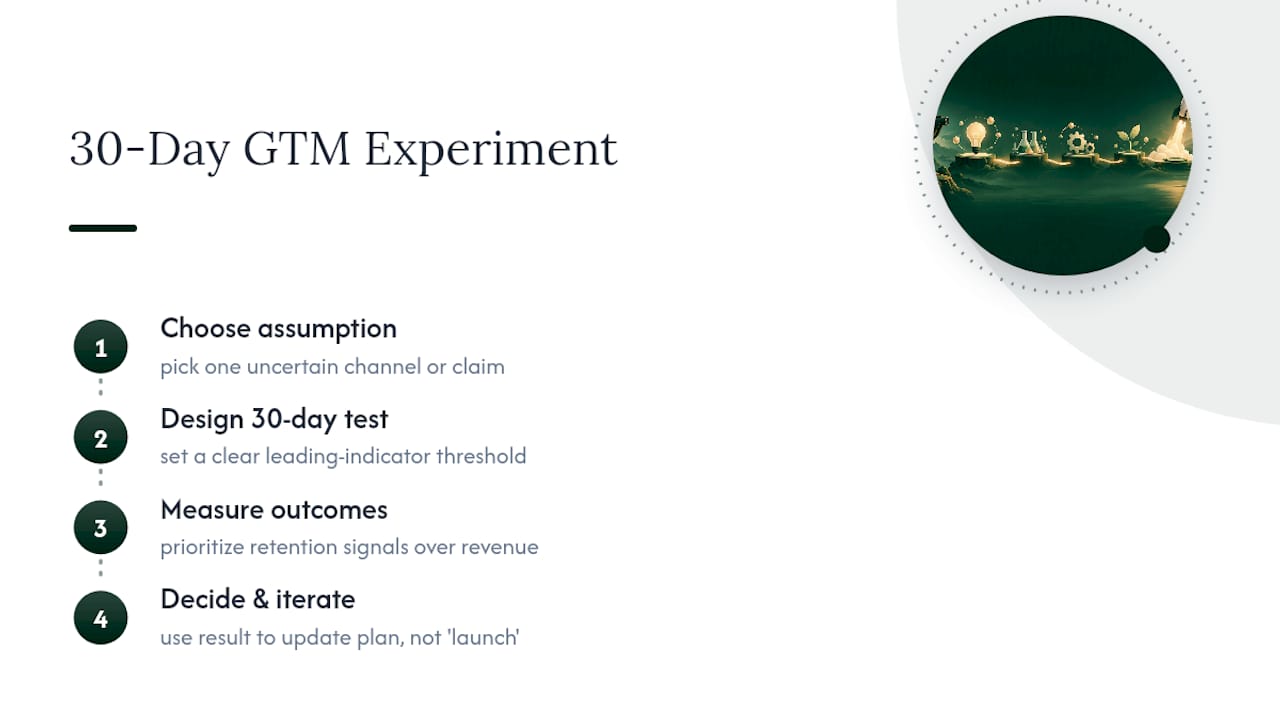
Most founders treat GTM as a launch event: build the plan, ship it, move on. The system that actually works never stops testing. Retention signals matter more than the revenue number that follows weeks later, because revenue is a lagging confirmation of a decision you already made.
Pick one assumption in your current plan, the channel you’re least sure about, and run a 30-day test against it with a clear leading-indicator threshold. That single experiment will tell you more than another week of planning.
— Kalle
How Align turns GTM strategy into market share
Building a GTM system takes discipline. Validating it under real market conditions, especially a new one, takes speed most internal teams don’t have room for. Go-to-Market & Market Entry, Commercial Strategy, and Brand & Positioning services exist for exactly that gap: when you’ve run your own experiments and need a partner who can move faster on market entry, localization, or repositioning than your internal team can alone.

If you’re weighing whether to keep testing in-house or bring in outside execution, our guide on choosing a marketing agency that delivers results walks through that decision. When you’re ready, see how Align’s services map to your GTM plan, or explore Leadership Trips for teams preparing to enter APAC markets firsthand.
Primary sources and further reading
Sources
FAQ
What are the five pillars of a go-to-market strategy?
Definitions vary by framework, but a common version covers target market and ICP, value proposition and messaging, channel strategy, pricing, and the sales model. Gartner’s framework frames these around target market identification, demand generation, sales compensation, corporate investment, and voice of the customer.
What are the top GTM tools?
There’s no single authoritative list of top GTM tools, since the right stack depends on your channel mix, sales model, and budget. Focus on categories instead: a CRM for pipeline data, a landing-page or experimentation tool for testing hypotheses, and a cohort or analytics tool for tracking retention and unit economics.
What is GTM versus RTM?
GTM (go-to-market) is the full strategy for how you reach and win customers, covering positioning, channels, pricing, and sales model. RTM (route-to-market) is narrower: it describes the specific distribution path a product travels to reach the buyer, such as direct sales, distributors, or retail.
Who owns the go-to-market strategy?
Ownership typically sits with a senior commercial or growth leader, often a CMO, VP of sales, or CRO, who coordinates sales, marketing, and product teams around one plan. Without a single named owner, GTM execution tends to fragment across teams working from different assumptions.
Recommended
RELATED INSIGHTS



LET’S TALK
What are you trying to grow next?
Brand, launch, market entry or performance. Book 30 minutes and tell us what you’re working on.