Growth / Performance
Kalle Mobeck
•

How to Write a Holding Statement: Examples You Can Use Now
A holding statement is a short, fast public response that acknowledges a developing situation without stating unverified facts. It buys you time, protects credibility, and signals control while your team confirms what actually happened.
Use this now: “We are aware of [issue] and are actively looking into it. Our priority is [affected group]. We will share an update by [time] and can be reached at [contact].”
That single sentence covers what industry guidance on holding statements identifies as the three non-negotiables:
Acknowledgment that you know something happened
Confirmation that an investigation or response is underway
A concrete update path and a named contact
Aligntcc builds these templates into pre-crisis playbooks for clients precisely because the fill-in-the-blank version above works across almost every scenario, from a server outage to a leadership misstep. The rest of this guide shows you how to adapt it.
Key Takeaways
A holding statement works because it separates immediate acknowledgment from verified fact, letting you respond fast without conceding liability or accuracy.
Point | Details |
|---|---|
Publish within minutes | Speed builds credibility even before facts are confirmed, as long as you avoid unverified claims. |
Include five core components | Acknowledgment, verified facts, empathy, current actions, and a clear update path with contact. |
Match wording to disclosure level | Use Level 1, 2, or 3 framing based on how much legal risk and confirmed fact you’re carrying. |
Store templates centrally | Keep versioned, channel-ready files with owner and last-reviewed date to avoid outdated activations. |
Build preparedness with Align | Align helps teams create scenario-mapped templates and cross-market activation support before a crisis hits. |
Table of Contents
What Is a Holding Statement and When Should You Publish One?
Best Practices for Writing a Strong Holding Statement
Holding Statement Examples and Templates by Scenario
How to Prepare, Store, and Govern Your Holding Statement Templates
Quick Checklist and Two Micro-Templates to Copy Right Now
What Most Advice on Holding Statements Gets Wrong
Get Your Crisis Communications Framework Built Before You Need It
Sources
What Is a Holding Statement and When Should You Publish One?
A holding statement is not a press release. It is a placeholder, built to be published within minutes rather than hours, while a press release waits for verified details, legal sign-off, and a fuller narrative. Think of it as the difference between answering the phone and giving a deposition.
You publish one the moment any of these triggers hits:
A journalist or reporter contacts you about an unconfirmed incident.
A service outage, breach, or system failure becomes visible to customers.
An allegation, safety event, or workplace incident surfaces publicly or internally.
Social media or customer complaints start amplifying faster than your facts arrive.
Speed matters more than completeness here. Story22’s crisis communication research found that a quick early acknowledgment improves how credible your organization looks, even when you have almost nothing confirmed yet. The catch: speed without discipline backfires. Publish an acknowledgment early, but never pair it with numbers, causes, or blame you can’t yet verify. The statement’s only job at this stage is to say “we see it, we’re on it, more soon.”
Best Practices for Writing a Strong Holding Statement
Every effective holding statement rests on five components. Skip one and you either sound evasive or you overcommit.
Acknowledgment — name the situation in plain language, no euphemisms.
Verified facts only — state what you can defend if questioned tomorrow.
Empathy — recognize who is affected before you talk about your own response.
Actions underway — one line on what your team is doing right now.
Update path and contact — a specific time and a specific person or inbox.
ContentGrip’s PR guidance frames this as answering four questions in order: Do you know this happened? Is anyone at risk? What are you doing now? Where will updates appear? Structure your statement around those four questions and you rarely go wrong.
What to avoid is just as important as what to include. Never assign blame, even to a vendor or third party, before an investigation confirms it. Never cite unverified numbers (affected users, financial impact, injury counts) that could shift within hours. And never apologize for the underlying event itself. Apologizing for the disruption or the uncertainty is defensible; apologizing for causing harm before you know the cause is not, since it can read as an admission of liability.
Operationally, assign one single owner for the statement’s language, even if legal, HR, and communications all weigh in. Set approval tiers in advance (who signs off on external versus internal versions) and commit to an update cadence, whether that’s every two hours during an active incident or once daily for a slower-moving story.
Pro Tip: Draft your update cadence into the first holding statement itself (“next update by 3:00 PM”) rather than leaving it vague. A stated deadline forces internal discipline and reduces the “why haven’t they said anything” pressure from reporters and customers alike.
Holding Statement Examples and Templates by Scenario
Different crises call for different postures, but the skeleton stays the same. Below are ready-to-adapt templates for the six situations communicators face most often, plus how to scale each one across disclosure levels.
1. Technical or service outage “We’re aware that [service] is currently experiencing issues affecting [scope, if known]. Our engineering team is investigating now. We’ll post an update by [time] at [status page URL].”
2. Data or security incident “We are investigating a potential security incident affecting [system/product]. We have not confirmed the scope or impact at this time. Affected customers will be notified directly, and we will share verified details by [time].”
3. Workplace injury or safety event “An incident occurred at [location] earlier today. Our first priority is the wellbeing of everyone involved. We are cooperating with [relevant authority, if applicable] and will provide an update once we have verified information.”
4. Offensive marketing or executive misstep “We are aware of concerns raised about [campaign/statement]. We take this seriously and are reviewing the matter internally. We will share our response by [time].”
5. Product recall or defect concern “We have identified a potential issue with [product]. Out of caution, we are investigating and will share guidance for affected customers by [time]. Questions can be directed to [contact].”
6. Customer service disruption “We know many of you are experiencing longer wait times [or: unable to reach support] right now. We’re working to resolve this and expect normal service by [time].”
Each of these can flex across what narracomm’s crisis prompt framework calls three disclosure levels, and picking the right one depends on how much legal exposure you’re carrying:
Level 1: Acknowledge. “We’re aware of reports regarding [issue] and are looking into it.” Use this when you have almost nothing confirmed and legal risk is high.
Level 2: Acknowledge + Act. “We’re aware of [issue] and have activated our incident response team.” Use this once you’ve confirmed the event is real but not its scope.
Level 3: Acknowledge + Act + Impact. “We’ve confirmed [issue] affected [scope]. We’ve taken [specific action] and are notifying affected parties directly.” Use this only once facts are verified enough to survive scrutiny.
Channel variants matter too. A media-facing release line stays formal and short. A customer note leads with the impact on them specifically, not the company. An internal employee line should give more operational detail (what happened, what to tell customers if asked, who to escalate to) since employees are your first line of defense against rumor.
How to Prepare, Store, and Govern Your Holding Statement Templates
The best holding statement is the one you don’t have to write from scratch at 11:00 PM. Workshop’s crisis communications guidance recommends keeping templates in a centralized, versioned location, tagged by scenario and channel, with a visible last-reviewed date on each file.
Four things belong in your governance structure:
A template owner responsible for keeping wording current and legally sound.
Backup approvers who can sign off if the primary owner is unreachable.
A legal contact pre-briefed on which phrases are safe versus risky.
A publishing owner who controls the moment a statement goes live across channels.
Review every template at least twice a year, and add a metadata line to each file recording owner, backup approver, last review date, and legal clearance level. That habit alone prevents the single most common failure: activating a template with an outdated contact name or an expired logo.
Pro Tip: Run a 15-minute “pre-activation checklist” the moment a crisis starts: confirm current contacts are listed, confirm branding matches the latest guidelines, and confirm legal phrasing hasn’t been flagged since the last review. Skipping this step is how outdated templates end up published live.
Adapting Wording and Distribution by Channel and Audience
The core statement stays identical in substance but shifts in length and tone by channel. Media releases run formal and brief. Social posts compress the same message into one or two sentences with a link to a longer update. Customer emails lead with reassurance and next steps. Internal briefs run longest, since employees need enough context to answer questions accurately without freelancing.
Draft one master version, then trim or expand it for each channel rather than writing separate statements from scratch.
Prioritize employee safety and internal clarity first, public reassurance and update timing second, since a poorly briefed employee can contradict your public message within minutes.
Route publishing through a single owner across all channels so the media statement, the customer email, and the internal memo say the same thing in different words.
Quick Checklist and Two Micro-Templates to Copy Right Now
Before anything goes out, run through five checks: confirm the facts you actually have, name who owns the statement, set a specific update time, choose your channels, and confirm the legal review level required for this scenario.
Confirm verified facts only, nothing assumed.
Assign one named owner for approval and publishing.
Set and state an update time.
Choose channels: media, social, customer email, internal, or all four.
Apply the correct legal review tier before publishing.
Micro-Template | Ready-to-Use Text |
|---|---|
Press holding line | “We are aware of [issue] and are actively investigating. We will provide a further update by [time]. Media inquiries: [contact].” |
Customer email line | “Dear [customer name], we want you to know we’re aware of [issue] and are working on it now. We’ll follow up with more information by [time]. If you have questions in the meantime, reach us at [contact].” |
Replace every bracketed placeholder before publishing, and never leave a placeholder like “[time]” visible in a live statement. That single oversight undermines the credibility you’re trying to build.
Author Note and Align’s Crisis Preparedness Support
. Teams that want a partner to build and maintain this infrastructure rather than assembling it ad hoc during a live crisis often turn to Align’s cross-market activation and B2B communications support.
Scenario-mapped, channel-ready template libraries built before a crisis, not during one.
Cross-market activation experience, particularly for companies operating across Europe, North America, and Asia.
Rapid-response support structured around Align’s collaborative specialist model.
What Most Advice on Holding Statements Gets Wrong
Most guidance on this topic treats the holding statement as a legal shield first and a communication tool second. That gets the priority backward. A statement engineered purely to avoid liability reads as evasive, and evasive statements generate more media follow-up, not less. The organizations that come out of a crisis with their reputation intact are the ones that sound human in the first hour, even while saying almost nothing concrete.
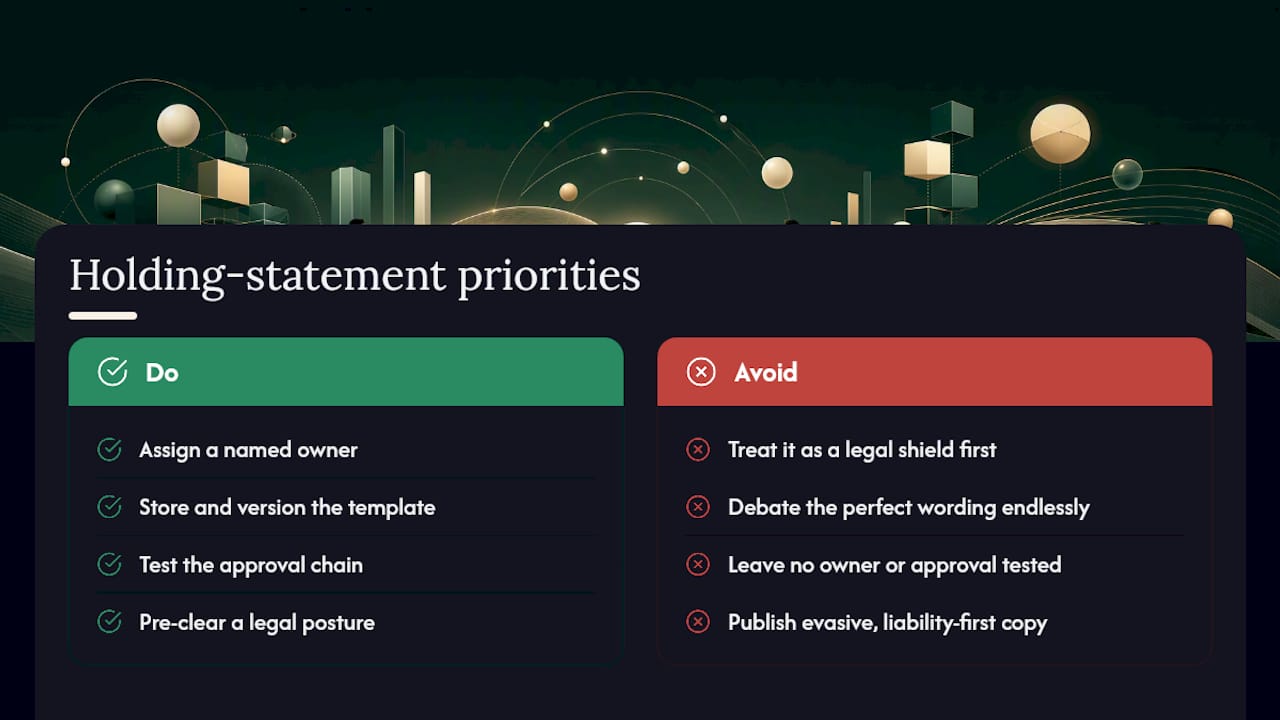
The bigger gap I see is preparation, not wording. Companies spend hours debating the perfect phrase for “we are aware of the situation” while having no owner assigned, no approval chain tested, and no idea where the template even lives. By the time a real incident hits, the words matter less than whether anyone can find and publish them in the next twenty minutes.
Prioritize the operational scaffolding first: a named owner, a stored and versioned template, a pre-cleared legal posture. The wording, frankly, is the easy part once that structure exists.
— Kalle
Get Your Crisis Communications Framework Built Before You Need It
Aligntcc is the alternative to scrambling for a communications lawyer or a generalist agency mid-crisis. Because crisis preparedness sits inside our broader brand and communications work, your holding statement templates get built alongside your actual brand voice and market positioning, not bolted on afterward by someone unfamiliar with your tone.

For companies operating across multiple markets, whether that means coordinating a customer-facing statement in North America while briefing employees in Europe, Align’s team handles the cross-market complexity that generic templates miss. Our approach to brand strategy and execution includes building the exact scenario-mapped, channel-ready library this article describes, reviewed and stored before you ever need it.
If your team is operating without pre-approved templates or a clear approval chain, start the conversation with Align about building your crisis-ready communications framework now, before the next unexpected call from a reporter.
Sources
Recommended
How to Write a Holding Statement: Examples You Can Use Now
THE POINT
How to Write a Holding Statement: Examples You Can Use Now
KEY TAKEAWAYS
01
Learn how to craft effective holding statements with practical examples. Safeguard your organization's credibility during a crisis.
02
Learn how to craft effective holding statements with practical examples. Safeguard your organization's credibility during a crisis.
03
Learn how to craft effective holding statements with practical examples. Safeguard your organization's credibility during a crisis.
RELATED INSIGHTS



LET’S TALK
What are you trying to grow next?
Brand, launch, market entry or performance. Book 30 minutes and tell us what you’re working on.