•
Prove Demand in Six Weeks: International SEO Strategy for Teams
International SEO means optimizing a website so search engines serve the most relevant page to each visitor based on their country and language, matching signals like hreflang, ccTLDs, or subdirectory structures. If you already see organic traffic or buying intent from a market, and you can support it operationally, the move is clear: validate the market with real data, lock down the correct URL and hreflang architecture, then localize content and build local authority. Skip any one of those three, and the other two waste budget.
TL;DR:
Confirm market demand using existing organic traffic, sales inquiries, or search volume before investing in localization efforts.
Use a six- to eight-week pilot with clear KPIs to test localized content, then decide to scale based on performance against predefined thresholds.
Implement hreflang tags with reciprocal annotations and valid ISO codes to prevent technical SEO errors and ensure correct language targeting.
Localize content thoroughly by adapting metadata, visuals, currency, and calls to action instead of relying on literal translation to improve conversion.
Build local authority through region-specific link building and partnerships, as international authority signals cannot be scaled by domestic tactics alone.
AligntccBuild A Sharper Market Entry StrategyAlign TCC helps international brands combine sharper positioning, market-specific execution, and targeted marketing across regions.Explore Align TCC
Table of Contents
Should you do international SEO right now?
Market research and target selection for international SEO
Content strategy: keyword research, localization, and UX fit
Technical architecture: URLs, hreflang, and canonicalization
Local authority and link building for international markets
Measurement, governance, and scaling an international SEO program
How Align TCC approaches international SEO and market entry
Where international SEO strategies usually go wrong
Turning strategy into execution with Align TCC
Where to verify the technical details
Sources
FAQ
Should you do international SEO right now?
Readiness isn’t about ambition. It’s about evidence. Before you commit budget, check for signals that a market is already knocking.
Sales signals: inbound leads, distributor inquiries, or customer support tickets originating from a country you haven’t targeted.
Organic traffic: meaningful non-paid sessions from a country already landing on your untranslated site.
Search volume shifts: rising branded or category search interest in a region, visible in keyword tools filtered by location.
Operational capacity: fulfillment, support, payments, and legal readiness to actually serve buyers there.
Resourcing: budget and personnel to localize content and maintain it, not just launch it once.
Once you’ve confirmed demand, prioritize markets with a simple impact-versus-effort view: rank each candidate market by revenue potential and search demand on one axis, and by localization, legal, and logistics complexity on the other. Markets in the high-impact, low-effort quadrant go first. This is where most teams get it backward: they chase the biggest market instead of the easiest win, and burn a year of runway proving something a smaller pilot could have shown in six weeks.
Market research and target selection for international SEO
Validating a market before you build for it is the difference between an international SEO program and an expensive guess. The workflow below is repeatable across markets, whether you’re testing one country or ten.
Export country-level data from GA4 to see which markets already send traffic, and at what conversion rate, before you spend a cent on localization.
Run location-filtered keyword research for each candidate market, checking search volume, intent, and competition using local-language queries, not translated English terms.
Check regional search engines beyond Google, since markets like China, Russia, and South Korea route significant search volume through Baidu, Yandex, and Naver respectively.
Conduct in-country interviews or surveys with a handful of target customers to hear how they actually describe your product category.
Review SERP formats in the target market. Rich snippets, local pack results, and shopping carousels vary by country and change what “ranking well” even means.
Publish a small sample of localized content on a subset of pages and measure engagement before scaling.
A practical pretest looks like this: pick two or three finalist markets, localize a landing page and a handful of supporting articles, run it for a defined window, and set a graduation threshold in advance. If organic sessions, click-through rate, and localized conversions clear that bar, the market graduates from pilot to full build. If it doesn’t, you’ve lost weeks, not years.
Pro Tip: Set your graduation criteria before the pilot starts, not after you see the numbers. Retrofitting success metrics to match results is how mediocre markets get funded.
Content strategy: keyword research, localization, and UX fit
Translation moves words across languages. Localization moves meaning across cultures, and it’s the version that converts. Ecommerce and product-focused international SEO depends on market-specific keyword research and true localization rather than literal translation, and human review consistently outperforms word-for-word conversion.
Start keyword research inside the target market itself: use geo-filtered tools, set the correct country and language parameters, and always run outputs past a native speaker before they go into a content brief. A term that ranks well in one dialect can read as awkward or outdated in another.
Localization guidelines worth building into every brief:
Metadata and titles: rewrite, don’t translate, so they match how locals actually phrase search queries.
Images and visuals: swap stock photography, models, and cultural references to match the target audience, not just the language.
Currency and units: display local currency, date formats, and measurement units by default, never as an afterthought toggle.
CTAs: adapt urgency and tone. Direct calls to action that work in one market can feel aggressive or presumptuous in another.
Legal and regulatory notes: flag any claims, disclaimers, or required disclosures that differ by jurisdiction before publishing.
Partners like Multilingual SEO Content exist specifically because scaling this kind of nuanced, native-reviewed content across dozens of languages is a production problem as much as a strategic one.
Test resonance in-market with small content batches before a full rollout: publish, measure engagement and conversion over a defined window, then iterate the brief based on what actually landed. A/B testing headlines or CTA phrasing with a local audience segment tells you more in two weeks than a translation agency’s confidence ever will.
Pro Tip: Write one master brief in your home language, then let native-market editors adapt structure and examples freely. Rigid word-for-word briefs produce content that reads translated, and readers notice.
Technical architecture: URLs, hreflang, and canonicalization
Site structure has no universally correct answer. Google does not inherently favor ccTLDs, subdomains, or subdirectories, as long as targeting signals are implemented correctly, so the decision should follow your business model and growth plans, not SEO folklore.
ccTLD (example.de): sends the strongest country signal and can support local trust, but it’s the most expensive to maintain, splits domain authority across properties, and demands separate hosting and legal setup per market.
Subdomain (de.example.com): easier to launch than a ccTLD and allows some separation of content management, though it can dilute authority signals compared to a subdirectory.
Subdirectory (example.com/de/): consolidates all authority under one domain, is the fastest to launch, and tends to be the easiest to scale. Search Engine Land notes that subdirectories consolidate link equity quickest, while ccTLDs carry the strongest country signal at the highest cost.
Whichever structure you choose, Google recommends dedicating a distinct URL to each language version rather than serving multiple languages from one URL, since visible page content is a primary signal search engines use to detect language.
Hreflang implementation is where most technical international SEO breaks down. The rules are strict: every page needs reciprocal annotations across the full cluster, meaning if page A points to page B, page B must point back to page A. Codes must be valid ISO 639-1 language codes, optionally paired with ISO 3166-1 region codes, and you need an x-default tag to catch visitors who don’t match any specified variant. Search Console’s International Targeting report is the fastest way to catch broken or missing reciprocal links before they cost you visibility.
Canonicalization needs its own logic layered on top. Use rel=canonical only within a single language or region cluster, never across languages, since hreflang and canonical tags interact: a canonical pointing to the wrong language variant can silently override your hreflang signals. Server location and CDN configuration also matter for page speed in distant markets, and slow load times undercut every localization effort you’ve made upstream.
Local authority and link building for international markets
Domestic link-building tactics scaled up rarely work abroad, because authority is local by nature. Government sites, regional media, trade associations, local directories, and country-specific influencers each carry weight that a generic outreach template can’t replicate.
Map the local ecosystem first: identify the government bodies, trade publications, and industry associations relevant to your category in each market before pitching anyone.
Build regional data assets: original research or local market data gives journalists a reason to link that a generic press release never will.
Pursue local PR relationships directly: local link-building is relationship-driven, and journalists and industry bodies respond better to genuine outreach than templated pitches.
Adapt outreach culturally: the tone, formality, and channel that works for a US journalist can misfire entirely with a German or Japanese one.
Prioritize partnerships over volume: a handful of strong regional partnerships tends to outperform dozens of low-relevance directory links.
Site architecture shapes how far that authority travels. A subdirectory structure lets link equity flow across the whole domain, so a strong link to your German pages can lift visibility on your Spanish pages too. A ccTLD keeps that authority siloed within its own country domain, which means every market has to build its own local reputation from scratch.
Measurement, governance, and scaling an international SEO program
A market you can’t measure is a market you’re guessing about. Build reporting and governance in from the start, not after the third market launch turns into a mess of inconsistent dashboards.
Track organic users, sessions, and market-specific conversion rate as your core health metrics, segmented by country in GA4.
Monitor SERP feature visibility per market, since featured snippets, local packs, and shopping results vary by country and shift what success looks like.
Use Search Console’s per-market reporting alongside rank trackers and local SERP monitoring tools to catch hreflang errors and ranking drops early.
Set a central governance structure: shared templates and diagnostic checklists speed up scaling, while local teams handle cultural fit and outreach.
Define rollout criteria and review windows in advance, so a market only moves from pilot to full investment when it clears a predefined bar, not when someone feels optimistic about it.
Governance is the unglamorous part of international SEO that determines whether five markets stay healthy or slowly rot from neglect. A quarterly review cadence per market, with a named owner for both central strategy and local execution, keeps standards consistent without strangling the local team’s ability to adapt.
How Align TCC approaches international SEO and market entry
Align TCC treats market entry the way it treats brand strategy: validate before you scale. The approach blends Scandinavian brand thinking with the execution speed of Chinese-market methodologies, using AI to accelerate localization while in-country editors handle idiomatic language and regulatory nuance.
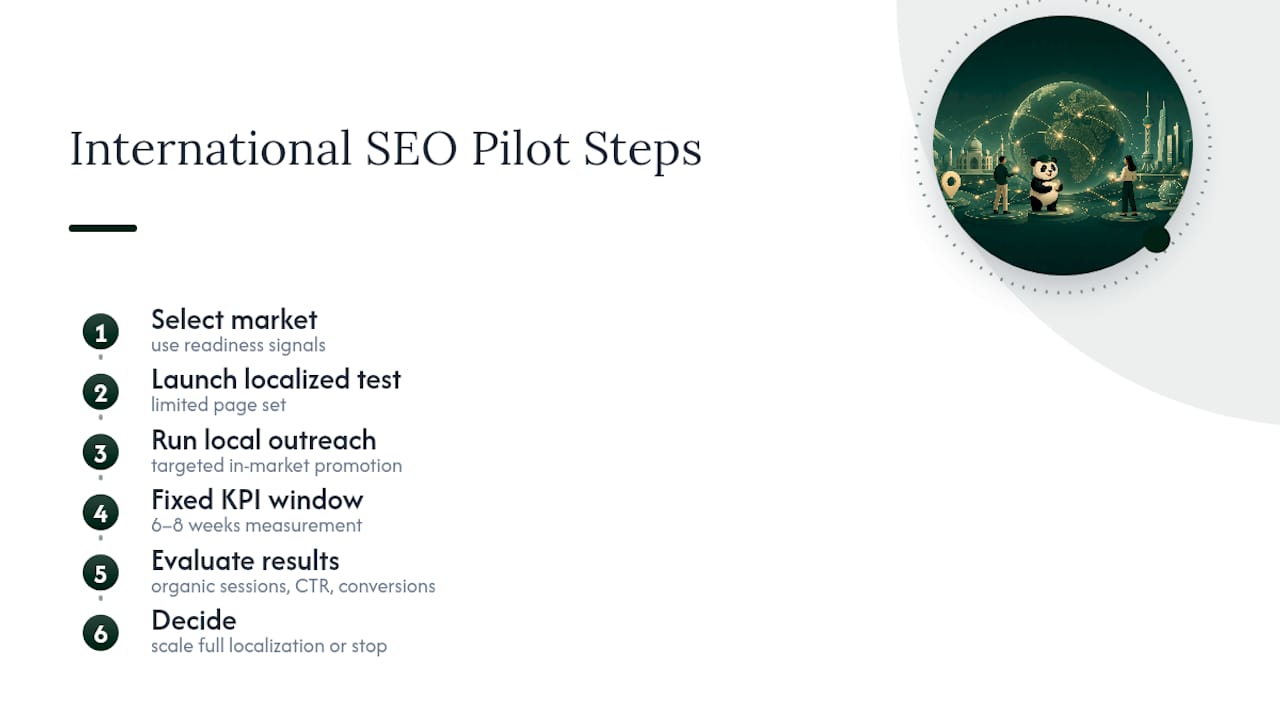
A typical pilot runs six to eight weeks: select a market using the readiness signals above, launch a localized content test on a limited page set, pair it with targeted local outreach, and hold everything against a fixed KPI window before deciding whether to scale. Pilot markets should use a strict KPI window and predefined success criteria, such as organic session growth, click-through rate improvement, and localized conversions, before committing to full localization. Central templates keep the strategy consistent, local edits keep it credible, and conversion data decides what happens next.
Where international SEO strategies usually go wrong
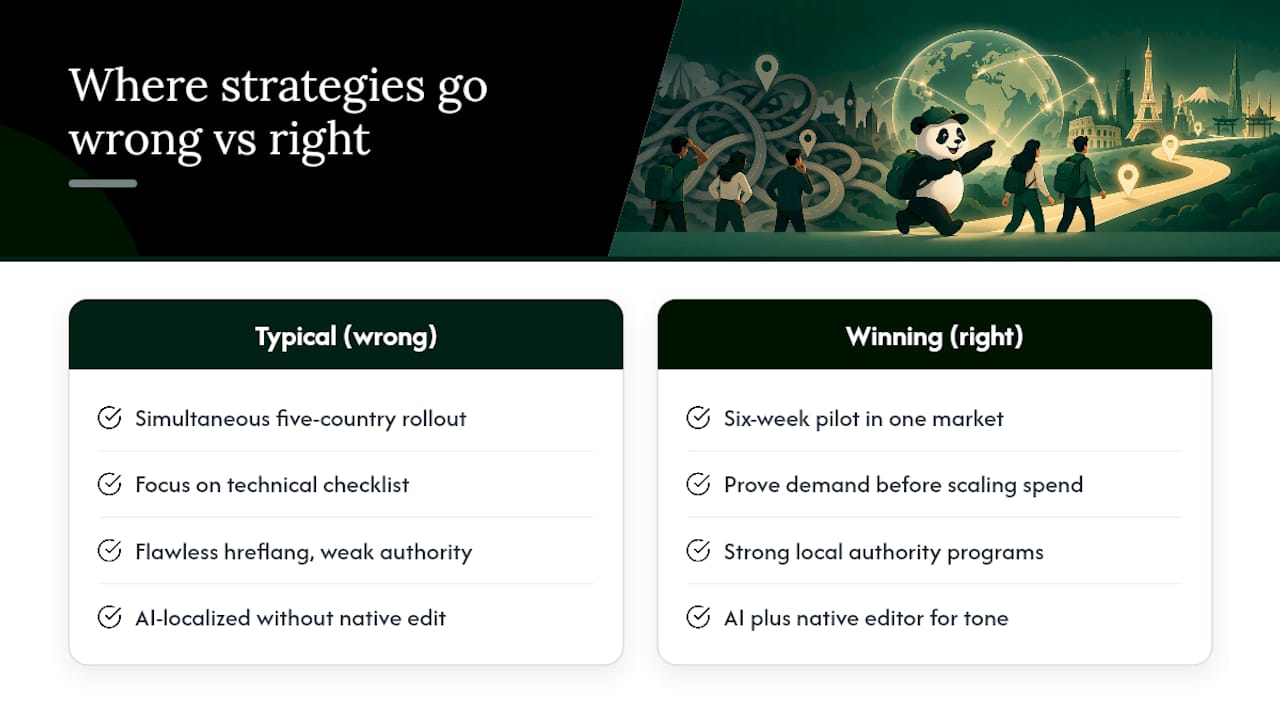
The technical checklist gets all the attention, but most international SEO failures are strategic: poor local execution, UX that ignores cultural norms, and weak local authority sink programs that have flawless hreflang. Perfect architecture on a page nobody local finds credible earns nothing.
The teams that win start small. A six-week pilot in one market beats a simultaneous five-country rollout every time, because it forces you to prove demand before you scale spend. AI can localize at volume, but it still needs a native editor’s judgment to keep tone, references, and compliance intact. Skip that step and you’ll ship content that’s technically correct and culturally hollow.
— Kalle
Turning strategy into execution with Align TCC
Reading the best practices is the easy part. Choosing the right market, building the pilot, and keeping local execution sharp while a domestic team runs the rest of the business is where most international SEO plans stall. Align TCC’s Go-to-Market & Market Entry work exists for exactly that gap: commercial strategy, AI-assisted localization, and conversion-focused execution built around validated demand rather than assumptions.

If China is on your roadmap, Align’s Leadership Trips put your team in-market for direct exposure to shifting consumer behavior and platform dynamics before you commit budget to a full build. For teams weighing a smaller first move, a structured six-week pilot or a governance workshop is often the faster path to a real answer than another quarter of internal debate. Explore Align’s services to see where a pilot could start for your business, or reach out through Align TCC to talk through your first target market.
Where to verify the technical details
For implementation specifics, consult Google Search Central’s guidance on multi-regional sites and hreflang requirements, plus practitioner guides from Search Engine Land and Semrush for executional detail.
Sources
Managing multi-regional and multilingual sites | Google Search Central
International SEO: Everything you need to know (Search Engine Land)
International SEO: Best Practices for Global Online Success (Semrush)
FAQ
How do I start building an international SEO strategy?
Begin by confirming demand: check for existing organic traffic, sales inquiries, or search volume from the target country before building anything. Once demand is confirmed, choose a URL structure, implement correct hreflang, and localize a small content set before scaling.
What is the correct way to implement hreflang tags?
Hreflang tags require reciprocal annotations across every page in the cluster, meaning each language version must link back to all others, plus a valid ISO 639-1 language code and an x-default tag for unmatched visitors. Search Console’s International Targeting report flags missing or broken reciprocal links.
Should I translate or localize my website content?
Localize rather than translate: literal translations often fail to match local search intent and tone, while localized content adapts keywords, currency, imagery, and calls to action to the target market. Human review by a native speaker consistently outperforms word-for-word conversion.
Which URL structure is best for international SEO: ccTLD, subdomain, or subdirectory?
There is no universal best option. Google does not favor one structure over another as long as targeting signals are correct, so the choice should match your business ownership model, budget, and how fast you need to scale into new markets.
How long should an international SEO pilot run before scaling?
A common pilot window is six to eight weeks, with success measured against organic session growth, click-through rate, and localized conversion rate set as thresholds before the pilot begins. Markets that clear the bar graduate to full localization and link-building investment.
Recommended
RELATED INSIGHTS



LET’S TALK
What are you trying to grow next?
Brand, launch, market entry or performance. Book 30 minutes and tell us what you’re working on.