Growth / Performance
Kalle Mobeck
•

Message Market Fit Sprint for Growth Teams: Test in 10–15 Interviews
Message-market fit means your value proposition makes the right buyer understand it, believe it, want it, and pay for it, within seconds of reading it. It sits on top of positioning, messaging, and copy, so you can have strong product-market fit and still lose deals because your words don’t land. The fix is a rapid test, not a rebranding: run a structured message test on your four-part value proposition this week, then iterate.
TL;DR:
Testing the clarity of headlines and visual proof is essential to ensure prospects understand and desire your value proposition before scaling efforts.
Recruiting only friendly customers or existing contacts introduces bias, so fresh, targeted respondents are necessary for accurate message validation.
Conduct two to three rapid testing rounds within a month, using AI-moderated interviews or panels, to iteratively refine messaging before high-stakes campaigns.
Low willingness-to-pay scores often indicate pricing or packaging issues, requiring separate experiments rather than further message adjustments.
Ongoing, rigorous message testing is more cost-effective than relying on internal consensus or assumptions, especially given the affordability of AI and synthetic tools.
Table of Contents
What Is Message-Market Fit, and How Does It Differ From Product-Market Fit?
Why Does Message-Market Fit Matter for CAC and Growth?
What Is the Minimum Viable Value Proposition to Test?
Which Testing Method Should You Use: Interviews, Panels, Surveys, or Landing Pages?
How Do You Run a Message Test Step by Step?
How Do You Interpret Test Results and Decide What to Change?
What Are the Most Common Mistakes in Message Testing?
Who’s Behind This Playbook
Why the Sprint Beats the Strategy Deck
How Align Turns Tested Messaging Into Growth
Sources
What Is Message-Market Fit, and How Does It Differ From Product-Market Fit?
Product-market fit answers whether people want what you built. Message-market fit answers whether they understand, believe, and act on what you say about it. You can nail the first and completely miss the second, which is why so many well-built products stall at a growth ceiling that has nothing to do with the product.
Message-market fit works across three layers, and confusing them is where most teams lose the thread.
Positioning: the strategic claim about who you serve, what category you compete in, and why you’re different. This is internal logic.
Messaging: the translation of that positioning into language a buyer would actually recognize and repeat back. This is the bridge layer.
Copy: the specific words on the specific asset, headline, subhead, ad, deck slide, that a real prospect reads in a real moment.
A company can have airtight positioning in a strategy deck and still fail at message-market fit because the copy on the landing page doesn’t carry that logic through. Message-market fit sits above product-market fit in the growth stack. Plenty of companies with genuine product-market fit stall at their next inflection point because the messaging never made the product legible to a new buyer segment, a new geography, or a new budget holder.
The internal versus external distinction matters more than most teams give it credit for. Internal alignment, your founder, your VP of sales, and your product lead all agreeing on the pitch, feels like progress. It is not the same thing as external resonance, where a stranger who has never heard of you reads your headline and immediately gets it. Sales and marketing teams routinely mistake the first for the second, because internal agreement is comfortable and external testing is not. That gap is exactly what a message test is built to close: it replaces “we all like this line” with a measurable read on whether outsiders actually do.
If you’re localizing that same message for a new market, the translation layer carries its own risk. A message that tests well in English can flatten or distort entirely once it’s adapted for a foreign market, so treat each language version as a separate test, not a straight copy job.
Why Does Message-Market Fit Matter for CAC and Growth?
Weak messaging is expensive in a specific, traceable way: it raises customer acquisition cost because prospects who don’t immediately understand your value require more touches, more sales hours, and more paid impressions to convert. It also stretches sales cycles, since reps end up re-explaining the offer on every call instead of qualifying and closing.
The Leading Indicators to Watch Before revenue moves, three signals tell you whether your message is working: headline comprehension in a cold read, how prospects engage with your sales deck mid-call (do they lean in on slide three or start checking email), and synthetic validation scores from rapid pre-launch tests. A synthetic score in the 60 to 70 percent range on comprehension and desire is treated as an early positive signal worth building on.
Lagging indicators confirm what the leading ones predicted, but by the time they move, you’ve already spent the budget. Watch churn tied to “this isn’t what I thought I was buying,” referral rate (people don’t refer what they can’t explain to a colleague), and sales cycle length creeping upward without a corresponding change in the product.
The strategic urgency in 2026 comes from how cheap testing has become relative to how expensive guessing still is. A single AI-moderated round can run for a fraction of what a traditional qualitative study cost even three years ago, which removes the old excuse for shipping a headline untested. Teams that treat messaging as a one-time creative decision, rather than an ongoing hypothesis to validate, are the ones still wondering why a technically superior product loses to a worse one with sharper language. Language market fit, the exact phrasing that resonates with a specific buyer, can flip conversion rates on a single headline swap, which is why it deserves the same testing rigor you’d apply to a pricing change.
What Is the Minimum Viable Value Proposition to Test?
You don’t need a full campaign to test a message. You need four components, built once and reused across every test round.
Headline: one sentence stating the core outcome or transformation.
Subhead: one sentence adding the mechanism or differentiator.
Three benefits: short, concrete statements of what the buyer gets, not what the product does.
Visual proof: a screenshot, diagram, or data point that makes the claim feel real rather than asserted.
Each piece maps to one of four questions, and this mapping is the entire backbone of a rigorous test. Value proposition testing evaluates the headline, subhead, benefits, and visual proof against comprehension, belief, desire, and willingness-to-pay, rather than asking a vague “do you like this” question that generates polite, useless feedback.
Value prop element | Validation question | What a fail looks like |
|---|---|---|
Headline | Do they understand it? | Respondent paraphrases something you didn’t say |
Subhead | Do they believe it? | “Sounds too good to be true” in open text |
Three benefits | Do they want it? | Shrug, or “nice but not urgent” |
Visual proof | Will they pay for it? | Interest drops once a price appears |
Here’s a compact example structure, built for a hypothetical B2B analytics tool, to show the shape without borrowing anyone’s actual copy: “Stop guessing why deals stall” (headline), “AI flags the exact objection killing your pipeline, before your rep does” (subhead), three benefits around time saved, deals rescued, and forecast accuracy, and a visual showing a before/after pipeline view.
To build the hypotheses behind that structure, convert your Value Proposition Canvas assumptions into explicit, testable claims rather than leaving them as internal beliefs. If your canvas says “buyers are frustrated by manual reporting,” that becomes a specific line in your test instrument, and you measure whether strangers agree with it before you ever test whether they’d pay to fix it.
Pro Tip: Write the visual proof element last, not first. Teams that design the graphic before locking the headline end up writing copy to match the picture instead of testing the claim the picture is supposed to support.
Which Testing Method Should You Use: Interviews, Panels, Surveys, or Landing Pages?
The right method depends on how deep an answer you need and how fast you need it, not on which tool has the flashiest demo.
AI-moderated interviews for depth at speed. These combine structured, comprehension-focused questions with open-ended probes, and a rigorous round typically uses 10 to 15 interviews, completed in three to five days rather than the three to four weeks a traditional moderated study takes. Use this when you need to hear the actual words prospects use to describe your value, not just a score.
Verified B2B panels for representativeness. Wynter runs panel-based message tests with verified buyers, returning quantitative scores plus qualitative quotes in under 48 hours. This is the right call when your buyer is narrow and senior, a VP of finance or a head of security, where a general panel would give you noise instead of signal.
Synthetic-audience tools for high-frequency iteration. Platforms like Articos run pre-launch comparisons in under 30 minutes at a fraction of panel cost, which makes them useful when you’re testing five headline variants in a week rather than committing to one and hoping.
Surveys with ranking or MaxDiff for prioritization at scale. Survey-driven value-prop testing using MaxDiff forces respondents to trade off benefits against each other instead of rating everything highly, which is how you find out which benefit actually drives the decision versus which one just sounds nice.
Landing-page tests and letters of intent for willingness-to-pay. A page with a real price and a “request access” button, or a signed letter of intent, tells you more about desire than any survey question ever will, because money and signatures carry weight that opinions don’t.
On economics: expect to run two to three rounds a month at the AI-moderated or synthetic tier before escalating to a formal panel study, and reserve the traditional multi-week qualitative study for decisions with real capital behind them, a pricing overhaul, a market entry, a rebrand. Testing SaaS pricing directly with real customers belongs in that higher-stakes tier, since willingness-to-pay signals move revenue in a way a headline tweak alone doesn’t.
How Do You Run a Message Test Step by Step?
A test only produces a decision if you define the decision rule before you see any data. Here’s the sequence that keeps a sprint honest.
Write the hypothesis and the pass/fail bar first. Something like “at least 70 percent of respondents correctly paraphrase our core claim, and at least half rank our top benefit above the other two” is a real bar. “See what people think” is not a hypothesis, it’s a wish.
Recruit against your exact ICP, on purpose. Pull from your actual customer list, a lookalike audience, or a verified panel filtered to the job title and company size you sell into. Deliberately include a few dissenters or churned customers, because a room full of people who already like you will validate almost anything you show them.
Field a mixed instrument. Combine structured comprehension and willingness-to-pay scales with open-ended probes, and record verbatim language, not paraphrases. The exact words a prospect uses to describe your product back to you are often better copy than anything your team wrote.
Analyze with a simple scoring rubric before you read a single quote. Score comprehension, belief, desire, and willingness-to-pay separately, split results by segment (title, company size, industry), and only then move to thematic coding of the open text. Reading quotes first biases you toward whichever comment was most quotable, not most representative.
Apply your decision rule and set the next round. If you clear the bar, ship it and monitor lagging indicators. If you miss it on one dimension, fix that dimension specifically. If you miss on multiple dimensions, that’s a signal to widen the test rather than patch the copy again.
Plan for two to three rounds inside a single month. The first round almost always surfaces a comprehension problem you didn’t know you had; the second round tests the fix; the third confirms it holds across a slightly different segment. Teams that stop after round one are, in effect, testing their first draft and calling it validated.
Pro Tip: Keep a running “verbatim bank” across every round, every phrase a respondent used unprompted to describe the value. After three or four rounds, that bank is often a better source of headline copy than anything a brainstorm produces, because it’s language buyers already reached for on their own.

How Do You Interpret Test Results and Decide What to Change?
A completed test gives you four scores, not one verdict, and the pattern across them tells you what kind of problem you actually have.
Low comprehension, everything else fine: your copy is the problem, not your offer. Rewrite the headline and subhead, retest in days, not weeks.
High comprehension, low belief: prospects understand the claim and don’t buy it. Add proof, specific numbers, a named result, a credible visual, rather than rewriting the pitch itself.
High comprehension and belief, low desire: they get it and believe it, but it doesn’t feel urgent to them. This often means you’re talking to the wrong pain point for that segment, which points to a positioning fix, not a copy fix.
Strong scores across comprehension, belief, and desire, but weak willingness-to-pay: this is a pricing or packaging issue, not a messaging issue, and it’s the clearest signal in the whole framework to escalate into a dedicated pricing experiment or a small pilot sale rather than another message round.
Triangulate the test data against what’s already happening internally. If your sales team independently reports the same slide losing attention on every call, and your synthetic test flagged desire as the weak dimension, that’s convergent evidence, not coincidence, and it should move faster through your roadmap than a single data point would. Internal alignment checks, does the founder’s version of the pitch match what a junior AE says on a discovery call, often expose the exact inconsistency a message test later confirms with numbers.
What Are the Most Common Mistakes in Message Testing?
Most failed message tests fail for the same handful of reasons, and each one has a cheap fix.
Testing the wrong audience. Recruiting from your existing email list or Slack community feels efficient and produces a friendly-sample bias that hides real problems. Fix: recruit fresh, ICP-exact respondents every round, even if it costs more.
Never asking about price. Comprehension and desire scores can look great while willingness-to-pay quietly fails, and teams skip that question because it’s the one most likely to disappoint them. Fix: put a real number in front of respondents in every round, not just the final one.
Testing only friendly customers. Happy existing customers will validate almost any reasonable-sounding claim about a product they already trust. Fix: deliberately include churned accounts or people who evaluated you and chose a competitor.
Stopping after one round. A single test tells you about one draft, not about your message. Fix: budget for two to three rounds before drawing a conclusion.
Misreading open-ended language. Skimming qualitative comments for anything that confirms what you already believed defeats the purpose of asking. Fix: code responses against your rubric before forming an opinion, not after.
Who’s Behind This Playbook
This piece was written by Kalle, drawing on the same rapid-testing frameworks Align applies inside client engagements: structured message instruments, mixed AI-moderated and panel methods, and a bias toward shipping a tested variant over a polished but unvalidated one. Align works with growth-stage B2B and B2C companies across brand strategy and execution, building and stress-testing the value propositions that carry a company into a new market or a new buyer segment.
The firm’s cross-market experience, particularly moving brands between Western and Chinese markets, means message testing at Align rarely stops at English. A headline that scores well domestically gets retested once it’s adapted for a new language and culture, because comprehension and belief don’t automatically transfer across that boundary. That discipline, test locally, don’t assume globally, is the same principle this article argues for at the segment level.
Why the Sprint Beats the Strategy Deck
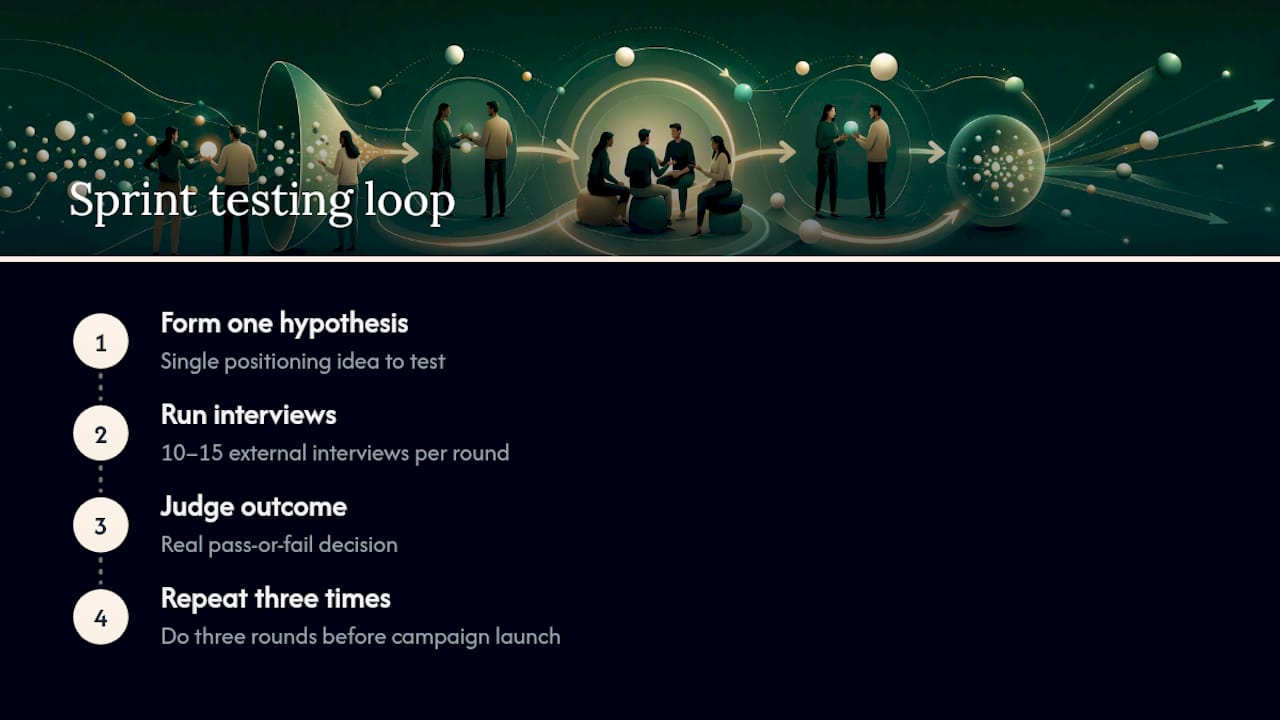
Most messaging advice still treats positioning as a document you finalize once and defend forever. That’s backwards. The research behind this article points to a different conclusion: messaging is a hypothesis, and the teams that win aren’t the ones with the cleverest line, they’re the ones who tested five lines and kept the one that actually worked on strangers.
The conventional wisdom oversells workshops and undersells cadence. A brilliant positioning session with no test afterward is a guess with better production values. What the reader should prioritize first isn’t a bigger brainstorm, it’s a smaller, faster loop: one hypothesis, one round of 10 to 15 interviews, a real pass or fail bar. Do that three times before your next big campaign launch, and you’ll know more about what actually resonates than a year of internal debate would ever tell you.
— Kalle
How Align Turns Tested Messaging Into Growth
Guessing at a headline and hoping sales figures it out later costs more than testing it upfront, and that’s the gap Align was built to close. Align runs message-market fit sprints as part of its broader brand strategy and execution work, pairing AI-moderated interviews with the same senior strategists who then build the positioning, campaigns, and sales enablement around whatever the test confirms.

A typical engagement delivers validated messaging variants scored across comprehension, belief, desire, and willingness-to-pay, full interview transcripts with verbatim buyer language, and a KPI plan tying those results to pipeline and CAC targets. Rather than treating research and creative as separate vendors, Align keeps the same team accountable from hypothesis through launch, which is how a tested insight actually makes it into a headline instead of dying in a slide deck. If your last campaign underperformed and you suspect the message, not the product, was the problem, start a conversation with Align about running a sprint before your next launch.
Sources
Koji’s value proposition testing guide breaks down the four-dimension framework and AI-moderated interview costs. Wynter’s message testing product covers verified B2B panel testing. Articos offers a synthetic-audience testing platform for rapid iteration. Strategyzer’s value proposition roadmap explains hypothesis sequencing, and Sproutworth’s message-market fit overview covers leading indicators in more depth.
Recommended
Message Market Fit Sprint for Growth Teams: Test in 10–15 Interviews
THE POINT
Message Market Fit Sprint for Growth Teams: Test in 10–15 Interviews
KEY TAKEAWAYS
01
Practitioner first sprint to message market fit. Use AI moderated interviews and score comprehension, belief, desire and willingness to pay.
02
Practitioner first sprint to message market fit. Use AI moderated interviews and score comprehension, belief, desire and willingness to pay.
03
Practitioner first sprint to message market fit. Use AI moderated interviews and score comprehension, belief, desire and willingness to pay.
RELATED INSIGHTS

LET’S TALK
What are you trying to grow next?
Brand, launch, market entry or performance. Book 30 minutes and tell us what you’re working on.