Growth / Performance
Kalle Mobeck
•

Managers: 7 Steps to Embed Sustainability Communications Strategy
A sustainability communications strategy is a stakeholder-focused plan that turns verified environmental and social work into clear, audience-specific messages. It aligns internal teams, external partners, and investors around the same proof points. Your first move: set SMART objectives and map your top five stakeholder groups before you write a single headline.
TL;DR:
Stakeholder mapping ensures messaging reaches relevant audiences and prevents campaigns from becoming ineffective by focusing on key influence groups.
Accurate data sources, clear timelines, verification, and transparency about setbacks are crucial to avoid greenwashing, greenhushing, and greenwishing traps.
Measuring success relies on stakeholder-specific outcomes like trust, engagement, and investor feedback rather than reach metrics alone.
Embedding sustainability questions in every creative brief and integrating verification steps improves credibility and operational consistency.
Regulatory requirements demand precise claims backed by third-party verification, making legal review and documentation essential before publishing any sustainability message.
Table of Contents
What Does a Sustainability Communications Strategy Actually Cover?
How Do You Build a Sustainability Communications Strategy Step by Step?
What Are Greenwashing, Greenhushing, and Greenwishing?
How Do You Measure Sustainability Communications Effectiveness?
Which Frameworks and Templates Should You Adopt?
How Do You Operationalize This Inside Real Workflows?
Why Does Storytelling Matter More Than Data Alone?
How Should You Use Social Media for Sustainability Messaging?
What Do Strong Sustainability Communications Examples Look Like?
What Legal and Regulatory Rules Apply to Sustainability Messaging?
Five Priorities If You’re Starting From Scratch
How Align Helps You Build and Operationalize the Strategy
Where to Go Deeper
Sources
What Does a Sustainability Communications Strategy Actually Cover?
Scope is where most teams stumble first. A sustainability communications strategy isn’t a press release calendar. It spans four distinct audiences, each with different information needs, different trust thresholds, and different regulatory exposure.
The business case is straightforward once you see the full map:
External customers and media need proof points that survive scrutiny, not slogans.
Employees need to understand the “why” behind operational changes before they can advocate for the company externally.
Supply chain partners need shared standards and data formats, especially as CSRD-style reporting mandates spread across markets.
Investors and regulators need disclosure-grade accuracy, not marketing copy.
Get this right and you build durable trust, sharper brand differentiation, and stronger investor relationships. Get it wrong and transparency becomes a liability instead of an asset. The tension every communications lead has to manage is real: say too little and you look evasive; say too much before the data is locked and you invite a fact-check you’ll lose. Mandatory reporting frameworks are pushing this from a marketing nice-to-have into a governance requirement, which is exactly why the strategy needs structure, not enthusiasm.
How Do You Build a Sustainability Communications Strategy Step by Step?
Communications works best when it’s treated as a management discipline, not a creative exercise. The IUCN’s ten-step planning guide frames it exactly that way, and it’s a solid backbone to build from.
Set SMART objectives tied to existing corporate sustainability targets and reporting deadlines, not vague aspirations like “raise awareness.”
Map and segment stakeholders by influence and interest, then rank your top five for immediate attention.
Build message architecture around evidence: emissions data, EPDs, life-cycle assessments, or Science Based Targets, wherever they exist.
Match channels to audiences. Investors read integrated reports; employees respond to town halls and intranet updates; consumers respond to short-form video and packaging callouts.
Assign governance. Name who drafts, who verifies data, and who signs off before anything ships.
Build a content calendar anchored to real milestones (audits, certifications, product launches) rather than arbitrary posting cadence.
Write scenario playbooks for setbacks. What do you say if a target slips? Who responds if a claim gets challenged publicly?
Pro Tip: Draft your crisis scenario playbook before you publish your first sustainability claim, not after a journalist asks a question you can’t answer.
The order matters. Skip stakeholder mapping and jump straight to channel selection, and you’ll end up with a beautiful campaign nobody who matters actually sees.
What Are Greenwashing, Greenhushing, and Greenwishing?
These three traps kill credibility faster than almost anything else in this field. Greenwashing is overstating impact. Greenhushing is staying silent about real progress out of fear of scrutiny. Greenwishing is publicizing intentions as if they were results already achieved.
KPMG’s research on ESG pitfalls makes a point worth sitting with: over-claiming and under-communicating cause similar long-term damage. The fix isn’t caution, it’s precision.
Run every claim through this checklist before it ships:
Can you trace the data to its source and timestamp?
Does the claim specify a timeline, or does it imply something is already finished?
Is there third-party verification, or is this a self-reported number?
Have you stated what hasn’t been solved yet, alongside what has?
Has a named reviewer, not just a communications writer, signed off?
Communicating uncertainty honestly, “we’ve cut emissions 12% against our 2030 target,” beats a vague “we’re going green” every time it’s tested against a skeptical reader.
How Do You Measure Sustainability Communications Effectiveness?
Outputs are not outcomes. Reach and impressions tell you a message went out. They tell you nothing about whether anyone believed it or acted on it.
Track outcomes by stakeholder group instead:
Consumers: brand trust surveys, message recall, purchase intent shifts.
Employees: engagement scores, internal advocacy (are people sharing company sustainability content unprompted?).
Investors: ESG rating movement, qualitative feedback from analyst calls.
Media/regulators: tone of coverage, absence of correction requests.
Pair quantitative tracking (analytics, media monitoring, A/B-tested message variants) with qualitative stakeholder interviews on a quarterly cadence at minimum.
Set your expectations with a healthy dose of realism here. A large 2026 study covering 13,544 participants found that even the most effective climate messages typically shift attitudes or behavior by only about 1 to 4 percentage points. If your KPI dashboard assumes a single campaign will move the needle by double digits, you’re setting your team up to look like it failed when it actually performed normally.
Which Frameworks and Templates Should You Adopt?
You don’t need to build your framework from scratch. Three established playbooks cover most of the ground, and each solves a different part of the problem.
Framework | Best used for |
|---|---|
IUCN ten-step guide | Sequencing the planning process itself |
UN Global Compact CMO Blueprint | Aligning comms with growth, brand, and innovation strategy |
C2ES Communications Playbook | Governance, documentation, and scenario planning |
The UN Global Compact’s CMO Blueprint, built on input from more than 1,700 senior leaders, organizes the work around five pillars: growth strategy, brand strategy, innovation, communications and media, and partnerships. It’s a useful cross-check for whether your communications plan is actually wired into the rest of the business or operating as a standalone side project.
Build a small template library once and reuse it: a stakeholder map, a message matrix linking claims to evidence, a SMART objectives worksheet, a crisis scenario checklist, and a rolling content calendar. Adapt each to your sector rather than copying it wholesale.
How Do You Operationalize This Inside Real Workflows?
Frameworks fail when they live in a slide deck nobody opens again. The fix is embedding sustainability questions directly into the documents people already use.
Add a line to every creative and campaign brief: “What sustainability claim does this asset make, and who verified it?” Google’s sustainability marketing playbook makes this exact point: anchoring narratives to genuine user needs, not manufactured ones, keeps campaigns honest and prevents the creation of new consumption drivers dressed up as sustainability wins.
Governance works best with one named reviewer accountable for sign-off, not a committee. A short internal example: a mid-size manufacturer preparing a packaging campaign added a single verification step, confirming the recycled-content percentage against its supplier’s certificate before copy was finalized, and caught a claim that was two years out of date.
One-page checklist to copy into your next brief template:
Named sustainability reviewer assigned
Claim traced to a verifiable data source
Timeline stated explicitly
Setbacks or limits acknowledged somewhere in the asset
Channel matched to the audience it’s meant for
Pro Tip: Put the reviewer’s name on the brief itself, not just in a shared drive folder. Accountability that’s visible gets acted on; accountability that’s buried gets skipped.
Why Does Storytelling Matter More Than Data Alone?
Numbers convince the analytical reader. Stories move everyone else. A sustainability communications strategy that leads with a spreadsheet loses most of its audience before the second sentence.
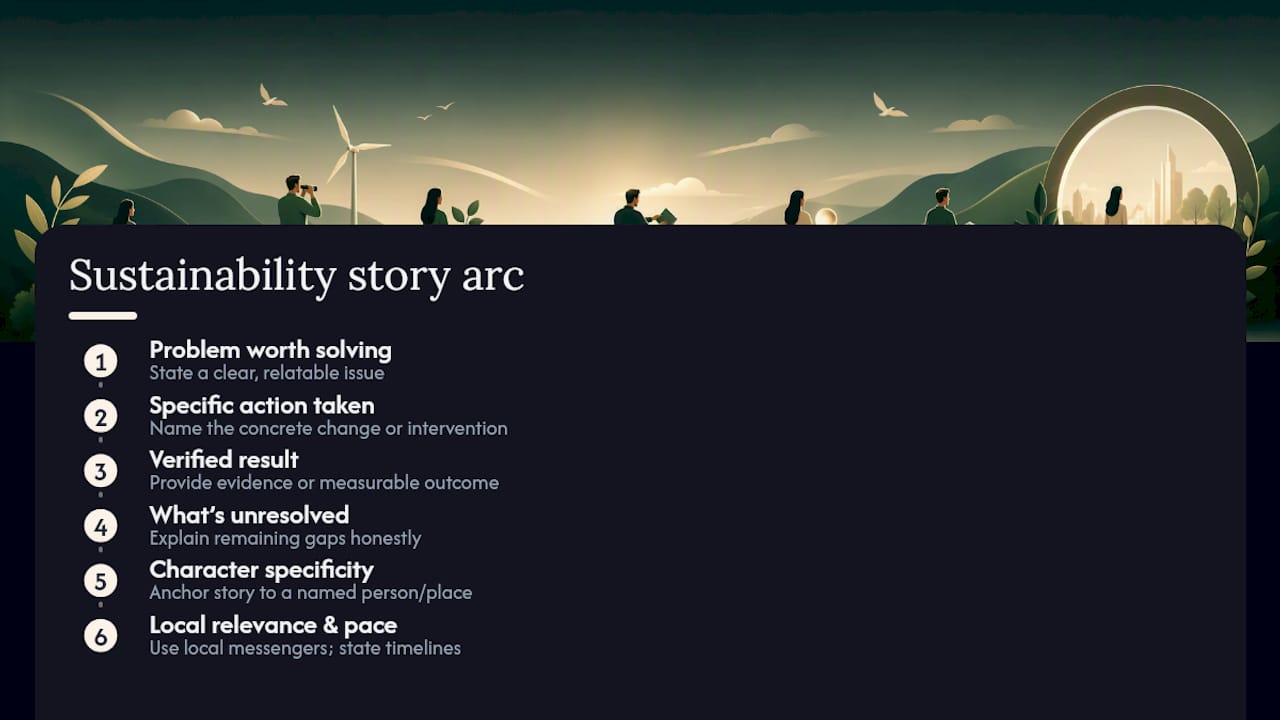
The strongest sustainability narratives follow a simple arc: a problem worth solving, the specific action taken, the verified result, and what’s still unresolved. That last part is what separates credible storytelling from marketing spin. Audiences have grown skeptical of tidy sustainability arcs that never mention a setback, because real progress is never that clean.
Character matters as much as plot. A story anchored to a named engineer who redesigned a supply route, or a specific factory that hit a milestone, lands harder than a corporate “we” statement. Specificity is what makes a claim feel real instead of templated.
Psychological distance is the enemy of engagement. Climate and sustainability topics often feel abstract and far away, which is part of why they struggle to move behavior. Research on local and community messaging points to a clear fix: use locally relevant examples and trusted local messengers rather than global abstractions. A regional plant manager describing a change at their facility will out-perform a global sustainability officer describing the same change at scale, because the audience can picture it.
Keep the narrative honest about pace. If a target is three years out, say so in the story rather than implying it’s already done. Readers forgive incomplete progress. They don’t forgive discovering they were misled about how far along something actually is.
How Should You Use Social Media for Sustainability Messaging?
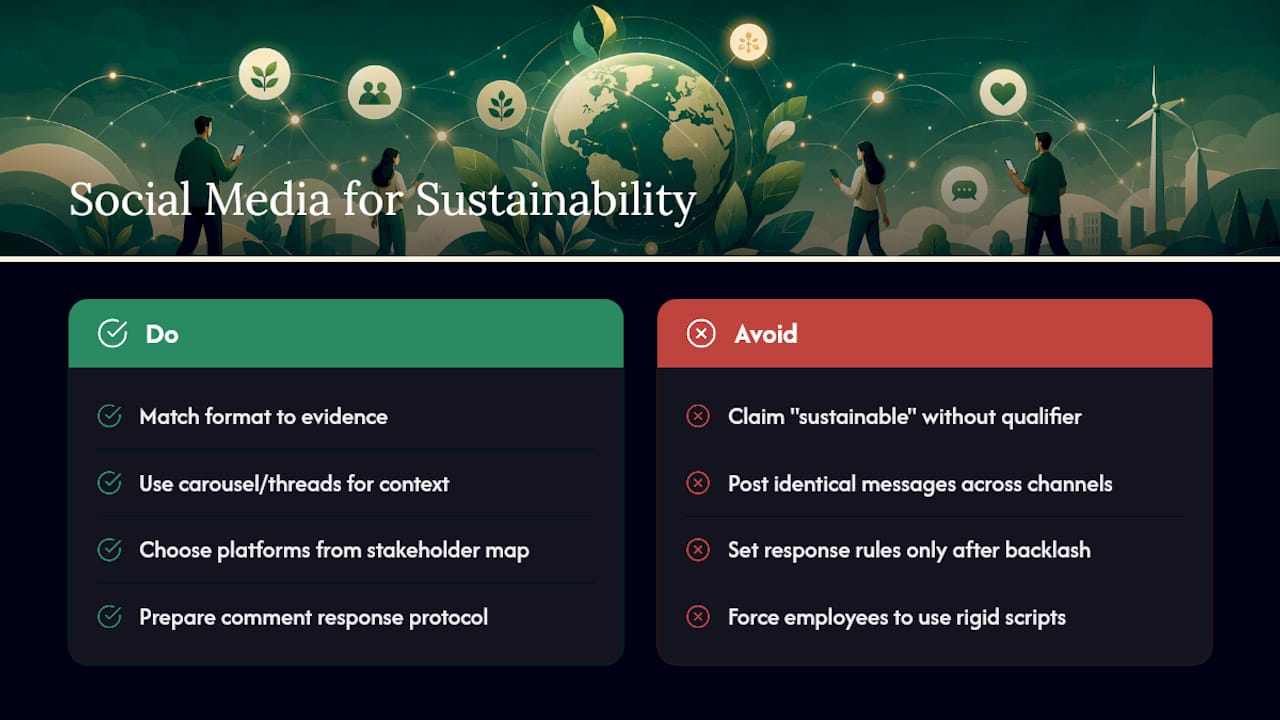
Social platforms reward brevity and visuals, which is exactly the format that gets sustainability communicators into trouble. A 15-second video claiming a product is “sustainable” with no qualifier is a greenwashing risk waiting to surface in a comment thread.
The fix isn’t avoiding social media. It’s matching format to evidence. Short-form video works well for behind-the-scenes proof: a supplier audit, a facility tour, a specific number tied to a specific timeframe. Carousel posts and threads work better for claims that need context, since they let you show the data and the caveat in the same format instead of forcing an oversimplified headline.
Platform choice should follow your stakeholder map, not the other way around. LinkedIn tends to reach investors, partners, and employees more effectively than Instagram or TikTok, which skew toward consumer audiences who respond to visual proof over technical detail. Posting the same message identically across every channel usually means it’s optimized for none of them.
Comment sections are where sustainability claims get stress-tested in public, often within hours. Build a response protocol before you post, not after a claim gets challenged. Who monitors comments, what’s the escalation path if a claim is disputed with data, and how fast can a correction go out? These questions belong in your governance step, not as an afterthought once something goes sideways.
Employee advocacy on social channels tends to outperform brand-account posts, since employees are viewed as more credible than corporate accounts on values-based topics. Give employees pre-approved, factually vetted content they can share in their own voice rather than a rigid script.
What Do Strong Sustainability Communications Examples Look Like?
The best examples share one trait: they document verified data alongside the narrative, rather than treating documentation as a separate compliance exercise. Organizations following the C2ES Playbook’s approach to telling “the full story” report progress and setbacks in the same document, which builds credibility precisely because it doesn’t read like a highlight reel.
A pattern worth studying: companies that publish year-over-year progress against a named target, including the years they missed it, tend to retain more stakeholder trust than those that only publish success years. The gap in the data becomes evidence of honesty rather than a liability, provided the explanation for the miss is specific.
Supply chain communication offers another instructive pattern. Organizations that share the same data format and reporting cadence with suppliers as they use for their own public disclosures avoid the credibility gap that shows up when a company’s public claims outpace what its supply chain can actually verify. This is less a communications tactic than an operational discipline that communications teams have to advocate for internally.
The common denominator across strong examples isn’t polish. It’s consistency between what’s said publicly, what’s disclosed to regulators, and what employees are told internally. When those three versions of the story match, stakeholders notice, even if only subconsciously.
What Legal and Regulatory Rules Apply to Sustainability Messaging?
Regulatory exposure around sustainability claims has tightened considerably, and the direction of travel is toward more scrutiny, not less. The Corporate Sustainability Reporting Directive is reshaping disclosure requirements for companies operating in or selling into the EU, pulling sustainability claims out of the marketing department’s sole control and into a compliance framework with real penalties for inaccuracy.
The practical implication for communicators: a claim that would have been acceptable as aspirational marketing language five years ago can now trigger regulatory review if it appears misleading or unsubstantiated. Comparative claims (“greener than,” “more sustainable than”) face particularly high scrutiny in most markets because they imply a benchmark that regulators expect you to be able to produce on request.
Get your legal and sustainability teams reviewing claims before launch, not after a complaint arrives. This isn’t about slowing communications down for its own sake. It’s about avoiding the retraction cycle, which does far more brand damage than a delayed launch ever does. Document your evidence trail for every quantitative claim you publish. If a regulator or journalist asks where a number came from, “we don’t have that record anymore” is the worst possible answer, and it’s entirely avoidable with basic version control on your message matrix.
Third-party certification and independent verification aren’t just credibility boosts. Increasingly, they’re becoming the practical standard regulators expect for any claim carrying commercial weight.
Five Priorities If You’re Starting From Scratch
Internal alignment comes before external announcements, always. Employees who read about a target on a press release before hearing it internally stop trusting future announcements. Use local messengers wherever you can. A regional voice describing a real change closes the psychological distance that global corporate language never manages to close.
Mandate a sustainability question in every creative brief, no exceptions. Prefer specific, time-bound claims over broad ones. And measure outcomes, trust shifts, behavior change, investor sentiment, not the vanity metrics that make a quarterly report look busy without proving anything moved.
— Kalle
How Align Helps You Build and Operationalize the Strategy
AlignTCC is the alternative to running sustainability communications as a bolt-on side project. We embed sustainability review directly into brand strategy, creative briefs, and campaign governance, so claims get verified before they ship, not after a journalist asks a hard question.

If you’re starting from a blank page, an audit of your current messaging against the frameworks covered here is the fastest way to find your credibility gaps. If you already have a strategy but it’s stalled, a focused workshop can rebuild your stakeholder map and message matrix in a single working session. For teams entering new markets, our cross-market approach helps translate sustainability proof points across cultures without losing accuracy in the process. Explore Align’s full capabilities and get a working plan on the calendar this quarter.
Where to Go Deeper
For hands-on planning, consult the IUCN’s ten-step guide, the C2ES Playbook, and the UN Global Compact CMO Blueprint. Adapt each to your sector rather than copying it directly, and check message-testing evidence against the environmental messaging checklist before you finalize claims.
Sources
Study reveals opportunities and challenges for climate messaging — Cornell/related report
Creating effective environmental communication strategies — IUCN
Recommended
Managers: 7 Steps to Embed Sustainability Communications Strategy
THE POINT
Managers: 7 Steps to Embed Sustainability Communications Strategy
KEY TAKEAWAYS
01
Practical playbook for communications managers: 7 steps, templates, and a verification checklist to embed sustainability claims into briefs.
02
Practical playbook for communications managers: 7 steps, templates, and a verification checklist to embed sustainability claims into briefs.
03
Practical playbook for communications managers: 7 steps, templates, and a verification checklist to embed sustainability claims into briefs.
RELATED INSIGHTS


LET’S TALK
What are you trying to grow next?
Brand, launch, market entry or performance. Book 30 minutes and tell us what you’re working on.