Growth / Performance
Kalle Mobeck
•
Marketing Leaders: Four Question Thought Leadership Strategy with AI
A thought leadership strategy is a plan to own a defensible position for a defined audience, then build a repeatable content and distribution system that turns recognition into revenue. Start with three moves: pick a position nobody else in your category can credibly claim, inventory the evidence you already have sitting in old case studies and P&L data, and schedule your first capture session this month. Do this well and you’ll see it show up in pipeline influence and unprompted recognition, not just likes.
TL;DR:
A defensible position must be narrow, unique, and backed by evidence only your organization can produce, with its clarity tested against competitors and objections.
Building a sustainable content engine relies heavily on educational material, a clear distribution plan, and a lean, interview-first workflow involving a producer, editor, and amplification roles.
Establishing cross-functional buy-in from sales, product, legal, and communications is essential, with clear roles, review timelines, and a focus on pipeline impact rather than vanity metrics.
Metrics should prioritize pipeline influence and unprompted recognition over engagement numbers, with monthly tracking of leading indicators like AI citations and press mentions.
Regular reviews of position, evidence, and channel effectiveness are necessary to keep the strategy fresh, evolving with market shifts, evidence updates, and team changes.
AligntccSharpen Your Brand StrategyAlign TCC helps fast-growing companies develop targeted commercial strategies, clearer positioning, and marketing processes supported by AI.Explore Align TCC
Table of Contents
What Is the Framework Behind a Strong Thought Leadership Strategy?
How Do You Pick a Position and Map Your Audience?
How Do You Build a Content Engine That Doesn’t Burn Out Your Executive?
What Distribution Tactics Actually Get You Cited?
Which Metrics Actually Tie Thought Leadership to Revenue?
What Does the First 12 Months Actually Look Like?
What Mistakes Quietly Kill Most Thought Leadership Programs?
How Does Aligntcc Apply This Framework in Practice?
Why Does Cross-Functional Buy-In Make or Break the Strategy?
How Should the Strategy Evolve Over Multiple Years?
How Do You Use Competitive Analysis Without Copying Competitors?
What Ethical Lines Matter Most in Executive Thought Leadership?
Is a Thought Leadership Strategy Worth the Discomfort?
How Can Aligntcc Help You Build This Strategy?
Sources
What Is the Framework Behind a Strong Thought Leadership Strategy?
Every credible executive thought leadership program answers four questions, in order: position, audience, evidence, infrastructure. Skip the sequence and you get noise. A strong executive thought leadership strategy answers position, audience, evidence, and infrastructure in that exact order, because each question constrains the one after it. You cannot define your audience until you know what you’re claiming. You cannot know what evidence matters until you know who needs convincing. And you cannot build infrastructure until you know what you’re feeding it.
Position is the one-sentence claim you’re willing to defend in public, repeatedly, for years. Audience is the two or three groups whose decisions actually move your business. Evidence is the proof you can produce on demand. Infrastructure is the system, cadence, and team that turns a single good idea into a year of content without burning out your executive.
Here’s a template that forces discipline into that first question: “We will establish [person/company] as the recognized authority in [specific domain] for [specific audience] by [unique approach].” Fill in the blanks honestly and you’ll notice how hard it is. Most drafts default to vague categories (“digital transformation,” “the future of work”) that a hundred other executives already claim. A defensible version names a narrow domain, a specific buyer, and an approach nobody else is using the same way.
Evidence is where most strategies collapse, because leaders assume they have none. You almost certainly have more than you think, across five categories:
Outcome data: revenue lift, cost savings, or efficiency gains you can attribute to a decision you made.
Named case studies: a client willing to go on record, with numbers attached.
Original research: a survey, a proprietary dataset, or an internal study nobody outside your walls has seen.
Recognition: awards, board appointments, speaking invitations, press citations.
Live demonstrations: a product walkthrough, a workshop, a public forecast that later proved right.
Run an evidence-inventory session before you write a single post. List every asset in each category, date it, and flag who owns the rights to share it. You’ll likely find you’re sitting on two years of usable proof that’s never left an internal slide deck.
The output of this work should be a short strategy document, not a slide deck that gets skimmed once and forgotten. The recommended format is roughly 10 pages, sequencing the position statement, audience map, evidence inventory, and a distribution plan. It should have a named owner (usually the CMO or head of communications) and a sign-off from the executive whose voice it represents. Everyone downstream, from the content producer to the social media lead, should be able to point to this document when they’re unsure whether a piece fits.
Draft the position statement using the template above.
Run the evidence inventory across all five categories.
Map two to three audience segments and the decision each one makes.
Compress all three into a 10-page document with a named sign-off owner.
Pro Tip: Book two 90-minute workshops, one week apart, instead of trying to force this into a single session. The first session generates raw material. The second forces the hard edits, because a position that survives a week of scrutiny is usually the one worth publishing under.
How Do You Pick a Position and Map Your Audience?
The fastest test for a defensible position is one blunt question: who else could credibly say this? If three competitors could swap in their own name and the claim still holds, it’s not a position, it’s a category description. A defensible claim usually has three attributes: it’s specific enough to be falsifiable, it’s backed by evidence only you can produce, and it implies a point of view someone could disagree with.
Compare “we help brands grow internationally” against “we believe Scandinavian brand discipline paired with Chinese market speed outperforms either approach alone for fast-growing companies entering new regions.” The second version can be argued with. That’s the point. A position nobody can disagree with isn’t a position, it’s a mission statement.
Write your current position statement as it exists today (even if it’s vague).
Ask three colleagues who don’t work in marketing whether a competitor could say the same thing. If yes, sharpen it.
List the specific evidence that only your organization could produce to back the sharpened version.
Test the position against a real objection you’ve heard from a skeptical prospect.
Audience mapping matters just as much as the position itself, and executives routinely skip it because “our audience is everyone in our industry” feels safe. It isn’t useful. A leadership brand exists whether you manage it or not, shaped by whatever stakeholders find when they search your name, so you need to know exactly whose search results you’re trying to influence.
Most B2B thought leadership programs have real traction with two or three segments, each tied to a distinct decision:
Buyers: need enough proof to shortlist you for an RFP or a first call.
Influencers or analysts: need original data or a defensible argument they can cite in their own reporting.
Talent or investors: need signals of momentum and judgment before they join or fund you.
Run a 30-minute workshop per segment. Ask: what does this person need to believe before they act, and what content of ours currently helps them believe it? Build a one-page audience decision map with three columns: segment, decision they need to make, and evidence that moves them. Most teams discover they’ve been producing content for buyers while ignoring the analyst segment that actually amplifies everything else.
How Do You Build a Content Engine That Doesn’t Burn Out Your Executive?
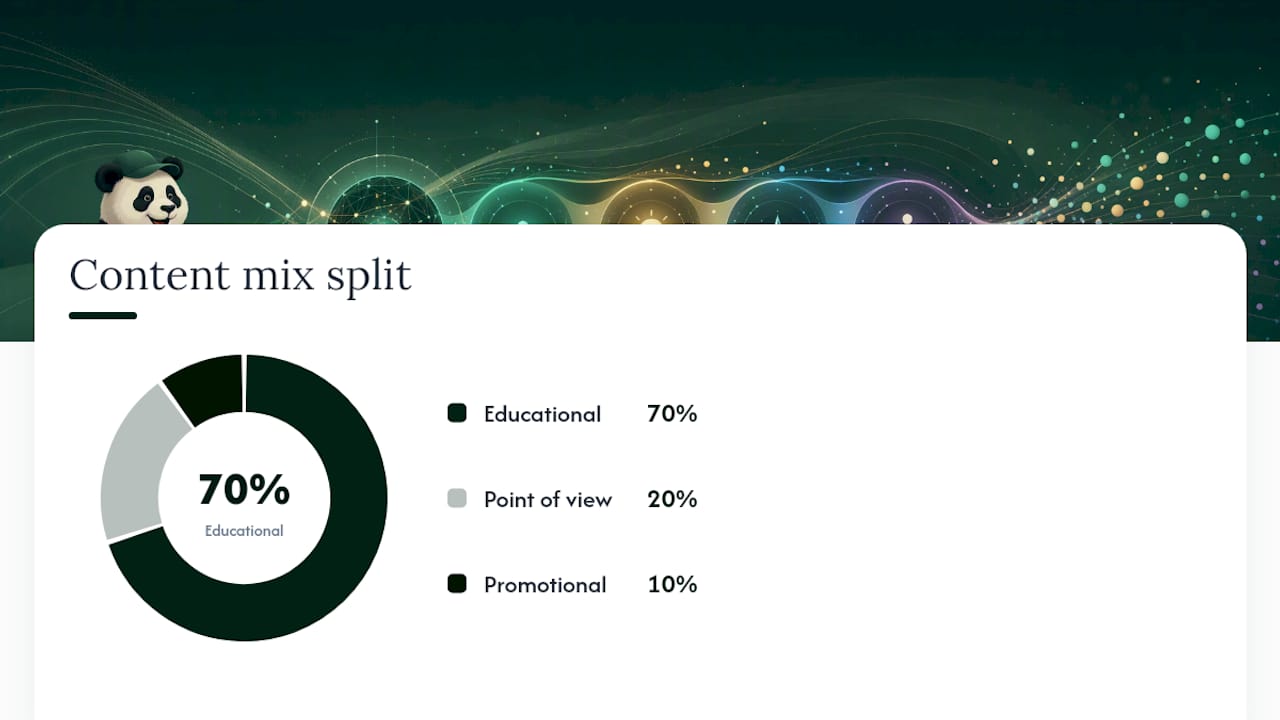
The mix that keeps a program credible and sustainable over multiple years leans heavily educational. A widely used 70-20-10 content split allocates roughly 70% to educational material that helps the audience regardless of whether they buy anything, 20% to sharper point-of-view content that stakes out a position, and 10% to company news or promotional material. Flip that ratio and the audience tunes out fast.
Channel fit follows the same logic. LinkedIn remains the primary distribution channel for executive voice because it rewards personal accounts over company pages. Owned long-form content, published on your own domain, does double duty: it feeds search and it feeds AI answer engines that need retrievable, well-structured source material. Email newsletters do neither of those jobs well, but they build the kind of direct relationship that survives an algorithm change, which makes them worth the lower reach.
The single biggest constraint on any executive content program is time, not ideas. Solve for that with an interview-first workflow instead of asking your CEO to write. A producer interviews the executive for 30 to 45 minutes on a specific point of view, a writer turns the transcript into a draft, and the executive reviews and edits rather than starting from a blank page. This structure typically needs three roles: a producer who runs the interview and keeps momentum, an editor who shapes the draft into something publishable, and an amplifier who handles distribution once it’s live.
AI belongs in this workflow as a diagnostic tool, not a ghostwriter. Practitioners in 2025 and 2026 increasingly use AI to scan industry data and surface patterns worth commenting on, then validate whether an idea is genuinely novel before an executive spends time on it. The human still supplies the point of view; AI just makes the research faster. This mirrors how source-grounded AI content works more broadly: AI helps verify and structure, humans decide what’s worth saying. Aligntcc’s own work on AI-assisted content workflows walks through similar pattern-detection use cases in more detail.
One 45-minute interview should generate far more than one post. Build a repurposing matrix and squeeze it:
One core long-form article for the owned blog, structured with clear headers and definition-first paragraphs for AI extractability.
Three to five LinkedIn posts, each isolating one argument from the interview.
One newsletter section summarizing the position for the direct-relationship list.
A short video clip or audio excerpt for social, pulled directly from the interview recording.
Pro Tip: Publish the long-form piece first and let the social posts link back to it. Reversing the order means your best SEO and AI-citation asset ends up as an afterthought instead of the anchor.
What Distribution Tactics Actually Get You Cited?
Content nobody sees doesn’t build authority, no matter how sharp the position. Thought leadership compounds only when a consistent point of view gets repeated across formats and channels rather than published once and abandoned. A single well-argued post rarely shifts how a market sees you; a dozen variations on the same core argument, distributed over months, usually does.
Prioritize channels based on where your mapped audience segments actually spend attention, not where your team feels most comfortable posting. A buyer-heavy audience often lives on LinkedIn and in inboxes. An analyst-heavy audience responds better to bylined articles in trade publications and direct pitches to reporters covering your category.
A short, specific pitch beats a long one every time reporters get asked to cover something. Structure it in three lines: the news hook (why now), the unique data or angle only you have, and one sentence on why your executive is the right person to comment. Founders who publish consistently under their own name and respond quickly to reporter requests earn disproportionate earned coverage relative to teams that wait for reporters to come to them.
Employee amplification is the cheapest distribution channel most companies ignore. A simple checklist works better than a mandate:
Send the finished piece to relevant employees before it goes live, not after.
Draft one suggested comment or share caption they can personalize, never copy-paste verbatim.
Track which employees consistently amplify and involve them earlier in the capture process.
Thank and credit amplifiers publicly; it costs nothing and compounds participation.
Paid promotion earns its budget once a piece has already proven organic traction, not before. Boost a post that’s outperforming your baseline engagement to extend its life among a specific audience segment. Partnerships work similarly: co-publishing with an adjacent brand or a partner like Pilotdeck’s distribution guidance suggests can put your position in front of an audience you haven’t earned organically yet.
Map your two or three priority channels to the audience decision map you built earlier.
Draft the reporter pitch template and keep it on file for reactive opportunities.
Set up the employee amplification checklist before your next major publish.
Reserve paid budget for pieces that have already shown organic traction.
Which Metrics Actually Tie Thought Leadership to Revenue?
Most programs measure the wrong layer first. Executive programs that connect thought leadership to real business value use a four-tier metric stack: pipeline impact, position recognition, audience growth, and content distribution, in that priority order. Most teams report the bottom layer, engagement and follower counts, because it’s easiest to pull, then wonder why finance doesn’t take the program seriously.
Programs that lead their reporting with pipeline impact rather than engagement numbers are the ones that survive budget season.
Pipeline impact means tracking whether deals in your CRM had contact with your content before closing, and whether influenced deals close at a higher rate or shorter cycle than deals with no content touch. Position recognition means tracking unprompted mentions, inbound speaking or advisory invitations, and whether your named position shows up when someone asks an AI assistant about your category.
A practical dashboard should track:
Leading indicators: AI citation checks (does your content surface when you query major AI tools about your position), inbound press mentions, unsolicited inbound inquiries referencing specific content.
Lagging indicators: pipeline dollars influenced, win-rate difference between touched and untouched deals, sales cycle length comparison.
Audience growth: qualified follower growth in your mapped segments, not raw follower count.
Distribution health: publishing consistency against your planned cadence, repurposing yield per core asset.
Report monthly on leading indicators and quarterly on lagging ones, since pipeline data needs a full sales cycle to mean anything. Expect three to six months before recognition metrics move meaningfully, and six to twelve months before pipeline attribution becomes statistically useful.
What Does the First 12 Months Actually Look Like?
Weeks 1 through 4 are foundation work: run the positioning and evidence workshops, draft the strategy document, and get executive sign off. Months 2 and 3 build the engine: hire or assign the producer and editor roles, run your first three capture interviews, and publish the first repurposing cycle. Months 4 through 12 are about scaling cadence and optimizing based on what the metric stack tells you.
Weeks 1 to 4: positioning workshop, evidence inventory, strategy document, sign-off.
Months 2 to 3: assign roles, run first capture interviews, publish first content cycle, set up the dashboard.
Months 4 to 6: establish steady cadence, review leading indicators monthly, adjust channel mix.
Months 7 to 12: scale distribution, add paid amplification where organic traction proves itself, report pipeline impact.
Roles matter more than headcount. A lean setup works with four functions covering it: an owner (usually the CMO) who protects the strategy document, a producer who runs capture interviews, an editor who shapes drafts, and a distribution lead who manages channels and amplification.
Executive time commitment: roughly 2 to 4 hours per month for interviews and review, once the workflow is running.
Producer and editor time: often a significant fraction of one role each, depending on publishing cadence.
Distribution lead: part-time is workable in year one for most mid-sized programs.
Budget ranges vary widely by staffing choices; it is recommended to establish milestones such as scaling only after consistent cadence is proven and approving paid amplification based on organic traction.
What Mistakes Quietly Kill Most Thought Leadership Programs?
Four traps account for most failed programs. Praise addiction happens when a team starts chasing likes instead of the pipeline metrics that actually matter, and the content quietly drifts toward safe, agreeable takes. Consensus creep sets in when every post gets watered down by committee review until the original defensible position disappears. Delegation blur happens when nobody remembers whose voice the content is supposed to represent, so it reads like nobody in particular. Confusing volume with authority means publishing constantly without ever revisiting whether the underlying position still holds up.
Fix praise addiction by reporting pipeline metrics before engagement metrics, every time.
Fix consensus creep by limiting sign-off to one named executive plus the strategy document owner.
Fix delegation blur by keeping the interview-first workflow, so the executive’s actual voice anchors every piece.
Fix volume chasing by scheduling a quarterly evidence-inventory review, not just a content calendar review.
Pro Tip: If you can’t remember the last time your executive said something that made a colleague uncomfortable, pause and revisit the position. Comfortable content rarely gets cited.
Pause and revisit your evidence inventory whenever a core case study goes stale, a client relationship ends, or the market shifts enough that last year’s data no longer supports this year’s claim.
How Does Aligntcc Apply This Framework in Practice?
Some agencies build thought leadership programs by pairing brand discipline that favors a narrow, defensible position with fast iteration methodologies. AI may enter the process as a diagnostic layer, surfacing patterns in market data rather than replacing the executive’s actual point of view. You can see how that approach to brand strategy and execution plays out across client work.
Before choosing any partner for this work, ask a few diagnostic questions: Does the agency insist on a written strategy document before producing content? Does it treat AI as a research tool or a content generator? Can it show how a past program tied content to pipeline, not just engagement?
Does the agency require an evidence inventory before drafting anything?
Does it protect one executive’s voice, or dilute it through committee review?
Does its reporting lead with pipeline and recognition, or with likes?
Why Does Cross-Functional Buy-In Make or Break the Strategy?
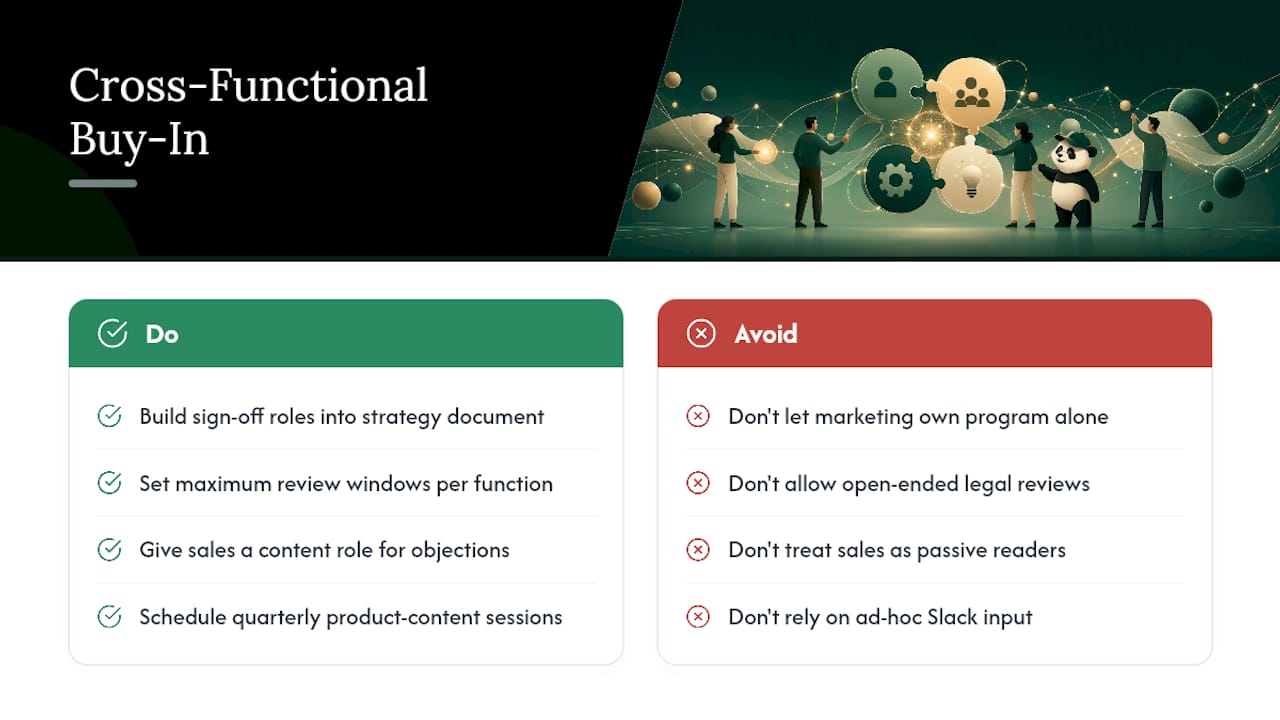
A thought leadership program that lives only inside marketing rarely survives its first budget review. Sales needs to flag which prospects are actually reading the content before it closes deals. Product needs to confirm technical claims before they go public. Legal and communications need a fast review path that doesn’t turn a two-day publishing cycle into a two-week one.
Build this into the strategy document itself rather than negotiating it project by project. Name who signs off on technical accuracy, who signs off on legal risk, and what the maximum review window is before a piece is considered stale. A common failure mode is legal review with no time limit attached, which means every point-of-view piece dies in committee before it reaches an audience.
Sales deserves a specific role beyond “read the newsletter.” Ask account executives which objections they hear most often, and let those objections shape upcoming content topics directly. This does double duty: it makes sales feel ownership over the program, and it guarantees the content addresses real buying friction instead of abstract industry commentary.
Product and technical teams should have a standing quarterly session with the content producer, not an ad hoc Slack thread. Feed genuine product roadmap insight into the evidence inventory before it becomes public information elsewhere. The goal isn’t consensus on every sentence. It’s making sure the people closest to the proof points are contributing to the raw material before an executive ever sits down for a capture interview.
How Should the Strategy Evolve Over Multiple Years?
A position that felt sharp in year one can go stale by year three, either because the market caught up or because your own evidence base outgrew it. Build a review cadence around this instead of waiting for the content to feel tired. Revisit the core position statement every 12 months, treating it the same way you’d treat a corporate strategy: worth defending, but not sacred.
Evolution usually shows up first in the evidence category, not the position itself. New case studies, new data, a new market you’ve entered. Feed these into the existing position before considering a full rewrite. Most programs that feel stale don’t need a new position; they need a refreshed evidence inventory behind the same one.
Team turnover is the quiet threat to sustainability. If the producer or editor who understands the executive’s voice leaves, the content noticeably drifts within one publishing cycle. Document the interview process and the executive’s actual speaking patterns, not just the strategy document, so a new team member can pick up the voice quickly rather than starting from a generic template.
Expect the channel mix to shift as well. A platform that drives strong distribution today may not in three years. Build quarterly channel reviews into the same cadence as your metric reporting, and treat channel loyalty as a tactical choice, not a strategic commitment.
How Do You Use Competitive Analysis Without Copying Competitors?
The point of competitive analysis here isn’t to match what other companies in your category are publishing. It’s to find the gap they’ve left open. Pull the last twenty pieces of thought leadership content from your three closest competitors and map what position each one is actually claiming, not just what topics they cover.
Most categories cluster around two or three overused positions: efficiency, innovation, and customer centricity, phrased slightly differently by everyone. If your competitive scan turns up the same three claims repeated with different logos, that’s your signal. The defensible position sits in the gap nobody in that cluster has claimed, backed by evidence only you can produce.
Look specifically at format and channel gaps too. If every competitor publishes generic blog posts but nobody runs original research, that’s an opening. If nobody’s executive shows up on a specific podcast circuit your buyers actually listen to, that’s a distribution gap worth more than a content gap.
Revisit this scan roughly twice a year. Positions that felt uncontested when you launched often get crowded within twelve months, once competitors notice what’s working. The goal is staying one step ahead of the cluster, not reacting to it after the fact.
What Ethical Lines Matter Most in Executive Thought Leadership?
Authenticity is the actual product here, not a nice-sounding value. A ghostwritten post is fine; a ghostwritten post presented as the executive’s unfiltered opinion, when the executive never reviewed the argument, is not. The interview-first workflow described earlier protects against this specific risk, because the executive’s actual words anchor every draft.
Evidence claims need the same rigor you’d apply to a public financial statement. A case study with rounded, unverifiable numbers erodes trust faster than publishing less content overall. If a client doesn’t go on record with specific figures, use a qualitative account instead of inventing a percentage to make the story sound sharper.
AI use deserves a clear internal policy, disclosed if your audience would reasonably expect it. Using AI to surface a research pattern or check a claim is materially different from having AI draft the opinion itself and attaching an executive’s name to it. Readers and AI answer engines alike increasingly reward attribution that’s actually accurate, not just present.
The line to hold: say something only if you’d defend it in a room full of skeptical peers, using your own name.
Is a Thought Leadership Strategy Worth the Discomfort?
Most executives underestimate how uncomfortable a genuinely defensible position feels in the first few months. If nobody has pushed back on something you’ve published, you probably haven’t said anything yet. That discomfort is the signal the strategy is working, not a reason to soften the next draft.
One governance rule earns its keep here: before publishing anything, ask whether the executive would say the same thing out loud, unscripted, to a skeptical customer. If the answer is no, the piece isn’t ready, regardless of how polished the prose reads.
Run this as a 90-day pilot before committing to a full year. Three months gives you enough capture cycles to test the position, enough publishing volume to see early recognition signals, and enough evidence to decide whether the framework fits your organization before you scale the budget around it.
— Kalle
How Can Aligntcc Help You Build This Strategy?
If you’ve read this far, you already know the hard part isn’t ideas. It’s the system: the capture workflow, the evidence discipline, the distribution muscle that turns one good interview into a year of compounding authority. That’s the gap Aligntcc closes for marketing leaders who have a real position but no infrastructure to sustain it.

Some agencies apply a four-question framework to clients, combining disciplined positioning with AI-assisted research to focus team effort on judgment rather than manual pattern-spotting. Engagements can start either with a diagnostic workshop to build positioning and evidence inventory, or a pilot program that runs the full capture-to-distribution cycle for a quarter before any ongoing commitment. These approaches aim to accommodate realistic executive time.
Explore how Aligntcc structures this work on the brand strategy and execution approach page, or look at the broader B2B marketing approach if your thought leadership program needs to connect directly to demand generation. When you’re ready to talk through your specific position and audience, start a conversation with Aligntcc about what a diagnostic workshop would look like for your team.
Sources
How to develop your personal leadership brand — Russell Reynolds Associates
11 thought leadership tactics to help you stand out in 2026 — Forbes
Thought leadership strategy: A practical guide for founders in 2026 — Pilotdeck
Recommended
Marketing Leaders: Four Question Thought Leadership Strategy with AI
THE POINT
Marketing Leaders: Four Question Thought Leadership Strategy with AI
KEY TAKEAWAYS
01
12 month playbook for marketing leaders: a four question thought leadership strategy—position, audience, evidence, infrastructure—with AI validation to...
02
12 month playbook for marketing leaders: a four question thought leadership strategy—position, audience, evidence, infrastructure—with AI validation to...
03
12 month playbook for marketing leaders: a four question thought leadership strategy—position, audience, evidence, infrastructure—with AI validation to...
RELATED INSIGHTS

LET’S TALK
What are you trying to grow next?
Brand, launch, market entry or performance. Book 30 minutes and tell us what you’re working on.