Growth / Performance
Kalle Mobeck
•

90–180 Day Revenue First US Market Entry Plan for Executives
Most executives face a binary choice on US market entry: move fast with an outsourced sales team or an employer-of-record arrangement, or commit to a Delaware C-corp for full legal control. Timeline, capital, and your need for a US legal presence decide which path wins. Start with a 30 to 90 day test: secure an EIN, open a bank introduction, and fund a modest test budget before you sign anything permanent.
TL;DR:
An outsourced sales contract or employer-of-record arrangement enables quick US market entry, often within two weeks or around 45 days for initial sales, with lower upfront costs.
Full Delaware C-corp formation typically takes three to nine months and involves higher legal and accounting expenses, but grants complete control over contracts and operations.
Registering for an EIN and conducting foreign qualification are essential steps before sales, with bank onboarding delays sometimes adding multiple weeks to the process.
Industry-specific registrations, sales tax nexus management, and compliance filings are critical to avoid delays, audits, or legal issues upon entering the US market.
Starting with a clear cap on capital and a fixed timeline for testing demand helps prevent indefinite extensions and ensures disciplined market validation.
AligntccBuild A Sharper US Market Entry StrategyAlign TCC helps fast-growing companies develop targeted commercial strategies for market-specific execution and stronger brand impact.Explore Align TCC
Table of Contents
What Are the Main US Market Entry Strategies?
Which US Market Entry Strategy Fits Your Business?
What Regulatory Steps Come Before Your First US Sale?
How Should You Sequence US Operations After Setup?
Building a Go-to-Market Plan That Actually Converts
What Does US Market Entry Really Cost, and How Long Does It Take?
What Risks Should Executives Watch Before Scaling in the US?
How Align TCC Runs a US Market Entry Pilot
What Leadership Actually Determines a US Launch’s Outcome
Ready to Run Your US Market Entry Pilot?
Sources
FAQ
What Are the Main US Market Entry Strategies?
There’s no single “right” way to enter the US, and pretending otherwise is how executives burn six figures before their first sale. Each strategy trades speed against control. Here’s what you’re actually choosing between.
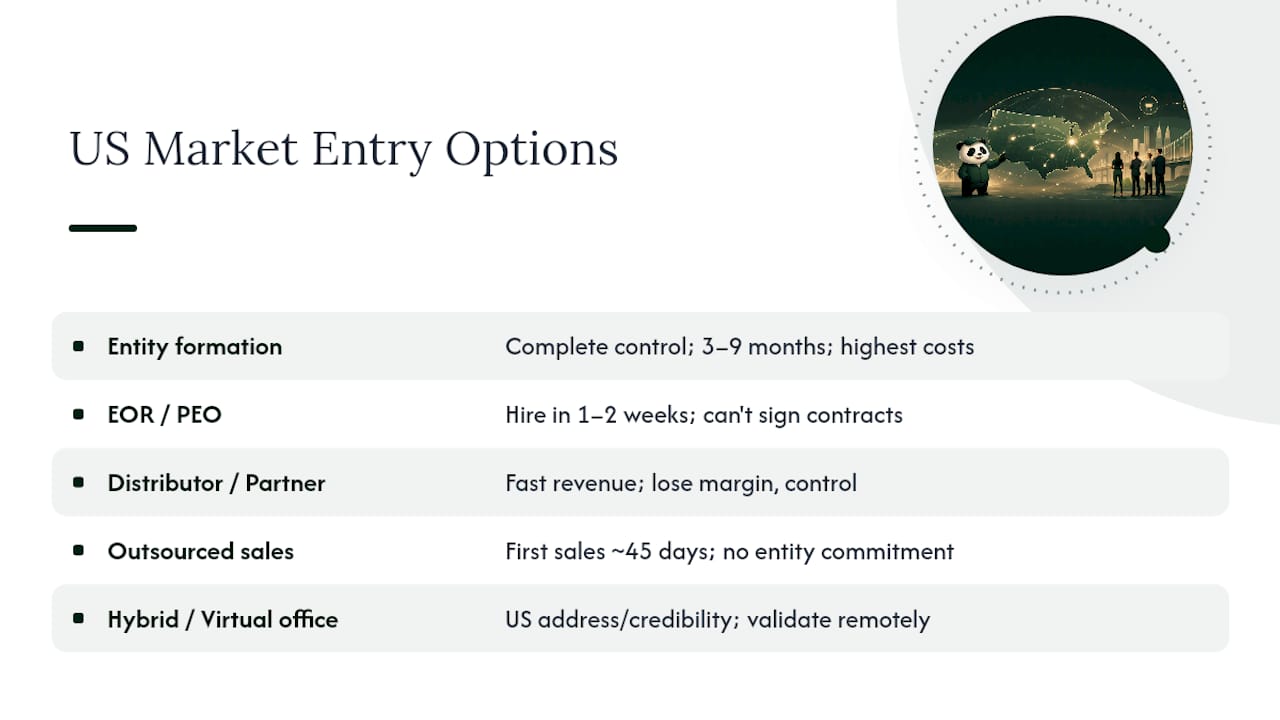
Full entity formation means incorporating, usually as a Delaware C-corp if you plan to raise US capital or sign enterprise contracts, or an LLC if you want pass-through taxation and simpler governance. This gives you complete control over hiring, contracts, and banking. It also takes three to nine months and carries the highest upfront legal and accounting costs.
Employer of Record (EOR) or PEO arrangements let you hire US-based staff without forming a legal entity. An EOR becomes the legal employer of record while you direct the work, which gets you a salesperson or country manager on the ground in one to two weeks. The tradeoff: you can’t sign contracts directly in the entity’s name, and per-employee fees add up fast if you scale headcount.
Distributor, partner, or reseller models hand off market access to a company that already has shelf space, buyer relationships, or a sales force. You reach revenue faster and skip most compliance work, but you surrender margin and lose direct control over pricing, positioning, and customer data.
Outsourced sales or dedicated sales team contracts put a US-based sales function to work under contract, without the commitment of an entity or the margin loss of a distributor. Some models report first sales in roughly 45 days.
Hybrid and virtual-office approaches combine a US mailing address or coworking membership with remote leadership, giving you US credibility on paper while you validate demand before committing capital.
Which US Market Entry Strategy Fits Your Business?
Choosing the right path comes down to answering three questions honestly, in order:
How fast do you need revenue? If the answer is “within a quarter,” entity formation is off the table as a starting move. EOR or outsourced sales gets you selling while the legal groundwork catches up.
How much capital can you commit before proof of demand? A six-figure entity setup with no confirmed buyer is a gamble. A five-figure test budget with an outsourced sales contract is a hypothesis you can validate.
Do you need to sign US contracts or raise US capital? Enterprise buyers, government contracts, and US venture investors typically want a US entity in place before they’ll sign anything, which changes the calculus regardless of your timeline preference.
A rough matrix: fast revenue with limited capital points to EOR plus a dedicated sales contract. Investor-readiness or multi-function operations point to entity formation, likely a Delaware C-corp. Retail-heavy categories with established buyer networks often favor a distributor relationship despite the margin cost.
Many companies sequence rather than choose once: start with an EOR to prove demand, then convert to an entity once headcount, contract volume, or investor requirements justify the cost.
Pro Tip: Set a hard capital ceiling and a calendar date for your test phase before you launch it. Companies that skip this step almost always extend the “test” indefinitely because nobody wants to call it a failure.
What Regulatory Steps Come Before Your First US Sale?
Skipping compliance groundwork is the fastest way to stall a launch that was otherwise going well. A handful of filings and registrations are non-negotiable regardless of which entry strategy you pick.
Getting an Employer Identification Number (EIN) from the IRS is usually the first move, since most US banks won’t open a business account without one. Banking delays are one of the most underestimated timeline killers in the entire process, often adding two to four weeks that founders don’t budget for.
If you form an entity in one state but operate in another, you’ll need foreign qualification in each additional state where you have a physical presence, employees, or significant sales activity. Skipping this step can void your ability to enforce contracts in those states.
Sales tax nexus rules vary by state and can be triggered by physical presence, employee location, or even sales volume thresholds. Manual tracking across even a handful of states becomes unmanageable quickly, which is why most scaling companies adopt automated tools like Avalara or TaxJar rather than trying to track rates by hand.
Industry-specific registrations add another layer entirely:
FDA registration for food, cosmetics, medical devices, or supplements
FCC certification for electronics and wireless devices
Export-control review for dual-use technology or sensitive IP
CFIUS screening if foreign ownership stakes trigger national security review
The BEA’s 2024 data shows continued strong foreign direct investment inflows into the US, confirming this regulatory friction hasn’t dampened international appetite for the market. If your leadership team needs to relocate, the USCIS E-2 treaty investor visa offers a pathway, but eligibility depends on your home country having an active treaty with the US, and it comes with specific investment and ownership conditions worth confirming with immigration counsel early.
How Should You Sequence US Operations After Setup?
Sequencing matters as much as the individual steps. Getting the order wrong creates bottlenecks that cascade into weeks of delay.
Secure your EIN first. Everything else, from banking to payroll, depends on it.
Get bank introductions moving immediately. US banks are notoriously slow to onboard foreign-owned entities, so start this the same week as your EIN application, not after.
Set up payment gateway and merchant accounts. Stripe, Adyen, and similar providers have their own underwriting timelines that run parallel to banking.
Automate sales tax tracking before your first invoice, not after your first nexus violation.
Onboard payroll or EOR arrangements once you know who your first US hires will be.
On fulfillment, resist the urge to overbuild. Most international brands start by shipping from home country inventory or a single fulfillment hub, then move to one US-based third-party logistics (3PL) provider once volume justifies the fixed costs, and only add multi-node fulfillment when order volume and delivery-speed expectations demand it.
Customer service resourcing follows a similar logic: a lean, remote-friendly team with clear service-level agreements can cover early volume, but US consumers expect fast response times, and that expectation tightens as your order volume grows.
The clearest signal to convert from EOR to a full entity is when EOR per-employee fees exceed what entity overhead would cost at your current headcount, or when a specific contract requires you to sign as a US legal entity.
Building a Go-to-Market Plan That Actually Converts
Creative that worked in your home market rarely performs the same way in US paid social, and that gap is the single most common reason international brands underestimate their launch budget. A US-recorded UGC library of 20 to 30 pieces gives you enough creative variation to test messaging, format, and hook angles without commissioning new content every two weeks.
Before scaling spend, run a CAC/LTV stress test using realistic US media costs. Executives who model based on home-market CPMs consistently underbudget. Reference BLS wage data when estimating US sales and support headcount costs, since compensation benchmarks vary meaningfully by state and role.
A repeatable test structure that many direct-to-consumer brands use:
Run a minimum six-month test window rather than judging results after four to six weeks
Budget in the $15,000 to $50,000 per month range for many brands testing paid social and search simultaneously
Sequence channels digital-first, since performance data comes back faster than traditional channels
For B2B categories, adjust the sales play itself, not just the creative. US buyers expect different proof points and a faster sales cycle than many international markets
A geo-targeted local campaign structure also helps you validate regional demand before committing to a national rollout, since US consumer behavior can vary sharply by region.
Pro Tip: Don’t judge US paid social performance against your home-market benchmarks. US CPMs run higher in most categories, and a campaign that looks “underperforming” by home-market standards may be perfectly on track for the US.
What Does US Market Entry Really Cost, and How Long Does It Take?
Budget expectations vary enormously by path, and mismatched expectations are one of the top reasons launches stall mid-year.
Entity formation typically runs from a few thousand dollars in basic legal and filing fees up to high tens of thousands once you factor in ongoing compliance, registered agent fees, and accounting. EOR arrangements charge monthly per-employee fees that scale with headcount but avoid the upfront entity cost entirely. Distributor relationships cost the least in cash terms but the most in margin, often 20 to 40 percent of retail depending on category.
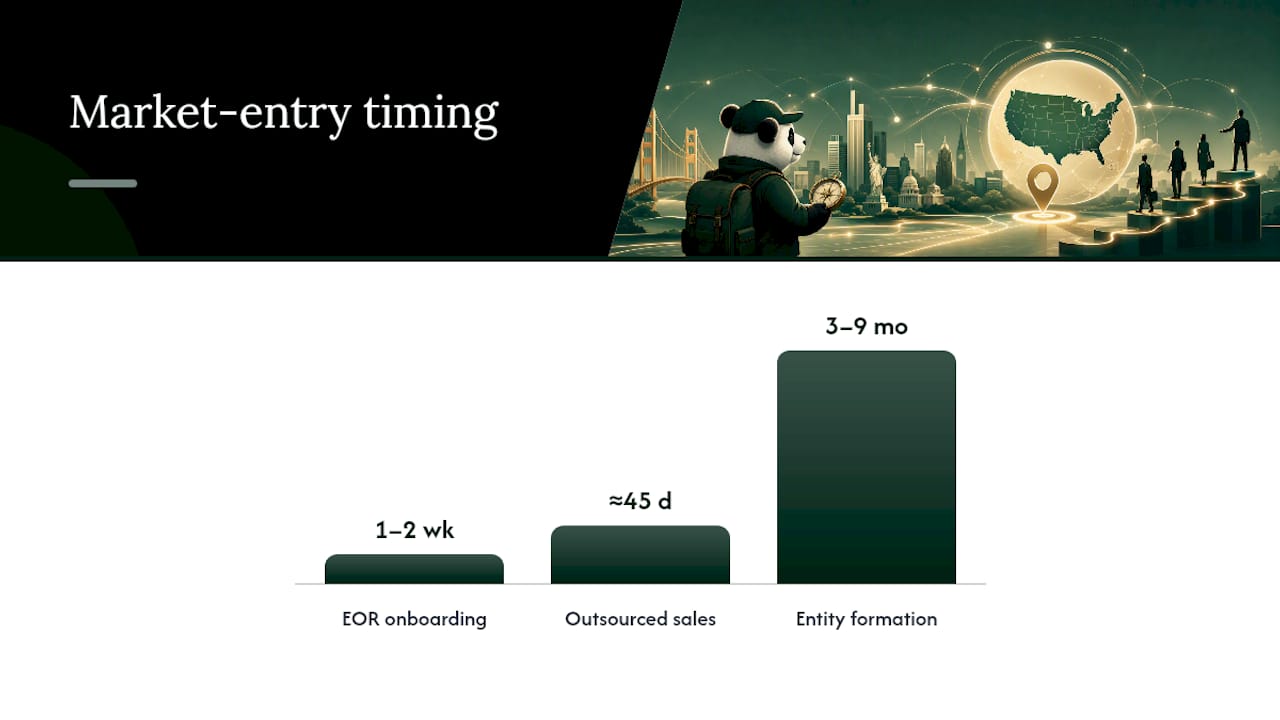
On timing, practitioner benchmarks put EOR onboarding at one to two weeks, full entity formation at three to nine months, and some outsourced-sales models reporting first revenue in roughly 45 days.
Hidden costs catch even well-prepared executives off guard: bank onboarding delays, multi-state compliance once you cross nexus thresholds in a second or third state, sales tax audits triggered by inconsistent filing, and return logistics that cost more than expected when US consumers expect free, fast returns as standard.
What Risks Should Executives Watch Before Scaling in the US?
Some risks are worth pausing for. Call specialized legal counsel before proceeding if your ownership structure, industry, or technology touches CFIUS review, export-control classifications, or unresolved IP ownership questions. These aren’t areas where a generalist can safely improvise.
On intellectual property, file provisional patent or trademark protections before you publicly launch or pitch US buyers. A first-to-file mistake is expensive to unwind later.
Practical mitigation steps that reduce failure risk:
Build supply-chain redundancy rather than relying on a single manufacturer or shipping lane
Factor tariff exposure into landed-cost models before pricing, not after
Treat “no defined test budget” and “no stop conditions” as red flags. Launches without a budget ceiling or a predetermined exit point rarely fail cleanly. They just quietly drain resources
Revisit your entry assumptions every quarter against actual sales and cost data, not projections
How Align TCC Runs a US Market Entry Pilot
Align TCC’s Prove Demand First model breaks US entry into seven workstreams covering positioning, creative production, paid media testing, sales enablement, localization, partner evaluation, and performance reporting, mapped directly against the checklist items above. Localization accelerates creative testing by generating and adapting UGC-style variants faster than traditional production cycles allow, which shortens the CAC learning loop and reduces wasted media spend during the test phase. You can review capability and client evidence directly on the site. Engagement models range from a six-week pilot to an interim chief growth officer arrangement to a full retainer-led launch, depending on how much of the execution you want to run in house versus hand off.
What Leadership Actually Determines a US Launch’s Outcome
Executives spend too much time debating entity structure and not enough time deciding who owns the decision to kill a failing test. That’s the first directive: name one person with explicit authority to shut down or pivot the US effort before you spend a dollar on it. Committees don’t kill bad launches. Individuals do.
The second: treat your US launch as a credibility signal for global stakeholders, not as validation that you’ve “arrived.” A well-run pilot, even a small one, tells investors and partners you can execute in the world’s most competitive market. A Forbes roadmap on US entry during tough conditions makes a similar point: discipline and narrative control matter as much as the underlying commercial plan. Overcommitting early to prove a point you haven’t earned yet is how good companies turn a smart test into an expensive mistake.
— Kalle
Ready to Run Your US Market Entry Pilot?
Aligntcc gives you a faster, lower-risk alternative to committing six figures to entity formation and creative production before you know what converts. The Prove Demand First model runs your positioning, localization, and paid media test as one coordinated sprint instead of a slow handoff between separate vendors, which means you get real CAC and conversion data in months, not the better part of a year.

If you’re an executive weighing whether to build this test in house or hand it to a team that’s already run the workstreams before, start with a conversation about the six-week pilot option. Review Align’s service models and reach out through Aligntcc to scope a pilot built around your specific entry path, timeline, and capital constraints.
Sources
For investment context and FDI trends, the BEA’s foreign direct investment report is the primary government source. Small businesses evaluating manufacturing incentives should review the SBA’s Made in America initiative, while SelectUSA’s matchmaking resources and the Trade cover state incentives. For visa questions, consult USCIS E-2 treaty investor guidance and travel.state.gov directly, and check FDA or FCC portals for any industry-specific registration your product category requires.
FAQ
How Do You Enter the US Market?
Most executives start with either an outsourced sales contract or an EOR arrangement to prove demand quickly, then transition to a full entity, typically a Delaware C-corp, once revenue, headcount, or investor requirements justify the cost.
What Does Market Entry Mean?
Market entry refers to the strategy and operational steps a company uses to start selling, hiring, or operating in a new country, covering everything from legal structure to go-to-market execution.
What Are the Four Main US Market Entry Strategies?
The four most common paths are full entity formation, employer of record or PEO arrangements, distributor or partner relationships, and outsourced or dedicated sales teams, each trading speed against control and cost.
What Is US Market Access?
US market access refers to a company’s practical ability to sell, hire, and operate legally in the United States, shaped by entity status, industry-specific regulatory approval, and compliance with state and federal rules.
How Long Does US Market Entry Typically Take?
EOR arrangements can have you operating in one to two weeks, outsourced sales models report first revenue in roughly 45 days in some cases, and full entity formation typically takes three to nine months.
Recommended
90–180 Day Revenue First US Market Entry Plan for Executives
THE POINT
90–180 Day Revenue First US Market Entry Plan for Executives
KEY TAKEAWAYS
01
Revenue first plan for executives entering the US: run a 30–90 day test, choose EOR or Delaware C corp, and get real CAC and conversion data with a six...
02
Revenue first plan for executives entering the US: run a 30–90 day test, choose EOR or Delaware C corp, and get real CAC and conversion data with a six...
03
Revenue first plan for executives entering the US: run a 30–90 day test, choose EOR or Delaware C corp, and get real CAC and conversion data with a six...
RELATED INSIGHTS




LET’S TALK
What are you trying to grow next?
Brand, launch, market entry or performance. Book 30 minutes and tell us what you’re working on.