•
China Ecommerce Platforms: Test Brand Fit in 90 Days
China’s ecommerce ecosystem centers on marketplaces (Taobao/Tmall, JD.com), value-driven group buying (Pinduoduo), and content-first commerce (Douyin, Kuaishou, Xiaohongshu), with WeChat commerce and cross-border routes on the side. The real decision is how your customers buy: do they search and compare, discover through content, or purchase through livestreams and local immediacy?
TL;DR:
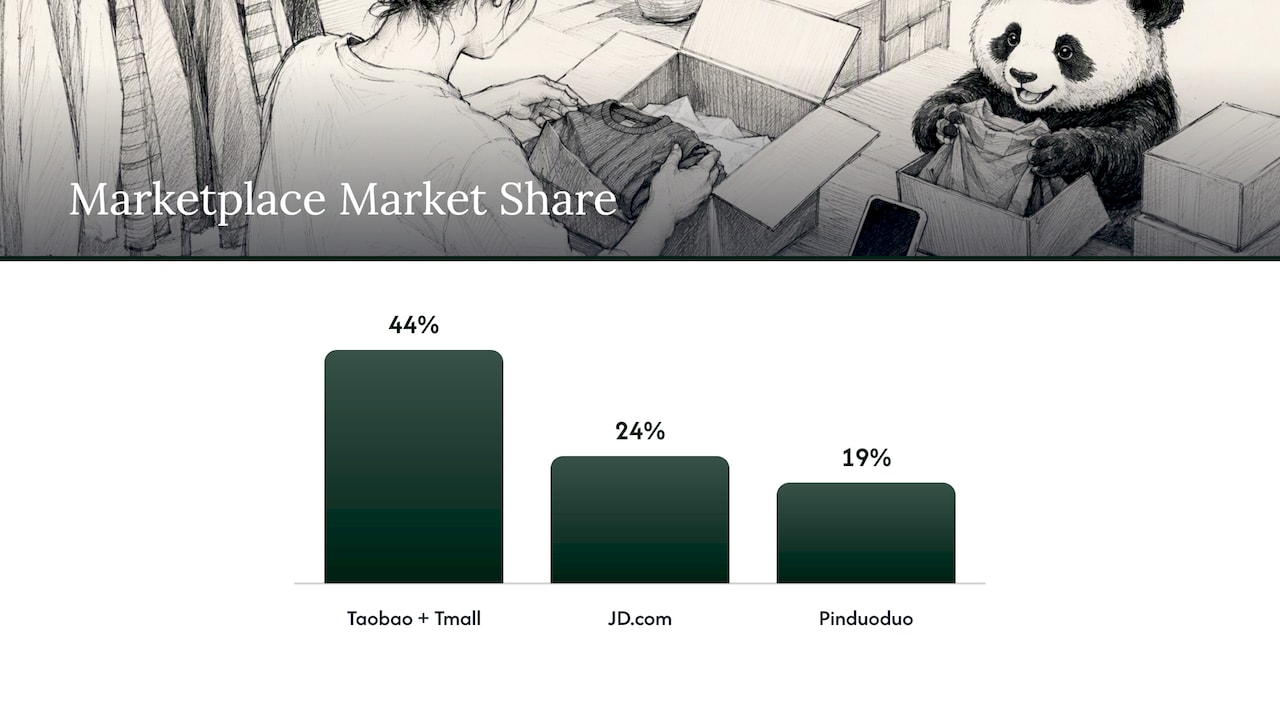
Mid 2023 figures put Taobao and Tmall at 44% share, JD.com at 24%, and Pinduoduo at 19%; treat these as scale context, not universal rankings.
Use Douyin or Kuaishou for younger shoppers and live demonstrations, Xiaohongshu for premium research, Pinduoduo for value focused buying, and WeChat for repeat customers.
Tmall Global and JD Worldwide can lower upfront commitment for overseas sellers, but product, platform, logistics, and compliance requirements still apply.
Run one channel for 90 days with preset conversion, acquisition cost, and repeat purchase thresholds; confirm payments, logistics, platform rules, and creator sourcing before launch.
Aligntccaligntcc.comFind the Right Fit for ChinaAlign TCC combines brand thinking with China market methodologies to help companies sharpen positioning and engage audiences across platforms.Explore China market support
Table of Contents
Which China ecommerce platforms matter most, and what is each best at?
How do marketplaces, social, livestream and local platforms differ?
Who shops on which platform, and which audience fits your brand?
What should foreign brands know about cross-border routes into China?
What operational essentials decide whether a platform strategy works?
Which trends are reshaping China ecommerce right now?
How do we pick a platform and run a 90-day proof-of-demand test?
What are the regulatory and compliance requirements for selling online in China?
Which marketing strategies work best on each platform?
What are the typical stages and timelines for launching in China?
Why one focused platform beats five scattered ones
Ready to test China with a clear plan?
FAQ
Sources
Which China ecommerce platforms matter most, and what is each best at?
Start with the shortlist. As of the mid-2023 figures the U.S. Commercial Service cites from Yinma Data Research, Taobao and Tmall together held 44% of market share, JD.com 24%, and Pinduoduo 19%. Those numbers use one market-share method and are not universal GMV rankings, so read them as scale context, not a verdict. Platform leadership shifts depending on whether you measure GMV, visits or category.
Here is what each platform is, in plain terms.
Taobao and Tmall: Taobao and Tmall are domestic marketplace options. Brands can consider them for marketplace and flagship-store strategies. If your customers type a product need into a search bar and compare options, this is where they do it.
JD.com: A marketplace option for brands considering electronics and higher-ticket categories. Shoppers come here when delivery reliability and authenticity matter more than the lowest price.
Pinduoduo: Discount-driven, built on social and group buying. It serves value shoppers who respond to deals and sharing mechanics. Statista tracks it among the highest-GMV marketplaces, though rankings differ by measurement.
Douyin: The leader in short-video and livestream commerce. Shoppers discover products inside entertainment, then buy without leaving the feed.
Kuaishou: Another short-video and livestream-first platform, strong on creator relationships and community trust.
Xiaohongshu (Little Red Book, also called RED): A lifestyle and recommendation community. Beauty, fashion, travel and premium lifestyle purchases often start with a saved note here.
WeChat commerce: Mini programs and official accounts turn WeChat into a private-domain channel for repeat business and customer relationships.
Vipshop: A platform brands may consider for fashion and lifestyle goods.
Suning: A retailer brands may consider for electronics and appliances.
Cross-border channels: Tmall Global, JD Worldwide and Kaola are designed for overseas brands that want faster market access without a full local setup.
The same platform can serve a very different job depending on your product. A skincare brand might use Xiaohongshu for discovery, Tmall for sales, and WeChat for customer relationships. A consumer electronics maker might consider JD.com and Douyin for its launch strategy.
One more point matters before you pick anything. The U.S. Commercial Service notes that platform specialization and media strategy are inseparable: Douyin leads short video and livestream commerce, Xiaohongshu benefits from influencer-driven recommendations, and WeChat mini programs connect commerce with a wider mobile-service ecosystem. A listing alone is rarely a go-to-market plan.
How do marketplaces, social, livestream and local platforms differ?
Platform types behave differently, and the difference changes how you attract traffic, convert buyers and spend your marketing budget. Trade agencies like the Canadian Trade Commissioner Service organize China ecommerce into categories: traditional marketplaces, social commerce, livestreaming, cross-border, new retail and local services. A single-platform launch often misses how Chinese consumers actually discover and evaluate products.
Marketplace mechanics (Taobao, Tmall, JD.com): Marketplace strategies can focus on search visibility, product range, store pages, reviews and promotions. Your job is to be findable and credible: strong product pages, competitive pricing, and participation in major sales events. Paid search placement and category visibility matter heavily.
Social commerce mechanics (Xiaohongshu, WeChat, Pinduoduo’s sharing model): Shoppers arrive without a fixed intent and get persuaded by people like them. User-generated content, community discussion, creator recommendations (often called KOLs, or key opinion leaders) and reviews do the selling. Trust matters in social commerce, where brands may use community discussion and creator recommendations.
Livestream commerce mechanics (Douyin, Kuaishou, Taobao Live): A host demonstrates the product in real time, answers questions, and creates urgency with limited offers. Conversion happens inside the stream. The U.S. Commercial Service lists Taobao, Douyin and Kuaishou among the leading livestream-shopping platforms. Categories that benefit from demonstration, like beauty, food, fashion and gadgets, tend to suit this format best.
Local and O2O mechanics (online-to-offline services): Immediacy rules. Shoppers want a product or service nearby and quickly. Last-mile delivery, store inventory and service booking are the product experience.
Why does orchestration matter? Because these mechanics feed each other. A Xiaohongshu note, a Douyin stream, a Tmall flagship and WeChat can play different roles in a customer journey. The U.S. Commercial Service points out that livestreaming, influencer recommendations, payment, customer service, logistics and platform-native content all affect conversion together.
For brand teams, the practical consequence is budget logic. Marketplace spend buys visibility for people already searching. Social and livestream spend creates demand that did not exist yesterday. Funding only one side leaves the funnel half built.
For a deeper look at how social and private-domain traffic differ, our playbook on Weibo versus WeChat breaks down reach and use cases.
Who shops on which platform, and which audience fits your brand?
Choose platforms by audience, not convenience. The easiest platform to set up may not be where your buyers spend their time.
Alibaba-backed consumer analysis in the Bain online strategic consumer groups report groups online shoppers into three clusters: Backbone, New Power and Blue Ocean. Each shows distinct channel and promotion preferences, which brands can target on platforms like Tmall and Taobao. The report also identifies ecommerce as an engine of FMCG growth.
597 million Chinese consumers had purchased through livestream commerce as of December 2023, equal to 54.7% of Chinese netizens, according to the U.S. Commercial Service. Content-led buying is mainstream behavior, not a niche tactic.
Use the clusters as a starting lens, then match them to platforms.
Gen Z and younger shoppers: Short-video platforms like Douyin and Kuaishou, where entertainment and shopping blend. Expect fast trend cycles and a strong reaction to creators.
Premium and quality-conscious shoppers: Xiaohongshu for research and inspiration, Tmall for flagship-store purchasing. These shoppers read, compare and save before buying.
Value shoppers: Pinduoduo, where price, group deals and sharing mechanics lead the decision.
Convenience seekers: JD.com for dependable delivery, plus WeChat and local O2O services for speed.
Repeat and loyal buyers: WeChat mini programs and communities, where a brand can talk directly to its own customers.
A few practical rules help the matching.
Start from the buyer, not the platform. Write down who your best customer is, how they find new products, and where they ask friends for advice.
Check price position. A premium brand dropped into a discount-led environment will fight the platform’s culture.
Match category to format. Products that need explanation or demonstration suit livestreams. Products people search by name or specification suit marketplaces.
Resist the urge to be everywhere. One well-fitted platform beats five half-served ones.
The Bain clusters come from 2019 analysis, so treat them as a framework for thinking about segments and not as current sizing. Validate your own audience with a small test before committing budget.
What should foreign brands know about cross-border routes into China?
Cross-border platforms are the lower-commitment way to test China. The EU SME Centre identifies Tmall Global, JD Worldwide, Kaola, Xiaohongshu and WeChat as the main cross-border channels for overseas sellers. It notes that cross-border ecommerce can reduce some upfront investment and commitment, but requirements still vary by product, platform, logistics model and market. It is not a blanket exemption from Chinese compliance.
The critical distinction: domestic storefronts and cross-border platforms are not interchangeable. Tmall Global and JD Worldwide are built for cross-border entry. Domestic Tmall and JD.com operations require a different operating and compliance setup. Treating them as the same thing is one of the costliest early mistakes a foreign brand can make.
Tmall Global and JD Worldwide: Cross-border storefronts for overseas brands, often with bonded or direct-mail fulfilment options.
Kaola: A cross-border import platform the EU SME Centre lists among the main channels.
Xiaohongshu: Strong for building awareness and community around imported goods, with cross-border selling options alongside content.
WeChat mini programs: Useful for overseas brands that want a direct customer relationship and have a plan for traffic.
Expect operational friction. Operators repeatedly run into customs-clearance efficiency, monitoring and supervision, tax-rebate settlement, payment risks, logistics costs and talent shortages. None of these are dealbreakers. All of them need an owner on your side before you launch.
Cross-border is best understood as a demand-testing mechanism. The EU SME Centre describes it as valuable for first access and market feedback for overseas SMEs, while the commercial case still depends on target-group fit, platform procedures, logistics and legal requirements. If the test shows real pull, scaling usually calls for a local follow-up: local entity, local fulfilment, local marketing and often a domestic storefront.
Pro Tip: Treat your cross-border launch as a learning budget. Define in advance which signals (repeat orders, search volume for your brand, creator interest) would justify a local setup, so the decision to scale is made on evidence, not enthusiasm.
Our guide to proving demand first lays out the workstreams foreign leaders should line up before committing to a full China entry.
What operational essentials decide whether a platform strategy works?
Marketing gets the attention, but operations decide the outcome. A livestream can lose a customer if an order ships late or checkout fails. Work through this checklist before launch.
Payments. Check which payment methods are available for your chosen platform and sales channel. Your platform storefront usually handles checkout, but if you build a WeChat mini program or a brand site, confirm which payment methods you can integrate and who settles funds.
Logistics model. Choose between platform-run warehousing, bonded warehousing and direct cross-border shipping. Bonded stock ships faster to the customer but requires inventory commitment. Direct shipping keeps risk low but lengthens delivery, which affects reviews and repeat purchase.
Intellectual property. Consider trademark protection in China before listing, and learn each platform’s takedown and complaint process. Brands may want to consider how they would respond to potential counterfeits or copycats. Local monitoring, either in-house or through an agent, makes takedowns faster.
Platform rules. Each platform sets its own store standards, category approvals, content guidelines and promotion terms. Read them early, because a rule violation can suspend a store during your most important sales window.
Cost categories. Budget for platform commissions or fees, advertising and creator costs, fulfilment and storage, returns handling, customer service staffing and compliance. Costs differ by platform and model, so request current rate cards instead of assuming.
Customer service. Plan how customer questions will be handled in chat. Decide who responds, in which language, and during which hours.
The U.S. Commercial Service reinforces that payment, customer service, logistics and platform-native content all affect conversion, which is why we treat operations as part of the go-to-market plan, not an afterthought.
Which trends are reshaping China ecommerce right now?
Several shifts matter for platform choice.
Livestreaming at scale. Livestream commerce has reached a large share of online shoppers, and it favors categories that benefit from live demonstration and urgency. If your product is easy to show and explain, a stream can compress the whole funnel into one session.
Short-video discovery. Douyin and Kuaishou are now traffic sources as much as sales channels. A content strategy can include a continuing stream of useful, entertaining product content rather than a one-off campaign.
Private-domain traffic. Brands can use WeChat mini programs, official accounts and communities to communicate with customers directly. This is where repeat business grows.
O2O and instant fulfilment. Shoppers may expect fast delivery for everyday goods. Local inventory or partner networks may help brands compete on fulfilment.
54.7% of Chinese netizens had purchased through livestream commerce as of December 2023, per the U.S. Commercial Service. When more than half of online users have bought this way, livestreaming belongs in every platform conversation.
What does this mean for your decision? Combine the trends instead of chasing one. Discovery content brings new buyers, livestreams convert them, private domain retains them, and fast fulfilment keeps them satisfied. Our WeChat marketing strategy playbook covers the private-domain side in detail.
How do we pick a platform and run a 90-day proof-of-demand test?
We approach platform selection the way we approach everything in market entry: prove demand before scaling spend. Our commercial strategy work combines Scandinavian brand thinking with the speed of Chinese market methods, and AI helps us move faster without replacing creative judgment.
Our framework starts with one question: which single channel best fits your audience and product? We pick one, set a limited budget, add creator or KOL support, and test.
Match audience, product and platform. Define the buyer, the buying behavior (search, discovery or live purchase) and the platform where that behavior happens.
Measure what matters. Track conversion rate, customer acquisition cost, repeat purchase and content engagement. Vanity metrics like raw views tell you little about demand.
Line up the operating checklist. Before day one, confirm your logistics partner, payment setup, platform rules and creator sourcing.
Run in 90 days, then decide. At the end, you either have evidence to scale, a reason to switch platforms, or a reason to stop cheaply.
Pro Tip: Set your pass/fail thresholds for conversion, acquisition cost and repeat purchase before the test starts. Teams that define success after seeing results tend to talk themselves into the wrong decision.
If Xiaohongshu is your likely test channel, see our guide to proving demand on Xiaohongshu. Brand positioning also shapes how a test lands, and an outside perspective such as this startup brand strategy resource from Quincy Samycia is a useful complement when you define your market position.
What are the regulatory and compliance requirements for selling online in China?
Compliance is not one rule, it is a stack. It covers product registration or filing, labeling, advertising standards, data and privacy handling, payment and tax treatment, and platform-specific store qualifications. Which items apply depends on your product category, your platform, and whether you sell cross-border or through a domestic entity.
The EU SME Centre is clear that cross-border ecommerce is not a blanket exemption from Chinese compliance. Requirements still vary by product, platform and logistics model. Categories such as cosmetics, food, health products and electronics tend to draw closer scrutiny than simple apparel.
Three habits reduce risk. First, confirm category eligibility with the specific platform before you invest in inventory. Second, check advertising and claims language, because rules for what you can say about a product are strict and platforms enforce them. Third, speak to a qualified local adviser or the relevant authority for your category, since a general guide cannot confirm what applies to your exact case. Rules change, so verify current requirements against primary government and platform sources before launch.
Which marketing strategies work best on each platform?
Each platform rewards a different playbook.
Taobao and Tmall: Search optimization, paid search placement, strong product pages and participation in major promotions. Flagship-store polish signals trust.
JD.com: Emphasize authenticity, delivery speed and detailed specifications. Detailed specifications can help shoppers evaluate higher-ticket products.
Pinduoduo: Price clarity, group-buy mechanics and bundled offers. Social sharing is the growth engine.
Douyin: Short, entertaining product videos, creator collaborations and regular livestreams. Content has to earn attention before it sells.
Kuaishou: Community-style trust building, authentic host relationships and repeat streams with loyal audiences.
Xiaohongshu: Honest, visually strong notes from creators and customers. Lifestyle context beats hard selling.
WeChat: Mini-program shops, official-account content, community groups and loyalty offers aimed at repeat purchase.
Across all of them, one rule holds: native content beats repurposed content. A video made for a Western social feed may need adaptation for Douyin. Plan creative for each platform’s format and audience.
What are the typical stages and timelines for launching in China?
Timelines vary widely by product, platform, compliance needs and logistics model, so treat these stages as a sequence, not a promise of dates.
Research and fit. Define your audience, shortlist one platform, and confirm category eligibility.
Compliance and setup. Handle trademark protection, product filings where needed, store application and payment and logistics arrangements. This stage often takes longer than teams expect.
Content and creator preparation. Build platform-native creative and line up creators or livestream hosts before launch.
Soft launch and test. Go live with limited spend, watch conversion, reviews and acquisition cost, and fix friction quickly.
Evaluate and decide. Our test gives you data to scale, adjust or stop.
Scale and orchestrate. Add platforms, local fulfilment or a domestic storefront only when the evidence supports it.
Rushing the setup stage is the most common reason launches stall. A clean start beats a fast one.
Why one focused platform beats five scattered ones
The most common strategic mistake we see is spreading too thin. Brands hear that China has many major platforms and try to be on all of them. Budgets fragment, content gets repurposed instead of built natively, and no single channel gets enough fuel to prove anything.
Our view is simple. China ecommerce platforms are not interchangeable shelves, they are different behaviors. Pick the one where your customer’s behavior already matches your product, and give it a real, measured chance. A focused 90-day test with a content plan and clear KPIs teaches you more than a year of thin presence everywhere.
The first step is small: name your buyer, choose one platform, write your pass/fail metrics. Everything else follows from that evidence.
— Kalle
Ready to test China with a clear plan?
If you want a partner to match your audience to the right platform and run a disciplined proof-of-demand test, we are ready. Our team handles commercial strategy, brand positioning, and go-to-market and market entry, so your first China platform decision rests on evidence, not guesswork. If you want to see the market firsthand, our Leadership Trips put your team inside China’s platforms and consumer behavior. Book a strategy call and we will help you pick the one platform worth testing first.
FAQ
What are the major ecommerce platforms in China?
The core set is Taobao, Tmall, JD.com, Pinduoduo, Douyin, Kuaishou, Xiaohongshu and WeChat-based commerce, with Vipshop as a notable specialist. The U.S. Commercial Service lists these as the main consumer platforms. Each serves a different buying behavior, from search to discovery to livestream.
Does China have a digital payment system?
Yes. Alipay and WeChat Pay dominate everyday digital payments, and UnionPay is also widely used. Most platform storefronts handle checkout for you, but any brand-owned shop or mini program needs its own payment integration.
Is JD bigger than Alibaba in China ecommerce?
Not by the market-share figures the U.S. Commercial Service cites: Taobao and Tmall together held 44% of market share, against 24% for JD.com, citing mid-2023 Yinma Data Research. Rankings depend on how you measure, since GMV, visits and category strength can tell different stories.
What does China have instead of Amazon?
Taobao and Tmall fill the closest role for marketplace shopping, while JD.com competes on logistics and trusted electronics. Unlike Amazon, though, China’s ecosystem also includes content-led platforms such as Douyin and Xiaohongshu, where discovery and purchase happen together.
Sources
Selling to China via Cross-Border E-Commerce | EU SME Centre
2019 Online Strategic Consumer Groups Report: Innovate for Consumers with Insights from Big Data
Recommended
RELATED INSIGHTS


LET’S TALK
What are you trying to grow next?
Brand, launch, market entry or performance. Book 30 minutes and tell us what you’re working on.