•

Corporate Narrative: Turn 3 Story Parts Into Measurable Change
A corporate narrative is the organizational story that connects purpose, people, and performance into a single account leaders can repeat with conviction. Done right, it aligns teams around shared priorities, motivates action during change, and sharpens decision-making at every level. This guide breaks down the frameworks, the step-by-step workflow, and the measurement approach that turn narrative from a slogan into strategic velocity.
TL;DR:
Use Public Narrative when leaders must mobilize people around shared values; choose the hero’s journey for a defined change with a clear before and after.
Build narratives from six elements: purpose, protagonist, challenge, stakes, action, and evidence; test drafts with a group spanning functions before adapting versions for each audience.
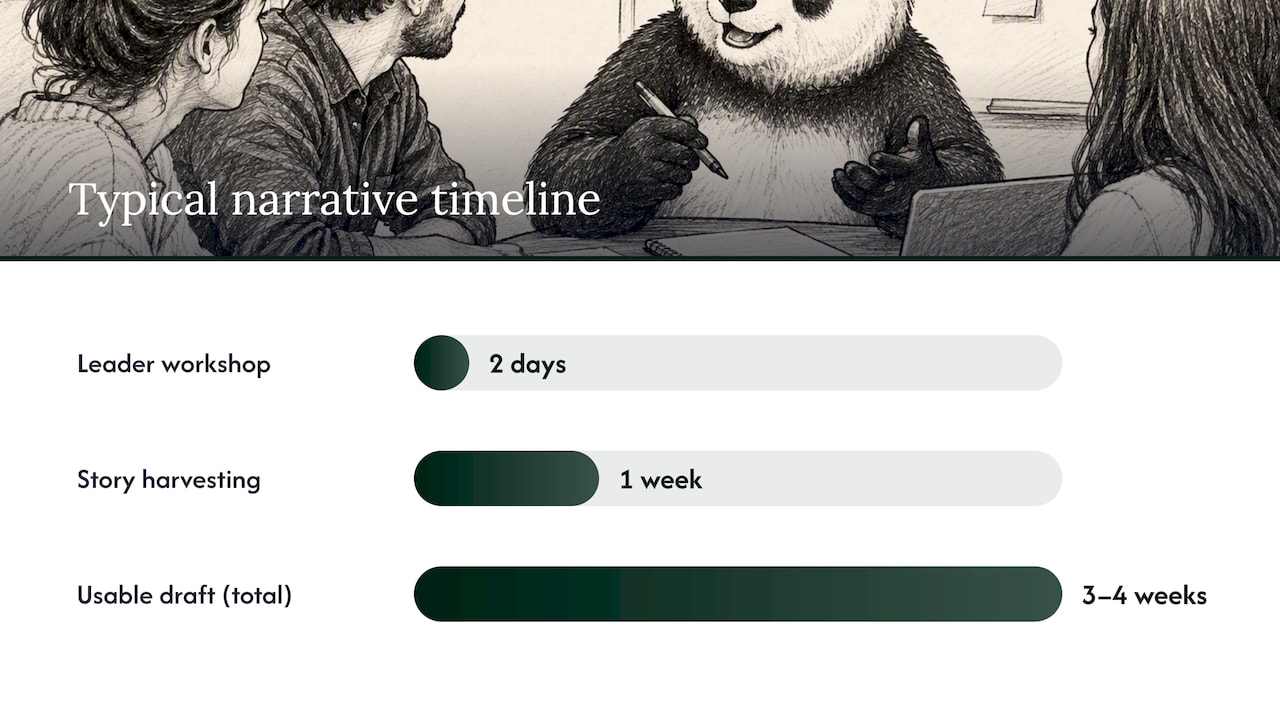
A workshop lasting two days, followed by a week of story harvesting, can produce usable narrative drafts within three to four weeks.
Track engagement and retention: authenticity correlates more strongly with employee engagement (r = 0.423) than with market reaction (r = 0.289) in ESG communications research.
Reserve a full narrative program for major change, funding rounds, or repositioning; use a single story for product launches or isolated events.
AligntccMake Your Brand Story Drive GrowthAlign TCC helps fast-growing companies sharpen their positioning and build commercial strategies that connect with audiences across markets.Explore Align TCC
Table of Contents
Why Corporate Narrative Matters for Strategy and Leadership Now
Practical Frameworks: Public Narrative, Hero’s Journey, and When to Use Each
How to Craft a Corporate Narrative: A Step-by-Step Workflow
Running Workshops and Storybanking to Activate Your Narrative
Measuring Narrative Impact and Authenticity
How Kalle and Align TCC Operationalize Narrative Work
Connecting Corporate Narrative to Brand Positioning and Commercial Strategy
Using AI to Develop and Distribute Corporate Narratives
Tailoring Narratives for Different Platforms and Audiences
Corporate Narrative Transformations at Fast-Growing Companies
Narrative’s Role in Market Entry and Go-to-Market Strategy
Aligning Leadership Communication Styles with the Narrative
When a Full Narrative Program Beats a Tactical Story
Getting Started with Align TCC on Your Corporate Narrative
FAQ
Sources
Why Corporate Narrative Matters for Strategy and Leadership Now
Strategy documents sit in folders. A narrative moves through hallways, Slack threads, and town halls, which is why it carries more weight when a company needs people to act differently. A coherent leadership narrative correlates with perceived leadership effectiveness, according to survey and interview evidence from MIT Sloan Management Review, where clarity of purpose ranked among the top factors separating effective leaders from the rest.
The same logic applies during transformation. Applying hero’s-journey-style narrative structures in corporate change programs helped leaders increase employee engagement and role clarity, based on case-based findings and interviews published in the California Management Review. The pattern holds whether the audience is internal or civic.
What a strong narrative does in practice:
Gives teams a shared reference point for prioritization when strategy gets ambiguous.
Converts abstract change initiatives into a story employees can see themselves inside.
Signals credibility to investors, partners, and talent before numbers alone can.
Reduces resistance to change by framing employees as protagonists rather than bystanders.
Practical Frameworks: Public Narrative, Hero’s Journey, and When to Use Each
Two frameworks dominate serious narrative work, and leaders rarely need more than these to get started.
Public Narrative, developed and taught through the Bloomberg Harvard City Leadership Initiative, structures a leader’s story into three linked parts: Story of Self (why you were called to act), Story of Us (the shared values connecting you to your audience), and Story of Now (the urgent choice facing the group today). It is a teachable leadership practice built on coaching, peer feedback, and repeated practice, and it is the structure behind public-sector wins like a South Bend civic workshop that helped secure a multimillion-dollar library investment.
The hero’s journey compresses the classic call-to-adventure arc into a change-management tool: the organization faces a disruption (the call), struggles through uncertainty (the trials), and emerges transformed (the return). It works best when employees need to see personal stakes in a transformation program, not just business logic.
Use Public Narrative when you need leaders to mobilize people around a shared cause or values shift.
Use the hero’s journey when you are managing a specific change program with a clear before-and-after.
Blend both when a CEO needs a personal origin story that also frames a company-wide transformation.
Pro Tip: Draft your Story of Self in one page before touching slides. A narrative that cannot survive without visuals is not yet a narrative.
How to Craft a Corporate Narrative: A Step-by-Step Workflow
Every durable corporate narrative is built from the same six blocks: purpose, protagonist, challenge, stakes, action, and evidence. Skip one and the story reads as marketing copy instead of a call to action.
Map your stakeholders. Identify which audiences (employees, investors, customers, regulators) need a version of the narrative and what each group cares about most.
Map the emotional terrain. Note where each audience feels uncertainty, pride, or fatigue; this tells you which emotional register the story needs to hit.
Harvest real stories. Interview frontline employees, customers, and leaders for specific moments that illustrate the challenge and the stakes. Generic claims do not survive scrutiny.
Draft the narrative. Write the Story of Self, Us, and Now (or the hero’s journey arc) using the material harvested, not hypothetical scenarios.
Test it on a small audience. Run the draft past a cross-functional group and watch for where attention drops or confusion rises.
Scale and adapt. Build audience-specific versions: an executive narrative for board decks, an employee narrative for town halls, an investor narrative for IR materials.
A two-day leader workshop (personal storytelling and drafting on day one, audience mapping and coaching on day two) followed by a week of story harvesting typically produces usable narrative drafts within three to four weeks, a cadence documented in Bloomberg Harvard’s public narrative resources.
Pro Tip: Write the investor version last. Once the employee and executive narratives hold together, the investor narrative becomes a matter of trimming, not inventing.
Narratively rich messages, even in CSR contexts, improve character identification and audience transportation without hurting credibility, according to a controlled experiment of 659 participants published in a study on narrative persuasion. Richness helps the story land. It does not replace the evidence behind it.
Running Workshops and Storybanking to Activate Your Narrative
A narrative drafted once in a conference room dies in a conference room. Activation requires a repeatable workshop structure and a system for storing the raw material.
The coaching cycle behind Public Narrative, explain, model, craft and share, debrief, maps directly onto corporate workshops: leaders draft their Story of Self, practice it with peers, get feedback, and revise. This pedagogy, documented by Bloomberg Harvard’s city leadership program, works equally well with a leadership team as it does with civic organizers.
Once stories are harvested, they need a home. Storybanking, treating stories as reusable assets, requires a searchable taxonomy and clear ownership, an approach described in practitioner material tied to a Stanford Graduate School of Business case study on narrative capture in extractive industries.
Tag each story by audience, use case, emotional tone, and supporting evidence.
Assign an owner who clears sensitive details with legal and investor relations before reuse.
Feed the storybank into internal comms, sales enablement, and leadership development programs, not just press releases.
A practical primer on activating employees as storytellers sits in Align’s employee advocacy playbook, useful once the storybank is populated and ready to circulate.
Measuring Narrative Impact and Authenticity
Leaders often ask whether a narrative is working before they ask what “working” means. Start with concrete signals rather than vibes.
Track message recall in pulse surveys after town halls or all-hands meetings.
Watch behavioral markers: adoption rates, support ticket tone, internal mobility within change programs.
Monitor earned and social signals, including employee advocacy volume and sentiment.
Run short A/B tests on narrative framing before a full rollout.
Communication authenticity correlates more strongly with employee engagement (r = 0.423) than with short-term market reaction (r = 0.289), according to the DAEM authenticity framework validated in ESG communication research. The implication for comms teams is direct: authenticity work pays off internally long before it shows up in stock price, so measure engagement and retention, not just media coverage.
For ESG-adjacent narratives specifically, a structured integration approach helps keep authenticity metrics from drifting; see Align’s sustainability communications guidance for a step-by-step embedding process.
How Kalle and Align TCC Operationalize Narrative Work
Corporate narrative only earns its keep when it survives contact with a real organization, not just a workshop room. That is the standard we hold our own work to.
We pair Scandinavian brand thinking with the commercial speed of Chinese market methodologies, so narrative work connects directly to go-to-market timelines rather than sitting as a separate brand exercise.
We use AI to accelerate drafting, testing, and localization of narrative material while keeping human judgment in the creative decisions that matter.
We run leadership trips that put executives inside the markets their narrative is meant to resonate with, turning abstract audience research into firsthand observation.
Engagement typically moves through discovery, a narrative workshop, and a pilot rollout before scaling across functions.
More on how we approach this work sits on our company story page.
Connecting Corporate Narrative to Brand Positioning and Commercial Strategy
A narrative that lives apart from brand positioning becomes internal theater, memorable in the room and forgotten by the next quarterly review. The two need to share the same spine.
Brand positioning answers what you offer and why it matters to a buyer. Corporate narrative answers why the organization exists and why now is the moment to act. When these align, a sales deck and a town hall speech sound like they came from the same company, because the underlying Story of Now, the market shift or internal challenge driving urgency, is identical in both.
This matters most during a reposition. If a company is shifting from a legacy product line toward a new category, the commercial strategy needs a narrative explaining why the shift makes sense now, not just a press release announcing the pivot. Employees selling the new positioning need the same Story of Us that investors hear, or the market will sense the disconnect faster than any competitor could exploit it.
Practically, this means narrative work should sit inside the same strategy sessions as pricing, positioning, and go-to-market planning, not downstream of them as a communications afterthought. The protagonist in your narrative (often the customer, sometimes the company itself) should match the persona your commercial strategy is built around. When a CFO hears the same framing an account executive uses on a sales call, the narrative has done its commercial job.
Using AI to Develop and Distribute Corporate Narratives
AI tools now handle much of the drafting and distribution labor that used to slow narrative work down, which frees leadership time for the judgment calls that actually require it.
On the development side, AI can draft multiple versions of a narrative arc from the same raw interview material, test phrasing against different audience personas, and flag where a story’s emotional beats fall flat before it reaches a live audience. This does not replace the harvesting step. The raw stories still need to come from real employees and customers, but AI shortens the distance between harvested material and a usable draft.
On distribution, AI-assisted platforms can adapt a single narrative into formats suited to LinkedIn posts, investor one-pagers, and internal newsletters without starting each from scratch. Practical frameworks for applying storytelling data to engagement are covered in a guide on boosting brand engagement, useful for teams building a distribution calendar around a core narrative.
We treat AI as a creative accelerant rather than a replacement for judgment: it speeds up drafting and localization across markets, but the emotional calibration, what resonates in a specific market or with a specific leadership team, still needs a human hand on the final cut. That balance is what separates a narrative that feels authentic from one that reads like it was generated for a content calendar.
Tailoring Narratives for Different Platforms and Audiences
The same Story of Now sounds different in a board deck than it does in a 90-second LinkedIn video, and treating every platform identically is the fastest way to flatten a narrative’s impact.
Executive audiences want brevity and stakes stated early. A board narrative should open with the Story of Now, the urgent choice, and only then move to the Story of Self or Us for context. Employee audiences need more emotional texture and more direct address, since the goal is identification, not just information. Investor audiences sit between the two: they want stakes and evidence stated plainly, with narrative richness used sparingly to maintain credibility, consistent with findings on narrative persuasion in CSR messaging where credibility remained the strongest predictor of audience attitude even as richness increased engagement.
A practical brand messaging framework for mapping these audience-specific versions back to a single narrative spine is laid out in a guide on brand messaging structure, useful when a comms team needs to keep multiple platform versions consistent without rewriting the core story each time.
Platform format matters too. A narrative built for a five-minute town hall needs trimming for a 60-second social clip, but the trimming should remove detail, not the protagonist or the stakes. If a short-form version loses the audience’s sense of who the story is about, it has lost the narrative, not just the length.
Corporate Narrative Transformations at Fast-Growing Companies
Fast-growing companies face a specific narrative problem: the story that worked at ten employees rarely survives at two hundred without deliberate reshaping.
Early-stage narratives tend to center the founder as protagonist, which works when the company is small enough that the founder’s story is the company’s story. As headcount grows, that narrative needs to shift toward a Story of Us that includes the people who joined later, or new employees will feel like they are living inside someone else’s origin story rather than building their own chapter of it.
The hero’s-journey structure applied to corporate change programs, documented in case-based research from the California Management Review, shows why this reshaping matters: employees who see themselves as protagonists in a transformation show higher engagement and lower resistance than those positioned as passive recipients of a change decided elsewhere. Fast-growing companies that successfully reshape their narrative tend to do it deliberately, timing the shift to coincide with a funding round, a leadership change, or a product pivot rather than letting the story drift until it feels stale.
Investor relations work during this growth phase benefits from narrative discipline too. Starting investor communications planning six to twelve months before a major corporate event, as outlined in Align’s IPO communications guidance, gives a growing company time to test its evolving narrative with investors before the story has to hold up under public scrutiny.
Narrative’s Role in Market Entry and Go-to-Market Strategy
Entering a new market without a localized narrative is one of the most common and avoidable go-to-market mistakes a growing company makes. A narrative built for one market’s values and pain points rarely transfers directly to another.
The Story of Now, the urgent market shift driving your relevance, changes by geography. A company’s narrative in a mature market might center efficiency and cost savings, while the same company entering an emerging market might need to center access or capability building instead. Getting this wrong does not just weaken marketing copy, it signals to local partners and customers that the company has not done its homework on what actually matters there.
This is where market immersion earns its place in narrative work. Leadership teams who spend time in a target market before finalizing a go-to-market narrative tend to catch cultural misalignments that desk research misses, whether that is a tone mismatch, a competitive blind spot, or an assumption about buyer behavior that does not hold locally. Narrative testing should happen alongside pricing and channel testing, not after the go-to-market plan is already locked.
For companies entering markets where investor and regulatory audiences are watching closely, the same narrative discipline used in IPO preparation (starting early, testing with real audiences, aligning executive and investor versions) applies just as directly to a market entry story aimed at local partners and regulators.
Aligning Leadership Communication Styles with the Narrative
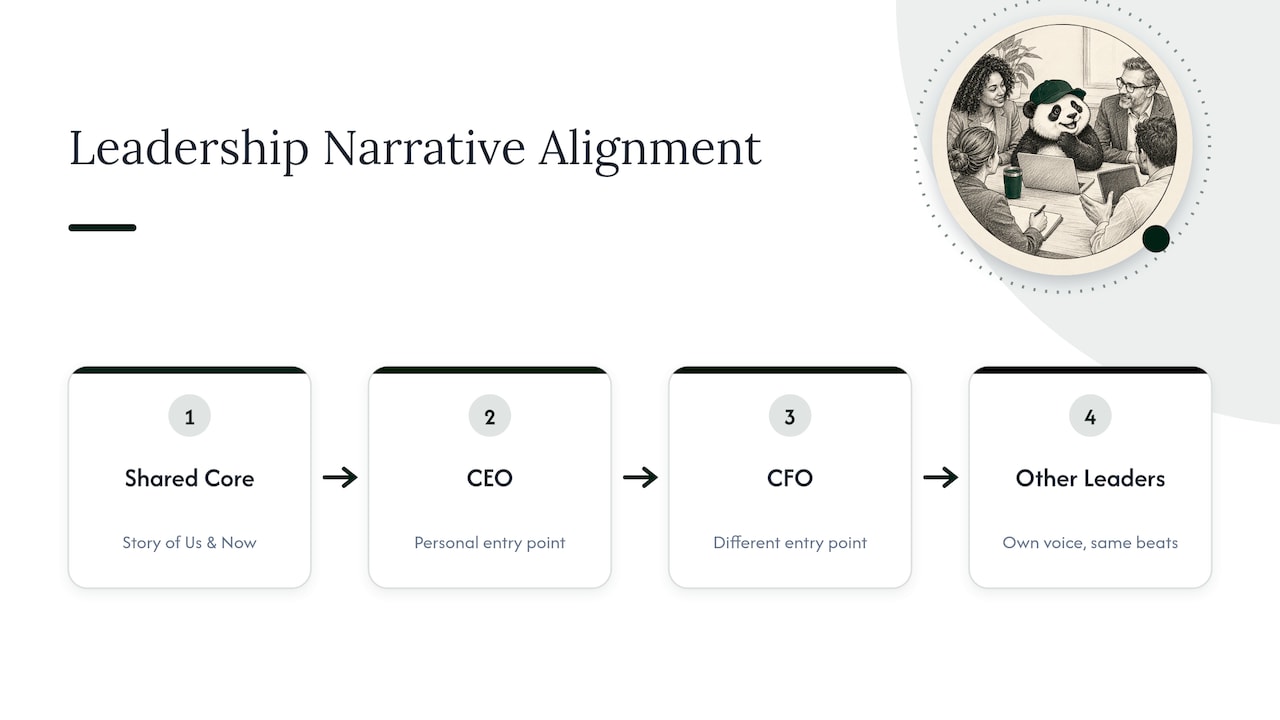
A narrative only holds together if every leader telling it sounds like themselves while still hitting the same core beats, and that balance is harder to achieve than it sounds.
The fix is not a script. Scripts produce leaders who sound identical and therefore sound like none of them mean it. Instead, give each leader the same Story of Us and Story of Now, the shared values and the shared urgency, and let each build their own Story of Self around it. A CEO’s personal entry point into the company’s challenge will differ from a CFO’s, and that difference is a feature, not an inconsistency, as long as the shared elements stay fixed.
Coaching cycles built on the Public Narrative pedagogy, explain, model, craft and share, debrief, work well here because they train leaders to internalize the shared structure rather than memorize shared language. A leadership team that has been through this coaching together tends to stay aligned under pressure, during a crisis response or an unplanned media moment, because the structure is practiced, not scripted.
Regular narrative refreshers matter too. A Story of Now that was accurate a year ago may be stale today, and leadership teams that revisit their shared narrative quarterly catch drift before it becomes visible to employees or the market.
When a Full Narrative Program Beats a Tactical Story
Invest in a full program when you are managing major change, a funding round, or a repositioning that touches every audience. Use a tactical, single-story burst for a product launch or a one-off event. Match the resourcing to the stakes, not the size of the company.
— Kalle
Getting Started with Align TCC on Your Corporate Narrative
We build corporate narratives that hold up under commercial pressure, not just in a workshop room. Our services span Commercial Strategy, Brand & Positioning, and Go-to-Market & Market Entry, each one built to connect narrative directly to measurable growth.

Most engagements start with a discovery session, move into a narrative workshop, and scale through a pilot before rolling out across functions. If market immersion would sharpen your Story of Now, our Leadership Trips put your team inside the market itself. Reach out through our services page to start the conversation.
FAQ
What are the four types of narratives?
Narrative theory generally identifies four structural modes: linear, nonlinear, parallel, and viewpoint-driven narratives, each organizing events differently in time or perspective. In a corporate context, most leadership narratives use a linear or viewpoint-driven structure, since clarity and a single protagonist tend to land better with busy audiences than nonlinear framing.
What are the 5 C’s of business storytelling?
Definitions vary across practitioners, but a common version includes character, conflict, context, curiosity, and consistency as the core elements a business story needs to hold attention. The specific labels differ by source, so treat the five C’s as a checklist of narrative qualities rather than a fixed framework.
What is a business narrative example?
A business narrative example is a company’s Story of Now: an account of a specific market shift or internal challenge that explains why urgent action matters today, built using frameworks like Public Narrative’s Story of Self, Us, and Now. A hero’s-journey version might frame a company’s digital transformation as a journey from disruption through struggle to a stronger operating model, a structure studied in corporate change management research.
What are 5 examples of narrative writing?
Common narrative writing forms include personal essays, case studies, origin stories, change-management stories, and customer success stories. In corporate settings, the most frequently used forms are the leadership origin story (Story of Self), the customer success story, and the change narrative used during transformation programs.
Sources
Recommended
RELATED INSIGHTS



LET’S TALK
What are you trying to grow next?
Brand, launch, market entry or performance. Book 30 minutes and tell us what you’re working on.