•
3 Month B2B Executive Profiling PR That Shows Results by Month Six
Executive profiling PR builds a leader’s visibility, credibility, and influence on buying decisions through earned media, bylined articles, speaking placements, and LinkedIn presence, and we see it work best when teams treat it as a discipline, not a press release. A focused pilot runs about three months, with measurable shifts in share of voice and engagement by month six. We built our approach around this timeline, combining executive presence frameworks with AI monitoring to keep the program honest.
TL;DR:
A pilot often lasts three months, with measurable visibility and engagement shifts by month six; full retainers typically run six to twelve months.
Map priority audiences and legal or investor relations risks before pitching, and require counsel and investor relations approval for public company or fundraising executives.
Tie each byline, talk, and social post to a defined buyer or investor audience and a business event; relevance matters more than placement volume.
Track target audience placements, relevant job title engagement, and inbound leads through tagged assets and sales handoffs instead of raw coverage counts.
Before signing, request a sample message map and executive writing sample, confirm deliverables and approval timelines, and reject guaranteed earned media placements.
AligntccBuild a More Distinctive Executive ProfileAlign TCC helps fast-growing companies sharpen brand positioning and create audience-focused marketing strategies across platforms.Explore Align TCC
Table of Contents
What Executive Profiling Actually Delivers
Core Services and Deliverables to Expect in a Scope of Work
The Campaign Roadmap: From Discovery to Sustained Presence
How to Measure Whether the Program Is Working
What Programs Typically Cost and How Long They Run
Why We Approach Executive Profiling Differently
Keeping Message Control, Disclosure, and Compliance in Order
What Success Actually Looks Like in Practice
How to Evaluate an Executive Profiling Partner
Connecting Executive Profiling to the Broader Brand
Common Pitfalls and How to Avoid Them
Our Take: Presence Is Infrastructure, Not a Campaign
Ready to Build Your Executive’s Profile? Here’s How We Start
FAQ
Sources
What Executive Profiling Actually Delivers
Executive profiling PR is the deliberate work of shaping how a leader is perceived by the people who decide whether to buy from, invest in, hire from, or partner with their company. It is not a vanity exercise. It is reputation infrastructure.
The work connects directly to Coqual’s executive presence framework, which breaks leadership perception into three measurable dimensions: gravitas, communication, and appearance. Gravitas covers how a leader handles pressure and makes decisions under scrutiny. Communication covers clarity, storytelling, and the ability to hold a room or an interview. Appearance covers polish and the physical signals of confidence. Coqual’s research treats presence as a real factor in advancement, not an intangible.
A related model, the ABC framework (Appearance, Behavior, Communication), treats presence as learnable rather than innate. Programs built on this model use coaching, rehearsal, and real feedback loops from actual interviews to shift behavior faster than classroom training alone.
When this kind of profiling runs well, it produces outcomes that show up in several parts of the business:
Brand awareness: a recognizable leader lifts recall for the company behind them.
Investor and partner confidence: public clarity during market shifts reassures stakeholders watching for stability.
Talent attraction: candidates research leadership before they accept an offer.
Pipeline influence: prospects who read a founder’s byline or hear them speak arrive further along in the buying decision.
Not every communications need calls for this investment. If the goal is a single product announcement or a reactive statement, standard PR support covers it. Executive profiling earns its budget when the business needs sustained authority ahead of a raise, a market entry, a category shift, or a leadership transition, something closer to a strategic asset than a news cycle.
Core Services and Deliverables to Expect in a Scope of Work
A credible executive profiling engagement is built from a specific set of deliverables, not a vague promise of “visibility.” When comparing statements of work, look for these components:
Media training and spokesperson coaching: mock interviews under realistic pressure, message maps tied to business priorities, and recorded rehearsal sessions with direct feedback.
Thought leadership content: bylined op-eds, long-form articles, and whitepapers built around a point of view the executive can defend in a live interview, not just restate from a script, leveraging the commercial value of primary research in thought leadership.
Executive ghostwriting process: structured interviews with the executive, a shared voice guide, and a draft-review cycle that keeps the published language recognizably theirs.
Speaking and events placement: conference panels, keynote pitches, and analyst briefings timed to align with product or funding milestones.
Awards and analyst programs: nominations and briefing prep that build third-party validation alongside earned media.
Executive bios and corporate narrative: a flexible bio built in multiple lengths, tied to the broader company story so sales, investor relations, and recruiting all pull from the same narrative.
Digital amplification: a LinkedIn posting cadence, an employee advocacy structure, and a CEO social playbook that turns one piece of thought leadership into several weeks of distribution.
Each deliverable should map to a specific audience. A byline aimed at investors reads differently than one aimed at enterprise buyers, and a scope of work that treats all content as interchangeable is usually underbuilt. Our thought leadership strategy guidance walks through structuring a content calendar around the four questions a buyer actually asks before engaging a leader’s company.
Pro Tip: Ask any proposed partner for a sample message map before signing. If they cannot produce one, the “media training” line item is likely a single coaching call, not a program.
The Campaign Roadmap: From Discovery to Sustained Presence
Executive profiling campaigns move through four phases, and skipping the first one is the most common reason programs stall.
Phase 1: Discovery, narrative, and risk review. This phase maps the target audience (investors, buyers, analysts, talent), audits the executive’s existing public footprint, and flags legal or investor-relations sensitivities before a single pitch goes out. Skipping this step is how an unscripted answer ends up in a trade publication with no one from legal ever seeing it.
Phase 2: Content production and target outreach. Bylines and op-eds get drafted against the message map built in Phase 1, and media pitching begins on a set cadence rather than an opportunistic one. This is where the ghostwriting process from the services phase gets operationalized into an actual publishing schedule.
Phase 3: Activation and distribution. Speaking bookings convert into actual stage time, the social rollout begins on LinkedIn, and employee advocacy extends reach beyond the executive’s own following. Our employee advocacy playbook outlines a six-week launch sequence that most teams can adapt directly.
Phase 4: Sustainment and escalation planning. Placements continue on a lower-intensity cadence, and the team builds a crisis-readiness plan so a negative story or a leadership misstep has a response path already drafted.
Across all four phases, AI-aware monitoring should run continuously rather than as a reporting afterthought. That means:
Real-time sentiment tracking across earned coverage and social mentions.
Placement scoring weighted by audience match and influence, not just volume.
A weekly triage list that tells the executive and their team which signals need a response this week.
Our 90 Day Reputation Plan with AI-aware monitoring is built around this exact rhythm: a short, measurable activation window followed by a sustained cadence, with monitoring surfacing priority actions rather than raw data.
How to Measure Whether the Program Is Working
Executive profiling only earns continued budget when it reports in the language a CMO or an investor relations team already uses. The KPIs that matter fall into a short list:
KPI category | What it tracks | Why it matters to stakeholders |
|---|---|---|
Quality media placements | Coverage in outlets the target audience actually reads | Signals relevance over raw volume |
Share of voice | Executive’s visibility relative to the competitive set | Shows whether the leader is gaining or losing ground |
LinkedIn engagement quality | Comments and shares from relevant job titles, not just totals | Confirms the right buyers are seeing the content |
Speaking placements | Confirmed stage time at target events | Builds authority with analysts and prospects in one setting |
Inbound leads from thought leadership | Pipeline traced back to a byline, gated asset, or talk | Connects PR spend to commercial outcomes |
Attribution gets practical rather than theoretical when a few habits are in place: UTM tagging on every gated asset tied to a byline, a defined handoff workflow between PR and sales so a lead that mentions “I read your CEO’s piece” gets logged, and a short qualitative debrief with the executive after major placements to catch signals a dashboard misses. Our guidance on B2B PR strategy that moves pipeline covers this handoff in more detail.
A monthly dashboard works for most CMOs; investor relations teams typically want a tighter cadence around funding events. Either way, the report should open with the KPI table, not a list of every article published.
What Programs Typically Cost and How Long They Run
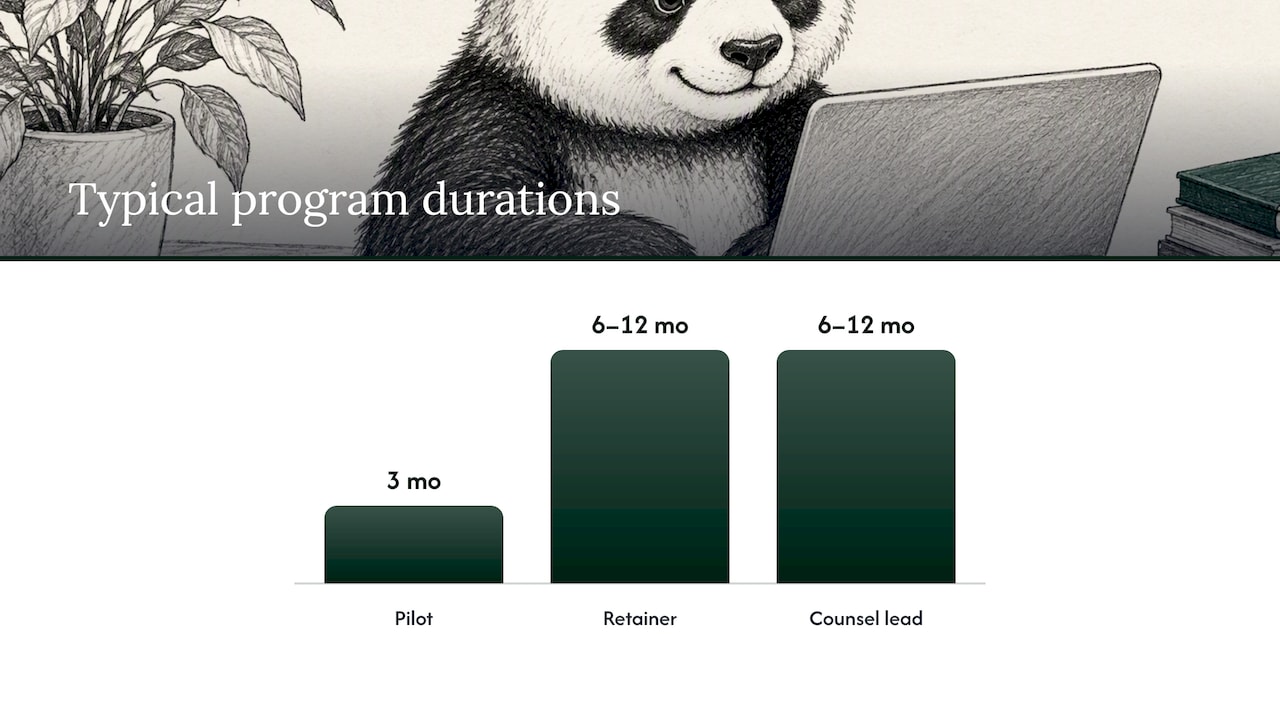
Executive profiling programs tend to follow a predictable shape, even though pricing itself varies by scope. A short pilot, often three months, establishes the message map, trains the executive, and lands a first wave of placements. A full retainer, typically six to twelve months, builds sustained media relationships, a steady content cadence, and a speaking pipeline that takes longer than a single quarter to fill.
Pricing on these programs is usually structured as a monthly retainer, a project fee for a defined deliverable set (such as a bio overhaul and launch), or a hybrid of both, with media spend and event travel billed separately in most cases. Before signing, confirm what is actually included.
A practical SOW checklist covers:
Deliverables: exact number of bylines, placements, and speaking submissions per quarter.
Approval workflow: who signs off on drafted content before it goes out, and how fast.
Media rights: who owns published content and whether it can be repurposed for sales or recruiting.
Travel and event costs: whether speaking-engagement travel is in scope or billed as an expense.
Escalation path: who handles a misquote or a negative story outside business hours.
Success metrics: the specific KPIs from the measurement section, written into the contract, not left as a verbal understanding.
If a fundraising or IPO timeline is in play, counsel should start six to twelve months before the event to secure placements and speaking slots and keep the narrative aligned with investor relations messaging.
Why We Approach Executive Profiling Differently
Executive profiling can be based on a hybrid of Scandinavian brand thinking and the speed of Chinese market methodologies, pairing long-term narrative discipline with execution that moves at commercial pace rather than editorial pace. That combination shapes how engagements are scoped.
A few things define how we work:
AI can be used to run continuous reputation monitoring and support creative workflows, not to replace the judgment of the people writing and coaching the executive.
Our 90 Day Reputation Plan with AI-aware monitoring is the practical framework we use to structure a short-term activation window with measurable checkpoints.
Teams are typically scoped around specific deliverables in the statement of work, often including a strategist, a writer, and a monitoring lead, with specialists added as needed for speaking placement or investor-facing work.
Clients often come from B2B and high-growth sectors, where pipeline attribution and investor confidence matter alongside general brand awareness.
Keeping Message Control, Disclosure, and Compliance in Order
Executive visibility raises the stakes on governance. A leader who publishes regularly and speaks on stages creates more surface area for a misstatement, a forward-looking claim that triggers disclosure obligations, or a comment that conflicts with legal guidance.
Message control starts with the message map built in discovery, which should explicitly flag topics the executive cannot discuss publicly, whether for competitive, legal, or investor-relations reasons. Any public company executive, or one heading toward a raise, needs legal and IR sign-off built into the approval workflow before a byline or interview goes out, not after.
Disclosure practices from other domains offer a useful model. Enterprise privacy governance, for instance, shows how a large organization documents what gets shared publicly and what does not, a structure worth borrowing for executive communications even outside the privacy context. Compliance review should be a standing step in the workflow, not a one-time audit, since the risk resets with every new placement.
What Success Actually Looks Like in Practice
Executive profiling impact tends to show up in a specific pattern: a leader starts speaking consistently on one clear point of view, trade press begins citing them as a source rather than just covering their company, and sales teams start hearing prospects reference a specific article or talk during early conversations.
The strongest signal is when a byline or talk shortens the sales cycle because a prospect arrives already trusting the executive’s judgment. That shift tends to follow a tight, well-sequenced campaign, not a scattershot series of unrelated media hits. A leader who publishes one sharp, well-timed piece ahead of a product launch typically outperforms one who publishes five generic ones with no connection to a business moment.
The weaker outcomes we see share a common cause: content disconnected from a business event, or speaking slots accepted without checking whether the audience matches the target buyer. Both waste the executive’s time without building the credibility the program is meant to produce.
How to Evaluate an Executive Profiling Partner
A few direct questions separate a capable partner from one selling a vague promise of “visibility.”
Ask for a sample message map and a writing sample attributed to a past executive client, since a partner who cannot produce either is likely light on process. Ask how placements get measured beyond count, since an agency reporting only volume is optimizing for the wrong number. Ask who actually writes the bylines, since ghostwriting quality varies enormously between a trained writer working from structured interviews and a junior account staffer paraphrasing a brief.
Red flags include a guarantee of a specific outlet or placement count (earned media cannot be promised), a scope of work with no legal or IR review step, and a pricing structure that bundles media spend into the retainer without itemizing it. One useful hiring note: in agency staffing language, “PR executive” typically denotes a junior delivery role. If a proposal lists “PR executives” as the senior strategists on the account, ask who is actually leading the work.
Connecting Executive Profiling to the Broader Brand
Executive profiling works best when it is not run as a parallel track to brand and marketing. The executive’s narrative, the company’s positioning, and the go-to-market story should trace back to the same strategic foundation, or the leader ends up saying something the brand’s broader marketing does not support.
In practice, this means the bio, the byline topics, and the social voice all pull from the same brand positioning work that shapes product messaging and sales enablement. When a company is also running a go-to-market push or a market entry, executive visibility should align with that timing rather than compete with it for attention. A founder’s op-ed landing the same week as a major product launch amplifies both; landing in a quiet month wastes the moment.
Common Pitfalls and How to Avoid Them
The most common failure is treating executive profiling as a short sprint instead of sustained infrastructure. A single wave of placements fades within a quarter if nothing follows it, and share of voice reverts to baseline.
A second pitfall is ghostwritten content that does not sound like the executive, which readers and journalists notice quickly and which undermines the authenticity the whole program depends on. A third is skipping the legal and IR review step under time pressure, which is exactly when a disclosure problem slips through. A fourth is measuring only volume, publishing frequently without checking whether the right audience is actually engaging.
The fix for all four is the same discipline: a documented message map, a sustained cadence rather than a burst, an approval workflow that is never skipped for speed, and KPI reporting that weighs relevance over raw counts.
Our Take: Presence Is Infrastructure, Not a Campaign
The most overrated idea in this field is that executive profiling is a media relations exercise. It is not. It is closer to product work: define the audience, build a message that holds up under pressure, ship it on a cadence, and measure whether it changes behavior.
The conventional advice undersells governance. Most guidance treats legal and disclosure review as a formality bolted onto the end of a workflow. We think it belongs at the start, built into the message map before a single pitch goes out, because the cost of one mishandled disclosure outweighs a dozen good placements.
If we had to tell a communications leader where to spend the first dollar, it would not be media training or a flashy launch. It would be the discovery phase: the audience mapping and risk review that most teams rush past to get to visible activity faster. Visibility built on a weak foundation does not hold once the AI-aware monitoring starts flagging the gaps.
— Kalle
Ready to Build Your Executive’s Profile? Here’s How We Start
We start every executive profiling engagement with a discovery call, not a pitch deck. That call maps your executive’s current public footprint, identifies the audiences that matter most to your pipeline, and flags any legal or investor-relations sensitivities before we scope a single deliverable.

From there, we send a scoping proposal built around your specific business moment: a fundraise, a market entry, a product launch, or simply a leader who should be better known in their category. That proposal lays out deliverables, cadence, and the KPIs we will report against, drawn from our core services in brand positioning, go-to-market strategy, and demand generation. Teams planning an APAC expansion alongside their executive visibility work often pair this with our Leadership Trips for direct market immersion.
If your leadership team is ready to build a presence that holds up under scrutiny and moves pipeline, request a proposal or book a strategy call with our team.
FAQ
What are the 7 C’s of executive presence?
There is no single, universally cited “7 C’s” model in the primary research on executive presence. The most established frameworks are Coqual’s three-dimension model of gravitas, communication, and appearance and the related ABC model (Appearance, Behavior, Communication); definitions beyond these vary by source.
What does “PR executive” stand for?
“PR executive” refers to a public relations professional, though usage varies by context. In agency hiring language, it commonly denotes a junior-to-mid-level delivery role, so senior strategic hires are usually titled Communications Manager or PR Director instead.
What does an executive profile mean?
An executive profile is the public-facing picture of a leader built from their bio, media coverage, published thought leadership, and speaking history. It shapes how investors, buyers, talent, and partners perceive that leader’s credibility and judgment.
What is an example of profiling?
In this context, profiling means building a CEO’s public narrative through a bylined op-ed on an industry shift, paired with a speaking slot at a relevant conference and a LinkedIn posting cadence that reinforces the same point of view. Each piece reinforces the others rather than standing alone.
How long before results show up from executive profiling?
A focused pilot typically runs around three months to establish the message map and land initial placements, with measurable shifts in visibility and engagement usually appearing by month six. Programs tied to a fundraise or IPO should start counsel six to twelve months ahead of the event.
Sources
What Is Executive Presence? The Coqual Framework and How to Develop It (2026) | Paperbell
Executive Presence: What Is It, & The ABCs of It | Thriving Talents
Recommended
RELATED INSIGHTS



LET’S TALK
What are you trying to grow next?
Brand, launch, market entry or performance. Book 30 minutes and tell us what you’re working on.