•
Go-to-Market in China for B2B: A Practical Playbook
A B2B go-to-market in China works when you prove demand before you build infrastructure. Pick one buyer segment. Localize the offer, not just the language. Run channels that Chinese buyers use daily. Align early with local data and digital trade rules. Then scale what produces qualified meetings.
Most foreign B2B teams do it in reverse. They register an entity, translate the website, hire a country manager and wait. Twelve months later the pipeline is thin and the board is asking questions. This guide lays out the sequence we recommend instead.
Aligntccaligntcc.comBuild a China-ready market strategyAlign TCC combines Scandinavian brand thinking with Chinese market methodologies to help companies sharpen positioning and engage audiences across markets.Explore Align TCC
TL;DR
Treat China as a separate commercial system, not an extension of your US or EU funnel. Channels, trust signals and buying committees differ.
Validate demand with a small, measurable test (90 days) before committing to an entity, headcount or a full localization.
Personal relationships and in-person events carry more weight in B2B than in most Western markets, so pair digital content with trade shows and leadership visits.
Data, hosting and cross-border rules shape your martech stack. Plan them in week one, not month nine.
Use AI to speed up research, content and testing. Keep senior human judgment on positioning and relationships.
Table of Contents
Why China B2B go-to-market is its own discipline
Step 1: Define who you sell to, and who signs
Step 2: Choose your entry model
Step 3: Build a China-ready digital foundation
Step 4: Pick channels by buying stage
Step 5: Make trade shows do real work
Step 6: Qualify leads the Chinese way
A 90-day plan to prove demand
Perspective: why we start with immersion and evidence
How Align supports a China B2B go-to-market
Common mistakes to avoid
FAQ
Sources
Why China B2B go-to-market is its own discipline
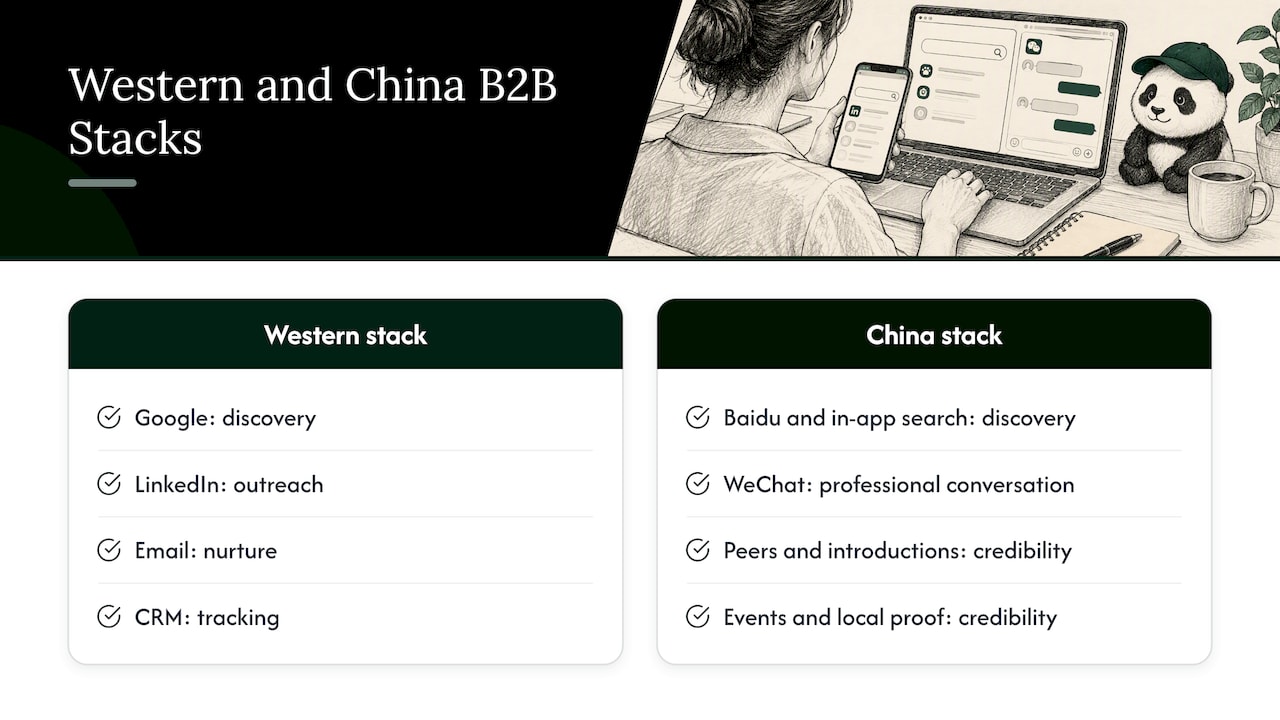
Western B2B playbooks assume a familiar stack: Google for discovery, LinkedIn for outreach, email for nurture, a CRM for tracking. In China, that stack is either unavailable or ineffective. Discovery runs through Baidu and in-app search. Professional conversation happens in WeChat. Credibility is built through peers, introductions, industry events and visible local proof.
That does not make the market closed. It makes it specific. The opportunity is large and active: at the 137th Canton Fair in May 2025, 288,938 overseas buyers attended, up 17.3% on the 135th session, with onsite intended export deals of $25.44 billion. That fair is mostly about Chinese exporters selling abroad, but it shows how much B2B commerce moves through physical, relationship-led marketplaces in China. If you sell into China, or sell from China into the West, the same logic applies: buyers want to meet you.
There is also a policy shift to understand. Chinese policy experts describe a move from element-based opening toward system-based opening, which means success for foreign firms increasingly depends on fitting local digital trade and data rules, not just showing up. For a B2B marketer, that is a practical message: your website, your CRM and your content workflow are all regulated surfaces.
Step 1: Define who you sell to, and who signs
Chinese B2B deals often involve more stakeholders than a Western buyer map suggests, and the person who champions you may not be the person who approves. Before any channel work, answer four questions:
Which segment first? One industry, one company size, one region. “All of China” is not a segment.
Who is the economic buyer? Founder, GM, procurement head or a state-linked decision body. The answer changes tone, proof and channel.
What is the local alternative? In most categories a domestic supplier already exists, often cheaper and faster to service. Your pitch has to explain why you win anyway: technology, quality, global compliance, international references.
What does proof look like here? Case studies from Western customers rarely carry weight on their own. Local pilots, local references and named partners do.
This is the core of what we call proving demand first. We cover the full sequence in our guide to seven workstreams for China market entry, and the logic is simple: spend the first weeks on evidence, not on assets.
Step 2: Choose your entry model
Your go-to-market model decides your cost, speed and control. Broadly, foreign B2B companies choose among four routes.
Route | Best for | Main trade-off |
|---|---|---|
Cross-border sales from outside China | Early validation, products that can ship or deliver digitally | Limited local presence, slower trust-building |
Distributor or local reseller | Industrial, hardware and channel-led categories | Less control over positioning and customer data |
Local partner or joint venture | Regulated sectors, complex sales | Shared control, partner dependency |
Own entity (for example a WFOE) | Proven demand, long-term commitment | Highest cost and the slowest start |
For a thoughtful overview of how leaders weigh these choices, see this primer on market entry strategy. It frames the decision in terms any leadership team will recognize: risk, speed, capital and control.
Our view: do not choose the model first. Choose it after a 90-day demand test. If buyers respond, you will know which route to fund. If they do not, you will have spent a fraction of an entity setup budget to learn it.
Using cross-border pathways as a soft entry
For product companies, cross-border e-commerce pilot zones can work as a test bed. The US Commerce Department’s China guide notes that U.S. companies can sell through cross-border e-commerce rather than establishing a physical presence, which lets them bypass some local registration complexity. Practitioners use this route to test response before taking on traditional product registration for domestic distribution.
A caution that matters for B2B: that same guide’s purchase limits, 5,000 RMB per transaction and 26,000 RMB per year for individual consumer transactions, apply to consumers. They are not a ceiling on business purchasing, so do not design B2B pricing around them. If your product is regulated, ask a qualified China regulatory counsel which route applies to your category before you ship.
Step 3: Build a China-ready digital foundation
Your global website will probably underperform in China, for reasons of speed, access, search and trust. A China-ready foundation has five parts.
A localized site, not a translated one. Simplified Chinese copy written for Chinese buyers, local case language, local contact methods (a WeChat QR code beats a web form).
Hosting and filings. Sites hosted on mainland servers generally need an ICP filing, and that process typically involves an onshore entity or partner. Decide early whether you want a mainland-hosted site or an offshore one that loads more slowly.
Baidu visibility. Search behavior and ranking signals differ from Google. Our Baidu advertising strategy guide lists 90-day fixes for international brands.
A WeChat presence. An Official Account, a Mini Program where useful, and a process for turning conversations into CRM records. See our WeChat marketing strategy for brands entering China.
Naming and terminology. A brand name that sounds fine in English can be unreadable, awkward or unlucky in Mandarin. Run the five checks for localizing brand names before you print anything.
Localization is not translation
Translation converts words. Localization converts meaning, proof and tone. A technical whitepaper that persuades a German engineering buyer may read as vague to a Chinese procurement lead who expects specifications, certifications and named references up front. AI helps here, with first-draft adaptation and terminology consistency, but a native senior reviewer must decide what the message should be. We explain the difference in localization vs translation for marketers.
Data rules shape your stack
A B2B funnel collects personal information: names, titles, phone numbers, chat histories. Moving that data across borders is regulated. China’s cyberspace regulator issued rules to promote and standardize cross-border data flows, described by commentators as optimizing standards and procedures and supporting foreign firms operating in China. Separately, in free trade zones such as Shanghai’s Lingang, local authorities have piloted institutional arrangements for cross-border data processing, with more than 20 companies running data-processing business of this kind at the time of that report (December 2022).
What this means for you: decide where leads live, who can access them and which tools handle them before you launch campaigns. Get legal advice from counsel qualified in Chinese data law. Rules change, and a marketing team should not interpret them alone.
Step 4: Pick channels by buying stage
A China B2B funnel is a mix of public content, private conversation and live contact. Map your channels to the stage of the buyer.
Stage | What buyers do | Channels that tend to work |
|---|---|---|
Awareness | Search, ask peers, scan industry media | Baidu search and ads, industry media placements, short video, thought-leadership articles |
Consideration | Compare suppliers, check references | WeChat Official Account content, webinars, case studies with local proof, Zhihu answers |
Decision | Meet, visit, negotiate | Trade shows, factory or office visits, introductions, private WeChat groups |
Expansion | Renew, refer | Account management in WeChat, events, customer councils |
Where Xiaohongshu fits in B2B
Xiaohongshu is known for consumer content, yet it increasingly matters for B2B companies whose buyers research tools, services and employers there, and for brands that sell to both businesses and consumers. A focused pilot is cheap to run. Our Xiaohongshu marketing playbook for market entry outlines a 90-day way to test it.
Creators and experts
B2B influence in China looks different from consumer influence. The best partners are practitioners, industry analysts, association figures and respected operators, not lifestyle creators. Their value is credibility, and credibility compounds. Brief them with data and access to your product, not scripts.
Content syndication and account-based marketing
For Western teams selling in China, and Chinese teams selling into the West, targeted account-based programs usually beat broad campaigns. Build a list of 50 to 200 named accounts, map the buying committee and run coordinated outreach through content, paid media and events. Our B2B content syndication playbook covers how to extend reach without sacrificing lead quality.
Step 5: Make trade shows do real work
In a relationship-led market, events are not a branding line item. They are a primary sales channel. The scale of the Canton Fair, mentioned above, is the headline example, but sector-specific shows across Shanghai, Shenzhen, Guangzhou and Beijing matter just as much for focused B2B categories.
To make a show pay:
Pre-book meetings. Reach your target accounts through WeChat and introductions weeks ahead, not on the show floor.
Staff for the language and the seniority. Bring a decision-maker, plus a fluent Mandarin speaker who understands your technology.
Capture leads in WeChat. Business cards are fine, but the real follow-up channel is a connection and a group.
Follow up within 48 hours with something specific: a quote, a technical sheet, a visit proposal.
We break down the planning in our guide to trade show marketing strategy for B2B. It is built around a goal of filling the calendar with ideal-customer meetings, not collecting badge scans.
Step 6: Qualify leads the Chinese way
Lead volume looks great in a dashboard and fails in a pipeline review. Chinese B2B leads arrive through chat, phone and events, and response speed is a differentiator. Define what “qualified” means for your offer: budget, authority, need and timing, plus a China-specific filter, such as whether the account can legally and practically buy from you. If you want a structured way to do this, these lead qualification frameworks cover how scoring, CRM discipline and automation fit together for sales and marketing teams.
Automate first-touch speed, not judgment. A prompt reply from a fluent person or well-built workflow wins more meetings than a polished brochure that arrives a week late.
A 90-day plan to prove demand
Here is a sequence we would hand a leadership team starting from zero.
Days 1 to 30: Foundation
Choose the segment, the buyer and the one-sentence offer in Chinese.
Audit the product, name, claims and certifications for local fit.
Set up the WeChat presence, the localized landing page and the data and CRM design.
Build the account list.
Days 31 to 60: Test
Launch a small paid test on Baidu and one social or WeChat channel.
Publish four to six pieces of local-language expert content.
Run outbound through introductions to the first 30 to 50 accounts.
Book one industry event or a leadership visit.
Days 61 to 90: Decide
Review response by channel: qualified conversations, meetings, pilots, quote requests.
Kill what fails. Double down on what works.
Present a go, adjust or stop recommendation, with the entry model that fits the evidence.
Define the pass mark before you start. For example: a target number of qualified meetings with named accounts and at least one live pilot discussion. If the market does not respond, you will know cheaply. If it does, you scale with confidence.
Perspective: why we start with immersion and evidence
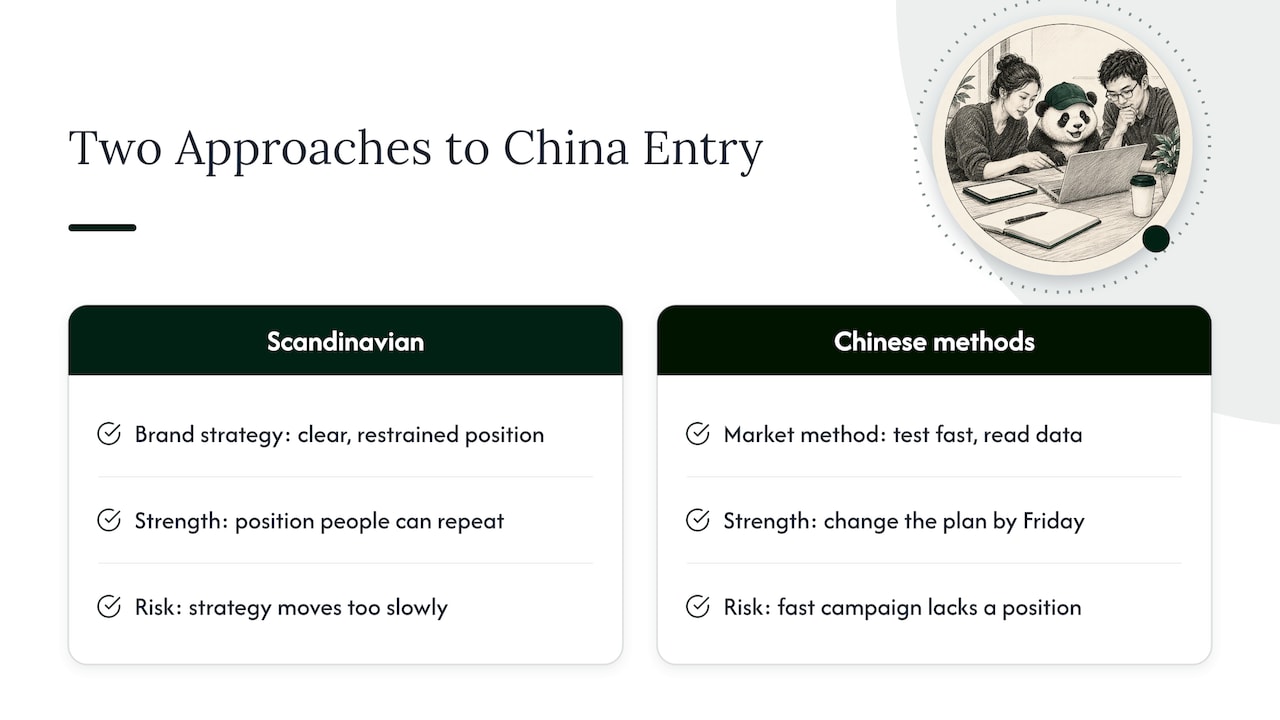
We work between two ways of thinking. Scandinavian brand strategy gives a clear, restrained position that people can repeat. Chinese market methods give speed: test fast, read the data, change the plan by Friday. Put together, they solve the problem we see most often in foreign B2B entry: a beautiful strategy that moves too slowly, or a fast campaign with no position behind it.
Our opinion is plain. Most China B2B failures are decision failures, not marketing failures. Leaders decide from slide decks, secondhand reports and the experience of a different market. So we push leadership teams to see the platforms, the buyers and the competitors first-hand, and to treat the first quarter as a validation exercise, not a launch.
On AI, we use it to accelerate research, drafting, localization checks and test analysis. We do not let it set the position or replace cultural fluency. Technology should enhance creativity, and a senior person should still own what the brand says and why.
— Kalle
How Align supports a China B2B go-to-market
If you are a marketing leader at a growth-stage or established company and need senior capability without building every function in-house, we can be that extension of your team. Our work spans commercial strategy, brand and positioning, go-to-market and market entry, creator marketing, content and performance programs, and our China leadership trips give your executives direct exposure to the platforms and consumer behavior that shape your market. Book a Strategy Call and we will help you define what to prove first.
Common mistakes to avoid
Launching in all of China at once. Pick a segment and a city cluster.
Using English-first creative with Chinese subtitles. Write natively.
Ignoring the local competitor set. Your buyer certainly compares you to it.
Hiring a country head before validating demand. Evidence first, headcount second.
Treating compliance as a later problem. Hosting, data and claims affect your plan from day one.
Measuring vanity metrics. Followers and impressions are not pipeline. Track meetings, pilots and pipeline value.
FAQ
What is the first step in a B2B go-to-market for China?
Choose one buyer segment and test demand before you commit to an entity or hires. A 90-day pilot with a localized offer, a WeChat presence and a targeted account list will tell you more than a long market report. Use the results to decide on the entry model.
Does LinkedIn work for B2B marketing in China?
Not as a main channel. Buyers conduct professional conversation in WeChat, discover suppliers through Baidu and in-app search, and meet at industry events. Many foreign firms still use LinkedIn for their own global audience, but your China funnel needs its own stack.
Do I need a Chinese entity to start?
Not necessarily. Many companies begin with cross-border sales, a distributor or a local partner to test demand. Some regulated products and mainland-hosted websites do require an onshore presence, so check your category with qualified legal counsel in China.
How long does it take to see results?
Expect early signals, such as qualified conversations and meeting requests, within about 90 days if the offer fits. Closed deals depend on your sales cycle, which in complex B2B categories is often longer than a quarter. Plan your budget around the full cycle.
Sources
Expert interpretation of the cross-border data flow rules, Cyberspace Administration of China
Shanghai Lingang cross-border data processing, Lingang New Area
Recommended
RELATED INSIGHTS


LET’S TALK
What are you trying to grow next?
Brand, launch, market entry or performance. Book 30 minutes and tell us what you’re working on.