•
Search vs Social Ads: How to Split Your Paid Budget
Search ads capture demand that already exists. Social ads create demand that does not exist yet. That is the core difference, and it decides how you budget, what you measure and which platform gets the next dollar. Most growth-stage brands do not need to pick a winner. They need to know which job each channel does, and in what order.
This guide compares the two on intent, cost, creative, measurement and funnel role. It also covers the platform questions readers ask most: Google vs Meta, Google vs Microsoft, TikTok vs Meta. And it shows where the Western playbook breaks, because in China the search box is not where discovery happens.
AligntccMake Your Paid Media Work Across MarketsAlign TCC combines brand strategy and market-specific execution to help companies reach audiences across China, Europe and North America.Explore Aligntcc
TL;DR
Search meets people who are already looking. It converts well and scales only as far as existing demand goes.
Social reaches people before they search. It builds the demand search later harvests, and it needs strong creative to work.
Search is not only bottom funnel. Google’s own research says category keywords lift brand awareness, even without a click.
Judge both by incrementality, not last-click reports. Geo-based tests show what each channel truly adds.
In China, the logic flips. Social platforms act as the search engine, so content-first beats keyword-first.
Table of Contents
What each channel actually does
Where each one sits in the funnel
Cost and performance: what the benchmarks say
Which search or social platform? The questions readers ask
Creative matters more on social than on search
Measure what each channel truly adds
A starting budget split by situation
Perspective: why the split looks different in China
When to bring in a partner
Common mistakes to avoid
FAQ
Sources
What each channel actually does
Paid search places your ad against a query. Someone types “B2B payroll software” or “waterproof trail shoes,” and your ad appears beside the results. The person has told you what they want. Your job is to be relevant, credible and one click away.
Paid social places your ad inside a feed. Someone is watching videos, checking friends or reading posts on Meta, TikTok, LinkedIn or Pinterest. They did not ask for you. Your job is to earn attention in about two seconds, then give them a reason to care.
That gives you two different mechanics:
Paid search | Paid social | |
|---|---|---|
Trigger | A query the user typed | A feed the user is scrolling |
Intent | Active, often high | Passive, often low |
Targeting | Keywords, match types, audiences | Demographics, interests, lookalikes, first-party data |
Creative role | Short text, relevance | Video, image, story, the creator |
Best at | Capturing demand | Creating and shaping demand |
Main limit | Query volume | Creative fatigue and attention |
Search is limited by how many people look for what you sell. Social is limited by how well you can make strangers care. Neither limit is a flaw. They are just different constraints.
Where each one sits in the funnel
The textbook view puts social at the top and search at the bottom. It is a useful shortcut and an incomplete one.
Social does its best work early. It introduces the brand, plants a point of view and keeps you visible with future buyers until they are ready. Search then collects the people who went looking after that exposure. This is why brands that cut social often see search performance slide a few weeks later. Search was harvesting what social had planted.
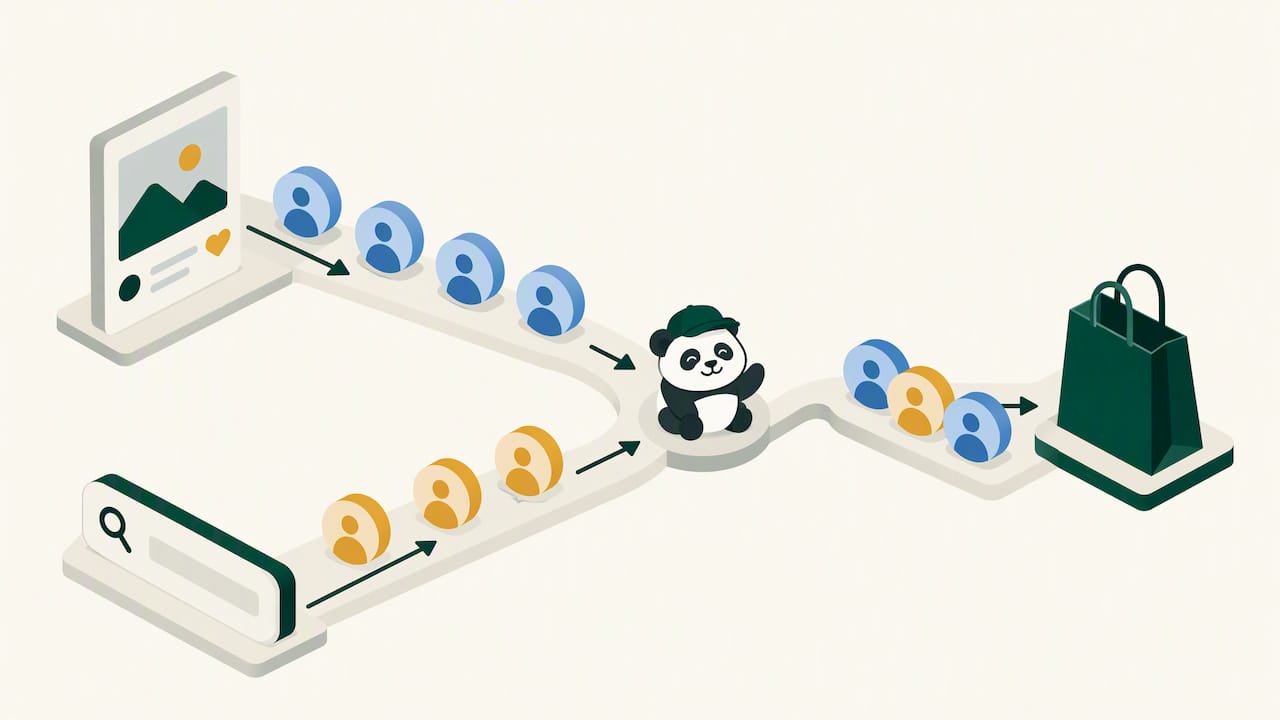
But search is not a pure closer. Google’s research on search for brand marketers reports that meta-studies of search ads show an average lift in top-of-mind brand awareness of 6.6 percentage points, an 80% relative increase from a baseline of 8.2%. Appearing for category terms builds familiarity even before a click. That is Google’s own data, so read it as a signal rather than a guarantee. Still, it is a good reason to bid on category terms, not only on your brand name.
A practical way to think about it:
Create: social video and creator content put the brand in front of people who are not looking.
Capture: search catches the ones who start looking, including for your brand name.
Convert: retargeting on social and search closes the gap with proof, offers and reminders.
The paid social funnel is rarely a clean line. People bounce between channels. Build for overlap, not for tidy stages.
Cost and performance: what the benchmarks say
Benchmarks vary by industry, year and how each source defines a conversion, so treat them as orientation, not targets. One 2026 PPC benchmark roundup lists these averages:
Platform | Avg. CTR | Avg. CPC | Avg. conversion rate |
|---|---|---|---|
Google Search | 6.66% | $5.26 | 7.52% |
Facebook lead gen | 2.59% | $1.92 | 7.72% |
TikTok | 0.84% | $0.20 to $2.00 | 0.46% |
Three lessons from a table like this.
First, search clicks cost more. You are paying for intent, and competitors bid on the same intent. Second, social clicks are cheaper but come from people who were not shopping, so more of them bounce. Third, the conversion rates are not comparable. A lead form on Facebook and a purchase on TikTok are different events. Compare cost per qualified lead or cost per acquired customer, never CTR alone.
For B2B, the picture shifts again. Search volume for narrow terms can be tiny. Social lets you reach a defined buying committee by job title and company. If you sell to enterprise accounts, our B2B LinkedIn ads strategy shows how to size audiences before you spend.
Which search or social platform? The questions readers ask
Google Ads vs Meta Ads
Google wins when your category has search volume and buyers know the problem. Think software, services, local demand, replacement purchases. Meta wins when the product needs explaining or is bought on impulse or taste: consumer goods, apps, fashion, DTC. If you are new to a category, Meta often finds your first audience faster. If your category is established, search usually pays back faster.
Google Ads vs Microsoft Ads
Microsoft’s search network is smaller, but it can be cheaper. The same benchmark roundup puts the average Bing Ads CPC around 40% lower than Google’s. Its audience skews toward desktop users, often older and in office settings, which suits B2B and professional services. A sensible move: build and prove campaigns on Google, then import them to Microsoft as a low-cost extension. Do not expect it to replace Google’s reach.
Google Ads alternatives
Cost is one reason brands look beyond Google. Shopify’s overview of Google Ads alternatives cites high costs from competitive bidding as a common motive. The realistic alternatives fall into types: a second search engine, marketplace and retail media ads, social platforms, and video. None substitutes for search intent exactly. They add reach where your buyers spend time. If you sell through retailers, retail media is often the closest thing to search intent outside Google.
TikTok vs Meta (Facebook and Instagram)
Meta offers scale, mature targeting and strong retargeting. TikTok offers attention and a creative-first format where authentic, creator-style video outperforms polished ads. In the benchmark table above, TikTok shows a lower conversion rate, but that reflects its role as a discovery channel for many advertisers. Test both with the same product and different creative. Let the cost per acquired customer decide, not the platform’s reputation.
Creative matters more on social than on search
On search, the query does the targeting and you win with relevance: a clear headline, a matching landing page, a fast site. On social, the creative is the targeting. The platform learns who to show it to based on who responds.
That changes how teams work:
Plan for volume. Social creative fatigues. Budget for a steady stream of new hooks, formats and angles, not one hero video.
Use creators. People trust people. Creator content often outperforms brand-made assets, and running ads through a creator’s handle extends its reach. Our guide to influencer whitelisting covers setup and contracts.
Match the promise. A thumb-stopping ad that leads to a generic page wastes the click. The landing page must continue the story.
Test the message before the media. Weak positioning drags down both channels. If your ads are not working, check the pitch before raising the bid.
Measure what each channel truly adds
The biggest mistake in this debate is trusting last-click attribution. Search looks brilliant in last-click because it sits right before purchase. Social looks weak because it started the journey earlier. Budget moves to search, social shrinks, and growth stalls.
Google’s guidance on measuring what matters recommends moving past correlative attribution toward causal measurement, such as geo-based experiments. You switch a channel on in some regions and hold it off in others, then compare outcomes. The difference is what the spend caused.
A simple version you can run:
Pick two or more comparable regions or markets.
Keep everything else steady: pricing, promotions, other channels.
Change one thing, such as pausing paid social in one region for four weeks.
Compare new customers, branded search volume and revenue against the control.
Repeat with the other channel.
You will often find that social lifts branded search, and that some branded search spend was capturing people who would have bought anyway. Both findings reshape the budget.
A starting budget split by situation
There is no universal ratio. Use these as hypotheses to test, not rules.
Situation | Lean toward | Why |
|---|---|---|
Established category, clear demand | Search first, social for retargeting | Buyers already look; capture them |
New category or new product | Social first, search to follow | Little demand exists; you must create it |
B2B, narrow buying committee | Mix of LinkedIn and search | Reach named roles and capture solution searches |
Consumer brand, visual product | Social-led with search on brand and category | Taste drives purchase; search closes it |
Entering a new country | Test both, add local platforms | Search habits differ by market |
Whatever the split, protect brand search. If you stop bidding on your own name, competitors will happily buy it. And keep a test budget, around a tenth of spend, for new channels and creative.
Perspective: why the split looks different in China
We work between Europe, the US and China, and China is where the search-versus-social debate gets interesting. The assumption that people search first and scroll later does not hold there.
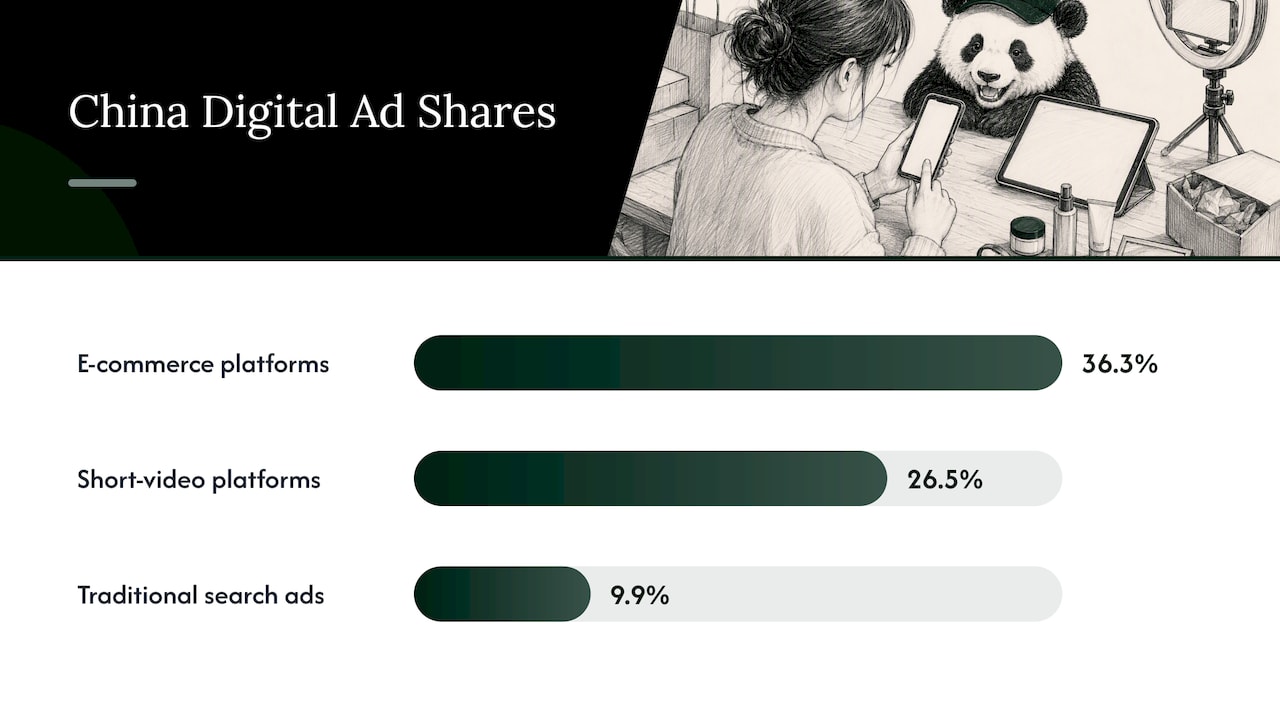
According to an iResearch report on China’s internet marketing market, e-commerce platforms held a 36.3% share of digital advertising in 2023 and short-video platforms 26.5%, while traditional search engine advertising held 9.9%. Chinese consumers research actively, and social and short-video platforms such as Xiaohongshu and Douyin have become a core gateway for discovery, reviews and value-for-money comparisons. The same report describes brands shifting toward scene-based, seed-planting content that reaches people before the need is explicit.
For a Western brand, that means the keyword-heavy search playbook does not travel. You need content people want to find, creators they trust and a presence where the questions are asked. We break down how in our guides to Xiaohongshu marketing, WeChat marketing strategy and Baidu advertising, where search still plays a role.
The lesson travels in both directions. Brands from China arriving in Europe and North America should not assume social alone will carry them: Western buyers still type their needs into a search box. And Western brands should treat social as a search surface of its own, because younger audiences already use it that way.
Our view, in short: stop treating search and social as rivals. Treat them as one system with a shared job, which is to prove demand, then capture it. Use AI to speed up creative testing and reporting, and keep human judgment on positioning and cultural fluency. Technology should make the thinking sharper, not replace it.
— Kalle
When to bring in a partner
Running both channels well takes strategy, creative, media buying and measurement working together. Many fast-growing teams do not want to build every function in-house. At Align, we combine brand strategy, creator programs, paid media and market entry work for brands growing across the US, Europe and China. If you want a senior team to design the full funnel and test it properly, see our services or start with a strategy call.
Common mistakes to avoid
Judging social by last-click. It will always look weaker than search. Use holdout tests.
Running search without a landing page plan. Paying for intent and sending it to a weak page burns budget.
Copying search ads into social. Different mindset, different creative.
Ignoring brand terms. Defensive search is cheap insurance.
Scaling before creative is proven. Find angles that work at small spend first.
Assuming one market’s habits apply everywhere. Check how buyers actually discover products in each country.
FAQ
Is paid search or paid social better?
Neither is better in general. Search is stronger when demand already exists, and social is stronger when you must create it. Most brands need both, with the mix set by category maturity and by what incrementality tests show.
Can search ads build brand awareness?
Yes. Google’s research reports that category-keyword search ads raised top-of-mind awareness by an average of 6.6 percentage points across meta-studies, even without clicks. That is a platform-published finding, so validate it with your own brand lift or geo tests.
Why are social ads cheaper per click but not always cheaper per customer?
Social reaches people who were not shopping, so fewer clicks turn into purchases. Compare cost per qualified lead or per new customer. Cost per click alone misleads.
Should B2B companies use social ads?
Often yes, especially LinkedIn and sometimes Meta, because they let you target roles and accounts when search volume for your niche is small. Pair them with search so people who respond to a social ad find you when they look.
Does the same split work in China?
No. Social and short-video platforms handle much of the product discovery that search handles in the West, so content and creators come first. Plan market-specific execution before you set budgets.
Sources
Recommended
RELATED INSIGHTS


LET’S TALK
What are you trying to grow next?
Brand, launch, market entry or performance. Book 30 minutes and tell us what you’re working on.