•

Earnings Call Preparation: A Playbook for Execs and IR
Earnings call preparation comes down to three jobs: lock the legal and logistical frame early, write a script that explains the numbers rather than repeats them, and rehearse the Q&A until every hard question has a clean, consistent answer. Do those three well and the call becomes a durable asset instead of a 60-minute risk. This playbook walks through each one, with a working timeline, a script structure and the messaging discipline that separates a forgettable call from one investors trust.
AligntccMake Your Brand Message ClearAlign TCC helps fast-growing companies sharpen positioning and build marketing strategies that connect with audiences across markets.Visit Align TCC
TL;DR
Start about five weeks out. Fix the date, the notice, the owners of each section and the legal review before anyone drafts a word.
Write the release and the script together, then keep the script for the “why” behind the numbers, not a re-read of the income statement.
Rehearse out loud, with a mock Q&A led by someone who will press you. Delivery is part of the message.
Keep KPI names, definitions and forward-looking language identical quarter to quarter. Transcripts get parsed by software as well as by analysts.
Pair every risk you name with a concrete action. Reassurance without a plan costs credibility.
Table of Contents
What an earnings call is really for
The legal frame: what you must get right before you draft
A five-week timeline that works
How to structure the script
Messaging: what investors actually hear
Preparing for the Q&A
Call-day logistics checklist
What to do after the call
Our perspective: the call is a brand moment
When to bring in outside support
FAQ
Sources
What an earnings call is really for
The numbers are already out. By the time the call starts, the press release is public and the analysts have a model. What they do not have is your read on it: what drove the quarter, what you are doing about the soft spots, and where the business goes next.
That is the job of the call. It is context, not disclosure of arithmetic.
The format is predictable. Calls typically run 45 to 60 minutes and move through a safe harbor statement, prepared remarks on results, and a question-and-answer session. Per the standard description, an investor relations officer usually reads the safe harbor statement first, to limit liability if actual results differ from forward-looking comments.
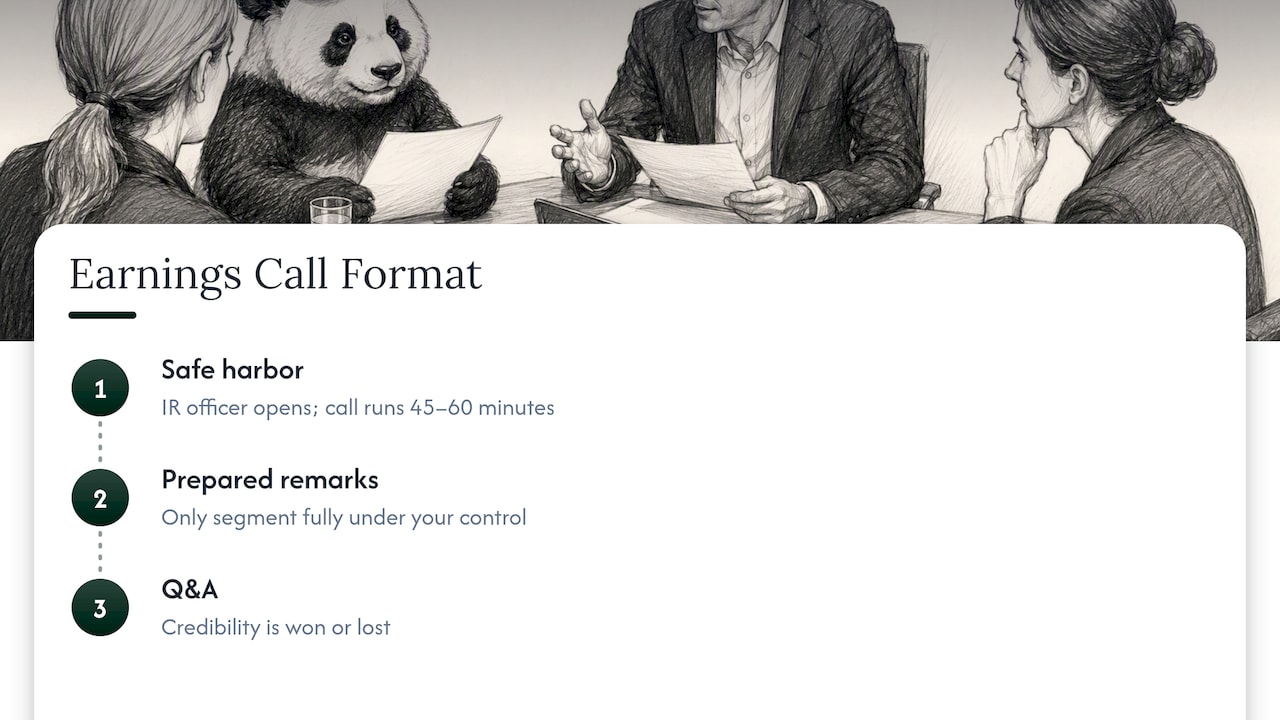
Two things follow from that format. First, the prepared remarks are the only part you fully control, so they should carry your narrative. Second, the Q&A is where credibility is won or lost, so it deserves at least as much prep time as the script.
The legal frame: what you must get right before you draft
Start with the rules, because they set your calendar.
A call is not itself mandated for every public company. But if you use a conference call to publicly disclose material information under Regulation FD, the SEC expects reasonable advance notice of the date, time and access details, and for quarterly results it has described several days as a reasonable period. In practice that means a broadly disseminated press release, usually with the same details posted on your investor relations site. Counsel commentary on Item 12 of Form 8-K lays out the same first step: announce the earnings release and the call a reasonable time ahead through a wide-distribution release.
Three practical consequences:
Public access is the default. Calls are normally webcast through the investor relations site and often archived for replay, so plan as if every word is permanent and public. LegalClarity’s overview covers how listeners access them.
The release and the call are one disclosure event. Anything new you say live should be something you are comfortable having treated as public disclosure. Your securities counsel should review the script and the Q&A guidance, not just the release.
Forward-looking statements need the safe harbor, and the script must be consistent with it. Counsel owns the wording. You own making sure the executives do not improvise beyond it.
This is the part where you speak to your own securities counsel. This article is not legal advice, and your disclosure policy should be the final word on who can say what.
A five-week timeline that works
Most teams that run clean calls work backward from the date. A five-week window is common, and it is long enough to absorb a legal review and two rehearsals without panic.
Timing | What happens | Owner |
|---|---|---|
5 weeks out | Confirm the date and time with CEO, CFO, counsel and the audit calendar. Check for conflicts with other companies in your sector reporting the same day. | IR lead |
4 weeks out | Agree the three to four themes for the quarter. Decide who covers what. Pull last quarter’s transcript and list every question asked. | IR lead, CFO |
3 weeks out | Draft the release and the script in tandem. Build the first list of hard questions. | IR, finance, comms |
2 weeks out | Legal review of script and Q&A. Issue the advance notice release. Test webcast and dial-in. | Counsel, IR |
1 week out | Full dress rehearsal with mock Q&A. Trim the script. Finalize the answer bank. | CEO, CFO, IR |
Day before | Short run-through. Confirm the release, slides if any, and the logistics checklist. | IR |
Call day | Final read-through, tech check, brief huddle. | Everyone |
After | Review transcript, log questions you fumbled, send follow-ups consistent with what was said publicly. | IR |
Timing of the call itself matters too. If your date falls on a crowded reporting day, shifting the start by 30 minutes can help you avoid colliding with peers that analysts also cover.
Document the whole process in writing, including who tests the phone system and who sends which files. A checklist feels bureaucratic until the one quarter the dial-in fails.
How to structure the script
A script is a spoken document. It should sound like an executive talking to a smart colleague, not a legal filing read aloud.
Length and pacing
A common benchmark puts a prepared script at roughly 2,500 words, around 20 minutes, which leaves ample room for questions inside a 60-minute slot. Treat that as a ceiling, not a target. A tighter script of 15 to 18 minutes often leaves analysts more time to ask what they actually care about.
The running order
Safe harbor and housekeeping (IR, 1 to 2 minutes). Standard wording, read cleanly. Name where the release and any supplementary material live.
Headline and theme (CEO, 3 to 4 minutes). One sentence on how the quarter went, then the two or three themes that explain it. Say what you are most proud of and what you are fixing.
Financial walk-through (CFO, 6 to 8 minutes). Cover drivers, not line items. Revenue by what moved it, margin by why it moved, cash by what you are doing with it.
Outlook (CFO or CEO, 2 to 3 minutes). Guidance, the assumptions behind it and what would change it.
Close and hand-off to Q&A (CEO, 1 minute). Restate the one thing you want remembered. Then open the line.
Keep the script off the income statement
The most common mistake is rehashing the press release. Practitioners advise drafting the release and the script together so the messaging matches, then deliberately using the call for color commentary: the reasons behind the numbers. If a sentence could be deleted without anyone who read the release noticing, delete it.
A useful test for each paragraph: does it answer “why” or “so what”? If it only answers “what,” the release already did.
Worked example of a before and after
Before: “Revenue was up 14% year over year and gross margin was 61%, compared with 59% in the prior-year quarter.”
After: “Revenue grew 14%, and most of that came from enterprise renewals expanding, not new logos. That mix is why gross margin improved two points to 61%. We expect the mix to hold through the second half.”
The numbers are the same. The second version gives an analyst something to model. (The figures are illustrative, not from any real company.)
Messaging: what investors actually hear
Facts, opinion and delivery
Investors respond to more than the numbers. Research summarized by the Philadelphia Fed examines how the mix of facts and opinions in management’s remarks relates to financial outcomes, and it is worth reading before you finalize tone. A practical reading: CEOs have more room for narrative than CFOs, but a call heavy on subjective claims and light on verifiable ones invites disagreement among analysts.
Delivery counts as well. A study discussed on the CLS Blue Sky Blog finds that investors react almost instantly to the quality of managers’ vocal delivery, which is linked to real-time trading volume and abnormal returns. Fluency and clear diction are not cosmetic. They are part of the message, so rehearse aloud, not silently.
Name risks and name the action
When you have bad news, the instinct is to soften it. The research points the other way. A Walton College piece on supply chain disclosure argues investors want transparency paired with credible action, not less disclosure. The pattern is simple:
State the problem plainly, with its size if you can.
Say what you have already done.
Say what you will do next and when you will report back.
A flourish with no roadmap behind it does more harm than a plain admission.
Consistency is a feature
Your transcript lives on. It is read by analysts and increasingly processed by automated tools. That is why IR practitioners urge keeping KPI names and definitions stable: renaming a metric or dropping forward-looking context one quarter can look like a change in the story, and it raises the cost of processing your information for the market.
Build a one-page glossary of every metric you cite, with its exact name and definition. Check each script against it. If a definition must change, announce the change and show the old and new figures side by side.
This is also where narrative discipline pays off. A call that repeats a clear corporate story each quarter is easier to believe. Our guide to building a corporate narrative shows how to turn that story into three parts you can keep stable.
Preparing for the Q&A
Do not wing it. Q&A is where the unscripted risk lives, and it is also where you can earn the most trust.
Build the question bank
Collect every question asked on your last two calls and on peers’ calls.
Add the questions you hope nobody asks. Have finance, legal and the business leads each contribute.
Group them by theme: growth, margins, guidance, capital allocation, competition, risk, management and strategy.
Write a two-sentence answer for each, then assign an owner.
Answers should not be scripted word for word. Aim for a clear position, one supporting fact and one forward step. Memorized answers sound memorized.
Run a hostile mock
The best rehearsal has someone play the toughest analyst on your coverage list. Ask follow-ups. Interrupt. Ask the same question differently three times. Record the session and play it back, because most executives are surprised by how they sound.
Agree the rules of engagement
Who answers which type of question, and who hands off to whom.
What you will not discuss, and the sentence you will use to decline.
How you handle a question that touches undisclosed material information. Decide this before the call, with counsel, not during it.
What happens if a question reveals a gap in your disclosure. A short follow-up statement may be needed afterward.
If a topic is sensitive enough that a stumble could become a news event, have a holding line ready. Our holding statement examples show how to word one that buys time without saying nothing.
Call-day logistics checklist
Test the webcast and dial-in, including the replay link.
Confirm the release and any slides are posted on the investor relations site at the same time the release goes out.
Have a backup line and a backup speaker for every executive.
Seat the executives in a quiet room, ideally together, with a monitor for questions.
Keep the glossary and the answer bank within reach.
Assign one person to log every question for the post-call review.
What to do after the call
The work is not over when the line closes. Read the transcript within a day and mark three things: questions you answered well, questions you dodged and phrases that could be misread out of context. Feed all three into next quarter’s plan.
Then check consistency. Did anyone use a metric name that is not in the glossary? Did anyone give a number or timeline that is not in the release? If so, decide with counsel whether a clarification is needed.
Finally, treat the call as a source of content. Clean excerpts can inform executive visibility work, such as the B2B executive profiling approach we describe, provided everything you reuse is already public.
Our perspective: the call is a brand moment
Most earnings call advice treats the call as a compliance event with a communications layer. We see it the other way round. It is the one scheduled moment each quarter when your leadership speaks to the market at length, on the record, and in a form that outlives the day.
That makes it a brand asset. The same questions we ask in positioning work apply here: what is the one thing you want the market to believe about this company, and does every sentence you say on the call earn that belief?
Three habits we would push for:
Pick the story before the script. If the CEO and CFO cannot state the quarter’s story in two sentences each, and the sentences differ, the script will drift. Agree on the narrative first.
Treat delivery as part of the content. Rehearsal with feedback on pace, clarity and tone is not polish. It changes how the same words land.
Design for the second reader. The first listener is a human on the live call. The second is a transcript that will be searched, summarized and compared quarter to quarter, increasingly by AI tools. Stable language, plain phrasing and explicit context serve both.
AI can help with the groundwork: summarizing past transcripts, clustering likely questions, flagging inconsistent terms across drafts. It should never write the voice of your CEO. Technology should sharpen the thinking, not replace the judgment, and certainly not the accountability.
— Kalle
When to bring in outside support
Many IR teams are small and run the call on top of everything else. Outside counsel on communications can help in a few clear situations: a first call after an IPO, a quarter with bad news, a leadership change, or a repositioning that the market has to understand fast. If you are heading to market, the groundwork starts well before the first call, and our piece on IPO communications strategy explains why starting six to twelve months early matters.
Align supports corporate narrative, brand and positioning, and commercial strategy work for ambitious companies, as an extension of your own team. If the story behind your numbers needs sharper framing before the next quarter, you can see how we work on our services page and book a strategy call from there.
FAQ
Are earnings calls public?
Yes, in nearly all cases. Companies usually broadcast them by webcast on the investor relations website and often keep a replay available for a period afterward. LegalClarity’s guide explains how to find and join one. Check the company’s advance notice release for the exact details.
Is an earnings call mandatory?
No law requires every public company to hold a live call. But companies furnish their results to the SEC, and if they use a call to disclose material information publicly, they should give reasonable advance notice so access is broad. Most larger companies hold one every quarter because investors expect it. Confirm your own obligations with securities counsel.
How long should an earnings call script be?
A commonly cited benchmark is around 2,500 words, or about 20 minutes of speaking, within a call that finishes inside an hour. Shorter is usually better if it leaves real time for questions. Cut anything that repeats the press release.
What should earnings call messaging focus on?
Focus on the reasons behind the numbers, the two or three themes that define the quarter, and the outlook with its assumptions. Name risks plainly and pair each with a specific action. Keep metric names and definitions the same from one quarter to the next.
Should you buy stock before an earnings call?
That is an investment decision, not a communications one, and it carries real risk, since the price can move sharply if results or management commentary miss expectations. Talk to a licensed financial adviser about your situation. From the company’s side, executives and insiders should follow the company’s trading window and insider trading policy, as set by counsel.
Sources
SEC: Manual of Publicly Available Telephone Interpretations, Fourth Supplement
FindLaw: Item 12 of Form 8-K and Regulation FD on quarterly earnings announcements
Philadelphia Fed: Disentangling the Content of Earnings Calls
CLS Blue Sky Blog: On Earnings Calls, It’s How Managers Say It
Walton College: How Should Companies Talk About Supply Chain Risks
Recommended
RELATED INSIGHTS


LET’S TALK
What are you trying to grow next?
Brand, launch, market entry or performance. Book 30 minutes and tell us what you’re working on.