•

Pricing Strategy for Market Entry: How to Set Your First Price
Your first price in a new market is a positioning statement, not a spreadsheet output. Set it low and you buy volume but may spend years climbing back. Set it high without proof and you hand the market to whoever is already trusted. The right entry price comes from three things: a clear objective, local evidence about what buyers value, and a plan to change the price once you have real data.
This guide walks through how to do that. It covers the main strategies, the factors that decide between them, how to localize a price without wrecking your global structure, and a six-week process for testing before you commit.
AligntccMake Your Market Entry ResonateAlign TCC helps companies shape market-specific commercial strategies and sharper positioning for audiences in China and beyond.Explore Align TCC
TL;DR
Pick the objective first: share, profit, or premium positioning. The objective picks the pricing strategy, not the other way around.
Never copy-paste your home price. Convert only if you have no data. Otherwise price from local demand, competitors, channels, currency and regulation.
Penetration and skimming are two ends of a range. Most strong entries sit between them, with a defined plan for when the price moves.
Test willingness to pay in market, with a small pilot, before you lock a price list.
Price signals brand. In some markets a low number reads as cheap, not smart.
Table of Contents
Start with the objective, not the tactic
The main pricing strategies for market entry
What actually drives the right number
Localize the price, not just the currency
Price is a brand signal
A six-week process to set and test your entry price
Common mistakes to avoid
Our perspective: price what you can prove
Where Align fits
FAQ
Sources
Start with the objective, not the tactic
Most articles on this topic open with a menu of strategies. The menu is useful, but it comes second. A pricing strategy is a way of reaching a goal, and market entry goals conflict. You cannot maximize share, margin and premium perception with one number.
As Lokalise advises, define whether you want to penetrate the market, maximize short-term profit or stay competitive, then choose pricing and keep it consistent across channels. That sequence matters. Teams that skip it end up debating discounts in a meeting with no shared definition of success.
Write the objective as one sentence with a number and a date. For example: “Reach 150 paying accounts in the first 12 months at a blended margin we can defend.” Now every pricing debate has a test.
Three objectives cover most entries:
Win share fast. You need customers, reference accounts and data. You accept thin early margin.
Protect margin. You are not in a hurry, or capacity is limited. You accept slower adoption.
Own a premium position. Your brand, product or origin story supports a higher price, and you want the market to read it that way from day one.
The main pricing strategies for market entry
Here is how the common approaches compare when you are the newcomer.
Strategy | How it works | Best when | Main risk |
|---|---|---|---|
Penetration | Low initial price to win customers and share quickly | Many similar offers, price-sensitive buyers, scale economics | Hard to raise later; low-price brand image |
Skimming | High initial price, lowered over time | Real differentiation, early adopters, limited capacity | Slow adoption; competitors move in under you |
Value-based | Price anchored to the economic or emotional value to the buyer | You can prove outcomes; buyers compare on results | Needs local research; value is perceived differently by market |
Competitive | Price at, above or below named local alternatives | Mature category with clear reference prices | You inherit a competitor’s logic and margin structure |
Cost-plus | Cost plus a target margin | Early baseline only | Ignores what buyers will pay |
Penetration pricing
Penetration is the strategy most search results focus on, and for good reason: it is the intuitive choice for a newcomer. It works when buyers see offers as similar and compare on price, and when your cost per unit falls as volume grows. It fails when the low price becomes the only thing the market knows about you.
If you go this route, treat the low price as a defined offer, not a new baseline. Label it as an introductory rate, a founding-customer tier or a launch bundle, with an end date. That keeps your list price intact and gives you a clean way to move up.
Price skimming
Skimming means launching high and stepping down. OpenStax’s marketing text presents skimming alongside penetration as one of the standard approaches to pricing a new product, and notes that the company has already invested heavily by launch. Skimming suits products with a real edge and a buyer who values being first. In a new country, though, your edge is unproven. A high price without local social proof often just reads as expensive.
The middle ground
Research has long framed new-product pricing as a choice between skimming and penetration. A study in the Journal of Product Innovation Management set out to address the other complexities that this binary leaves out. In practice, you rarely have to choose an extreme. A mid-market entry price with a premium tier, or a market-rate price with strong onboarding, often beats both.
What actually drives the right number
The 7Cs of international pricing give a practical checklist: costs, competitors, customers, cultural differences, channels of distribution, currency rates, and control by government. Use them as a pre-flight review before any price goes live.
The U.S. Department of Commerce’s export guidance makes a related point: pricing can be the most challenging element of going abroad because market forces and pricing structures differ around the world. Here is how each factor plays out.
Costs. Add what the entry actually costs you: landed cost, local taxes, payment fees, support in the local language, localization, and returns. Your home margin may not survive these.
Competitors. Map the real alternatives a buyer considers, including local players, regional incumbents and doing nothing. Reference prices in the market anchor what yours looks like.
Customers. Willingness to pay depends on income, urgency and how buyers judge quality. Ask what the product replaces and what that costs today.
Culture. The same price can signal premium in one market and a trap in another. Round numbers, bundles, discount culture and negotiation norms all vary.
Channels. Distributors, marketplaces, resellers and platforms each take a cut. If your price list ignores channel margin, you will either lose the channel or lose money.
Currency. Currency movement can erase your margin or push your local price out of range. Decide up front whether you absorb it, hedge it or reprice on a schedule.
Control. Regulation, tariffs, price controls and tax treatment sit outside your influence but inside your price. Check them before you publish a number.
Localize the price, not just the currency
Price localization means adapting what you charge to a specific market. Stripe describes geographic pricing as charging different prices in different places for the same product or service, to reflect factors such as demand, income levels, competition, shipping costs, taxes and regulation.
The first decision is how far to go. Reach, a cross-border payments provider, frames the first step as choosing between a straight conversion of domestic prices and market-specific pricing based on demand and competition. Straight conversion is fast and consistent. It is also the choice most likely to leave money on the table, or to price you out.
A practical way to decide:
Convert when the market is similar to your home market in income and competition, and when you need speed.
Adapt when income, competitors or buying behavior differ clearly. Build a local price from local evidence.
Restructure when the model itself does not fit. A subscription may need to become a per-project fee. A single price may need tiers. Payment terms may need to change.
Keep the structure global, the number local
The objective is not a one-size-fits-all global price. Market strategy experts cited by Lokalise suggest market-driven pricing can lift EBITDA by 2 to 7% and recommend an adaptive model that accounts for local demand elasticity and how each culture perceives premium versus value. Treat that range as an indication, not a promise: your result depends on where you start.
The risk of going fully local is arbitrage and brand confusion. Buyers compare. A multinational customer will notice if its subsidiary in one country pays far more than in another. Set guardrails:
A global price floor that protects margin.
A defined band around a reference price for each market.
Clear rules for discounts, who can approve them, and when they expire.
One packaging logic across markets, so differences read as regional pricing and not as different products.
Localization touches the whole offer
A local price lands only if the page, packaging and language around it are credible. Translation and localization budgets deserve a line in your entry plan. If your product is software, a breakdown of SaaS localization budgets shows the scale of spend product teams should expect before price tests even begin. For names, packaging and positioning, see our five checks in localizing brand names in China and Scandinavia.
Price is a brand signal
In B2B and consumer markets alike, the number tells buyers who you are. A low entry price can attract volume and also lock you into a bargain position. A high price can attract serious buyers and also isolate you if nobody has heard of you.
A study published in the Canada Journal of International Management and Marketing found perceived affordability and perceived product value were the strongest predictors of purchase decisions among the factors it examined. Note both words: perceived. Buyers react to how a price feels against what they believe they get, and that belief is built by brand, reviews, and who recommends you.
This is where pricing and positioning merge. If you are a newcomer to a market, the usual order of operations is:
Establish what you are in the buyer’s mind.
Set a price that matches that story.
Support the price with proof: references, creators, case studies, local presence.
Charm pricing, such as ending prices in .99, is a tactic and not a strategy. Research roundups on pricing psychology discuss charm and odd pricing as retail techniques. They matter at the shelf level in the US. In another market, they may not carry the same signal at all, so test before you assume.
A six-week process to set and test your entry price
You do not need a year of research. You need a short, structured pilot that produces evidence you would be willing to bet on.
Weeks 1 to 2: build the map
Collect local reference prices from competitors, substitutes and channels. Interview ten to fifteen buyers or channel partners. Ask what they pay now, what they would compare you to, and what would make a price feel unfair. Build your full local cost stack, including taxes, fees and currency exposure.
Weeks 3 to 4: test three price points
Pick a low, a mid and a high price that your cost stack can survive. Test through landing pages, outbound conversations, pre-orders, paid campaigns or creator-led offers. Measure conversion and quality of lead, not clicks alone. A price that converts well but attracts the wrong buyers is not a winner.
Weeks 5 to 6: decide and write the price plan
Choose the price, and document:
The list price and the introductory offer, with an end date.
The floor, and who may go below it.
The review date and the trigger for changing price, such as a conversion threshold or a competitor move.
The currency policy.
If you want a full structure for this kind of pilot, our six-week pilot for cross-cultural marketing fit lays out how to prove demand before scaling, and our 90 to 180 day US market entry plan shows where pricing fits in a revenue-first sequence.
Common mistakes to avoid
Pricing from cost alone. Cost sets your floor, not your price.
Entering with a discount and no exit. Without an end date, the discount becomes the price.
Ignoring channel margin. Your price must work for the distributor or platform as well as for you.
Assuming one market’s psychology applies in another. Test it.
Treating currency as someone else’s problem. Set a repricing rule before the exchange rate forces your hand.
Changing price without telling the story. A rise is easier to accept when it follows a visible upgrade, new proof or a clear tier.
Our perspective: price what you can prove
We work with fast-growing brands entering China, Europe and the US, and we see the same pattern. Teams treat pricing as a finance task and positioning as a marketing task. In a new market, they are one job.
Our approach blends Scandinavian brand thinking, which starts from clarity about what you stand for, with the speed of Chinese market methods, which favor fast, live testing over long planning. Applied to pricing, that means three things.
First, define the position before the price. If the market does not yet know why you are worth more, a premium number will not explain it. Creators, local proof and tight messaging do that work.
Second, test in market, quickly. A six-week pilot beats a six-month model, because real buyers tell you what a spreadsheet cannot. We use AI to speed up the research, the variant creation and the analysis, but the decision stays with people who understand the culture behind the numbers.
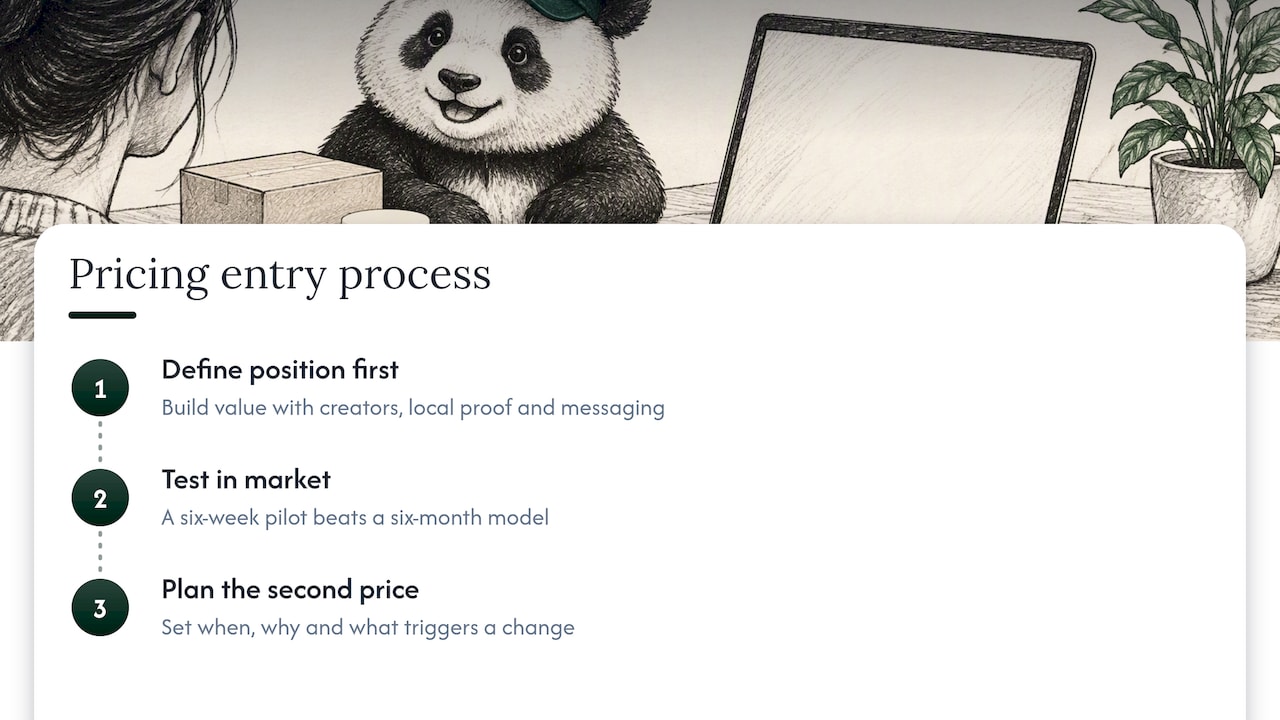
Third, plan the second price at the same time as the first. Every entry price should arrive with a path: when it changes, why, and what signal triggers it.
The brands that win a new market rarely have the lowest price. They have the clearest reason for theirs.
— Kalle
Where Align fits
If you are preparing to enter a new market and want pricing, positioning and go-to-market built as one plan, that is the work our team does. Our Go-to-Market and Market Entry, Brand and Positioning, and Commercial Strategy services cover the strategy and execution around your price: positioning, creator and paid programs, localization and demand testing. For leadership teams who want to see consumer behavior and platforms first-hand before setting a price, we also run Leadership Trips to China.
Entering China specifically? Start with our seven workstreams for China entry. Planning Europe? Read how AI localization speeds European entry.
FAQ
Is penetration pricing the best strategy for entering a new market?
Not always. It suits categories where offers look alike and buyers compare on price, and where your costs fall with scale. If your product is differentiated or your brand depends on a premium image, a low entry price can cost you more than it wins. Use it as a time-limited offer, not a permanent list price.
Should I convert my home price into local currency or set a new price?
Conversion is fine as a fast starting point in markets similar to your own. When income, competition or buying habits differ, build a local price from local evidence. Reach’s guidance treats this choice as the first decision in a local pricing strategy.
How do I avoid customers noticing price differences between countries?
You cannot hide them, so make them explainable. Keep packaging and tiers the same, set a global floor, and tie differences to real factors such as taxes, channel costs and local value. For multinational customers, consider a single global contract with defined regional rates.
How long does it take to test an entry price?
A focused pilot can produce usable evidence in about six weeks: two for research, two for live tests of three price points, and two to decide and document the plan. Larger or longer sales cycles need more time, but the structure holds.
Does the .99 trick work in every market?
It is a retail tactic with a long history in the US, but its effect depends on the category and the buyer. It carries little weight in many B2B negotiations, and it may not carry the same meaning abroad. Test it against a round number before you adopt it.
Sources
Best Practices for New Product Pricing, Journal of Product Innovation Management
Managing Your Local Pricing Strategy, Currency Risk, and Costs, Reach
Canada Journal of International Management and Marketing, 2025
Recommended
RELATED INSIGHTS


LET’S TALK
What are you trying to grow next?
Brand, launch, market entry or performance. Book 30 minutes and tell us what you’re working on.