•

C-Suite Buyer Engagement: How to Earn the Executive Seat
C-suite buyer engagement is the work of earning trust with the executives who approve, block or reshape a deal, long before a sales rep gets a meeting. It is not cold outreach with a bigger title list. It is a coordinated program: credible ideas in the right places, tailored to each executive’s risk, and enough support for the people around them to carry your case internally.
This guide covers who actually sits in the room, what each executive needs to see, and how to build an engagement program that moves pipeline.
AligntccBuild Trust With Decision-MakersAlign TCC helps companies develop targeted marketing strategies that engage audiences across platforms, including in China and other markets.Explore Align TCC
TL;DR
Executives rarely buy alone. Your program has to reach the whole buying group, with the CFO and CEO treated as distinct audiences.
Most buyers research without a rep first, so your ideas, proof and presence have to work before any conversation starts.
CEOs look for peer validation and outside perspectives, CFOs for numbers and risk, CTOs for technical depth. One message does not fit all three.
Orchestrate marketing, sales and service around named accounts instead of running separate campaigns.
In China and other relationship-driven markets, build personal trust first. Formal pitches come later.
Table of Contents
Who you are actually engaging
Why executives don’t respond to standard sales plays
What each executive needs from you
A practical C-suite engagement program
Measuring whether it works
Perspective: engage the person, then the organization
Where Align fits
FAQ
Sources
Who you are actually engaging
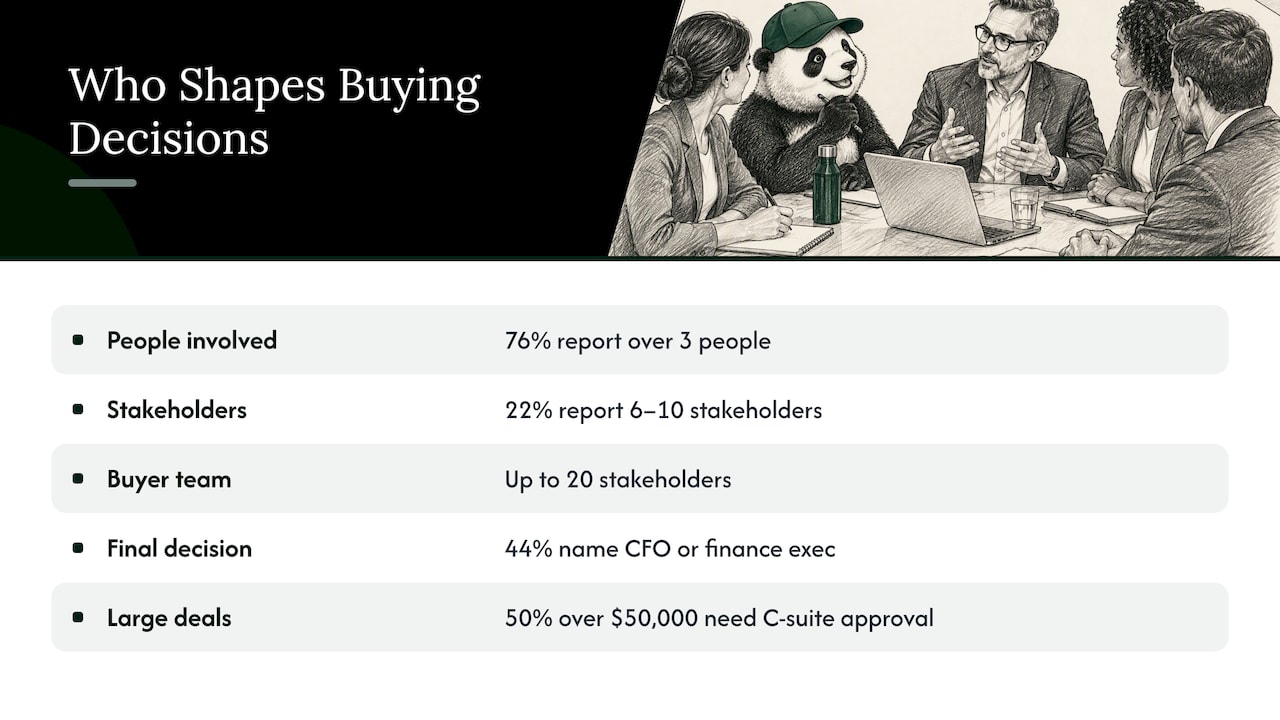
Start by dropping the idea of a single decision-maker. In 2025 buyer data from SoftwareSuggest, 76% of buyers reported more than three people involved in purchase decisions, and 22% reported six to ten stakeholders. Gartner’s own guidance goes further: its research describes buyer teams that can include as many as 20 stakeholders, each with different priorities.
Seniority still matters at the finish line. The same SoftwareSuggest report finds that 44% of buyers identify the CFO or another financial executive as the ultimate decision-maker, and 50% of purchases over $50,000 need direct C-suite approval. If your deal is large, expect an executive to see it.
Who counts as the C-suite also depends on what you sell. A study of 9,756 decision-maker title mentions from B2B companies found that CEO involvement is lower in enterprise buying processes than in SMB ones, while CTO involvement climbs. In plain terms: the bigger the target company, the more your real audience spreads across functional executives and the layer just beneath them.
C-suite versus VP
A frequent point of confusion is where VPs sit. VPs usually occupy the tier immediately below the C-suite and report into it. Seniority is often defined by scope: a VP who runs a full function with direct profit and loss accountability sits well above a VP title attached to a narrower, advisory remit. For engagement, treat VPs with P&L ownership as real budget holders and as the people who shape what the C-suite hears.
Why executives don’t respond to standard sales plays
Three patterns explain why generic outreach to executives fails.
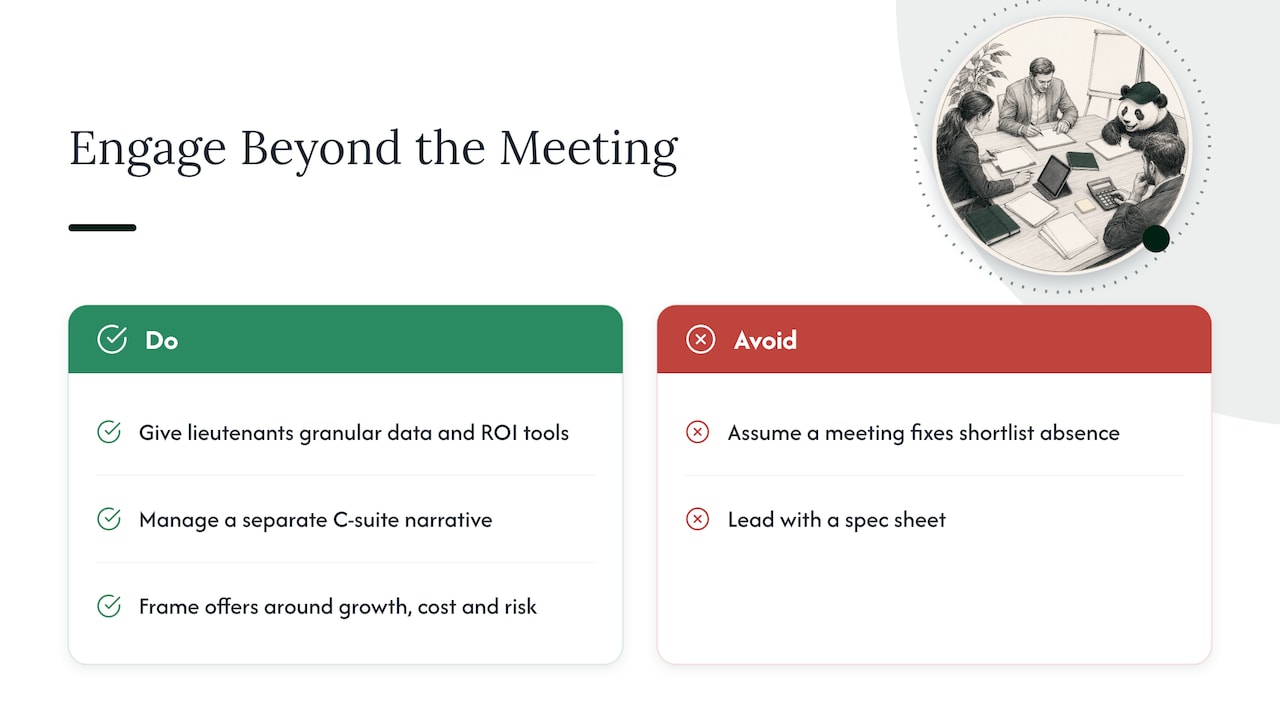
They research without you. Gartner’s March 2026 survey found that 67% of B2B buyers prefer a rep-free experience. Another 2025 analysis reports that nine out of ten tech buyers have identified their top three brands before formal research begins. If you are not on that shortlist, no executive meeting will fix it.
They delegate diligence. Mid-level IT and functional leaders often act as gatekeepers. The practitioners who win arm those lieutenants with granular data and ROI tools, while managing a separate top-down narrative for the C-suite focused on risk and business transformation.
They don’t want your spec sheet. Executives care about growth, cost and risk. Frame your offer against the numbers they own, not against your feature list.
The implication for marketing is direct. C-suite engagement is mostly earned in the “noise” before the meeting: the articles an executive reads, the peers who mention you, the events where you appear credible, the profile of your own leaders.
What each executive needs from you
Executives are not a monolith. Forrester’s guidance on engaging them notes that a CEO often seeks peer validation and objective third-party perspectives to reduce strategic risk, while a CTO is frequently more willing to engage directly with technical experts. Use that as the starting point for a role-by-role plan.
Executive | Primary concern | What earns attention | Best-fit formats |
|---|---|---|---|
CEO | Strategic risk, market position, reputation | Peer validation, third-party perspective, a clear view on where the market is going | Executive profiling, thought leadership, peer events, press |
CFO | Return, cost, downside | Business case in their numbers, clear risk framing, comparable outcomes | ROI models, concise briefs, customer proof with metrics |
CMO | Brand, demand, pipeline quality | Evidence that you understand their funnel and their brand constraints | Working sessions, benchmarks, pilot proposals |
CTO / CIO | Architecture, security, scalability | Direct access to technical experts, honest tradeoffs | Technical deep dives, documentation, expert-led briefings |
COO | Operations, delivery risk | Implementation clarity, timeline realism | Rollout plans, references from operators |
The CMO, COO and CTO rows are our working framework built on the above principle, not a published study. Test it against your own account research.
Avoid the generic content trap
Gartner’s guidance warns that the most effective approach is orchestrated, not merely multithreaded. It calls for convergence between marketing, sales and service to match the non-linear buying paths of different stakeholders. The common failure is sending the same content to everyone, which resonates with none of the specific pressures a CFO or COO faces.
A practical C-suite engagement program
Here is the sequence we would run for a B2B brand with a defined set of target accounts.
1. Define a small, named account list
Executive engagement does not scale like lead generation. Pick the accounts where a win changes your year. Map the buying group, not just the title at the top. A stakeholder map is a useful discipline here: ICAEW’s guide to stakeholder mapping and engagement explains how maps help identify and prioritize who to engage. It was written for boards, but the logic carries over to buying groups.
If you want a structured way to run this, our 90-day ABM pilot approach shows how to scope a small account set and test it quickly. For the PR side of a short list, see how we think about reaching the right 500 buyers.
2. Build the narrative for the top, the evidence for the middle
Write two layers. The top layer is a short, point-of-view story about where the market is going and what it means for risk and growth. The middle layer is the detail: technical documentation, ROI tools, implementation plans, security answers. Executives read the first. Their lieutenants test the second. Both need to say the same thing.
3. Make your leaders credible before the first call
Executives respond to peers. That makes your own leadership team part of the engagement program. A CEO or founder with a clear point of view, visible in the right media, is a stronger door-opener than any email sequence. Our approach to executive profiling PR is built around visible results within months, not years. A disciplined thought leadership strategy keeps those ideas consistent.
4. Use third-party proof, and check how machines describe you
Because CEOs lean on outside perspectives, the proof that matters sits beyond your own site: analyst mentions, customer evidence, credible press and expert voices. Increasingly, executives and their teams also ask AI assistants to summarize vendors during research. It is worth measuring how those assistants describe your brand, and frameworks for evaluating LLM outputs for marketing leaders are a useful starting point for that audit.
5. Reach executives where they already are
Paid social can be precise when you build audiences carefully. Our seven-step LinkedIn ads strategy walks through sizing a senior audience before you spend. Events are the other major channel: executives meet peers there and make time for substantive conversations. See our view on trade show marketing for B2B for how to convert booth traffic into ideal-customer meetings.
6. Orchestrate follow-up
Every touch should be informed by the last. If an executive reads a thought leadership piece, sales should know. If a lieutenant downloads an ROI model, the account team should adjust. We cover the mechanics in our piece on ABM orchestration and on aligning marketing and sales.
Measuring whether it works
Executive engagement is slow, so choose leading indicators you can act on:
Account coverage: how many roles in the buying group you have reached, not just how many contacts.
Seniority mix: the share of engaged contacts at VP and C-level in target accounts.
Meeting quality: meetings that match your ideal customer profile and include a budget holder.
Shortlist presence: whether prospects name you unprompted in early conversations.
Sales cycle movement: time between first executive touch and a scoped proposal.
Remember the research above: most buyers form a shortlist before talking to sellers. Unprompted mentions are one of the best signals that your program is working.
Perspective: engage the person, then the organization
We work with Western companies entering China and Chinese companies expanding into Europe and North America, and the lesson repeats across both directions. Executive engagement is a trust problem before it is a messaging problem.
In China the point is explicit. Research on Sino-US business relationships finds that guanxi is established between key individuals, not just between organizations, and that social interaction and long-term commitment often come before formal discussions produce results. A Finnish study of industrial buyer-seller relationships in China makes the same case for the role of connections. Western markets are less overt about it, but the pattern holds: executives buy from brands and people they already trust.
So our view is simple. Combine Scandinavian clarity of positioning with fast commercial execution. Use AI to speed up the heavy lifting, from audience research to content production, and keep human judgment on the story, the relationships and the call about what a given executive needs to hear. Technology should enhance the creativity that earns the seat, not replace it.
— Kalle
Where Align fits
If you are a marketing leader at an ambitious brand and need senior capability without building every function in-house, this is the work we do. Our services cover commercial strategy, brand and positioning, go-to-market and market entry, creator marketing, content, and demand and performance programs. For leadership teams that want first-hand insight into Chinese consumer behavior and platforms, we run leadership trips to China. Book a strategy call and we will map the buying group you are trying to reach.
FAQ
What is C-suite buyer engagement?
It is the practice of building relationships and credibility with the senior executives who influence or approve a purchase. It combines thought leadership, executive profiling, account-based marketing, events and sales outreach. The goal is trust and a place on the shortlist before formal evaluation begins.
Who has the final say in a B2B purchase?
Financial executives often do. In the 2025 SoftwareSuggest report, 44% of buyers named the CFO or another financial executive as the ultimate decision-maker. But the buying group usually includes several people, so the deal depends on the whole committee, not just the final signature.
Is a VP higher than the C-suite?
No. A VP typically sits one tier below the C-suite and reports into it. Titles vary by company, and a VP with full P&L responsibility carries more weight than one with a narrow advisory remit, as the VP benchmarks from AssessYou explain.
How do you reach executives who avoid sellers?
Assume they will research alone. Gartner reports that 67% of B2B buyers prefer a rep-free experience, so invest in credible content, third-party proof and visible leaders. Keep a clear human path open for the minority who want to talk first.
How is executive stakeholder engagement different from standard lead generation?
It targets a small set of named accounts and many roles inside each. Success is measured by relationships, seniority and meeting quality rather than form fills. It also needs close coordination between marketing and sales.
Sources
Gartner press release: 67% of B2B buyers prefer a rep-free experience
Trepo: Industrial buyer-seller relationships in a Chinese context
Recommended
RELATED INSIGHTS


LET’S TALK
What are you trying to grow next?
Brand, launch, market entry or performance. Book 30 minutes and tell us what you’re working on.