•
Pipeline Acceleration Strategy: How to Move Deals Faster
Pipeline acceleration means shortening the time between a deal entering your pipeline and closing, without lowering the bar for what gets in. The fastest way to do it is not more leads or more calls. Find the stage where deals sit with no buyer action, remove that friction, and give buyers the proof they need to decide with confidence.
This guide covers how to diagnose the blockage, which tactics shorten sales cycles at each stage, where AI helps and where it doesn’t, and how to measure whether any of it worked.
AligntccMake Your Brand Clearer to BuyersAlign TCC helps fast-growing companies sharpen positioning and build marketing strategies that connect with audiences across markets.Explore Align TCC
TL;DR
Pipeline speed is mostly a mid-funnel problem. Deals stall in the weeks where the buyer does nothing, so measure dead time per stage before adding volume.
Buyers don’t move in a straight line. Gartner’s research shows they perform non-linear “jobs”, so the best acceleration is content and proof that simplifies the decision.
Multithreading wins deals, but only when contacts are matched by seniority and role, ideally through warm introductions.
Use AI for repetitive prospecting, qualification and follow-up. Keep humans on the high-stakes conversations.
Replace activity metrics (calls, emails) with outcome metrics: stage-to-stage conversion, time in stage, and verified buyer actions.
Table of Contents
Why deals slow down in the first place
Diagnose before you accelerate
Tactics that shorten sales cycles, stage by stage
Use the traffic and demand you already have
Where AI helps speed up the pipeline, and where it doesn’t
Measure velocity, not activity
A 90-day pipeline acceleration plan
Our perspective: acceleration is a brand and market problem too
When to bring in a partner
FAQ
Sources
Why deals slow down in the first place
Most teams treat a slow pipeline as a top-of-funnel problem. The reflex is to buy more leads, add more outbound, and hope volume covers the gap. It rarely does. More volume often hides poor conversion health: the pipeline looks full, but the deals in it are not moving.
The real cause is usually a stalled middle. A deal enters a late stage on the strength of a rep’s optimism, not a buyer action. Weeks pass. Nobody returns the security questionnaire, nobody confirms the budget cycle, nobody introduces the finance lead. The deal isn’t progressing. It’s aging.
Three structural reasons sit behind this:
Buying is not linear. Per Gartner’s analysis of modern B2B buyers, buyers loop between jobs such as problem identification, solution exploration and consensus building. They also spend a meaningful share of the cycle, around 15%, reconciling conflicting information.
Buying groups are big. A 2025 Gartner survey of 632 B2B buyers, as summarized by Outreach Bloom, found groups of five to 16 people across as many as four functions. One champion cannot carry that alone.
Sellers push when buyers need clarity. Pressure doesn’t resolve conflicting information. It adds to it.
So the first principle of any pipeline acceleration strategy is to remove friction, not apply force.
Diagnose before you accelerate
You can’t shorten sales cycles you haven’t measured by stage. Averages hide the problem. A mean cycle of 74 days can mean every deal takes about 74 days, or that half close in 40 and the rest rot for 110. Those are different problems with different fixes.
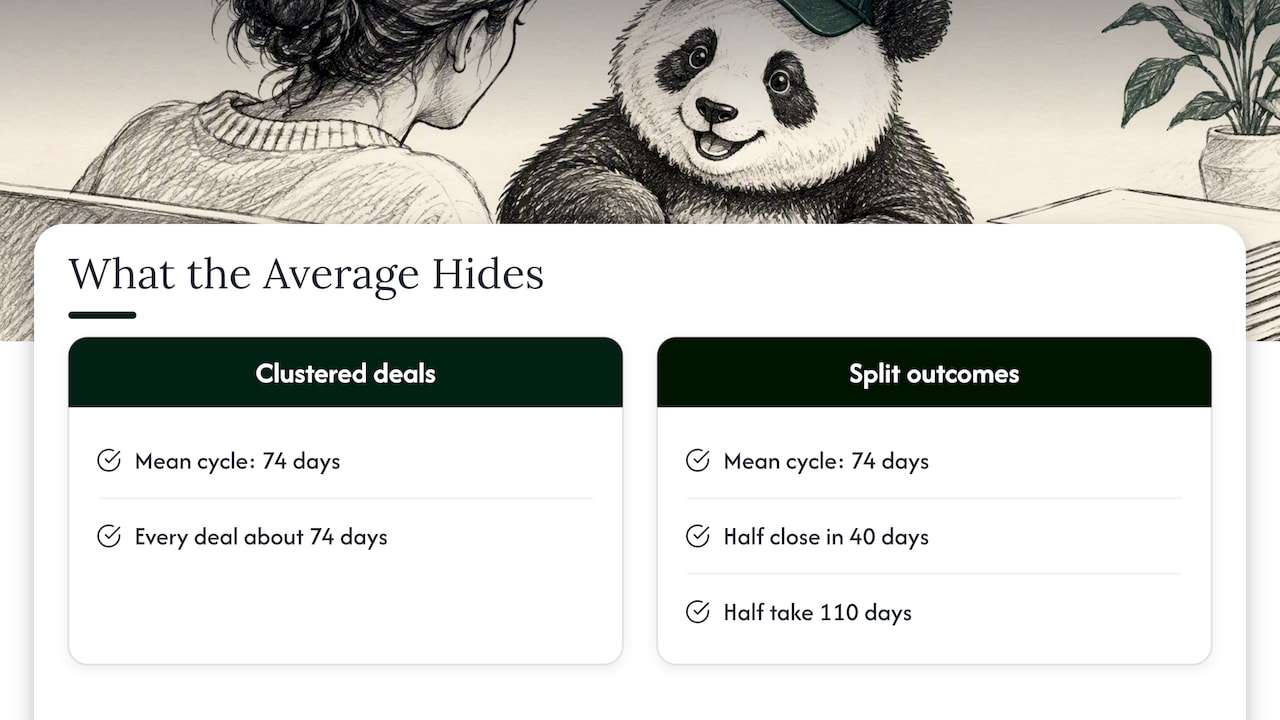
Split cycle time per stage
Pull the last 12 months of closed-won and closed-lost deals from your CRM. For each stage, record how many days the deal sat there. Then look at the distribution, not the mean: the median, the 75th and 90th percentiles, and the long tail.
Two patterns show up again and again:
A fat tail in one stage. Most deals pass through quickly, but a cluster stalls. That stage has a specific blocker: legal, security review, a missing economic buyer.
Uniformly slow across stages. The issue is upstream. Likely poor qualification or a vague value proposition that forces buyers to re-learn why they are talking to you.
Define dead time
Dead time is any period where no verified buyer action occurs. A rep’s call log doesn’t count. A buyer replying, attending, forwarding, signing or sending information does.
Once you define it, report it weekly: how many open deals have had no buyer action in 14 days, and what is their combined value? That one number focuses a pipeline review faster than any forecast category.
Enforce exit criteria
Every stage transition should require an objective event. Examples:
Stage move | Objective exit criterion |
|---|---|
Qualified to Discovery | Buyer attends a call with a named business problem and a second stakeholder identified |
Discovery to Evaluation | Buyer shares requirements or data, or grants access to a technical lead |
Evaluation to Proposal | Economic buyer is named and has been in at least one conversation |
Proposal to Negotiation | Buyer returns the security questionnaire or confirms the budget cycle |
Negotiation to Closed | Legal contact engaged, redlines in progress |
This purges phantom deals. Your pipeline gets smaller on paper, and your forecast gets more honest. That is progress.
Tactics that shorten sales cycles, stage by stage
Tactics work best when matched to the stage where your own data shows the delay.
Qualification: stop spending time on the wrong fit
Time spent on poor-fit prospects is a cycle killer that never shows up in cycle-time reports, because those deals eventually get closed-lost. Define your ideal customer profile with specific criteria: industry, size, tech stack, trigger events, and buying committee structure.
Then score for it. A simple, validated model beats a complicated one nobody trusts. Our guide to lead scoring models for B2B teams covers how to start simple, validate against closed deals, and govern the model so it doesn’t drift.
Also agree on what a qualified meeting is. If marketing hands over a lead that fails sales’ definition, the first two weeks of the cycle are wasted on a conversation neither side wanted. The marketing and sales alignment sprints we use are built to fix that handoff.
Early and mid-funnel: give buyers something to decide with
The most effective acceleration is to stop selling and start helping the buyer build confidence in their own purchasing process. In practice:
Decision-simplifying assets. One-page comparisons of approaches (not just your product), implementation timelines, and risk checklists the buyer can forward internally.
Role-specific proof. A CFO wants payback logic. An IT lead wants integration and security detail. Don’t send both the same deck.
A mutual action plan. A shared document listing the steps to a decision, owners and dates. It surfaces dead time early, because a missed date is visible to both sides.
Consistent messaging across channels. When your ads, outbound, PR and website tell slightly different stories, buyers lose time reconciling them. That is time you are paying for.
This is where brand and demand meet. Buyers who already know and trust you skip a stage of skepticism. Our brand to demand plan shows how to build that familiarity ahead of the in-market moment, and how to prove it moves pipeline. For trust at the account level, B2B PR aimed at the right 500 buyers is a fast way to be a known name before the first call.
Multithreading: widen the conversation early
Single-threaded deals die when the champion goes on leave, changes jobs or loses an internal argument. Gartner’s research on multithreaded engagements links unified commercial strategies and multiple-stakeholder engagement to revenue growth that outperforms competitors.
Multithreading is often misread as “add more contacts to the email.” The better approach:
Map the buying group in the first two calls: who feels the problem, who owns the budget, who can block it.
Match by level and function. CFO to CFO, technical lead to technical lead. Peers trust peers.
Use warm paths. An introduction from a shared investor, customer or executive sponsor bypasses the initial resistance cold outreach meets.
Give the champion material for their colleagues, not just for themselves.
Account-based marketing supports this directly: air cover for each stakeholder while sales works the conversation. If you’re building that motion, start with a 90-day ABM pilot and learn how to orchestrate contact signals into sales action.
Late stage and procurement: remove the invisible delays
The final phase is where good deals go to wait. Most of that wait is avoidable:
Pre-empt security and legal review. Share your security documentation, standard terms and data processing details before the buyer asks. Offer a call between your security lead and theirs.
Name the approval path. Ask who signs, what the threshold is, and when the next budget or board cycle falls. A deal that misses a cycle can lose a quarter.
Get an executive sponsor involved. A senior-to-senior conversation can unblock what ten rep follow-ups can’t.
Keep the business case alive. Between proposal and signature, re-send the value logic in the buyer’s words, not yours.
Use the traffic and demand you already have
Before you fund new channels, check how much existing demand leaks. Visitors who view pricing, case studies or contact pages are telling you something. If your website converts poorly, every downstream stage inherits a thinner, slower flow.
A focused 90-day conversion strategy for B2B teams starts with what’s already coming in: clearer calls to action, faster routing of high-intent visitors, and follow-up measured in minutes rather than days.
For paid channels, precision beats reach. A LinkedIn ads strategy built on audience counts lets you confirm that a target audience is big enough and specific enough before you spend. And when the goal is meetings with qualified buyers, a BANT-oriented demand generation approach keeps the pipeline focused on accounts with budget, authority, need and timing.
Where AI helps speed up the pipeline, and where it doesn’t
AI is useful in the parts of the cycle where speed is about capacity. Salesforce’s CEO Marc Benioff estimated that about 100 million sales leads had gone unanswered over 25 years because there weren’t enough people to call them back, a story told in Salesforce’s account of agentic sales. That is exactly the kind of gap AI agents can close.
Good uses:
Lead prioritization. McKinsey’s research on how business customers buy reports that organizations moving to journey-based sales strategies and using AI to prioritize leads can reach up to a 20% increase in leads, 10% growth in first-time customers and a 20% speedup between qualifying a lead and closing.
Instant first response to inbound inquiries, including qualification questions.
Re-engaging cold leads with relevant, timed follow-ups. If you’re designing this, a practical reference is this walkthrough of lead nurture sequences with automated follow-up. It’s written for martial arts studios, but the sequence logic carries over: trigger, message, reply handling, handoff.
Meeting prep and CRM hygiene, so reps spend selling time on buyers, not admin.
Bad uses: replacing the senior conversation where trust, nuance and negotiation decide the deal. The teams that gain most use AI for high-volume, repetitive work and free their people for the high-stakes, relationship-driven interactions. Technology should enhance the human work, not replace it.
One caution. Automated outreach amplifies whatever message you give it. If your positioning is vague, AI just delivers vague faster. Fix the message first.
Measure velocity, not activity
Call volume and email counts tell you how busy the team is. They don’t tell you whether deals are moving. Track these instead:
Metric | What it tells you |
|---|---|
Time in stage (median and 90th percentile) | Where the long tail of stalled deals sits |
Stage-to-stage conversion | Whether qualification and exit criteria are working |
Dead-time deals (no buyer action in 14 days) | How much of the pipeline is only apparently alive |
Number of engaged stakeholders per deal | Whether multithreading is real |
Pipeline velocity | Qualified opportunities × average deal value × win rate ÷ sales cycle length |
Lead response time | Whether inbound demand is wasted at the door |
Pipeline velocity is a standard formula, and its power is in the levers it shows: more qualified opportunities, bigger deals, a higher win rate or a shorter cycle. Improve one at a time and you can attribute the change. Improve all at once and you can’t learn anything.
Set a baseline, pick one stage, run one change for a full quarter, and compare distributions. Resist declaring victory from one good month.
A 90-day pipeline acceleration plan
Days 1 to 30: diagnose.
Export 12 months of deal data and calculate time in stage by distribution.
Define dead time and exit criteria; apply them to the current pipeline.
Audit the marketing-to-sales handoff and lead response times.
Days 31 to 60: fix the biggest blockage.
Choose the single stage with the longest tail. Introduce the matching tactic: mutual action plans, pre-emptive security packs, executive sponsor outreach, or tighter qualification.
Build role-specific assets for the buying group.
Launch automated first response and follow-up for inbound leads.
Days 61 to 90: scale and verify.
Extend multithreading to every deal above your threshold value.
Align marketing air cover (ABM, paid, PR) to the accounts in active evaluation.
Re-run the stage distribution. Keep what moved the tail; drop what didn’t.
Our perspective: acceleration is a brand and market problem too
Most pipeline advice lives inside the CRM. We see the other half. Deals slow down when a buyer doesn’t know who you are, can’t tell why you’re different, or finds a mismatch between what marketing promised and what sales delivers.
At Align, we combine Scandinavian brand thinking, which is disciplined about positioning and clarity, with the speed of Chinese market methodologies, where creator, content and commerce cycles run fast. We use AI-driven execution to move quickly, but the creative and strategic judgment stays human. The lesson from both worlds is the same: trust is a commercial asset. The faster a buyer trusts you, the shorter your cycle.
That is why we push clients to fix positioning before they push volume, to align marketing and sales around one definition of a qualified account, and to measure what buyers do, not what the team does. Cultural fluency matters too. A buying committee in Shanghai, Stockholm and Chicago doesn’t weigh proof the same way, and a global pipeline needs that built into its content and its introductions.
— Kalle
When to bring in a partner
If your pipeline problem is clearly tied to positioning, market entry, creator and paid programs, or marketing and sales misalignment, an outside team can move faster than building every function in-house. Align works with fast-growing companies on commercial strategy, brand and positioning, go-to-market and market entry, influencer and creator marketing, and demand and performance. If you want a senior view on where your deals are stalling, start there. You can also explore our Leadership Trips for first-hand immersion in China’s consumer and platform landscape.
FAQ
What is pipeline acceleration?
It is the practice of reducing the time between a deal entering the pipeline and closing, without lowering the standard for what enters. It focuses on removing friction at each stage: weak qualification, stalled stakeholders, slow reviews. It is different from simply generating more leads.
How do I shorten a long sales cycle?
Split cycle time by stage and find where deals sit with no buyer action. Then tighten qualification, widen the buying-group conversation, supply role-specific proof, and address security and legal review early. Change one stage at a time so you can see what worked.
What is the difference between pipeline acceleration and sales acceleration?
Sales acceleration is the broader term for tools and strategies that move prospects to a signed contract faster. Pipeline acceleration is a focused version: shortening time in the pipeline through stage-level diagnosis, deal hygiene and buyer-side enablement. In practice, the two overlap heavily.
Can AI really speed up my sales pipeline?
Yes, where speed is limited by capacity: instant response, lead prioritization, follow-up and re-engagement of cold leads. McKinsey’s research points to up to a 20% faster lead-to-close time for organizations that pair journey-based selling with AI prioritization. It does not replace senior human judgment in complex deals.
Sources
Gartner: Why multithreaded engagements are the secret to accelerating revenue growth
McKinsey: Do you really understand how your business customers buy?
Recommended
RELATED INSIGHTS


LET’S TALK
What are you trying to grow next?
Brand, launch, market entry or performance. Book 30 minutes and tell us what you’re working on.